ANXIETY & MOOD TRACKER

MoodPulse
Private anxiety & mood log
Naming the feeling is one tap. The rest is what you do with it.
MoodPulse records how you feel on a grid of twenty-five words, then gives you the worksheets to sit with it: a five-step thought record, a log of what you were afraid of and what actually happened, and breathing exercises for the loud moments.

14-day trial, no card.
From $2.99/month. Android.
A tracking journal, not a medical device. MoodPulse does not diagnose or treat, and it is not a replacement for professional mental-health care. Every screen in the app carries this line and a link to crisis resources. If you are in crisis, contact your local emergency number or a crisis line in your country now.
One tap, twenty-five words
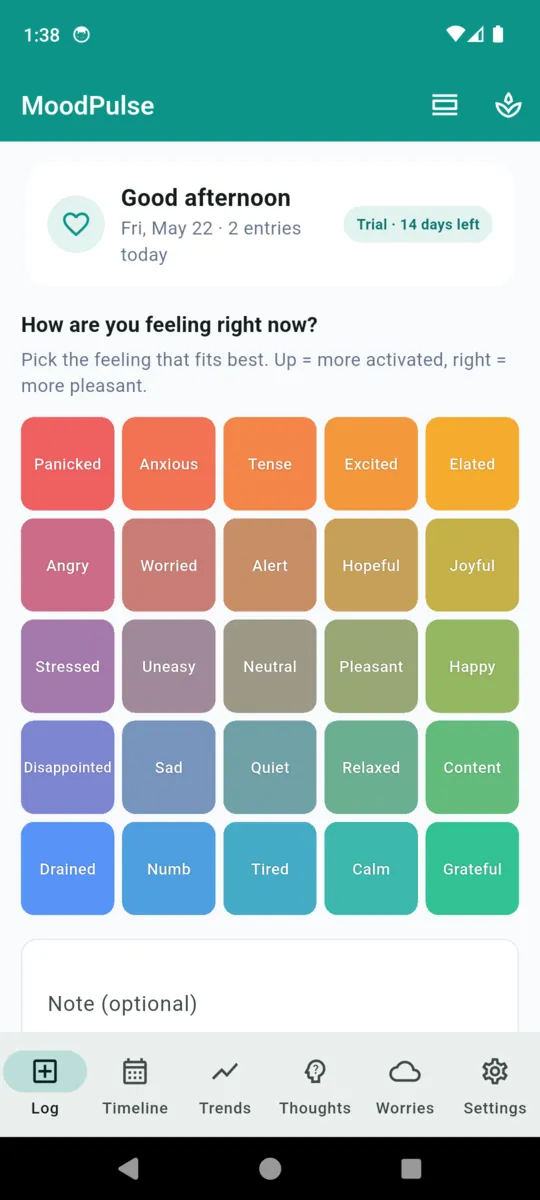
Most trackers give you a row of faces. MoodPulse gives you a grid with two axes: left to right is unpleasant to pleasant, bottom to top is calm to activated. Tapping a cell records the word and both scores at once, so "Tense" and "Drained" stop collapsing into the same sad face.
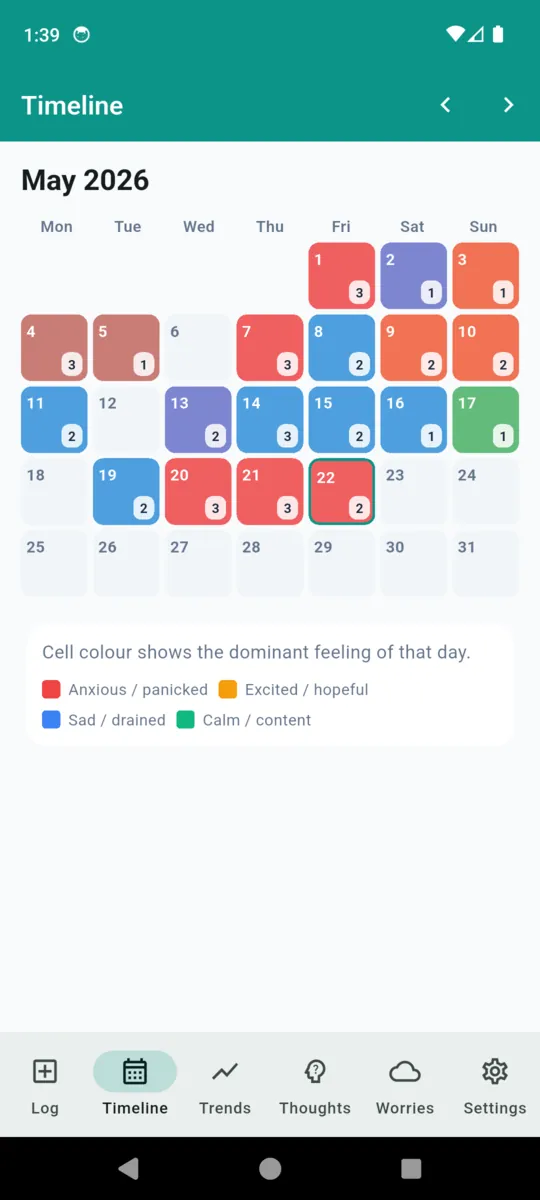
In the app every cell is tinted by its corner, red through amber along the top and blue through green along the bottom, so a month of entries reads as a colour pattern before you read a single word. Add a note, a photo, your own triggers, and a HALT check for hungry, angry, lonely or tired — or add none of them and just tap.
A thought record, filled in
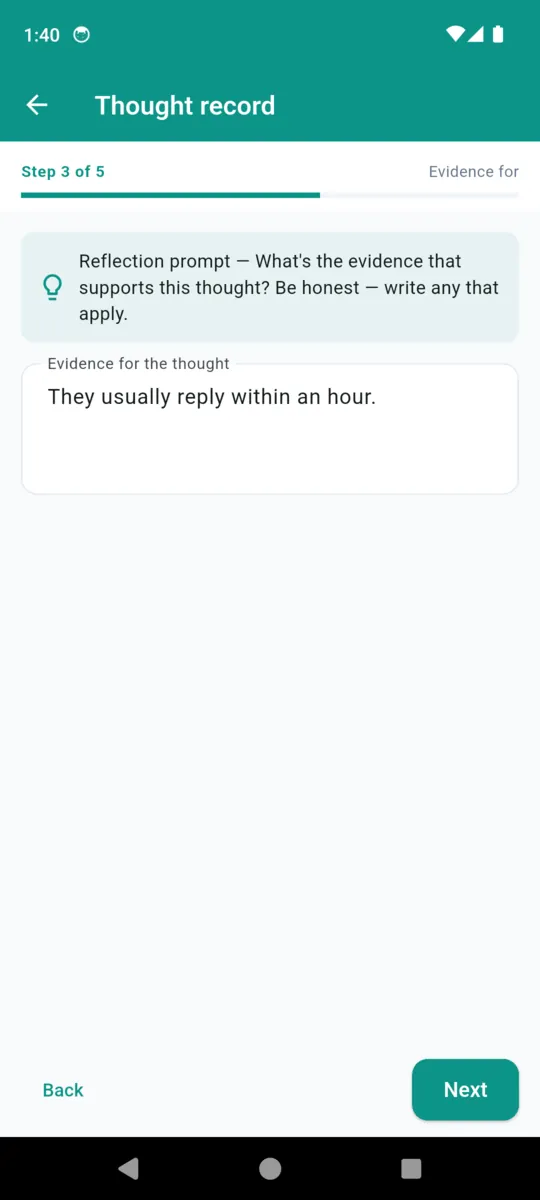
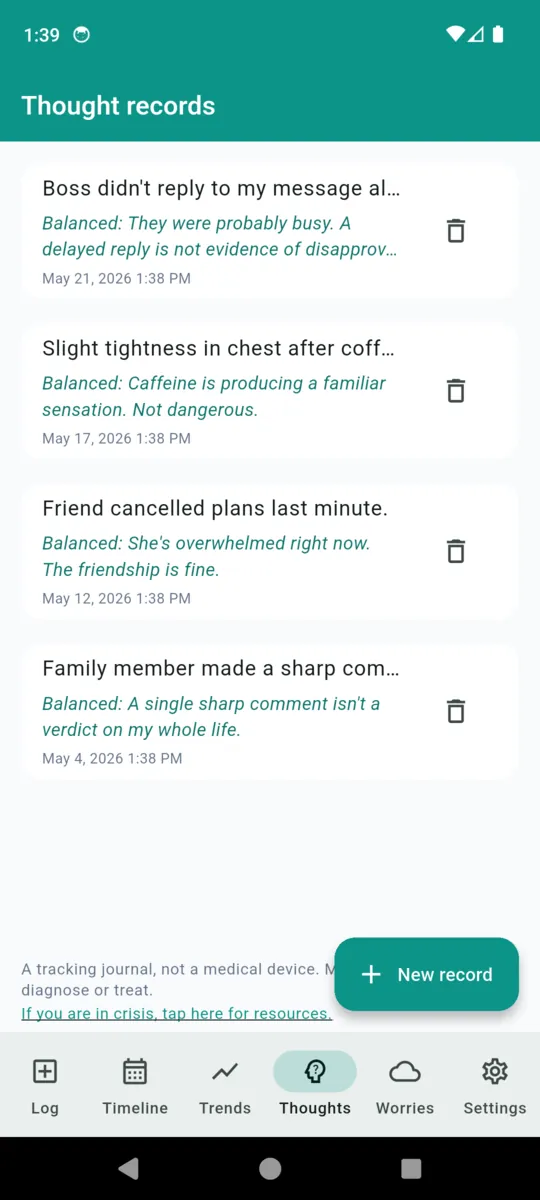
The thought record is five fields the app walks you through one at a time, with a reflection prompt on each. This one is the worked example MoodPulse ships with, shown exactly as it appears in the app.
- 1
Situation
Slight tightness in chest after coffee.
- 2
Automatic thought
I'm having a heart attack.
- 3
Evidence for
My chest feels different.
- 4
Evidence against
I had 3 coffees today. I'm 32. ECG was clear in March. The feeling fades when I breathe deeply.
- 5
Balanced thought
Caffeine is producing a familiar sensation. Not dangerous.
You rate the feeling on the same grid before you start and again at the end, so the record keeps both readings side by side. Nothing scores you, and nothing tells you the balanced thought is correct. Writing the evidence against is the whole exercise.
The prompt on step three reads: what's the evidence that supports this thought? Be honest — write anything that applies.
What you were afraid of, and what happened
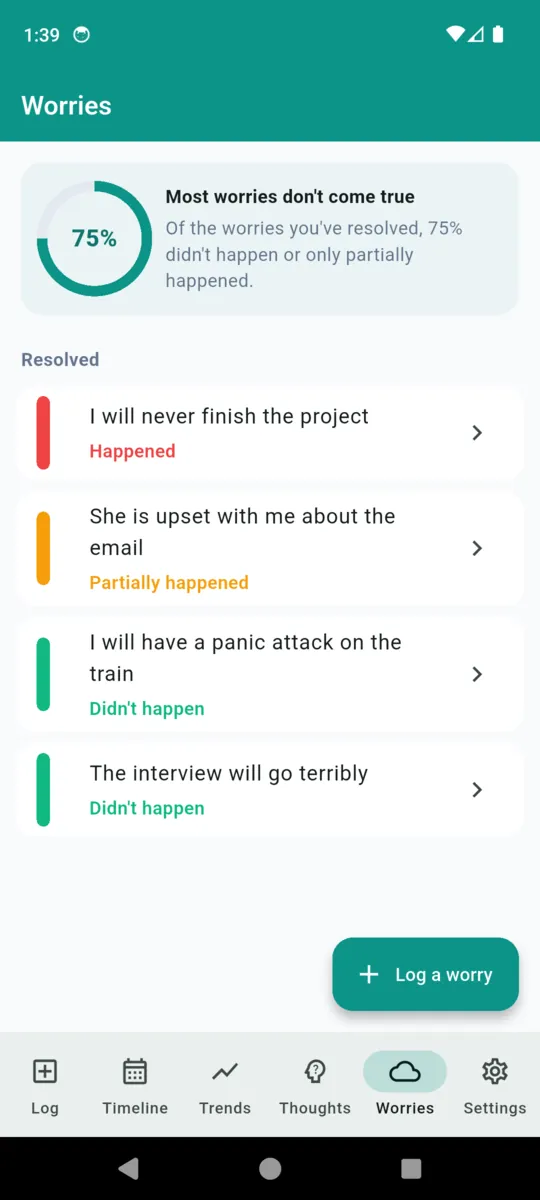
Write down a worry, pick a date to check back, and forget about it. When that date arrives MoodPulse asks you to close it off: did it happen, did it partly happen, or did it not happen. Over time you end up with a ledger of your own predictions.
| The worry | Check back | Outcome | What you wrote at the time |
|---|---|---|---|
| The interview will go terribly | 7 days | Didn't happen | Got positive feedback. |
| I will have a panic attack on the train | 4 days | Didn't happen | Felt anxious but no attack. |
| She is upset with me about the email | 3 days | Partially happened | Mildly annoyed, resolved quickly. |
| I will never finish the project | 14 days | Happened | Missed deadline by 2 days. |
The percentage the app shows on this screen counts only the worries you have resolved yourself. It is not a statistic about anxiety and it is not borrowed from anywhere. If your worries do keep coming true, it will say so, which is the point of keeping the record honest.
For the loud moments
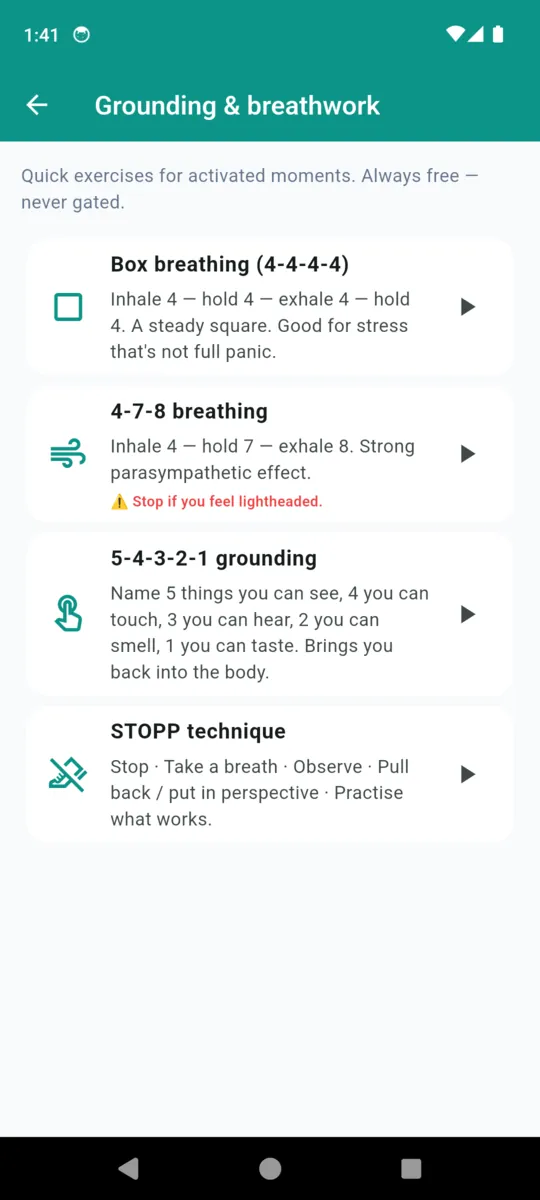
Four exercises sit one tap from the home screen. They are open on every tier and never gated, because a paywall in front of a breathing exercise would be indefensible.
- Box breathing Inhale 4, hold 4, exhale 4, hold 4. A steady square, with the phase counted on screen.
- 4-7-8 breathing Inhale 4, hold 7, exhale 8. The screen tells you to stop if you feel lightheaded.
- 5-4-3-2-1 grounding Name five things you can see, four you can touch, three you can hear, two you can smell, one you can taste.
- STOPP Stop, take a breath, observe, pull back and put it in perspective, practise what works.
The breathing screens carry their own caution: stop if you feel lightheaded. These are self-regulation exercises, not a treatment.
The rest of the app
Scroll sideways, or use the arrow keys
What it does
- Keeps everything on the phone. Entries, records, worries and triggers live in a local database. There is no server, no sign-up and no sync.
- Starts with nineteen triggers. Work, family, sleep, health, money, conflict, doomscroll, sensory overload, medication change and more. Add your own — three on the free tier, unlimited on Pro.
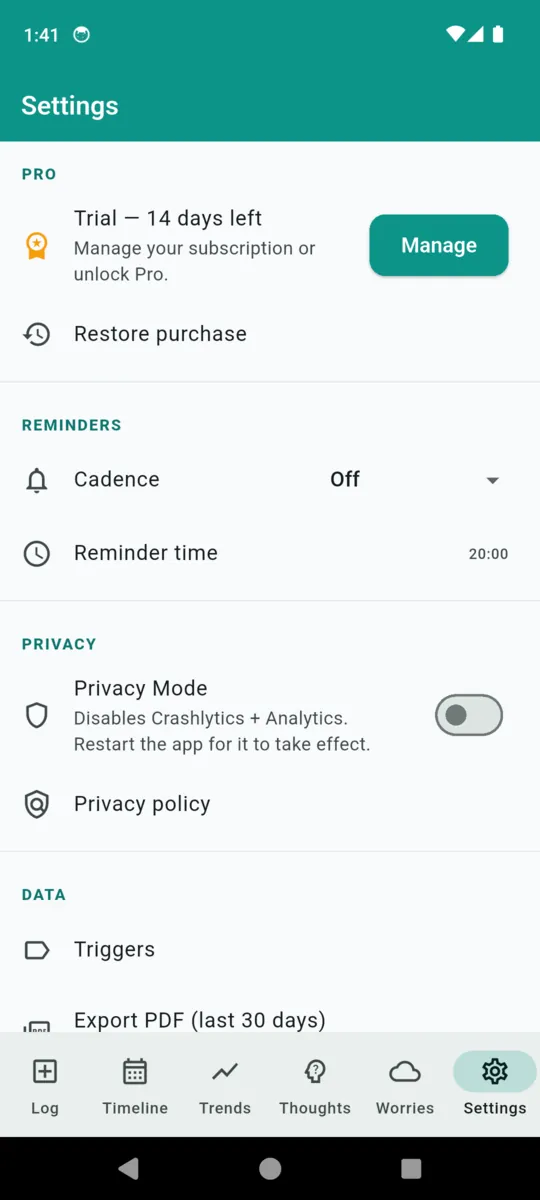
- Reminds you, if you want. Pick daily, every other day or weekly, and a time. Set the cadence to off and it never notifies you again.
- Exports a PDF of the last 30 days. Your mood entries as a table and your thought records underneath, with the disclaimer printed on the cover. Something to bring to an appointment.
- Lets you switch the telemetry off. Privacy Mode in Settings disables crash reporting and analytics.
What it doesn't
- No diagnosis, no score, no verdict. Nothing in the app tells you how you are doing or what your entries mean.
- No streaks and no pressure. Missing a week costs you nothing. There is no chain to break.
- No cloud backup, and no export of the raw data. Uninstalling the app removes the entries with it. The PDF is the only copy that leaves the phone.
- English only for now. The interface has not been translated yet.
- Nothing is locked when the trial ends. Everything you have already written stays readable, and you can keep logging.
Pricing
Everything is open for fourteen days when you install, with no card and no sign-up. After that the free tier keeps the grid, the thought records, the worry log and all four grounding exercises, and shows a banner ad. Pro removes the ads and the caps.
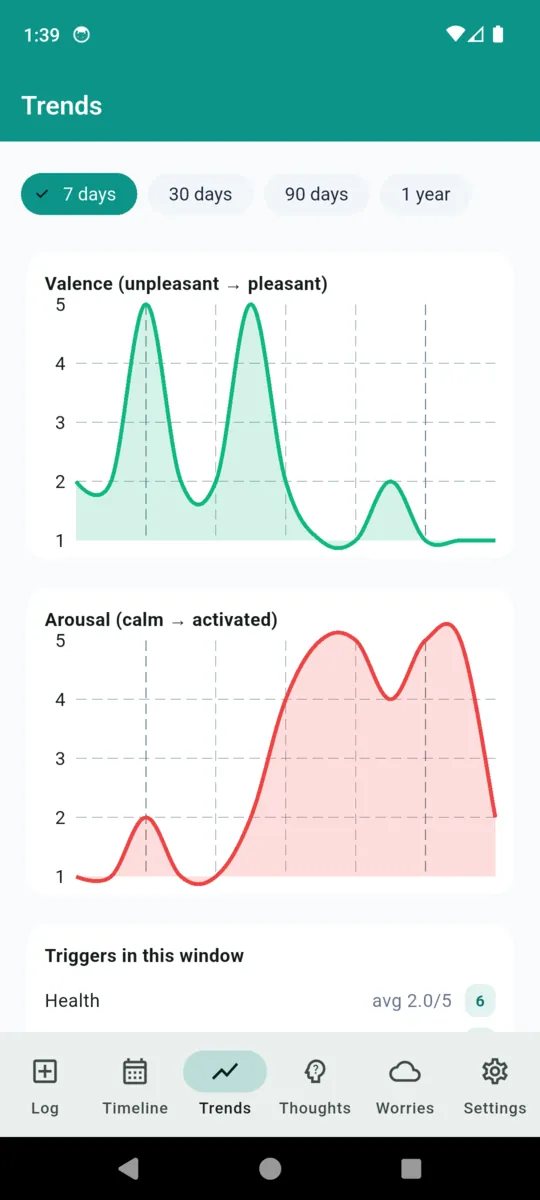
- Free tier caps. Trends limited to a 3-day window, the calendar to the last 30 days, custom triggers to three, and no PDF export.
- Pro. Unlimited trend and calendar windows, unlimited custom triggers, PDF export, and no ads anywhere.
- Lifetime is a single payment. Nothing renews, and what you have paid for stays yours.
Questions
Is MoodPulse therapy?
No. It is a self-tracking journal with some CBT-style worksheets in it. It does not diagnose or treat anything, and it is not a replacement for a clinician. Every screen in the app carries that line, and so does the exported PDF.
What does one entry actually record?
A point on the 5x5 grid, which gives a feeling word plus a valence and arousal score out of five. You can add a note, a photo, an anxiety type, any of your triggers, and a HALT check for hungry, angry, lonely or tired.
Does it need an account or the internet?
Neither. There is no sign-up. Entries, thought records, worries and triggers are stored in a database on your phone. A connection is only used to serve ads on the free tier.
What does the worry percentage mean?
It is worked out from your own resolved worries only. If you have closed twelve and marked eight as not happening, it reads 66%. It is your record, not a claim about people in general.
What happens when the 14-day trial ends?
Nothing you have written is locked or deleted. You keep reading and logging everything. Pro gates the trend windows longer than 3 days, the calendar past 30 days, custom triggers past three, and the PDF export, and it removes ads.
Can I turn off crash reporting and analytics?
Yes. Settings has a Privacy Mode toggle that disables Crashlytics and Analytics. It takes effect after you restart the app.
MoodPulse has its own privacy policy covering what stays on the device and what does not.
Start with today
Open it, tap the word that fits, and put the phone down. That is a complete entry.