Logged
A test was recorded inside that slot
The reading, the time and the operator initials are on the record. The slot closes when the next one opens, so a test taken at 8:40 satisfies the eight o’clock round rather than counting against it.
Commercial pool and spa log
AquaProof is an offline logbook for commercial pools and spas. Log each scheduled test in about thirty seconds, get the dose for the drum you actually own, and hand an inspector a dated ledger instead of a clipboard that has been living next to a chlorinated pool since March.

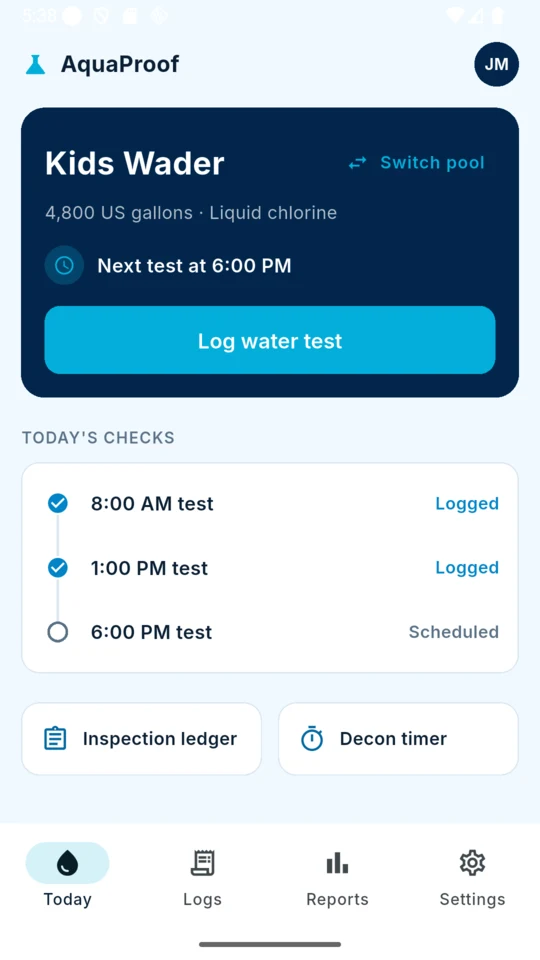
The rota
You set the test slots for the day. AquaProof tracks each one separately, because "we test twice a day" and "there is a test recorded for every slot this month" are very different claims, and only one of them survives being checked.
Logged
The reading, the time and the operator initials are on the record. The slot closes when the next one opens, so a test taken at 8:40 satisfies the eight o’clock round rather than counting against it.
Due now
This is the state the reminder fires on. It stays due for as long as the window lasts, which is until the next scheduled slot starts, not for some fixed number of minutes after the hour.
Missed
A missed slot is kept and printed. The app has no way to make a test that did not happen exist, and hiding the fact would make the record less useful than the clipboard it replaced.
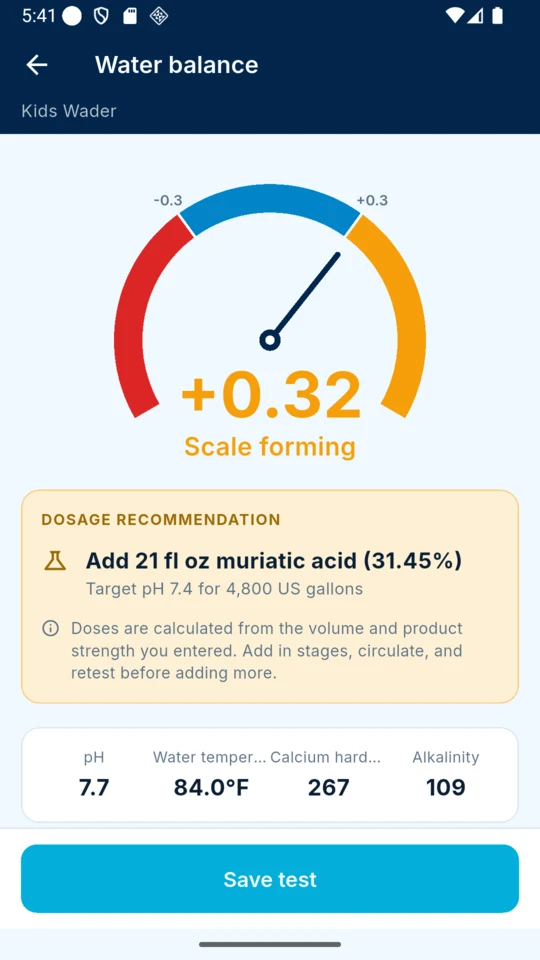
Saturation index
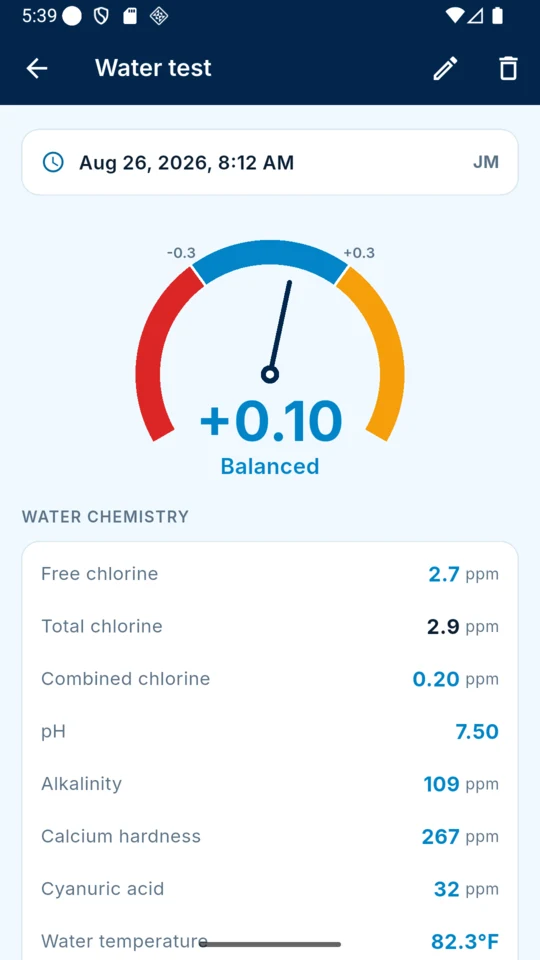
The dial says corrosive, balanced or scale forming. Underneath it, every factor that produced the number is listed on its own line, in the same terms as the wheel in your test kit. If the app and the wheel disagree, you can see which factor is responsible in about five seconds instead of taking the number on trust.
Calcium hardness, alkalinity and cyanuric acid are titrated weekly rather than every round. Where the index used a value carried forward from an earlier test, the record says so and names the date it came from, on screen and again in the printed ledger.
Dosing
Calculated from that pool's real volume and the strength printed on the drum, because 10 percent and 12.5 percent liquid chlorine are different doses out of the same shaped container. Stabilised chlorine tells you how much cyanuric acid it will add before you open it, which is the number that quietly ends a season.
Doses are presented in the order an operator actually works: alkalinity first because it is the buffer, then pH, then calcium hardness, then sanitiser.
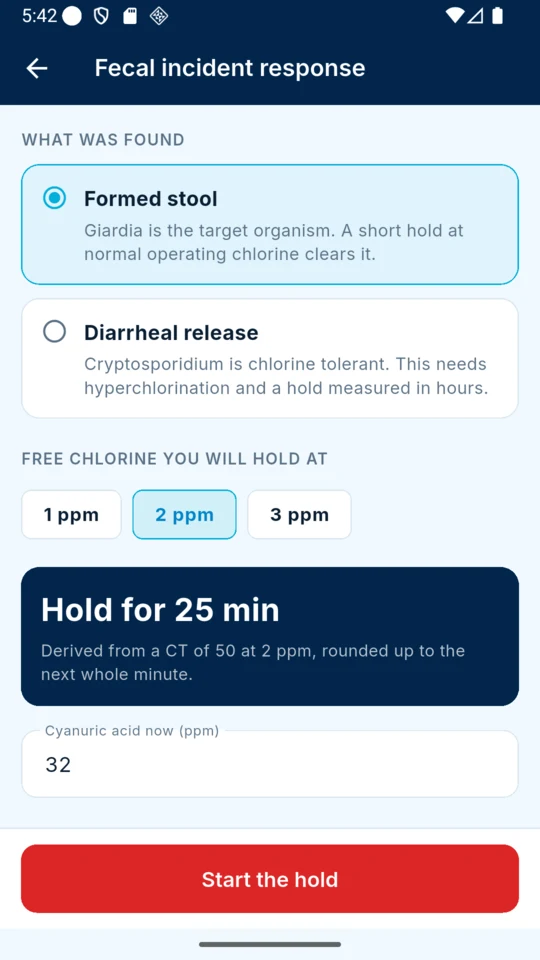
Fecal incident response
Pick the incident type and the free chlorine level you are holding at. The contact time is worked out from the published CT value, so a concentration that is not in the printed table still gives a correct hold rather than forcing you to round to one that is. The timer keeps running in the background.
Above 15 ppm cyanuric acid it refuses to start a hyperchlorination hold until you record a written reason. Stabiliser binds free chlorine and extends the real contact time well past the published figure, so a hold that looks correct on a timer would not be. The reason you give is written into the record an inspector reads.
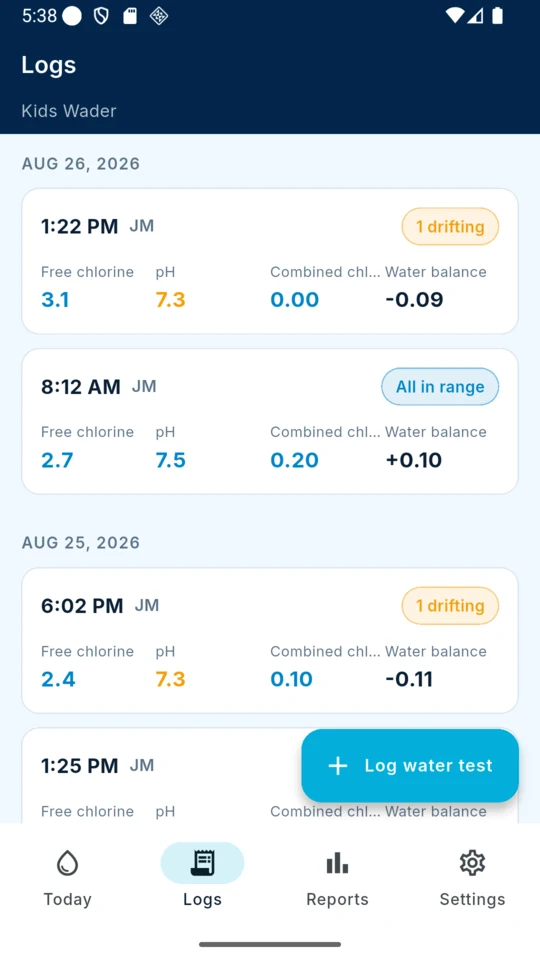
The inspection ledger
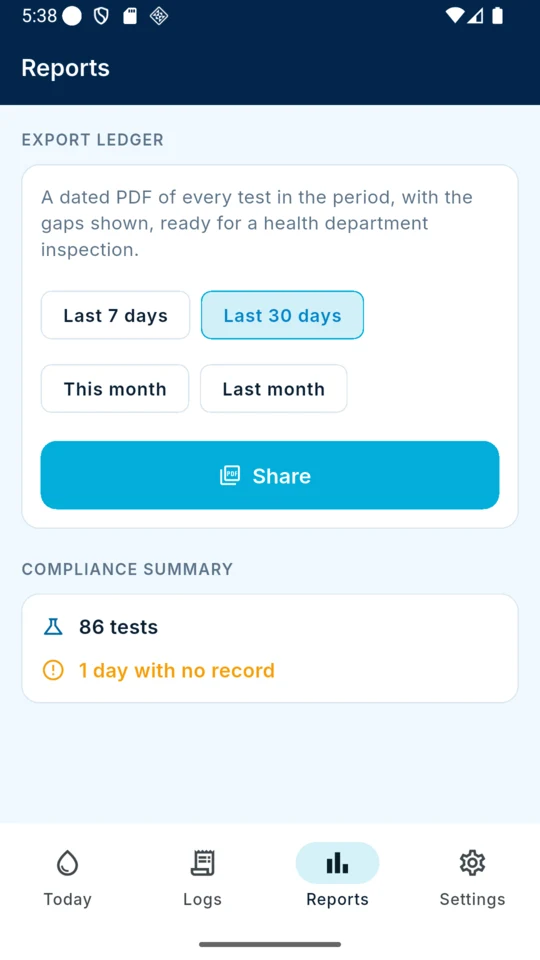
A cover page with the site, permit number, operating limits and operator, then a dated grid of every test with initials, and signature lines for you and the inspector. Days with no recorded test are printed rather than quietly skipped, and a saturation index that used carried-forward readings is marked and footnoted with what was reused.
A gap you already know about is a gap you can explain. A gap the document hides is one that gets found by somebody else.
The app
What it is not
AquaProof does not connect to controllers, dosing pumps or probes, and it does not pretend to. It records what you measured and what you added. You can log the automatic controller's reading beside the manual test, which is how a probe drifting out of calibration shows up early, but the app never sends anything to it.
There is no cloud sync and no account, which also means there is no backup file in this version. The PDF ledger is how records leave the phone. Worth knowing before you decide it is your only copy.
Price
The standard tier caps you at one body of water and thirty logged tests. Nothing you have already recorded is ever hidden or deleted, and reading your own history back is not the paid half. The trial is opt in: nothing starts counting down until you tap it.
Questions
No. You run the test with your own kit. AquaProof records what you measured, works out the dose and keeps the evidence. It is a logbook and a calculator, and the certified manual test stays exactly where it was.
The CDC Model Aquatic Health Code and PWTAG guidance, shipped as editable defaults. Health department limits vary, so the chlorine and pH bands can be overridden per pool where your authority enforces something different. The app says on screen that these are published guidance figures rather than the code at your site.
Because calcium hardness, alkalinity and cyanuric acid are titrated weekly rather than every round, so the index is computed from the last known values. The app marks those records as carried forward and names the date the figures came from, on screen and again on the printed ledger, so the number can always be traced back to the kit that produced it.
You pick the incident type and the free chlorine level you are holding at, and the contact time is derived from the published CT value rather than read off a fixed table, so a concentration that is not in the table still gives a correct hold. Above 15 ppm cyanuric acid it will not start a hyperchlorination hold until you record a written reason, because stabiliser extends the real contact time far past the published figure.
No. There is no account, no portal and no sync. Records live on the phone and the PDF is built on the phone, so a plant room with no bars changes nothing.
Yes, as the PDF ledger for any period you choose. There is no separate backup file in this version, which is worth knowing before you decide it is your only copy.
It caps you at one body of water and thirty logged tests. Nothing you have already recorded is ever hidden or deleted, and reading your own history back is not paid. There is a fourteen day trial of everything, which you start yourself from the paywall, the home banner or the Settings plan card.

Add the body of water, its volume and the product you dose it with, and the next test you run is on the record.