In calibration
The certificate is current and the next due date is further out than your due-soon threshold. Nothing to do.
Calibration log
CalibraVault
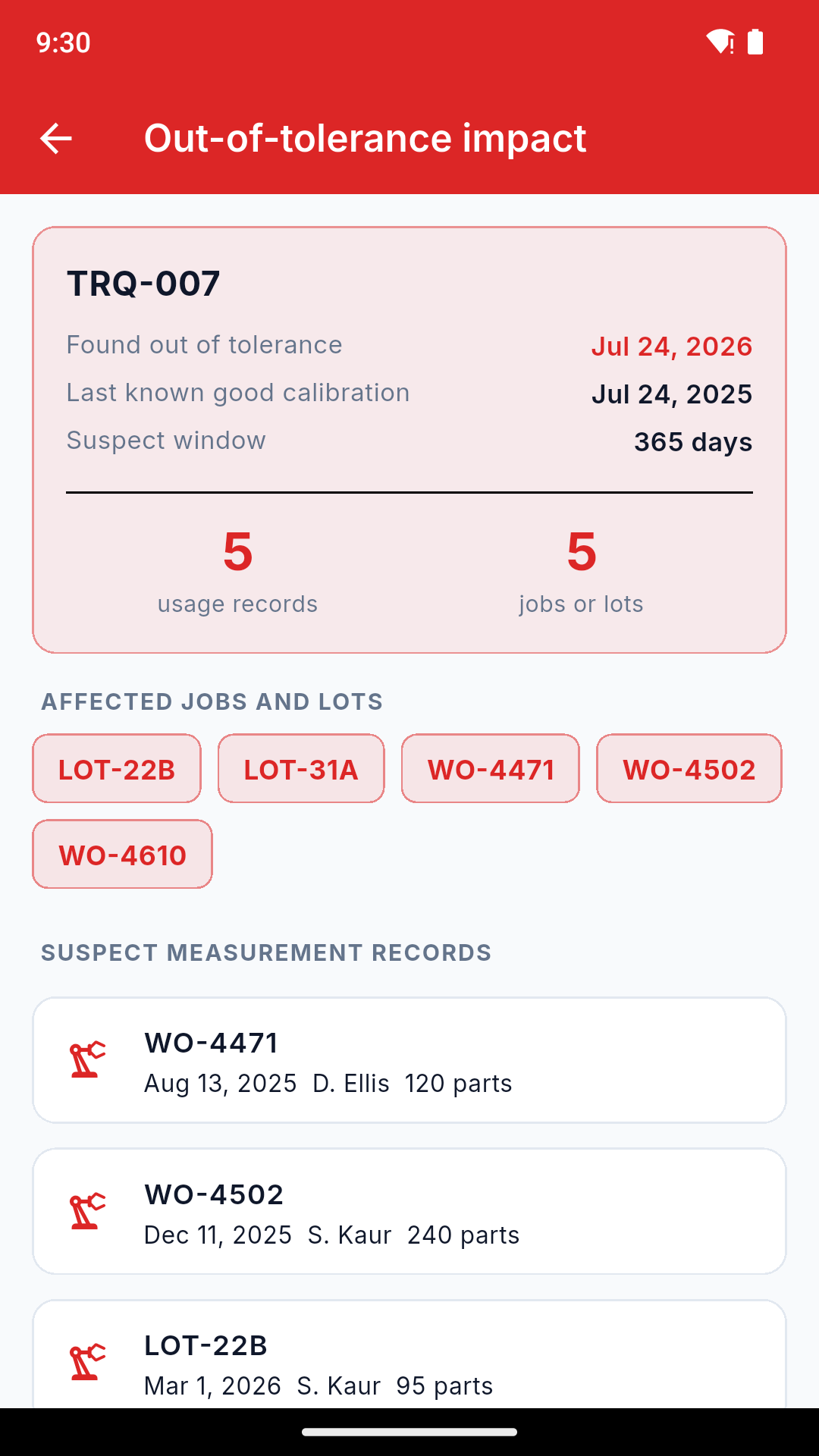
That is the question behind ISO 9001:2015 clause 7.1.5.2, which asks you to determine whether previous measurement results were adversely affected when equipment is found unfit for purpose. CalibraVault builds the list from the register you were keeping anyway: every job and lot recorded against that gauge since its last known-good calibration, exported as a PDF you can hand over.
What the answer is worth
The impact query reports the usage recorded in the app for the affected period. If a tool measured a job nobody logged, the app has no way to know it happened. That is written on the screen and printed on the report, so a short list is never mistaken for a complete one.
The same care runs through the rest. A gauge with no calibration that ever left it in tolerance has no known-good baseline to measure back to, so the app lists its entire usage history rather than a window of it, and says why. Where no job reference was recorded against the usage, it tells you that instead of pointing at parts it cannot identify.
The recall radar
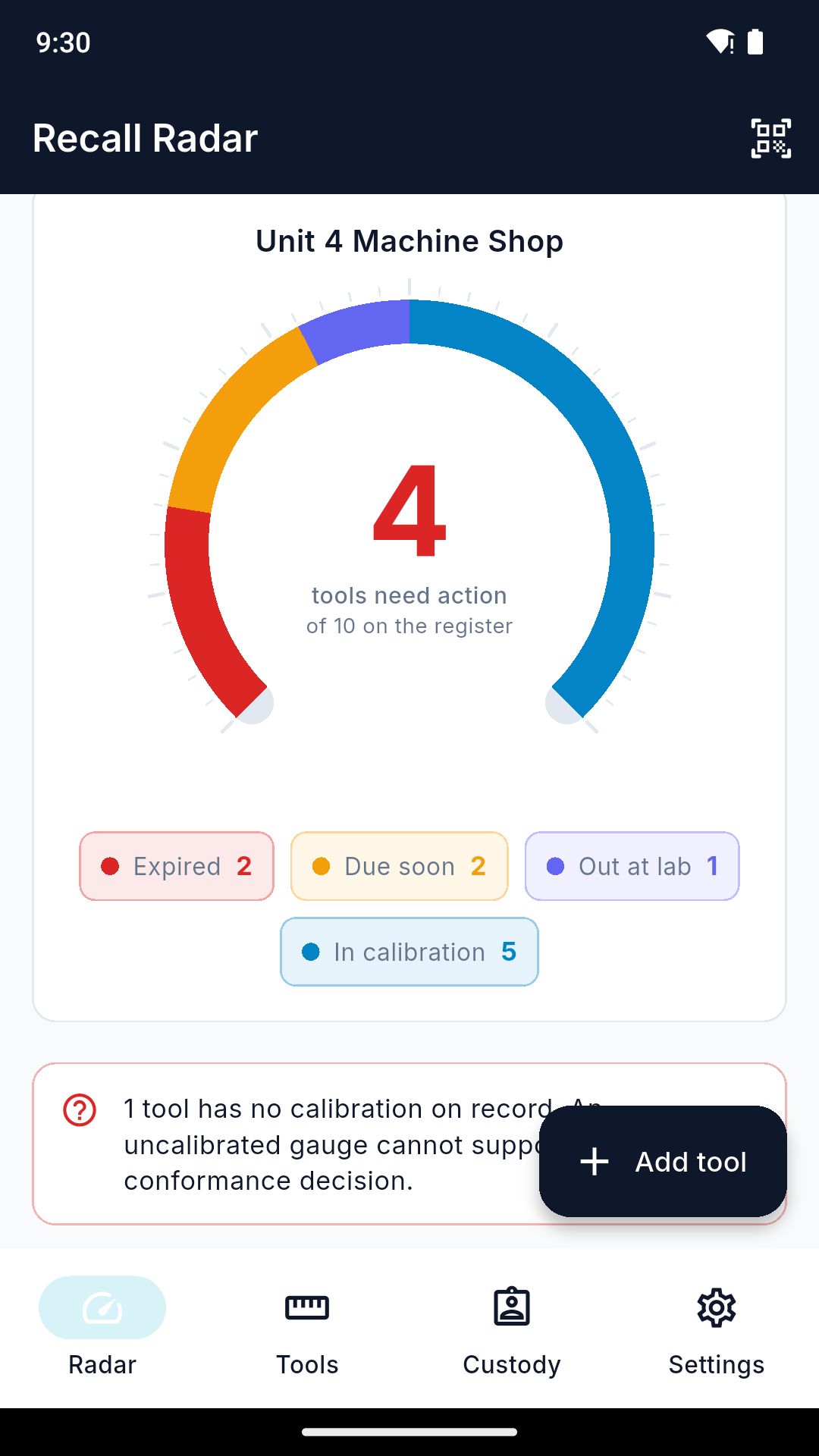
A calibration register that only knows current and overdue produces findings against gauges that are fine and silence about gauges that are not.
The certificate is current and the next due date is further out than your due-soon threshold. Nothing to do.
Inside the window you set. A tool due today sits here, not in expired, because it is still valid for the whole of the day it runs out.
Sent away and not back yet. It reads as out at the lab rather than overdue, so nobody raises a finding against a gauge that is already being dealt with.
Past its due date. A gauge with no calibration on record is counted here too and called out separately: without a record there is nothing to show the measurements it made were valid.
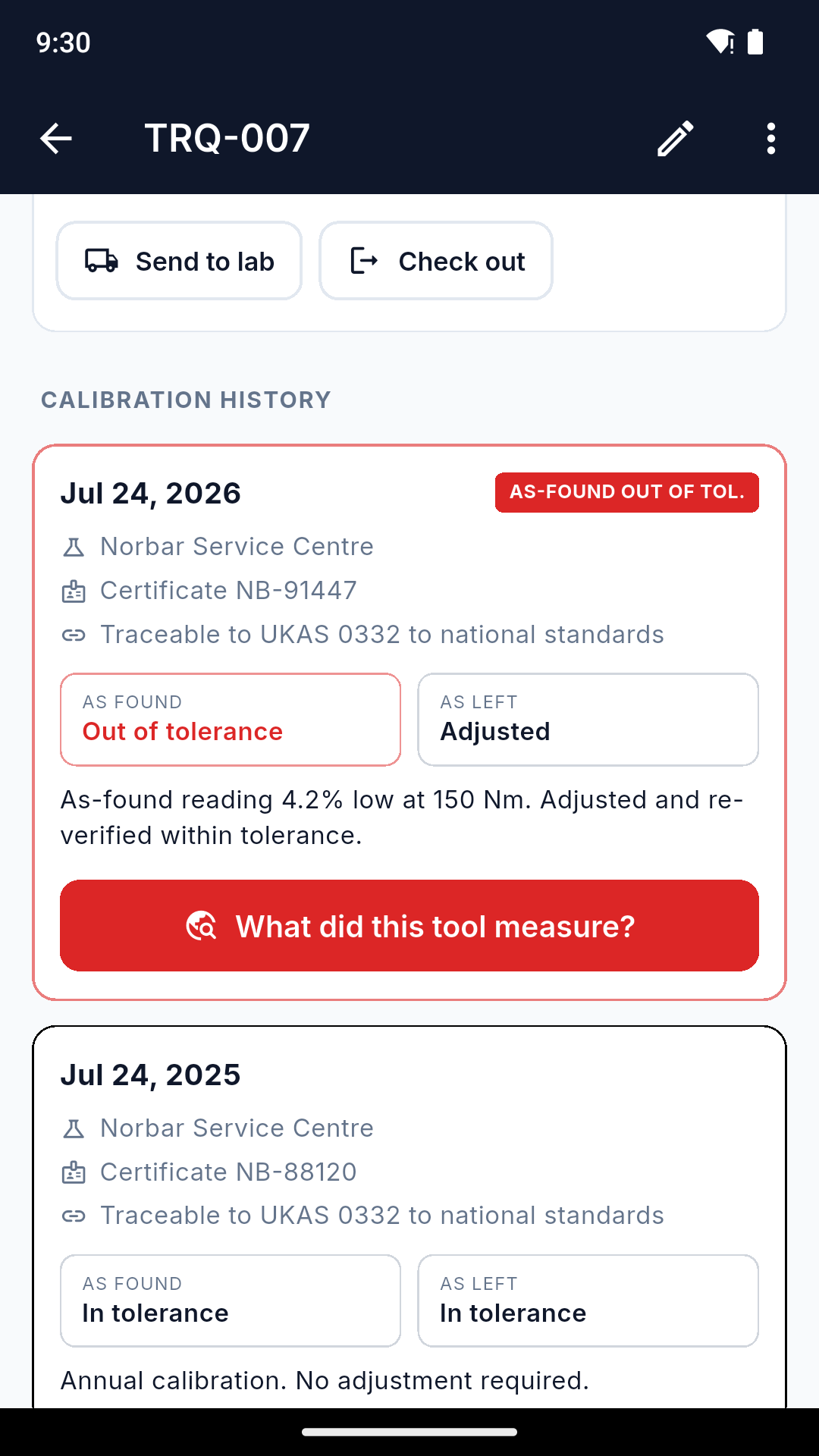
The certificate
AS FOUND
The condition on arrival, before any adjustment. This is what the tool was doing in production, and it is the field the impact query reads. An out-of-tolerance as-found is what starts the whole conversation.
AS LEFT
The condition after calibration or adjustment. Your own acceptance process decides whether the gauge returns to use; this is the field it reads, and it is what the next recall window counts from.
Stored beside them: the laboratory, the certificate number and the traceability reference. CalibraVault does not verify a certificate or a laboratory’s accreditation. It keeps what you were given, attached to the tool it belongs to.
On the phone
The lab’s clock, not yours
External laboratory turnaround is measured in weeks, and a gauge you cannot spare has to be scheduled around. A seven-day warning is no use to either problem.
The interval is per tool, because a torque wrench and a set of gauge blocks do not belong on the same cycle. Reminders are queued on a rolling window and slid forward every time you open the app, so a twelve-month interval does not depend on the phone holding a single alarm for a year. The due dates themselves are stored with the tool and the register is always current, whatever the phone does with notifications.
What you hand over
One PDF, every tool in order, with your facility name, your signatory and the standard you work to on the cover.
The impact report is a separate document, and it carries the suspect window, the jobs and lots, the measurement records and the same disclaimer that appears on screen.
How it is built
No account, no sign-in, no cloud. Your calibration register is evidence in a dispute, and holding the only copy of somebody else’s evidence is not a responsibility this app wants.
Not on local clock arithmetic that drifts an hour twice a year. A gauge due today is valid for the whole of today, and a twelve-month interval from the 31st does not quietly land two days late.
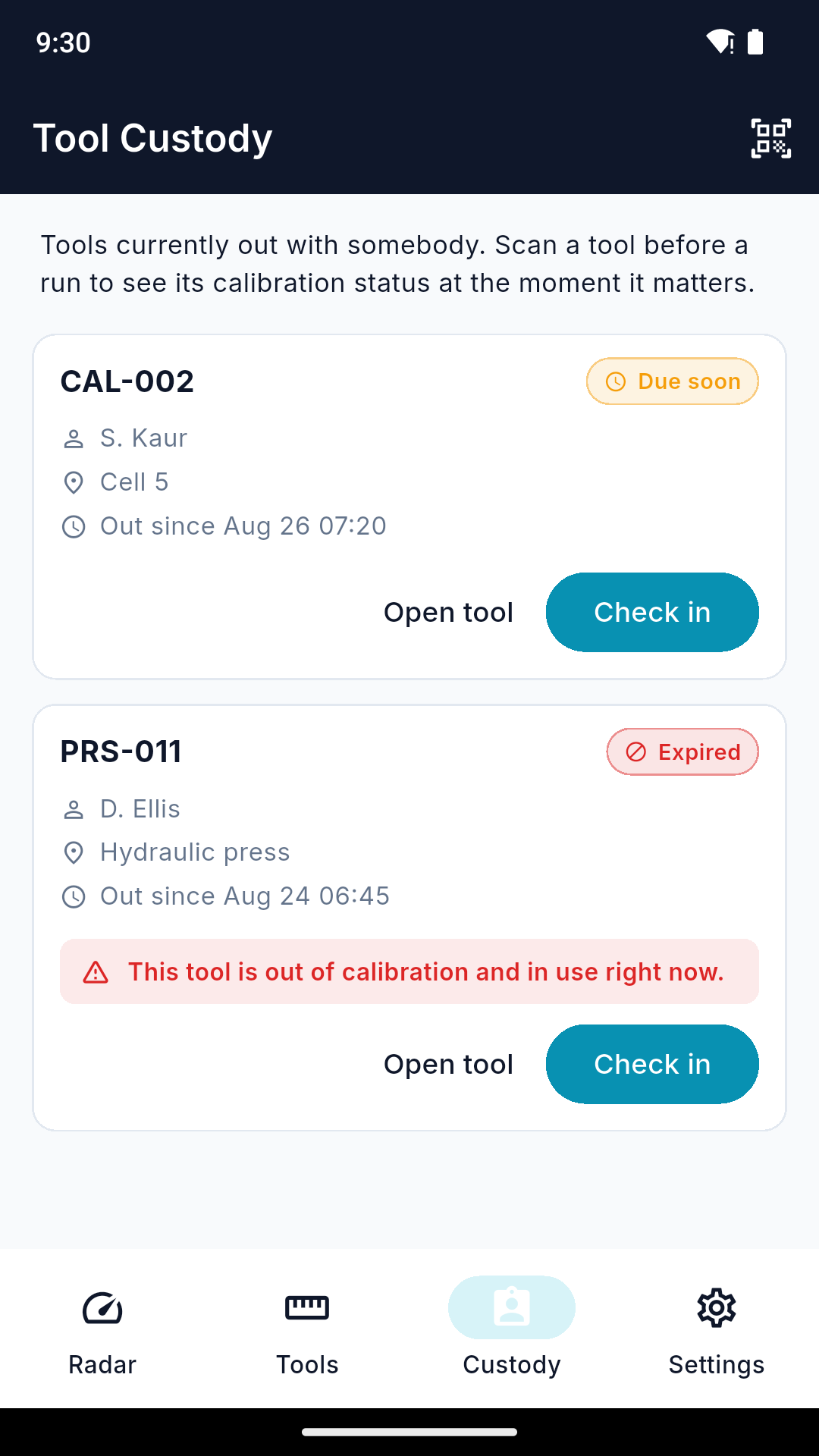
Tools are assigned to technicians and machine bays, and the custody screen shows each one beside its calibration status, so a gauge that is overdue and signed out reads as both at once. Scan it before a run and you get the same pair at the moment the check matters.
Everything you have recorded stays readable and editable. The paid tier adds capacity and the documents, never permission to see your own register.
Price
Standard
$0
Ten tools, the full recall radar and the certificate vault. Ads on this tier.
Pro
$3.99/mo
Unlimited tools, custody tracking, the impact query and the PDF exports. $24.99 a year, or $69.99 once and it is yours.
A 14-day trial is there when you want it, no card.
Questions
It can tell you every job recorded against that gauge. If a tool measured something nobody logged, the app has no way to know, and it says so on the screen rather than presenting a short list as a complete one. The impact query is a starting point for your own review, not a determination.
Yes. The register lives on the device. There is no account, no sign-in and no cloud, so a shop floor with no signal changes nothing.
Everything you have already recorded stays readable and editable, permanently. The standard tier holds ten tools with the full recall radar and certificate vault; unlimited tools, custody tracking, the impact query and the PDF exports are the paid part.
No. CalibraVault is a record-keeping tool. It reduces the admin of a calibration register and organises the certificates. It does not calibrate anything, it does not verify a certificate or a laboratory’s accreditation, and your quality management system still owns the procedure.
You pick one per facility: ISO 9001:2015, AS9100D or IATF 16949. The clause that drives the impact query is ISO 9001 7.1.5.2, which asks you to determine whether previous measurement results were adversely affected when equipment is found unfit for purpose. AS9100D and IATF 16949 both carry it.
Android. Offline. Ten tools free.