The day after the find
Used when you suspected it the moment it came out of the ground. Note it is the day after, not the day of.
ENGLAND, WALES & NORTHERN IRELAND

DigProof keeps the paperwork half of metal detecting on one phone: who gave you permission to be on the land, exactly where a find came from, and the statutory notice period that begins the moment you think something might be treasure.

Android · one permission included, then £4.99 a month or £24.99 once
TREASURE ACT 1996, SECTION 8(2)
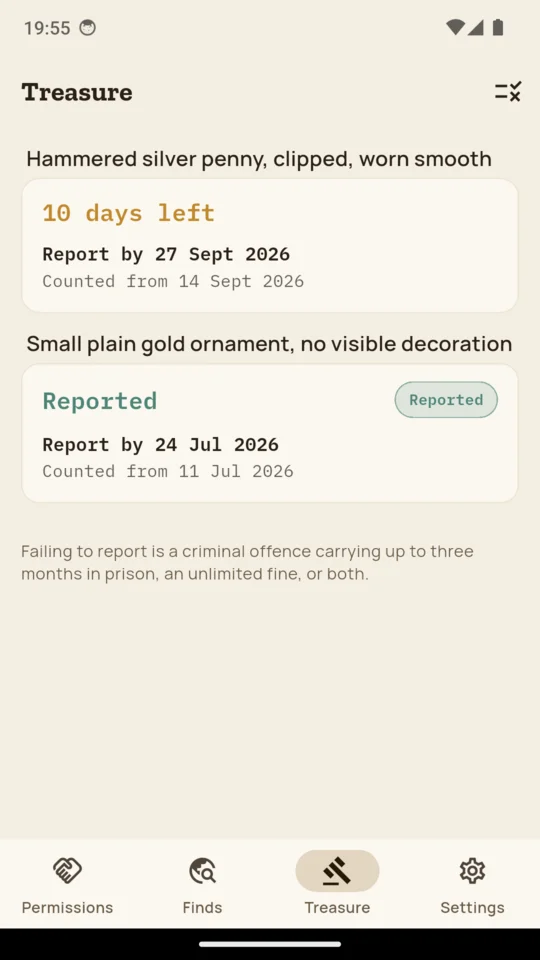
The notice period does not run from the day you dug the object. It runs from the later of two dates, and for anything identified after the event that is the second one. DigProof stores both, so the deadline it shows you is the deadline the statute sets.
Used when you suspected it the moment it came out of the ground. Note it is the day after, not the day of.
Used when that day is later. An object identified at a club night months afterwards has a different deadline from the day it was dug.
A find dug in August and recognised in September
That last step is the one worth checking. The statute says fourteen days beginning with the start day, so the start day is day one and the arithmetic is plus thirteen, not plus fourteen. DigProof counts it that way and prints the date it counted from, so you can check the arithmetic rather than take it on trust.
Day seven and day eleven leave working time to make a telephone call. Day thirteen is the day before the deadline. They are re-armed after a reboot, and they are available at every tier, because a deadline you can miss is not a feature to sell back to you. Android can still delay or suppress a notification, so the running count on the find is the record, not the reminder.
FAILING TO REPORT
3 months
imprisonment, a fine, or both, on summary conviction. Treasure Act 1996 s.8(3). The fine is unlimited in England and Wales and capped at £5,000 in Northern Ireland, because the section that removed the ceiling extends to England and Wales only, and the app prints whichever one applies to you.
THE CLASSES IN FORCE
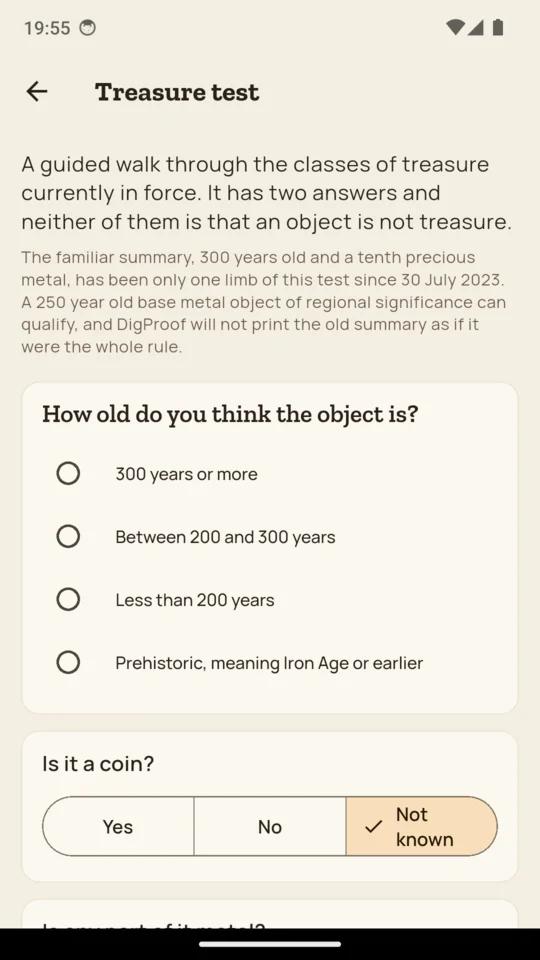
"Three hundred years old and a tenth precious metal" is the rule most detectorists carry, and it stopped being the whole rule on 30 July 2023. The guided walk covers every class that is actually in force, with the instrument printed beside it so you can check the app rather than trust it.
An object at least 300 years old, not a coin, at least a tenth of whose metal by weight is gold or silver
Treasure Act 1996 s.1(1)(a)(i)
One of at least two coins at least 300 years old containing gold or silver, found together
Treasure Act 1996 s.1(1)(a)(ii)
One of at least ten coins at least 300 years old, found together
Treasure Act 1996 s.1(1)(a)(iii)
One of at least two prehistoric base metal objects, other than coins, found together
Treasure Act 1996 s.1(1)(b) and SI 2002/2666 art.3(a)
A prehistoric object, other than a coin, any part of which is gold or silver
Treasure Act 1996 s.1(1)(b) and SI 2002/2666 art.3(b)
An object at least 200 years old, any part of which is metal, giving exceptional insight into national or regional history, archaeology or culture
Treasure Act 1996 s.1(1)(b) and SI 2023/404 In force 30 July 2023
An object that would have been treasure trove under the old law
Treasure Act 1996 s.1(1)(c)
An object found with another object that is treasure
Treasure Act 1996 s.1(1)(d)
There are only two answers. Either it may be treasure, or it does not appear to meet the test, and the second one always carries "if in doubt, report it". A coroner decides what is treasure, so an app that returned a confident negative would be wrong about a criminal duty in the one direction that costs the finder. "Not known" is a real answer to every question and rules no class out.
PERMISSIONS COME FIRST
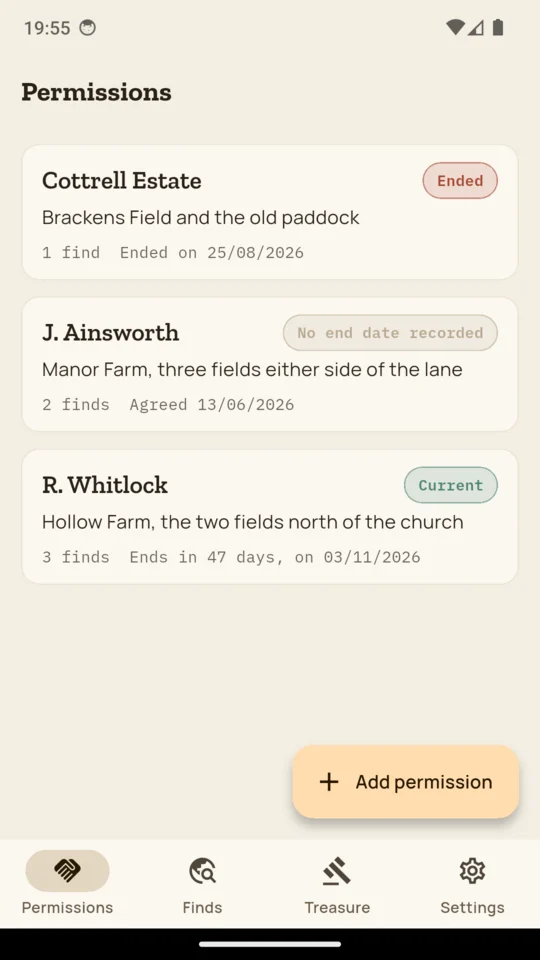
Not a warning, a constraint. Every find hangs off a permission, so the record can always answer the question that matters if anyone ever asks it: what were you doing on that land. Each one holds the landowner and their contact, the land it covers, the date agreed, an optional expiry, the agreed finds split, whether detecting is allowed on scheduled or protected land, and a photograph of the signed agreement.
An end date was recorded and it has not passed. The card shows the day it runs to.
Near enough that it is worth a telephone call before the next outing.
DigProof cannot say whether this permission still stands. Only the landowner can, so the app says that instead of guessing.
The recorded end date has passed. The register says so on the front screen rather than at the bottom of a detail page.
The third one is deliberate. Most permissions are a conversation in a farmyard with no end date attached, and an app that filed those as "active" would be asserting something the record does not contain.
FINDSPOTS
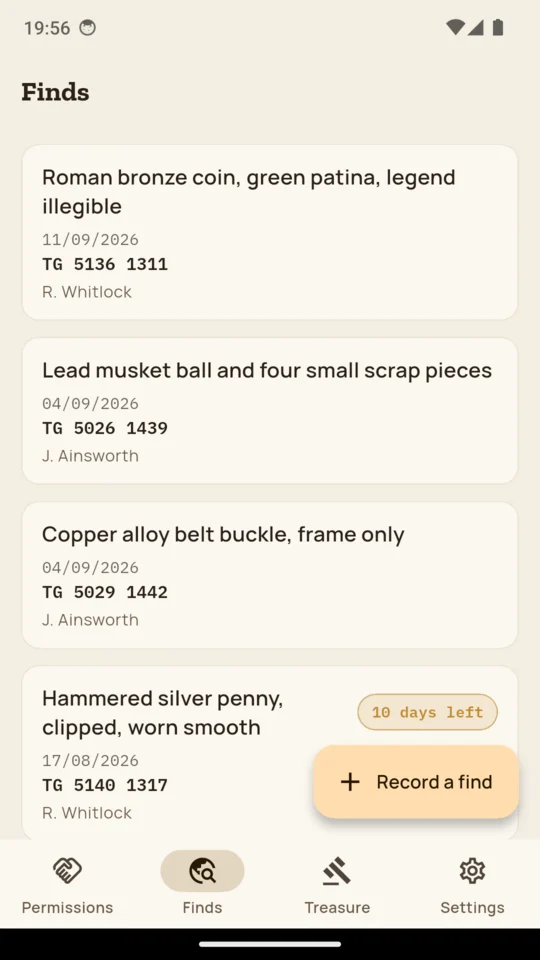
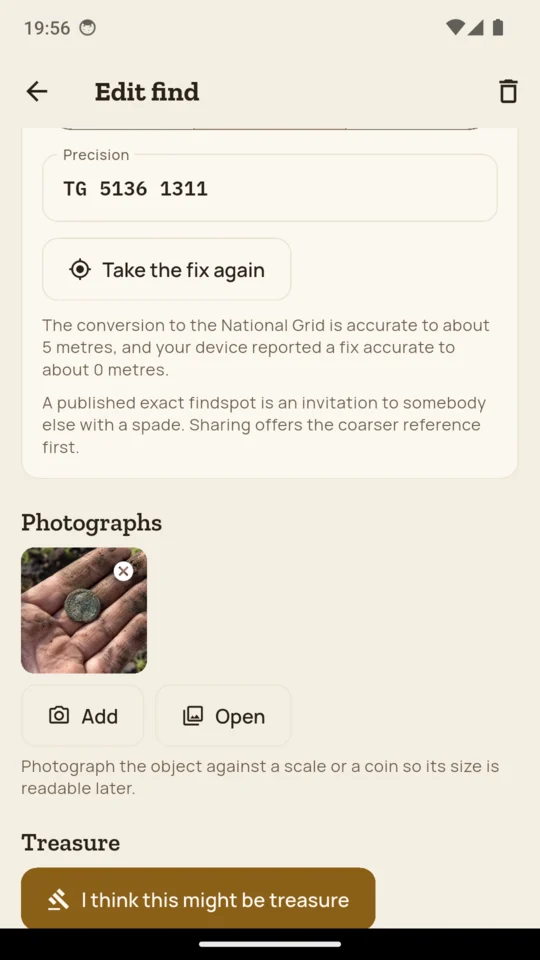
Each find stores the device coordinates and the British National Grid reference worked out from them. You choose the precision, and you can type one by hand, so the app still works with the GPS turned off.
Six figures
TG 514 131
100 m square
Eight figures
TG 5140 1317
10 m square
Ten figures
TG 51409 13177
1 m square
The conversion is a seven parameter Helmert transformation, which lands within about five metres. Ordnance Survey's own OSTN15 is sub-metre and needs a licensed data grid. Ten figures names a one metre square, which is finer than the transformation can justify, so the app prints its own accuracy and your device's fix beside the reference instead of quietly implying both are exact.
A published exact findspot is an invitation to somebody else with a spade. When you share a find, the app offers the coarser reference before the precise one. The full reference stays on your record and goes into the document you hand to a Finds Liaison Officer.
ON THE PHONE
PAPERWORK YOU HAND OVER
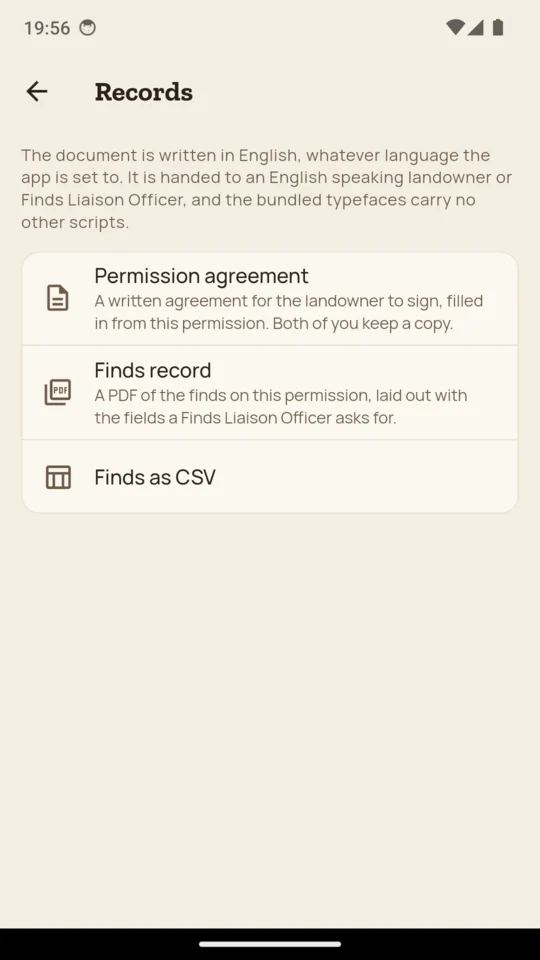
A written agreement for the landowner to sign, carrying the land, the term and the finds split you agreed. Both of you keep a copy.
A PDF laid out with the fields a Finds Liaison Officer asks for: findspot, grid reference and its precision, depth, material, apparent period, description and photographs.
The same record as a spreadsheet, for anyone who keeps their own catalogue or wants the data somewhere that is not this app.
There is no Portable Antiquities Scheme API and no route to a coroner from a phone. DigProof prepares the record and links you to the Finds Liaison Officer directory. You make the report.
WHERE THE LAW REACHES
The statutory duty names the coroner. gov.uk directs finders to their local Finds Liaison Officer, who passes the case on. The app shows both, because they are not the same fact.
The same fourteen days, through National Museums NI. It also carries a second and wider duty that the rest of the UK does not: every archaeological object, treasure or not, must be reported within fourteen days. A Northern Irish finder told only about treasure has been told half of what applies to them.
Scots law does not run on the Treasure Act. Finds fall to the Crown through Treasure Trove and the qualifying test is materially different, so DigProof keeps your permissions, finds and outings and runs no test and no clock. It names the Treasure Trove Unit instead of guessing.
PLAINLY
DigProof is a record and reminder tool for England, Wales and Northern Ireland. It is not legal advice, it does not report anything on your behalf, and it cannot tell you whether an object is treasure.
PRICE
Standard
Free
Everything
£24.99 once
or £4.99 a month, or £19.99 a year
A fourteen day trial is there if you want it, and you start it yourself. Nothing you have already entered is ever hidden or locked: what stops at the free cap is adding a second permission, not reading the first one.
QUESTIONS
On the later of the day after the find and the day you first believed it might be treasure. DigProof stores those two dates separately and every countdown names the one it used.
No. It prepares the record and you make the report. There is no Portable Antiquities Scheme API and DigProof does not pretend otherwise.
Never. The negative result is that it does not appear to meet the test, and it always carries "if in doubt, report it". Only a coroner decides.
It keeps your permissions, finds and outings there, and it deliberately runs no test and no clock, because the Treasure Act does not apply. It names the Treasure Trove Unit instead.
The conversion is accurate to about five metres, before whatever error your own device fix carried. The app prints both figures rather than implying a precision it cannot deliver.
Permissions, finds, outings and photographs do not. There is no account and no sign-in. The standard tier serves a banner advert, and the app reports crashes and basic usage.
Offline, on your own phone, with no account to create. England, Wales and Northern Ireland.