1
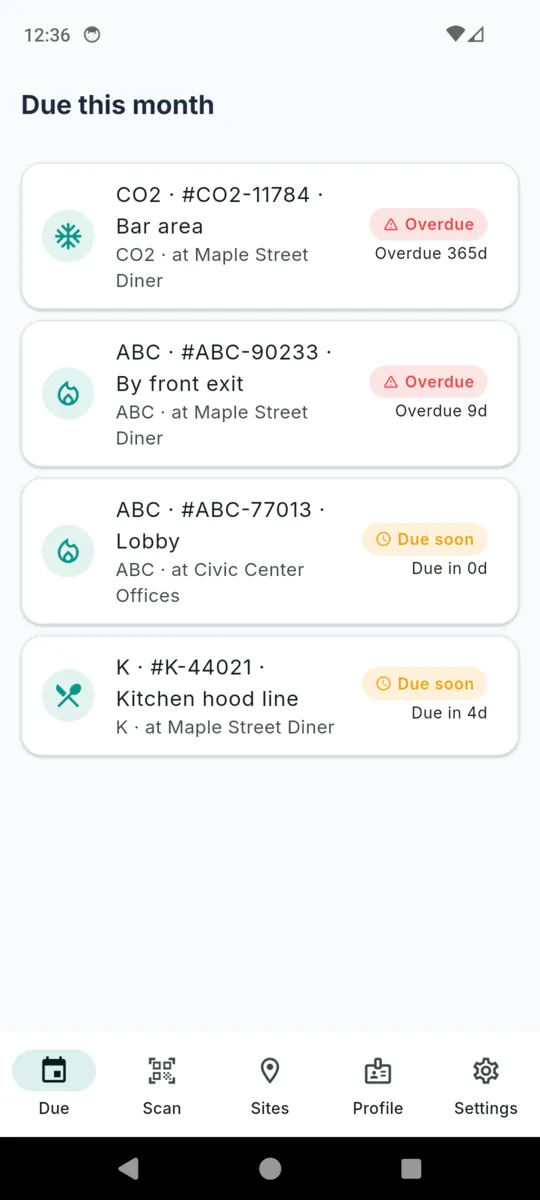
Open Due
Everything overdue or coming up across every site, worst first, with how many days each one is out by.
EXTINGUISHER INSPECTION LOG
FireTag
Every cylinder. Every inspection.
Monthly, annual, six-year internal, hydrostatic. FireTag runs all four against every extinguisher on your route, drops the ones that do not apply to that agent type, and tells you what is due before you get in the van.

14-day trial, then $1.99/mo,
$9.99/yr or $24.99 once. Android.
THE LADDER
They are separate pieces of work on separate schedules, and a log that collapses them into one "next service" date is the reason cylinders get missed. FireTag keeps them apart, each with its own last-done date, next-due date and status chip.
Every month
Six visual checks against the cylinder, marked and dated. FireTag flags the unit seven days before this one falls due — a shorter warning than the others, because a month is a short clock.
Every 12 months
A full service event with outcome, notes, photos and a signature. Logging it resets the annual clock, and on a cartridge-operated cylinder it is where the internal work lands too.
Every 6 years
Recorded against the unit as its own event so the six-year clock runs independently of the annual. Types with no internal examination simply do not show this row.
Every 5 or 12 years
The longest clock, and the one nobody remembers. Five years on CO2 and water, twelve on the dry chemicals, halon and cartridge cylinders, and nothing at all where the type is unknown.
Long cycles are flagged 30 days out, monthlies 7 days out. If you want the background on what each job involves and who does it, we wrote it up in NFPA 10 fire extinguisher inspection requirements explained.
The two long cycles depend entirely on what is in the cylinder. Pick the agent type when you register the unit and FireTag shows the rows that apply to it and hides the rest. Nothing is guessed: a cylinder logged as Other gets a monthly and an annual clock and no long cycles at all.
| Extinguisher type | Code | Internal examination | Hydrostatic test |
|---|---|---|---|
| ABC dry chemical | ABC | 6 years | 12 years |
| BC dry chemical | BC | 6 years | 12 years |
| Class K wet chemical | K | 6 years | 12 years |
| Halon / clean agent | HAL | 6 years | 12 years |
| Carbon dioxide (CO2) | CO2 | None for this type | 5 years |
| Water / foam (APW) | H2O | None for this type | 5 years |
| Cartridge-operated dry | CART | At each annual | 12 years |
| Other / unknown | OTH | Not tracked | Not tracked |
Monthly and annual clocks run on every type, including Other. Check the intervals against the current edition of the standard and your authority having jurisdiction before you rely on them.
The whole app is shaped around this loop, which is why the bottom bar is Due, Scan, Sites, Profile, Settings and nothing else.
1
Everything overdue or coming up across every site, worst first, with how many days each one is out by.
2
Point the camera at your QR or barcode label and its history opens. Or find it under the site, or type the code.
3
Pick the service type, run the checklist if it is a monthly, choose OK, needs service or failed, add photos and notes.
4
Sign on screen, generate the tag image, and the clock you just serviced resets while the other three carry on.
THE MONTHLY, IN FULL
Six items, each marked and stored against the event, then printed in the service history on the report.
Five screens from the shipped build. The sites, serials and technician details in them are sample data.
Scroll sideways, or use the arrow keys
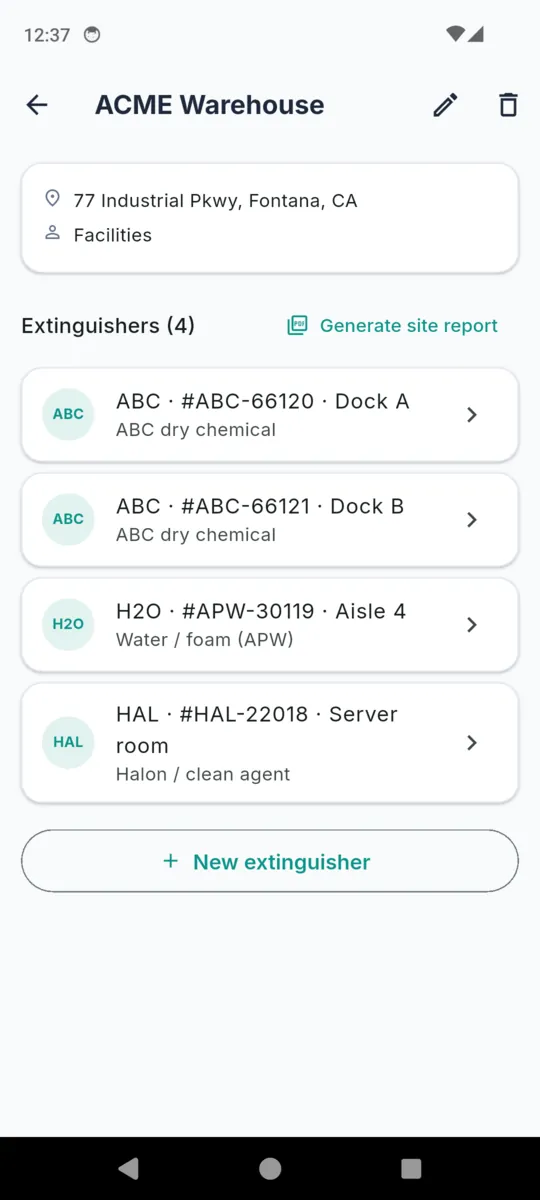
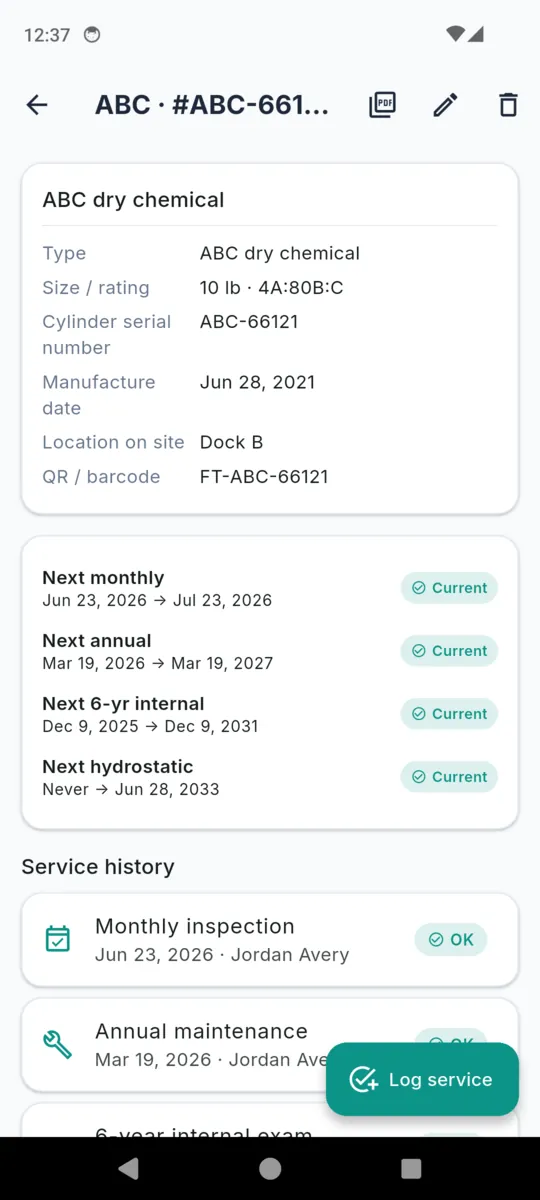
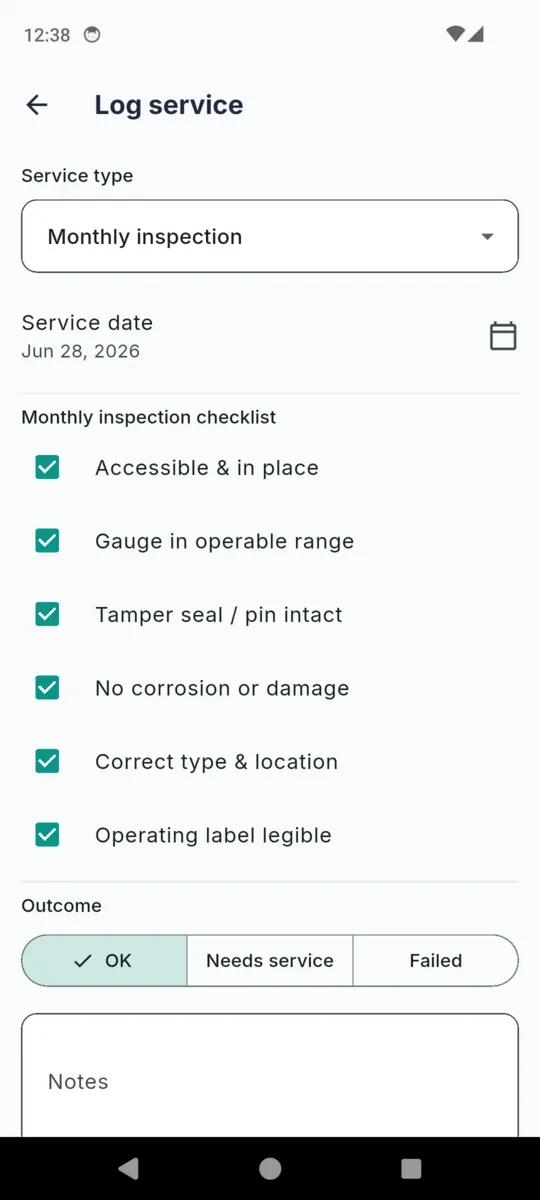
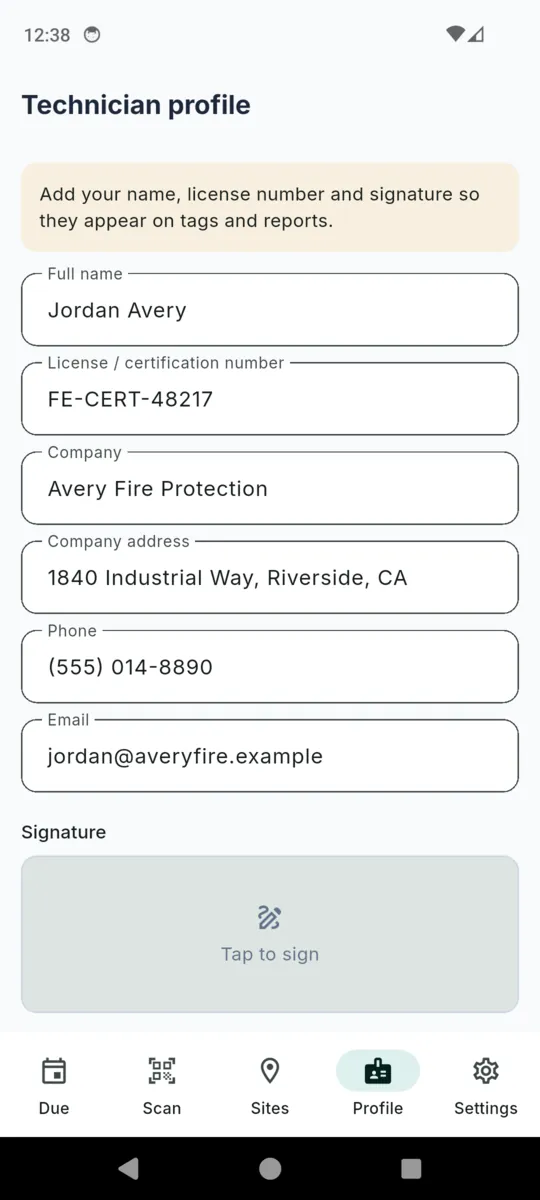
Three artefacts from the same records, all generated on the device.
TAG IMAGE
A card headed FIRE EXTINGUISHER / SERVICE RECORD carrying the service type, date, technician, company, cylinder serial and next due date, with the disclaimer along the bottom. Save it to the gallery or send it to the customer.
PDF · PER SITE
The cover carries the company, technician, license, site, address, contact and cylinder count, plus the disclaimer. Then a table of serial, type, location, monthly, annual, long cycle and status; the service history as date, service, outcome, technician and notes; the technician signature; and the photos. Pages are numbered.
PDF · PER CYLINDER
One unit end to end: type, size and rating, serial, manufacturer, model, manufacture date, location, then next monthly, next annual and whichever long cycles apply, followed by every event ever logged against it and the photos.
Fourteen days of everything on install, no card. After that, stay on the free tier or buy it once. Most people take the lifetime: nothing renews and it stays unlocked.
Either way, records you already made are never locked, hidden or deleted, and can always be re-exported. The free tier only stops you adding new ones past the cap.
LIFETIME
$24.99once
Or $1.99 a month, or $9.99 a year. Prices set in US dollars.
No. It records work you performed and works out the next-due dates from the dates you entered. You are the qualified person doing the work and signing the tag.
Because the type has no six-year internal, and its hydrostatic clock is five years rather than twelve. FireTag leaves rows out rather than showing a cadence that does not apply.
Set it to Other and you get the monthly and annual clocks only. FireTag will not invent a hydrostatic date for a cylinder it cannot identify.
You label each cylinder with your own QR or barcode. Scanning it opens that unit’s history. An unknown code offers to register it, and there is always a manual code box for a scorched label.
No. FireTag has no notifications. The Due list is what you open at the start of a route, sorted by whichever clock is closest.
Yes. Sites, cylinders, service events, photos, tags and reports live on the phone. A connection is only used to serve ads on the free tier.
Nothing you recorded is locked, hidden or deleted, and you can still re-export it. The free tier caps only new items: one site, ten cylinders and one report.
Yes. Your name, license or certification number, company and signature go in the technician profile once, then print on every tag and every report.
This is the notice the app shows on the service form, on the tag, on the PDF cover and in Settings, word for word:
FireTag helps you record fire-extinguisher inspections, maintenance, and test dates and compute next-due dates. It is not a certification, an inspection service, or legal/safety advice, and it does not guarantee that any extinguisher or record meets NFPA 10, OSHA, or your local authority's requirements. You are the qualified person responsible for performing the work, signing the tag, and the accuracy and sufficiency of every record. Verify all dates, intervals, and tag requirements against the current edition of NFPA 10 and your authority having jurisdiction.
Add it, put its cylinders in with their manufacture dates, and see what the four clocks say.