
Piano tuner log
The record belongs to the piano
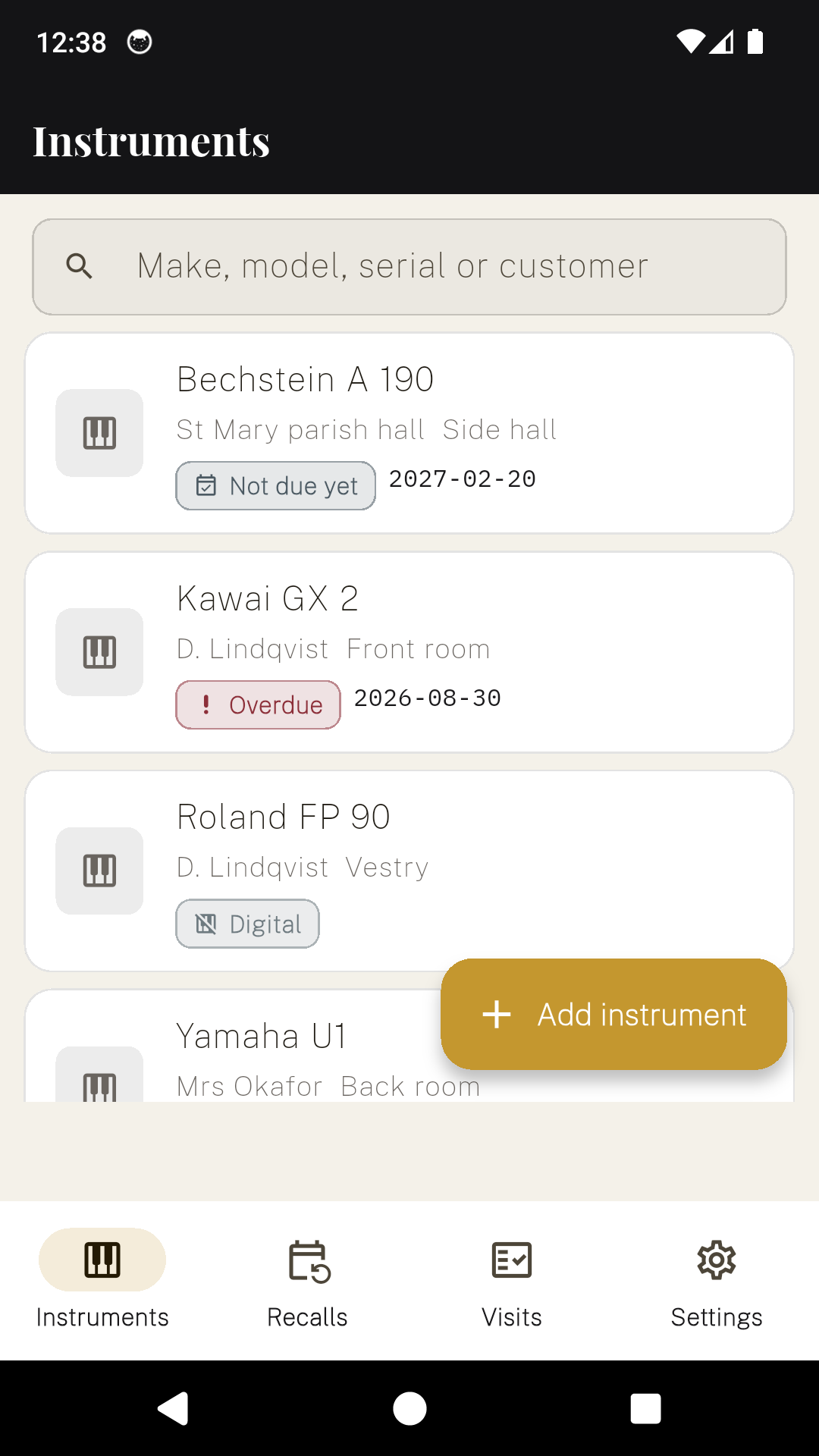
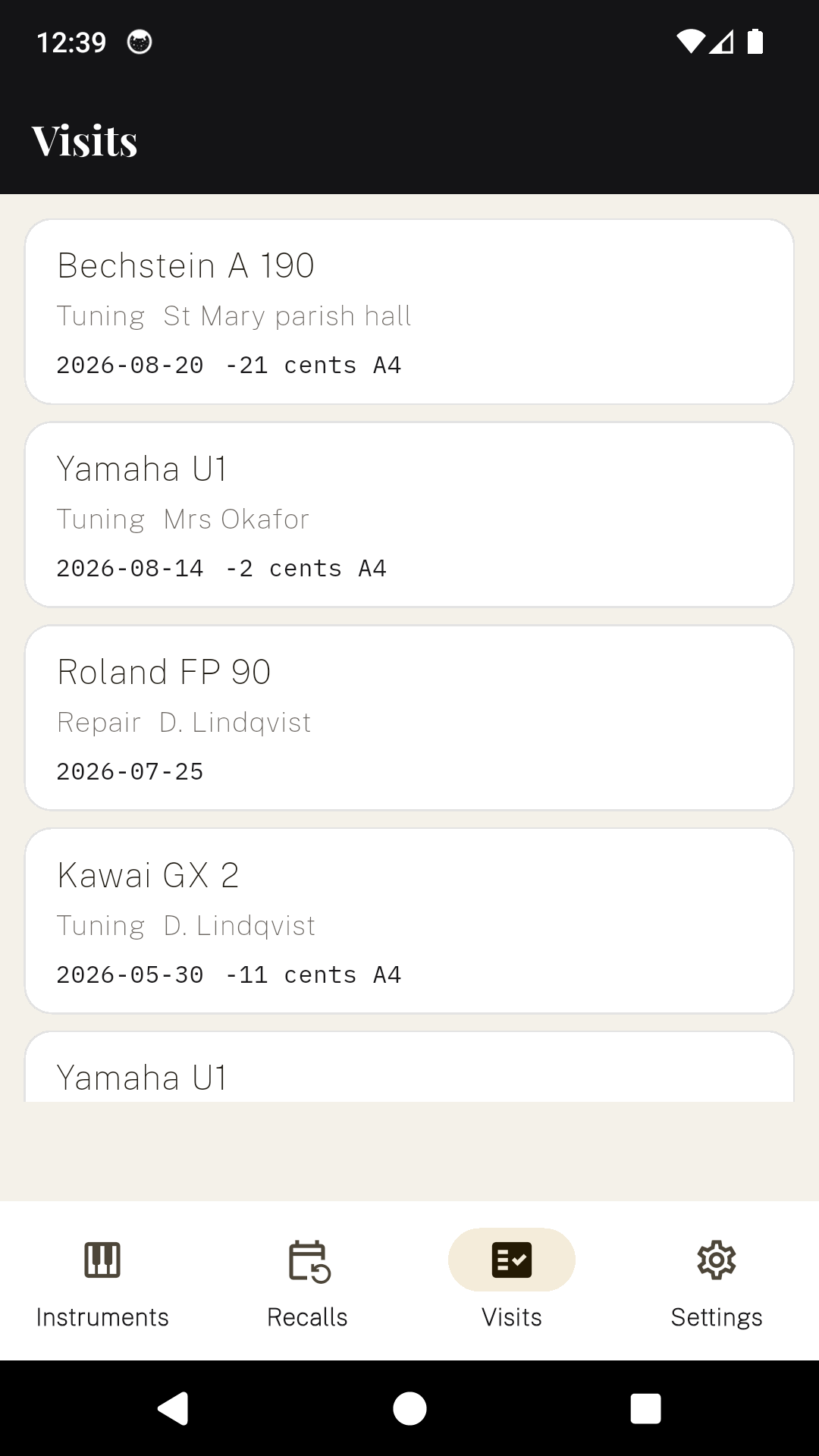
Which instrument, in which house, what you did to it, where you found the pitch and where you left it. PianoDesk keeps that history against the piano itself, so it survives the customer moving out.
- A history per instrument, not per name on the invoice
- Pitch in cents against A440, with the note you measured at
- A recall interval per piano, because they are not on one clock
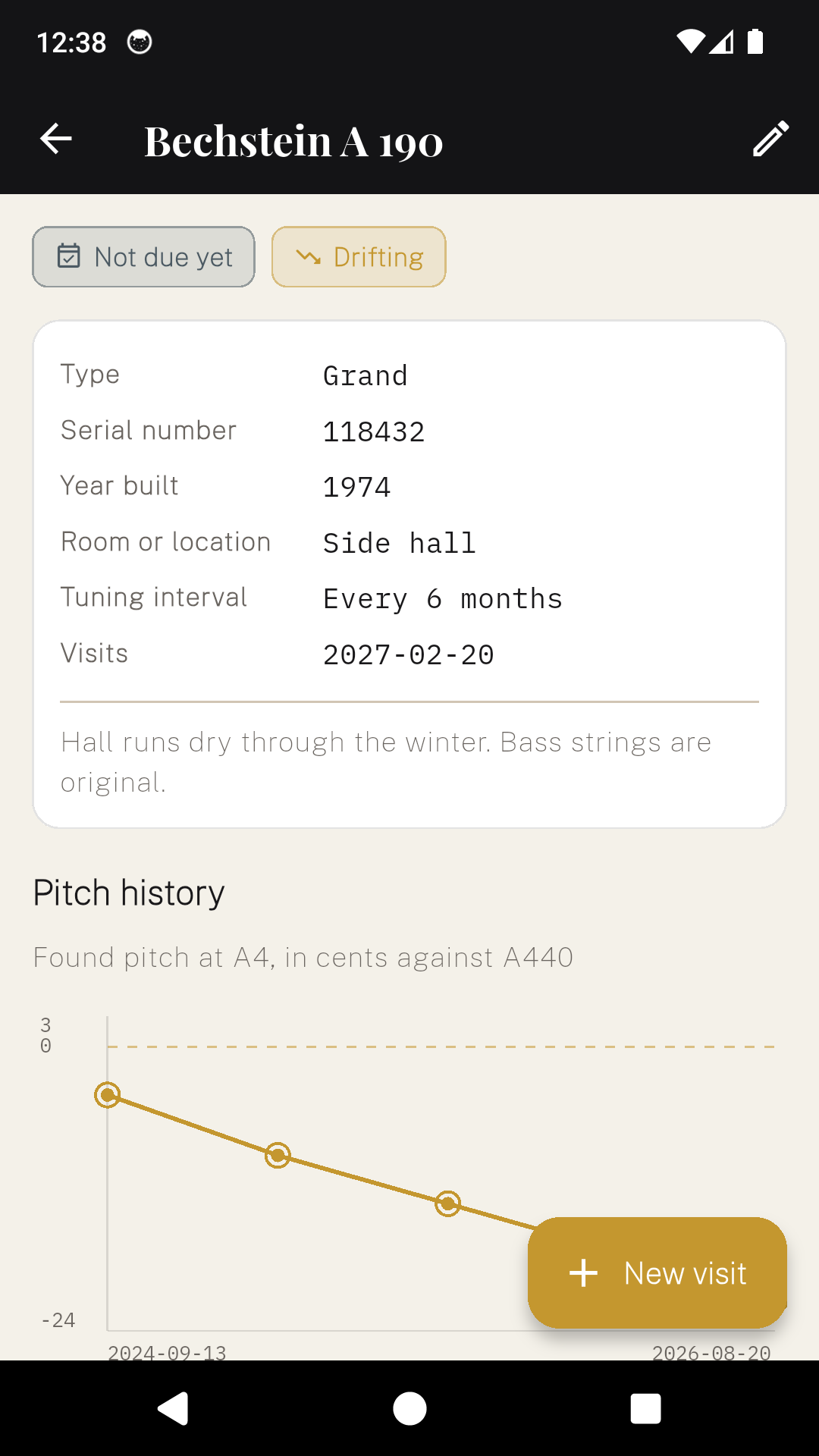
A piano outlives the person who bought it
One customer can own three instruments. A hall has an upright in the vestry and a grand on the stage. And when the house sells, the piano usually stays where it is and the name on your invoice changes.
A record filed under a customer loses all of that. PianoDesk hangs the history off the instrument, so what you need on the doorstep is what you did to this piano, whoever is paying this time.
Pitch
Cents against A440, and the note
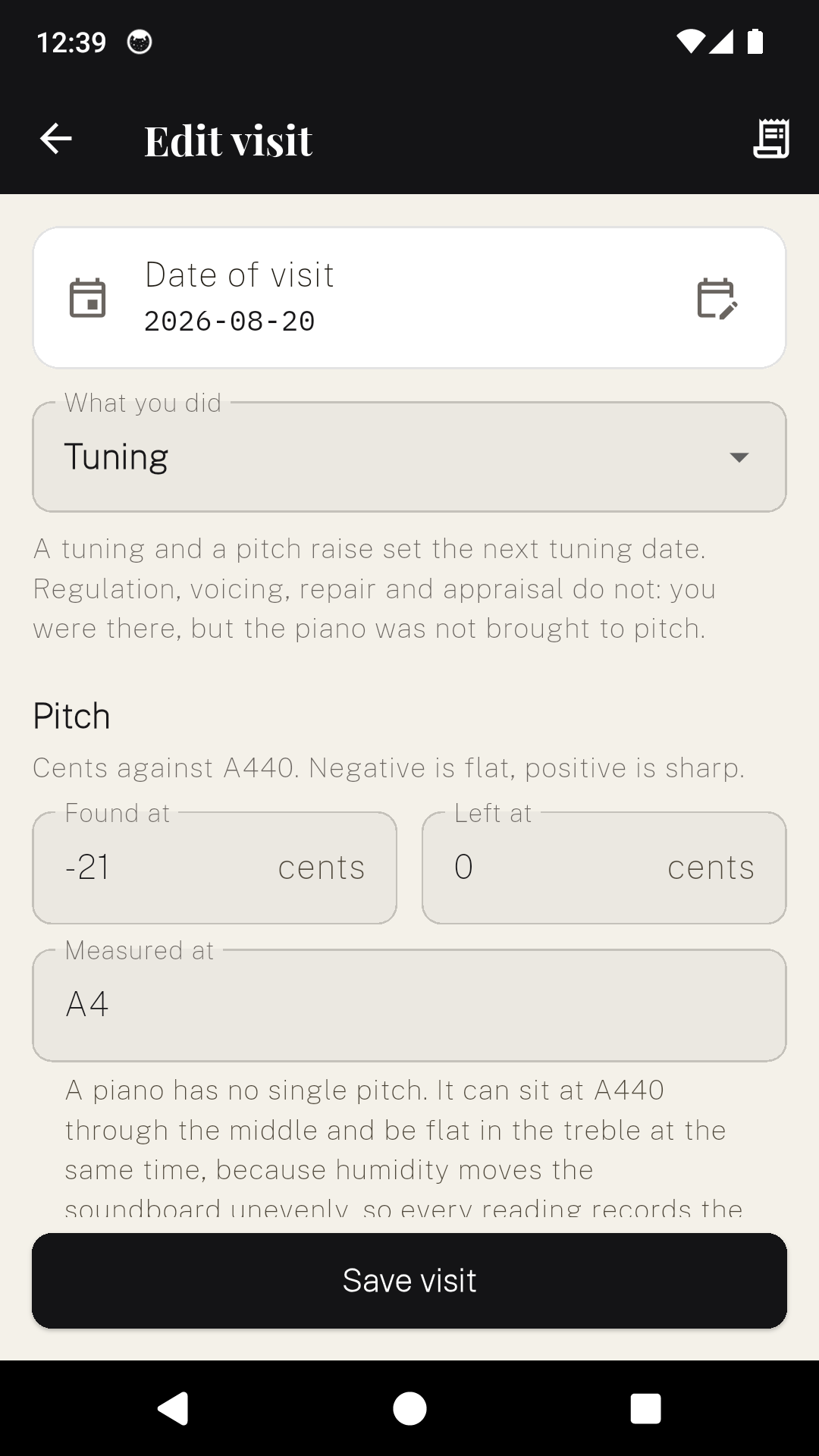
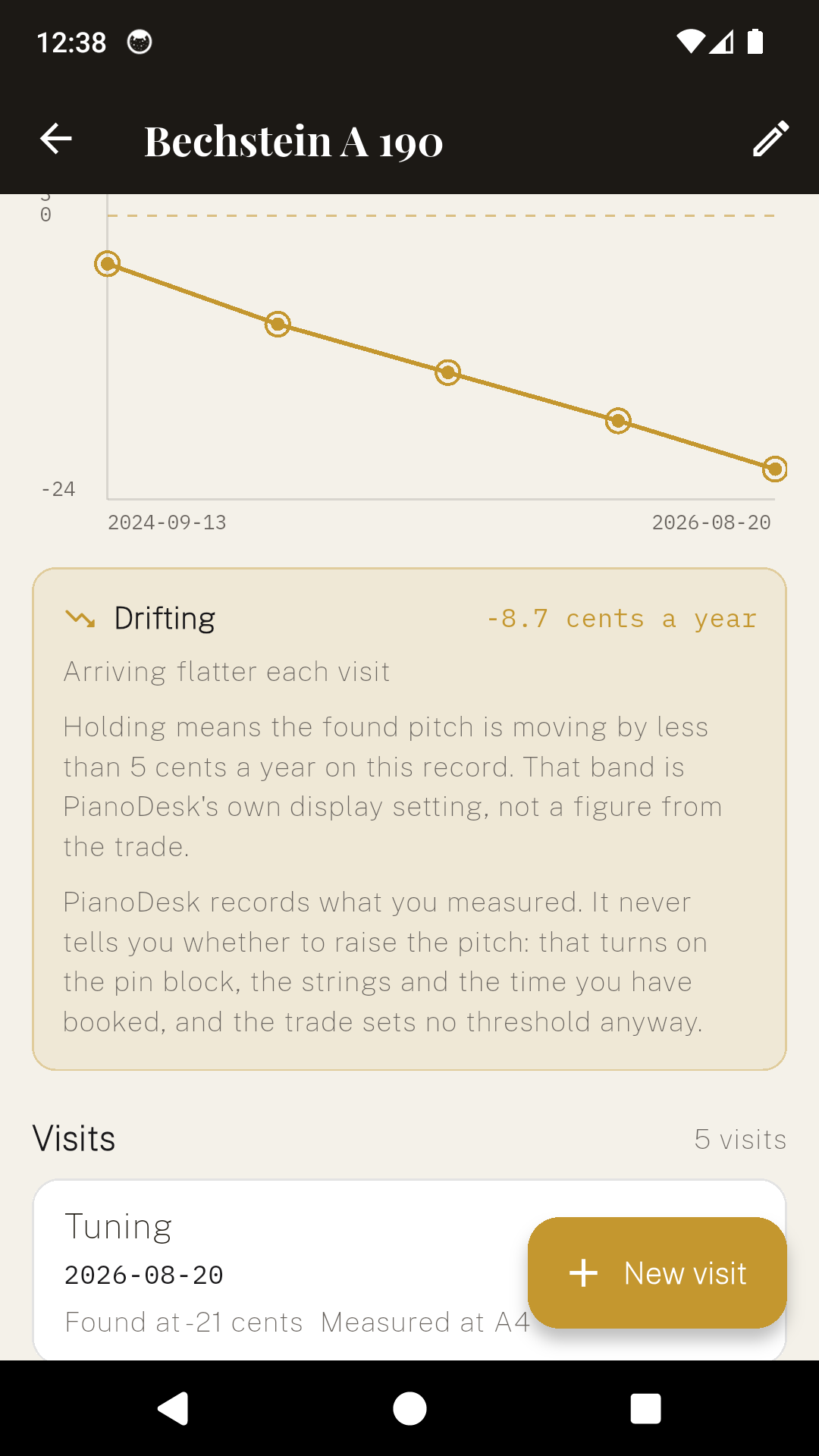
Negative is flat, positive is sharp, which is the universal convention and the app follows it exactly. Every visit records where you found the pitch and where you left it.
And every reading carries the note it was taken at, defaulting to A4. Humidity moves the soundboard crown unevenly, so an instrument can be at A440 through the middle and materially flat in the treble at the same time. Stored without the note, a figure is unattributable a year later, when it is the only evidence you have.
Where two visits used different reference notes the chart says so rather than drawing a line between them. A line from A4 to C7 is two different measurements presented as one trend.
The trend
Four things it may say, and two are refusals
The chart reads this instrument's own visits and nothing else. Two of its four answers are the app declining to classify, which is the honest outcome far more often than a chart usually admits.
Fewer than three readings, or a span shorter than about ten months. A piano dries out with the heating and comes back with the humidity, so three readings inside one season can be half a swing wearing a trend’s clothes.
The readings were not all taken at the same note, so there is no line to draw between them. A figure at A4 and a figure at C7 are two measurements, not a trend.
The found pitch is moving by less than five cents a year on this record. That band is PianoDesk’s own display setting and the app says so where it uses it.
It is moving faster than that, and the cents per year is printed beside the word so the number is never hidden behind the label.
The recommendation it will not make
It never tells you to raise the pitch
There is no pitch raise threshold anywhere in PianoDesk, and no such constant in its code. Ask three technicians how far flat is far enough and you get three cents, five to ten, and eight to ten "more practical".
The disagreement is the point. That decision turns on the pin block, the age of the strings, whether the instrument will hold, and how long the customer booked you for. None of that is visible to software, and a number printed on a screen a tuner reads as guidance would be guidance the trade never gave.
PianoDesk records what you measured. It never tells you whether to raise the pitch: that turns on the pin block, the strings and the time you have booked, and the trade sets no threshold anyway.
The round
Six months, per instrument, as a recommendation
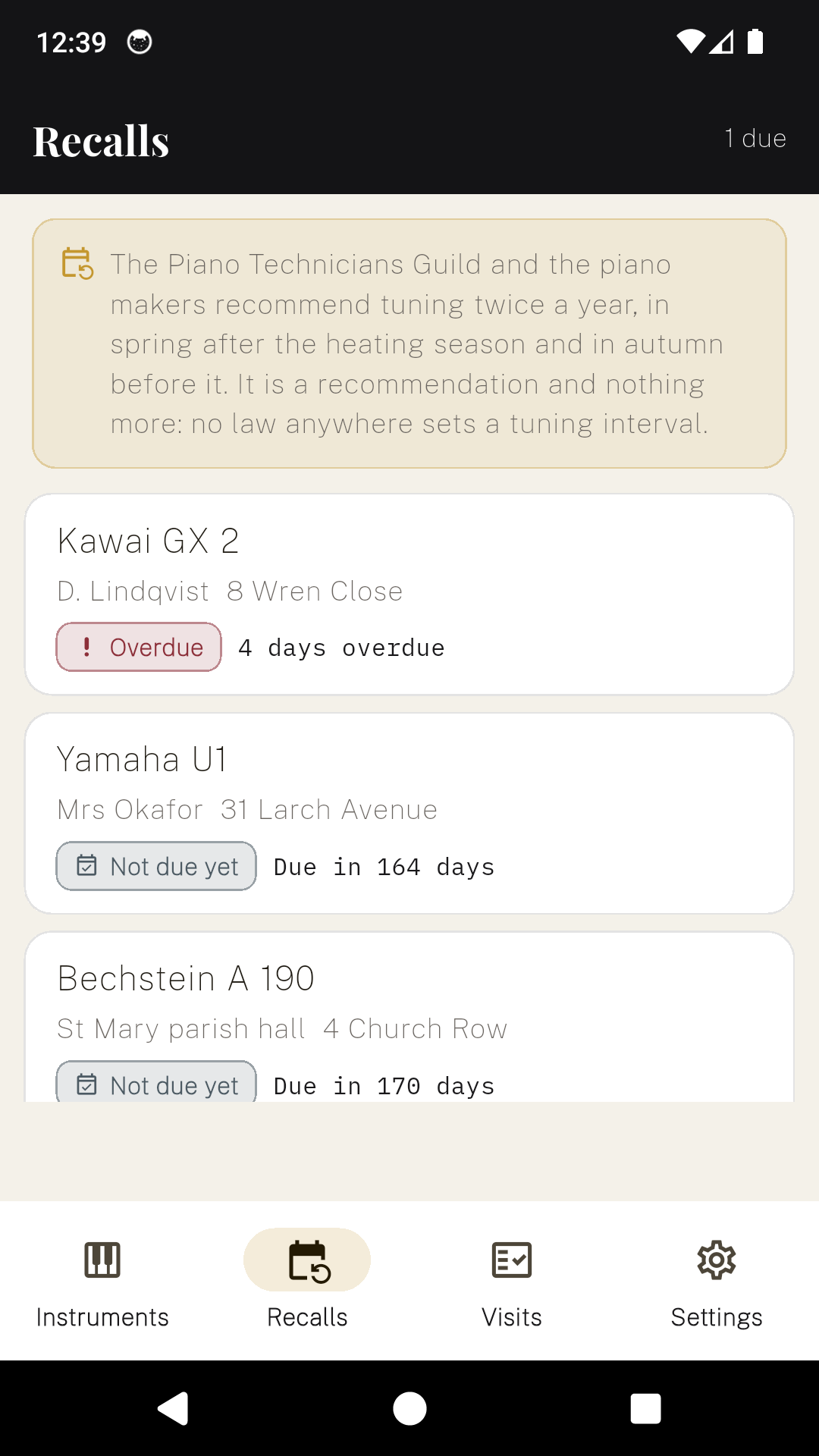
Six months is the trade's own figure and it is the default. Three sits beside it for a new instrument, which manufacturers want tuned about four times in its first year while the strings settle, and twelve is there for the piano nobody plays.
The interval belongs to the instrument, and the recalls screen says in plain words that it is a recommendation: no law anywhere sets a tuning frequency. A digital instrument is recorded like any other and never appears on that list at all.
Reminders arrive at six in the evening, when you are out of the last house, and a weekly look ahead lands on Monday morning when the week gets planned.
The app
The real screens
What it will not do
- It does not listen to the piano. You bring the readings; it keeps them.
- It does not recommend a pitch raise, and it does not tell you what interval a particular instrument should be on. Those are yours.
- It does not verify a credential. Guild membership is stored as you type it, and the helper text says what those credentials are and are not.
- It does not upload your round. There is no account and no sign-in. The app carries ads on the standard tier, plus crash reporting and analytics, so "nothing leaves the device" would be the wrong claim to make.
Price
One tuner, one van, one price
A 14-day trial you start yourself, with no card. Without paying you keep ten instruments, and the cap applies only to adding another: nothing already recorded is hidden, locked or deleted.
Backup and restore is not behind the paywall. Twenty years of a round is the reason you installed it.
Questions
Before you download it
Why does every pitch reading ask which note it was taken at?
Because a piano does not have a pitch, it has a pitch at a note. Humidity moves the soundboard unevenly, so an instrument can sit at A440 through the temperament octave and be materially flat in the treble at the same time. A bare "found at minus 18" is unattributable a year later, when it is the only evidence in the chart.
Will it tell me when a piano needs a pitch raise?
No, and there is no such threshold in the code. Working technicians put it at three cents, at five to ten, at eight to ten, and the decision is not really about the number at all: it turns on the pin block, the age of the strings, whether the instrument will hold, and how long the customer booked. Printing one figure would give a threshold the trade itself does not accept.
Is six months between tunings a rule?
It is a recommendation and nothing more. The Piano Technicians Guild and the piano makers say twice a year, once in spring after the heating season and once in autumn before it. No law, no standard and no certifying body sets a tuning frequency for a piano anywhere, and the app says so on the recalls screen.
Does a new piano get the same interval?
Not unless you want it to. Manufacturers ask for around four tunings in the first year while the strings are still stretching, so three months sits on the picker beside six and twelve with a label saying what it is for. The interval is per instrument, because a church piano played weekly and a bedroom upright nobody opens are not on one clock.
What happens with digital instruments?
They are recorded like anything else and they never get a due badge. A digital piano does not go out of tune, and an app inventing work for you is worse than an app that stays quiet.
Does it check my guild membership?
No. It stores what you type and prints it. Registered Piano Technician and its equivalents are voluntary credentials earned by examination, and piano technology is an unregulated trade: no piano technician anywhere holds a licence to practise, and the app never calls the field a licence.
Start with the piano in front of you
Add the instrument, record the visit, and the next recall takes care of itself.
Get it on Google Play