Mobile tyre job sheet
Four corners, one sheet, before you drive off
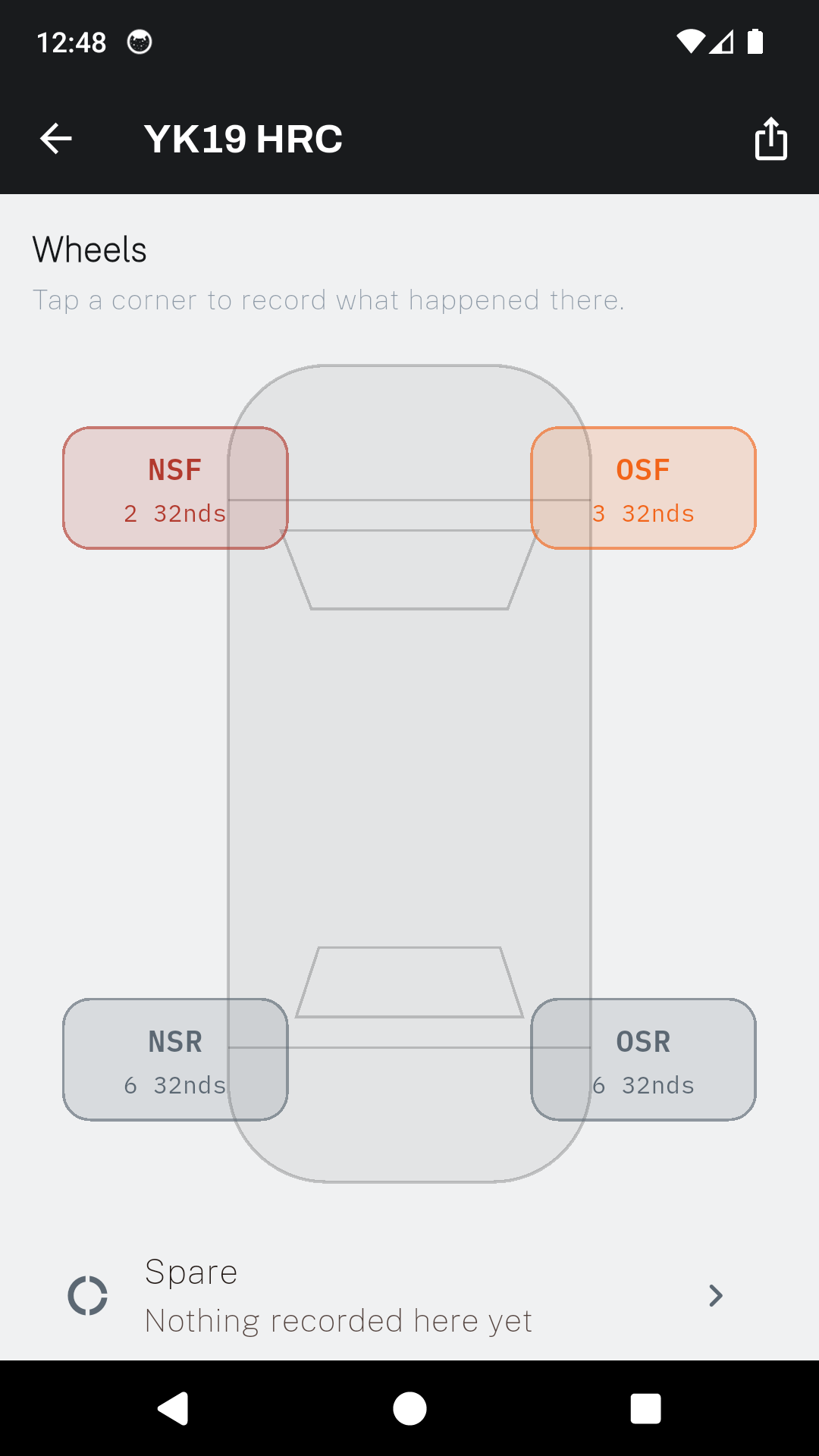
Tap a corner on the car, record what you found and what you did, photograph the wheel before you touch it, and have the customer sign. On the driveway, in the time the kettle takes.
- Tread depths off the wheels you took away
- The torque figure you used, and where it came from
- Photographs of the car before any work
The dispute in this trade repeats
The wheel was already kerbed. The locking nut was missing when you got there. The car pulls now and it did not before. Every mobile fitter has had at least one of those conversations, and every one of them is about a state the vehicle was in before the van arrived.
That is a record problem, not a fitting problem. TyreProof exists to make the record in the ten minutes when making it is easy.
One corner
What a wheel holds
Tap a corner and the whole of that wheel is on one screen. Nothing is required, so a pressure check is two taps and a full replacement is a minute.
What happened here
Replaced, repaired, rotated, inspected, or pressure only. One of five, per corner.
The tread that came off
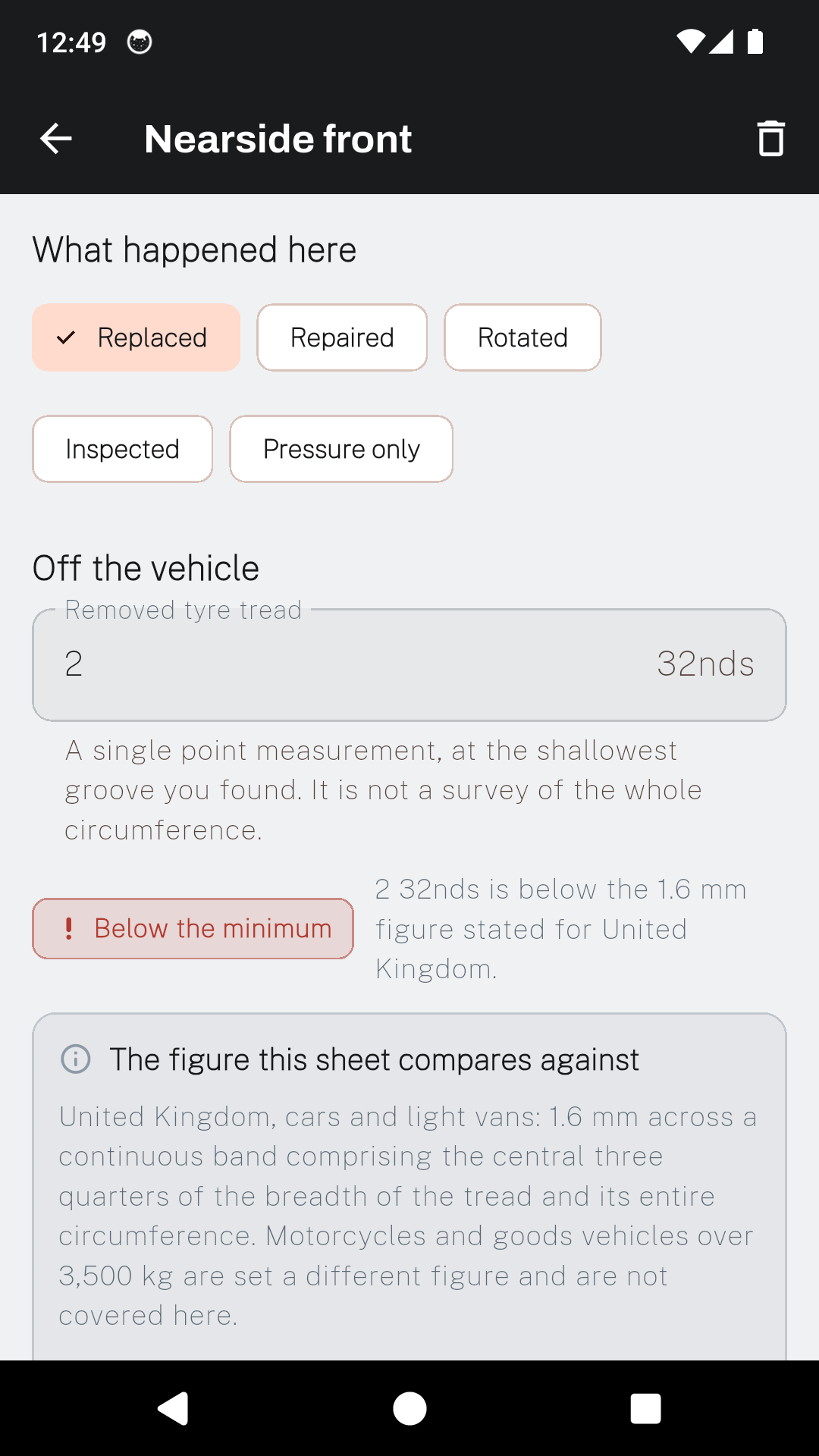
A single point measurement at the shallowest groove you found, compared against the figure for your region and never described as a survey of the whole circumference.
What went on
Brand, size and the four digit DOT code off the sidewall, recorded exactly as you read it.
What you set it to
The pressure, the torque figure you used and where it came from, and the charge for that corner if you price by wheel rather than by visit.
Tread
It names the figure, and it names the limits of the figure
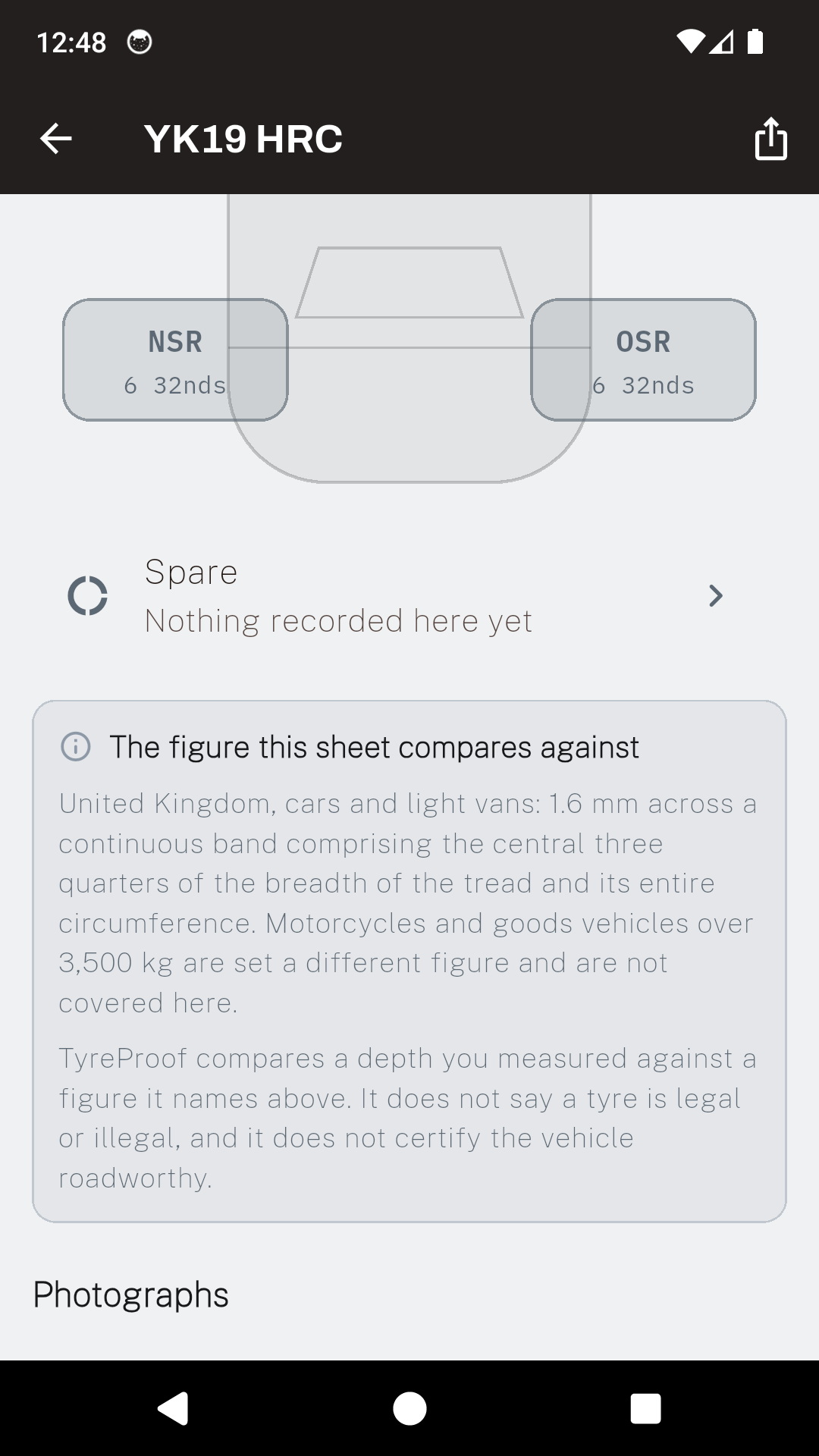
The engine has no pass and no fail in it. It reports where your reading sits against the figure for your region, prints the figure in full on the sheet, and leaves roadworthiness to somebody who can see the whole tyre.
No depth was recorded for this corner. It is a blank, not a pass.
The reading you took is above the figure the app names for your region.
Above it, but not by much. Worth saying out loud to the customer while you are there.
The reading is under the figure. The sheet says that, names the figure, and stops.
The half that usually gets dropped
The UK figure is 1.6 mm across a continuous band comprising the central three quarters of the breadth of the tread and its entire circumference. A tyre can hold 1.6 mm where you put the gauge and be under it a quarter turn further round, so the sheet prints the rule in full and the measurement field says the reading is a single point.
In the United States the app names two thirty seconds as the figure most states adopt, never as a federal minimum, and prints the caveat that two states set a lower one and seven set none.
The number it will not give you
There is no torque database in here
You type the figure you used and where you got it from. TyreProof will never suggest one, because specifications vary by vehicle, by wheel and by stud, and a wrong figure offered by an app is a wheel coming off somebody's car.
The same principle runs through the rest of it. The DOT code is stored exactly as you read it off the sidewall and never turned into a date. Pressure is what you set it to, not what a database thinks it should be. The app records the job; it does not have opinions about it.
Units
Your units, converted exactly once
Pressure in psi or bar, torque in newton metres or pound feet, tread in millimetres or thirty seconds. Set them once and the whole app follows, including the sheet the customer gets.
Every quantity has one canonical unit inside the app and is converted at the edge, so a figure never round-trips through two conversions and accumulates error into a number printed on a job sheet.
The UK defaults to psi rather than bar, because psi is what the placard says and what every forecourt gauge reads, whatever the metric answer would be.
The app
The real screens
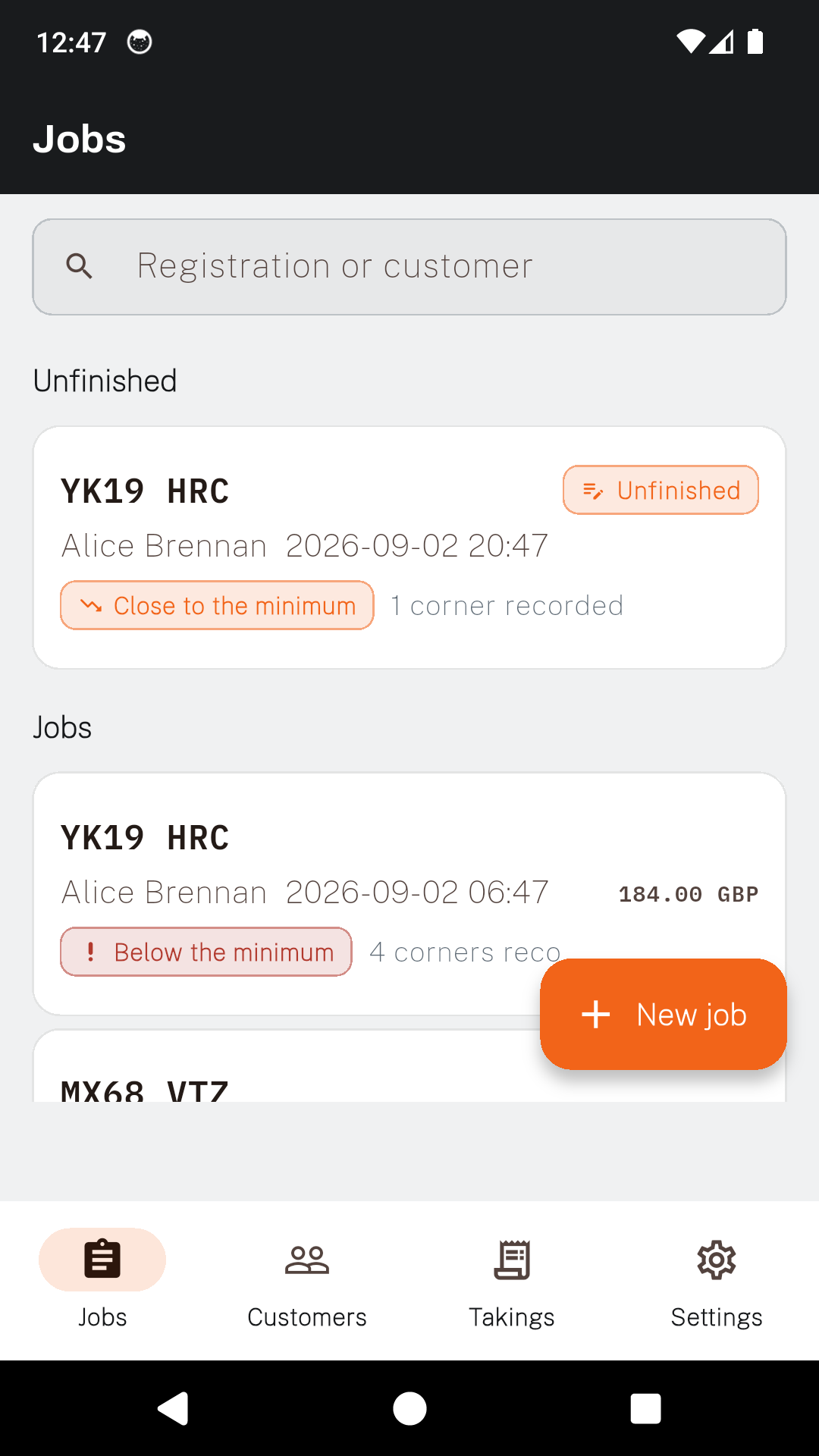
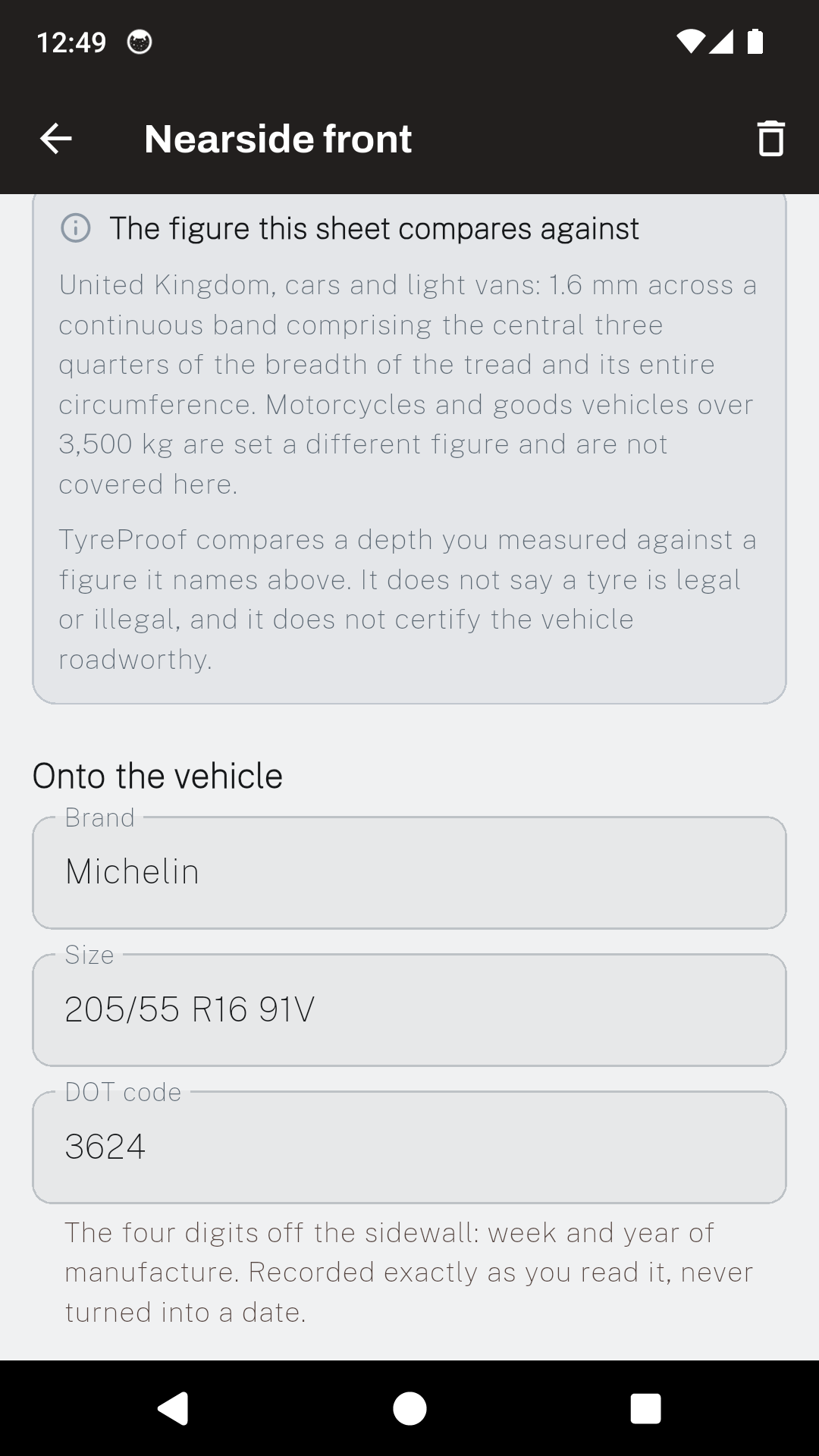
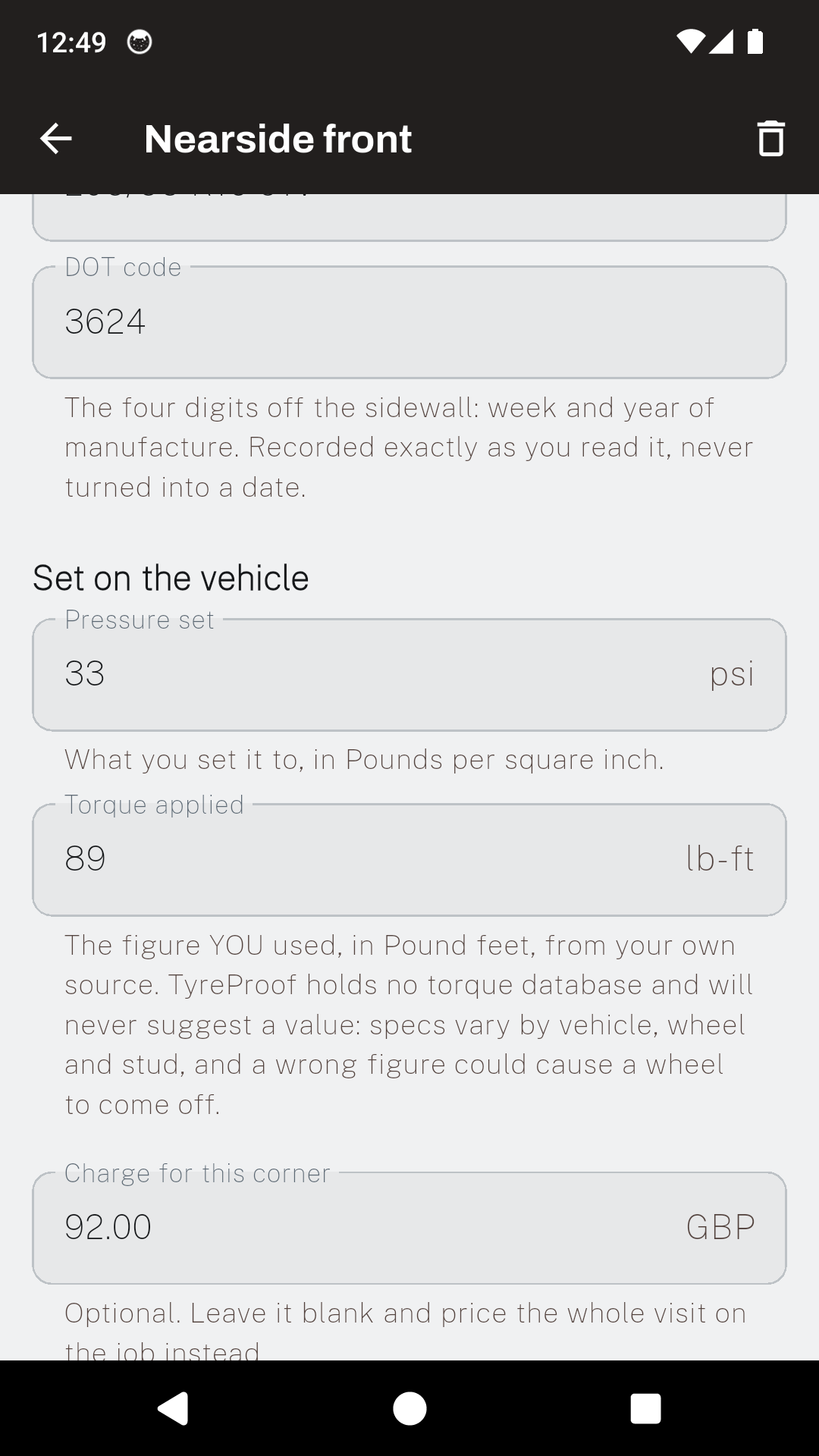
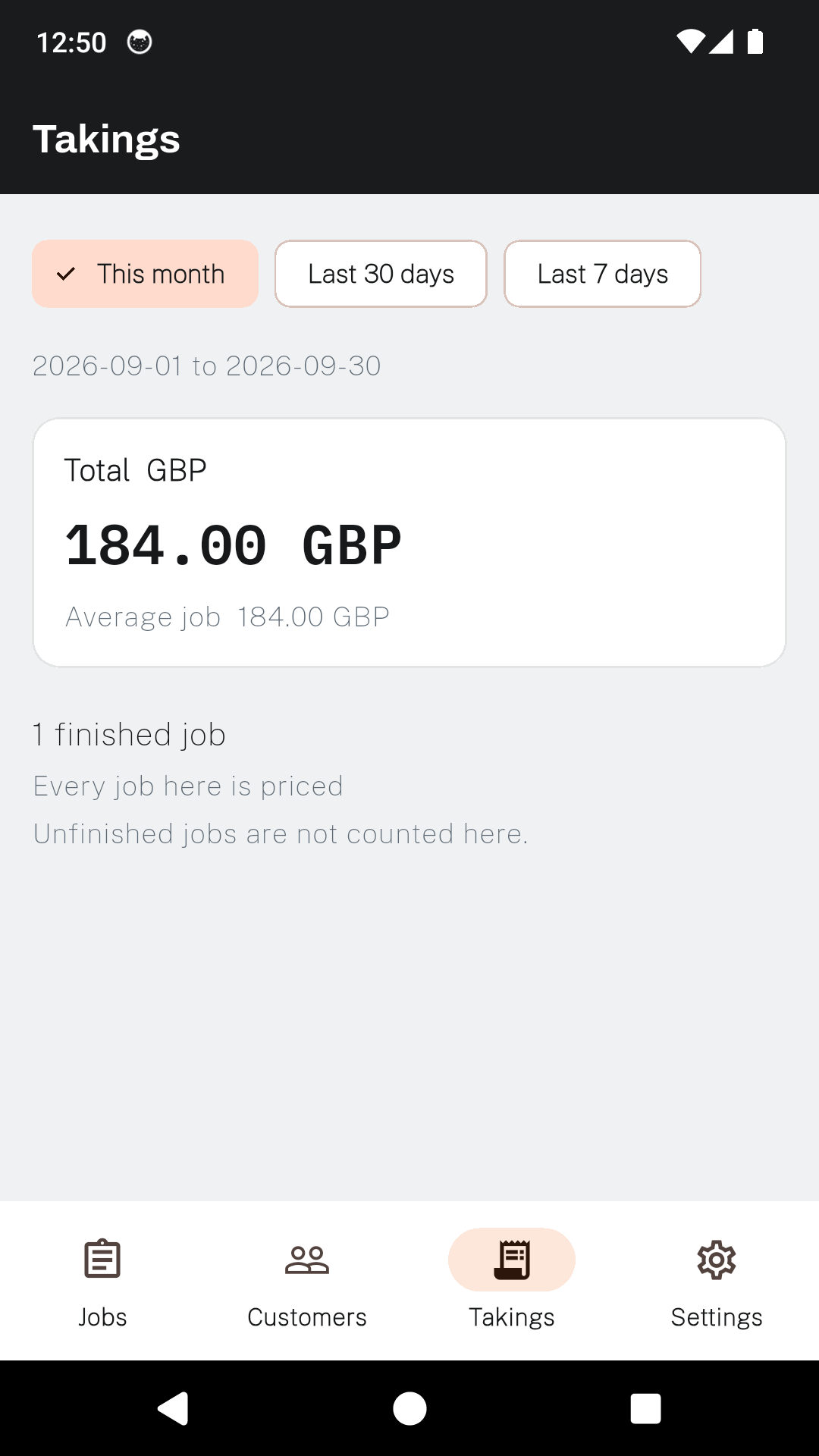
What it will not do
- It does not certify a vehicle roadworthy, and it does not call a tyre legal or illegal.
- It does not hold torque or pressure specifications for any vehicle.
- It does not cover motorcycles or goods vehicles over 3,500 kg, and it says so.
- It does not upload your jobs. There is no account and no sign-in. The app carries ads on the standard tier, plus crash reporting and analytics, so "nothing leaves the device" would be the wrong claim to make.
- It does not chase your invoices. Takings totals what you recorded and stops there.
Price
One van, one price
A 14-day trial you start yourself, with no card. Without paying you keep five jobs, and the cap applies only to starting a new one: nothing already recorded is hidden, locked or deleted.
Backup and restore is not behind the paywall. A year of job sheets is the reason you installed it.
Questions
Before you download it
Does TyreProof say whether a tyre is legal?
No. It reports that a depth you measured is above or below a figure it names, and it names where that figure comes from. There is no legal, illegal, pass or fail anywhere in the engine. Roadworthiness involves a vehicle class, a jurisdiction and the whole circumference of the tyre, and the app has none of the three.
What figure does it compare against in the United States?
Two thirty seconds of an inch, described as the figure most states adopt rather than as a federal minimum. There is no federal tread minimum for a private car: the 49 CFR figure everyone quotes binds commercial vehicles in interstate commerce. California and Idaho set a lower figure and seven states set none at all, and the sheet prints that caveat beside every US reading.
Is 2/32 in the same as 1.6 mm?
No, and treating them as the same is a real defect. Two thirty seconds is 1.5875 mm, so a tyre measured at exactly that figure is at the US minimum and below the UK one. TyreProof stores each region’s minimum in the unit that region legislates in and converts exactly at comparison time, so neither figure is ever a rounded copy of the other.
Will it tell me the torque for this wheel?
No, and it never will. TyreProof holds no torque database. Specifications vary by vehicle, wheel and stud, and a wrong figure could cause a wheel to come off. You record the figure you used and where you got it, which is what the job sheet needs to say anyway.
Does it use nearside and offside, or left and right?
Whichever your region uses. Underneath, each corner is stored as a physical position, so a record made on one setting means the same corner on any other. Nearside is the kerb side, which is the left in the UK and the right in a right-hand-traffic country, so storing the abbreviation would eventually flip left for right.
Which vehicles does it cover?
Cars and light vans. Motorcycles and goods vehicles over 3,500 kg are set a different tread figure in the UK, and rather than quote a car figure against a motorcycle tyre the app says plainly that they are not covered.
Write up the next driveway
Set your region and units once. After that a job is a registration, four corners and a signature.
Get it on Google Play