
Underground tank walkthrough log
Every 30 days, and the one that is not
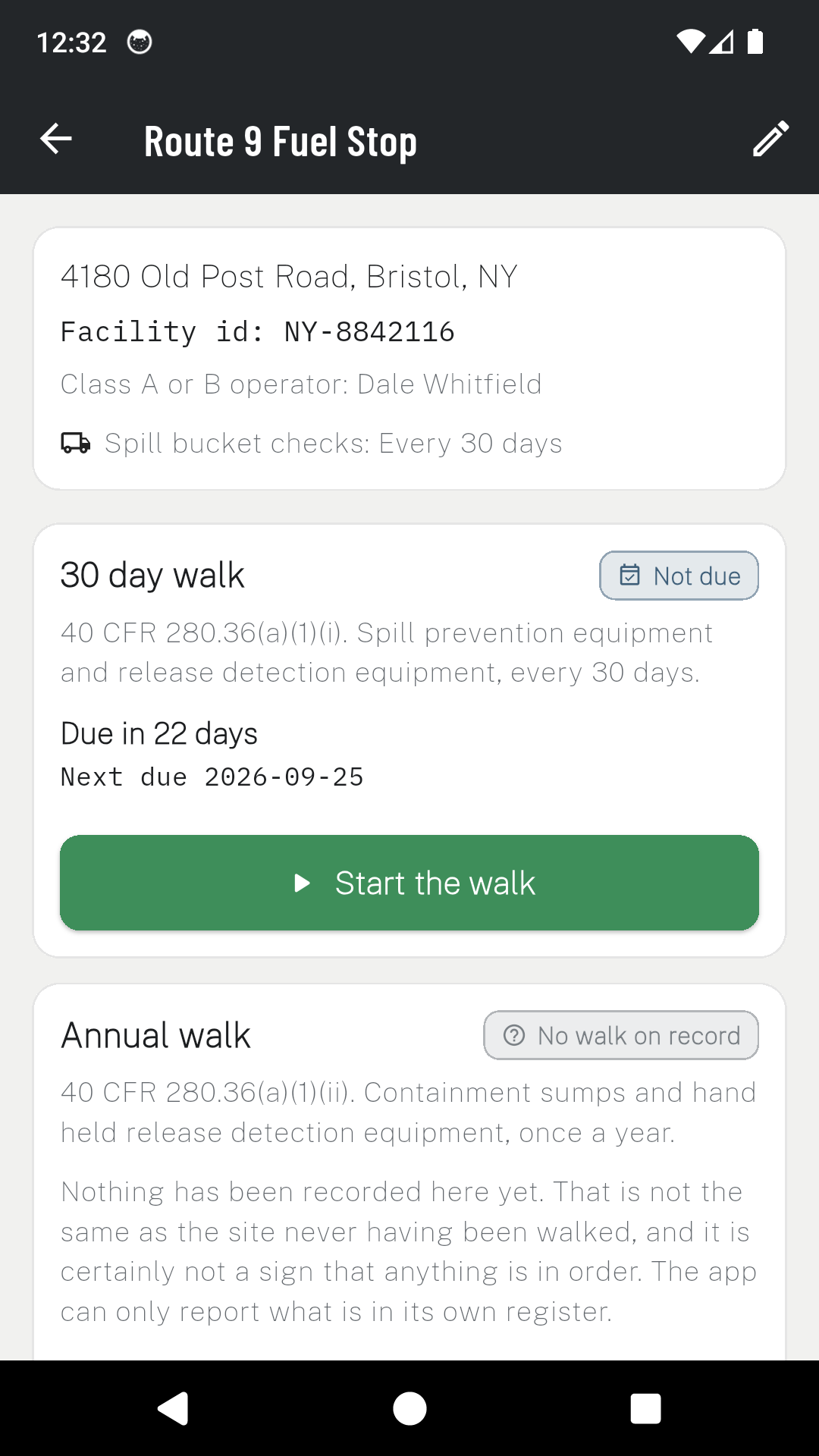
The walkthrough inspection is two duties on two clocks. USTCheck keeps them apart, carries the clause each item comes from, and has the year ready when somebody asks for it.
- A 30 day clock and an annual clock, per site, counted in days
- Every check carries the clause it is drawn from
- Problems carry onto the next walk until they are closed
The question is always the same
Show me the last twelve months. A folder in the office answers it if somebody kept the folder, and a phone photograph of a clipboard answers it badly.
USTCheck is built for the owner-operator with one site or a handful, who does the walk himself or sends the manager, and who has nobody to keep the folder for him.
The split
Two clocks, four items, four clauses
40 CFR 280.36 divides cleanly, and USTCheck divides with it. Each walk carries the scope it was performed under, and the two checklists are built from two different tables.
Thirty days is not a month. Twelve monthly walks leave eleven uncovered days in a year, so the clock counts days, and a walk on day 31 is recorded as late rather than fitted into a window the section does not give.
The walk itself
A route, not a form
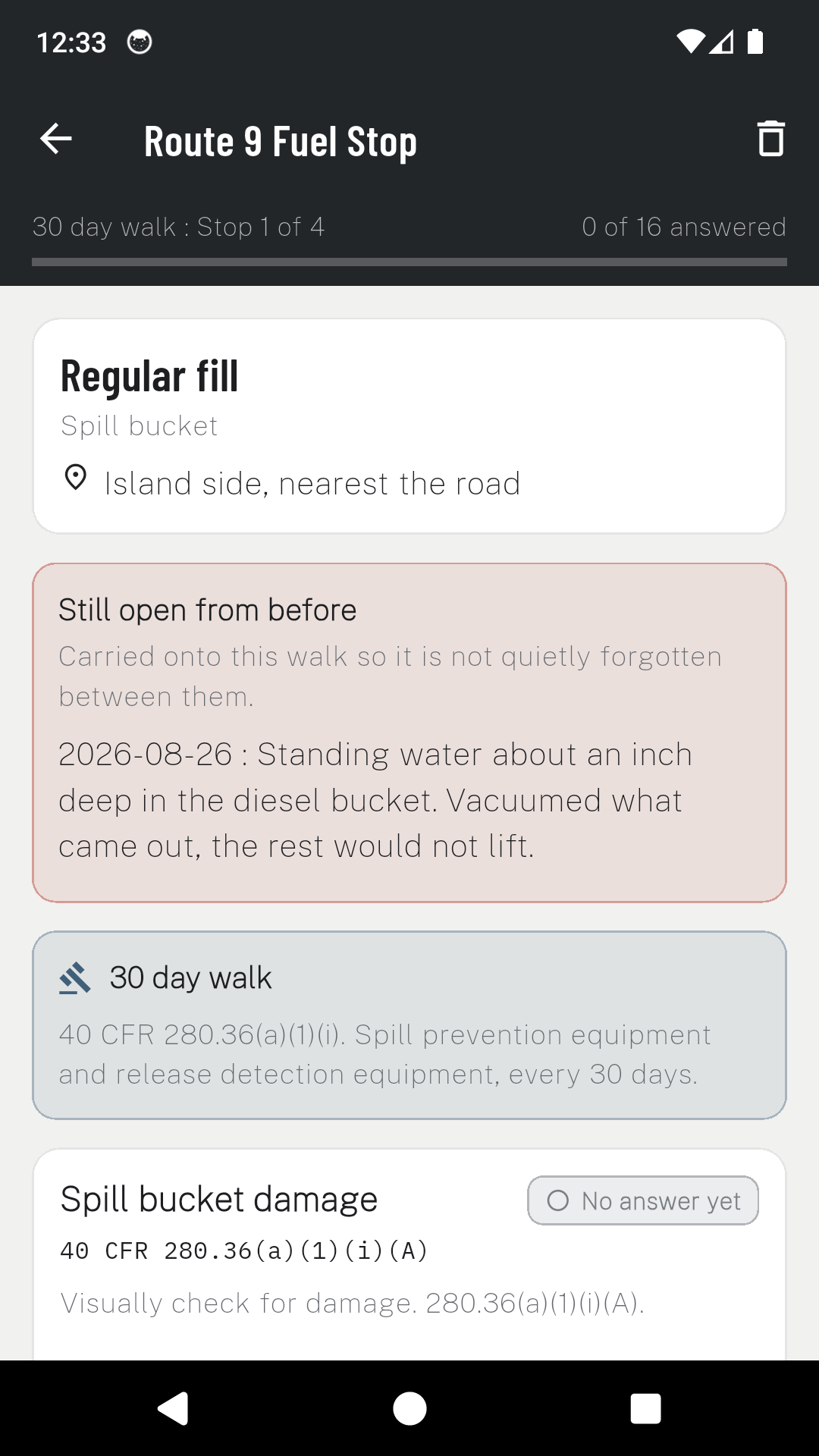
The walk is built from the assets you recorded, stop by stop: the fill points, the console, the sumps. The header counts the stops and the answers, so you can see what is left without scrolling for it.
Each item shows its own clause and the words the clause uses. The interstitial check only appears on equipment flagged as double walled, and it is not counted as unanswered on the equipment that is not.
A problem raised on an earlier walk is shown at the top of the stop it belongs to, with the date it was raised. It travels with the site until somebody closes it.
Three answers
And the third one is not a pass
Checked, nothing to report
You looked at it and there was nothing to write down.
Something to report
It opens a problem against the site, with a note and a photograph. The problem is carried onto the next walk until somebody closes it, so it is not quietly forgotten between them.
Could not check
The item was not examined. It is recorded as unexamined and it is never read as a pass, here or in the export.
Two names
Who walked, and who is responsible
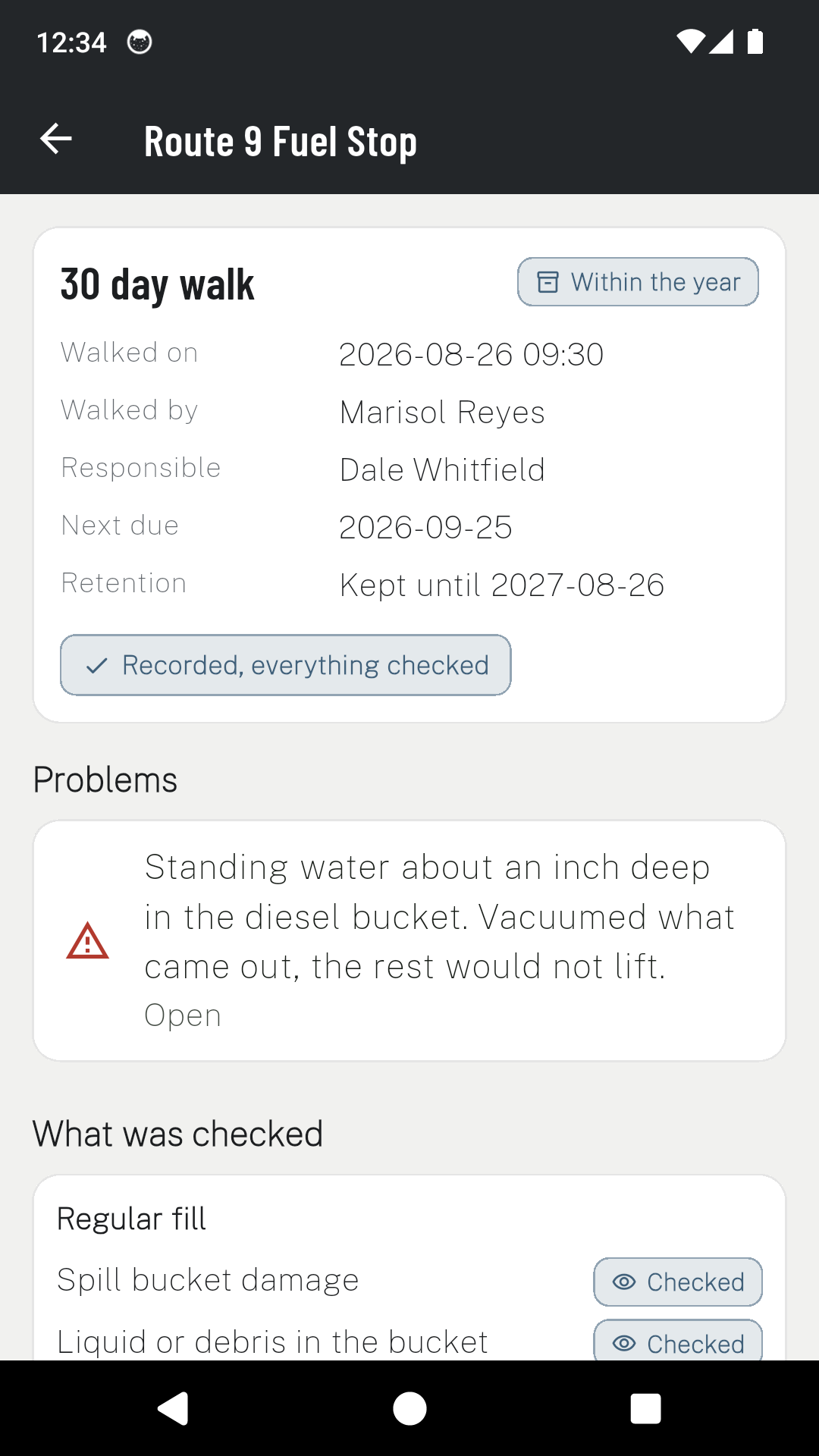
The section places the duty on owners and operators and never says who does the walking. So the record carries both: the person whose boots were on the forecourt, and the person the duty sits with. They are often not the same person, and the app does not pretend otherwise.
What it will not do is tell you who is allowed to perform the walk. Nothing in 280.36 or in the operator training section assigns it to a class of operator, so USTCheck does not either.
Retention
One year, and nothing deleted
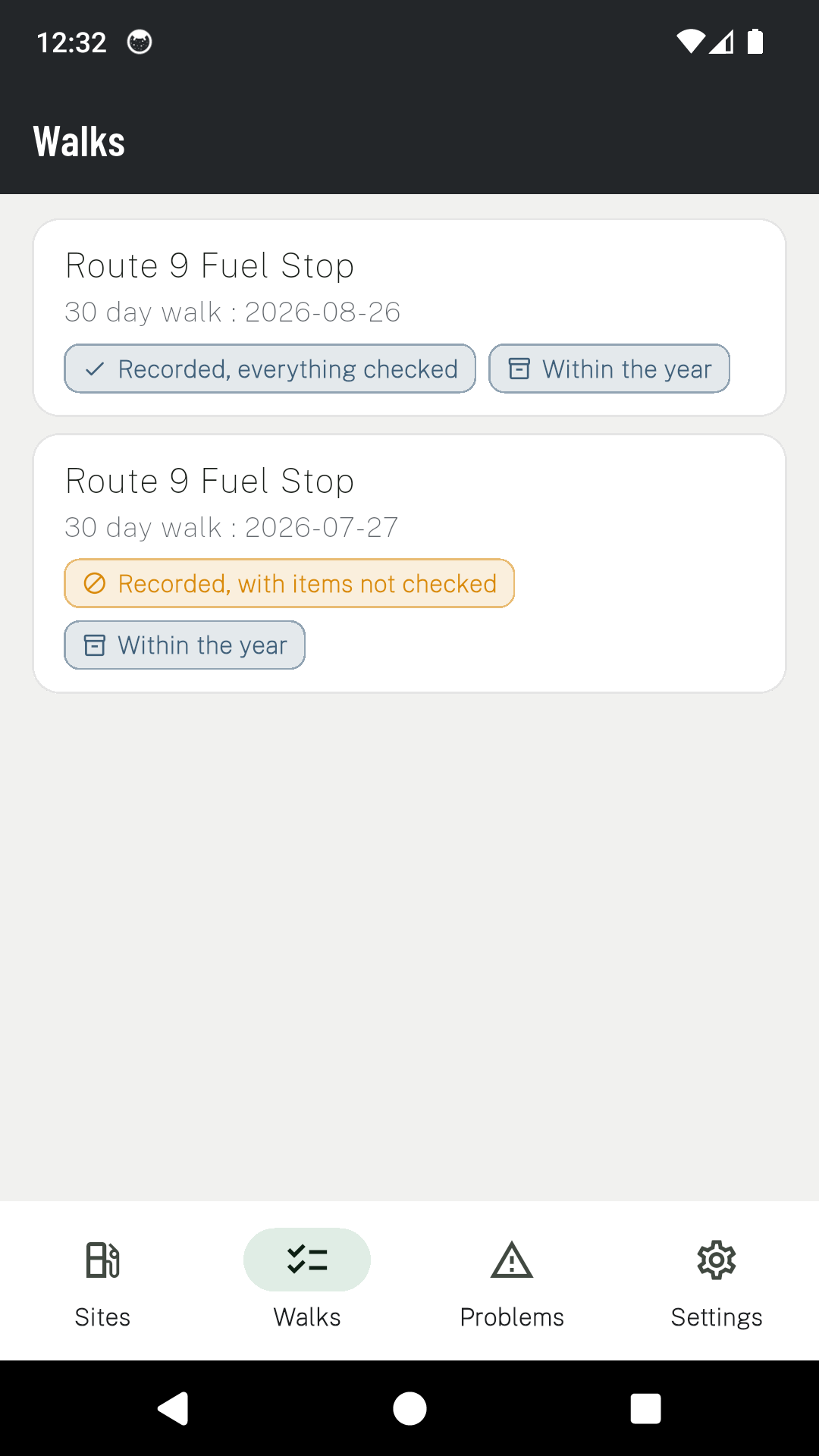
280.36(b) keeps walkthrough records for one year. USTCheck badges each walk with the date it passes that mark, and when it does, it offers you the export. It never deletes anything on its own.
The records this app does not hold
One year is not the retention period for the rest of the site file. Testing and inspection records for spill prevention equipment, containment sumps used for interstitial monitoring of piping, and overfill prevention equipment are kept for three years under 280.35(c)(1). That is a different obligation under a different section, USTCheck does not record it, and the app says so rather than letting a one year badge read as though it covered everything.
The export is not behind the paywall. 280.34(c) wants the record available at the site for the implementing agency, which is a poor moment to find out that a subscription has lapsed.
The app
The real screens
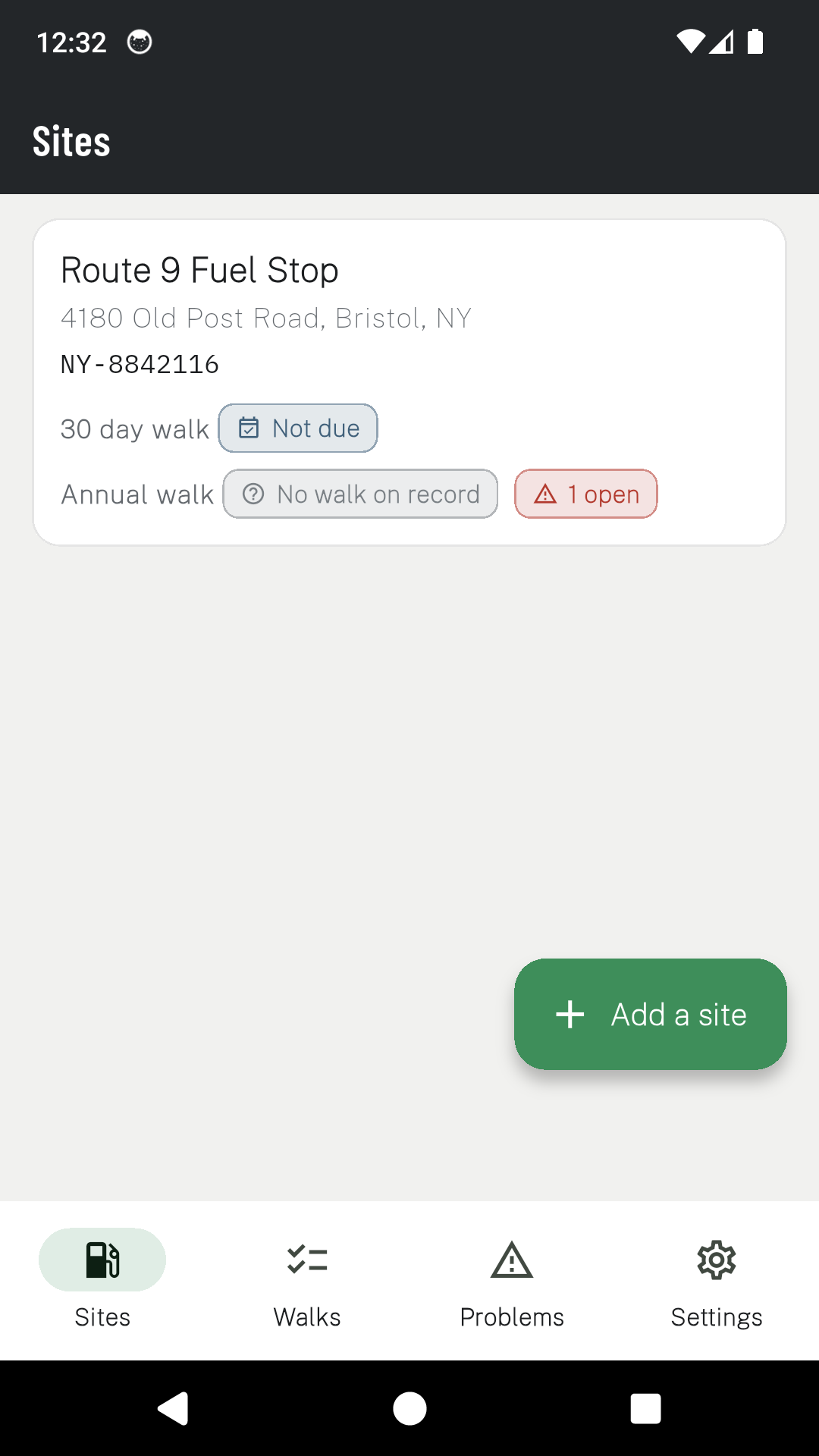
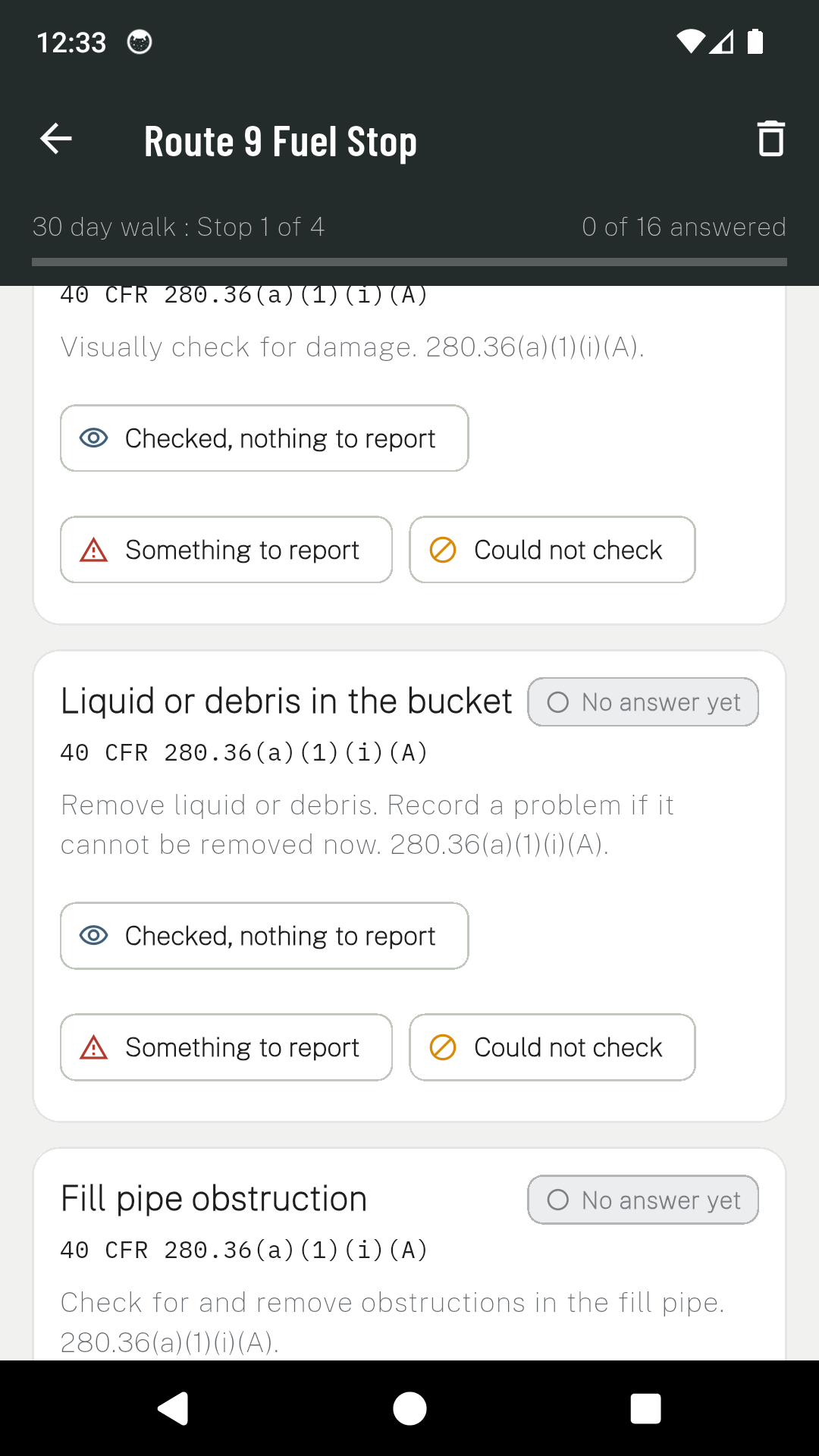
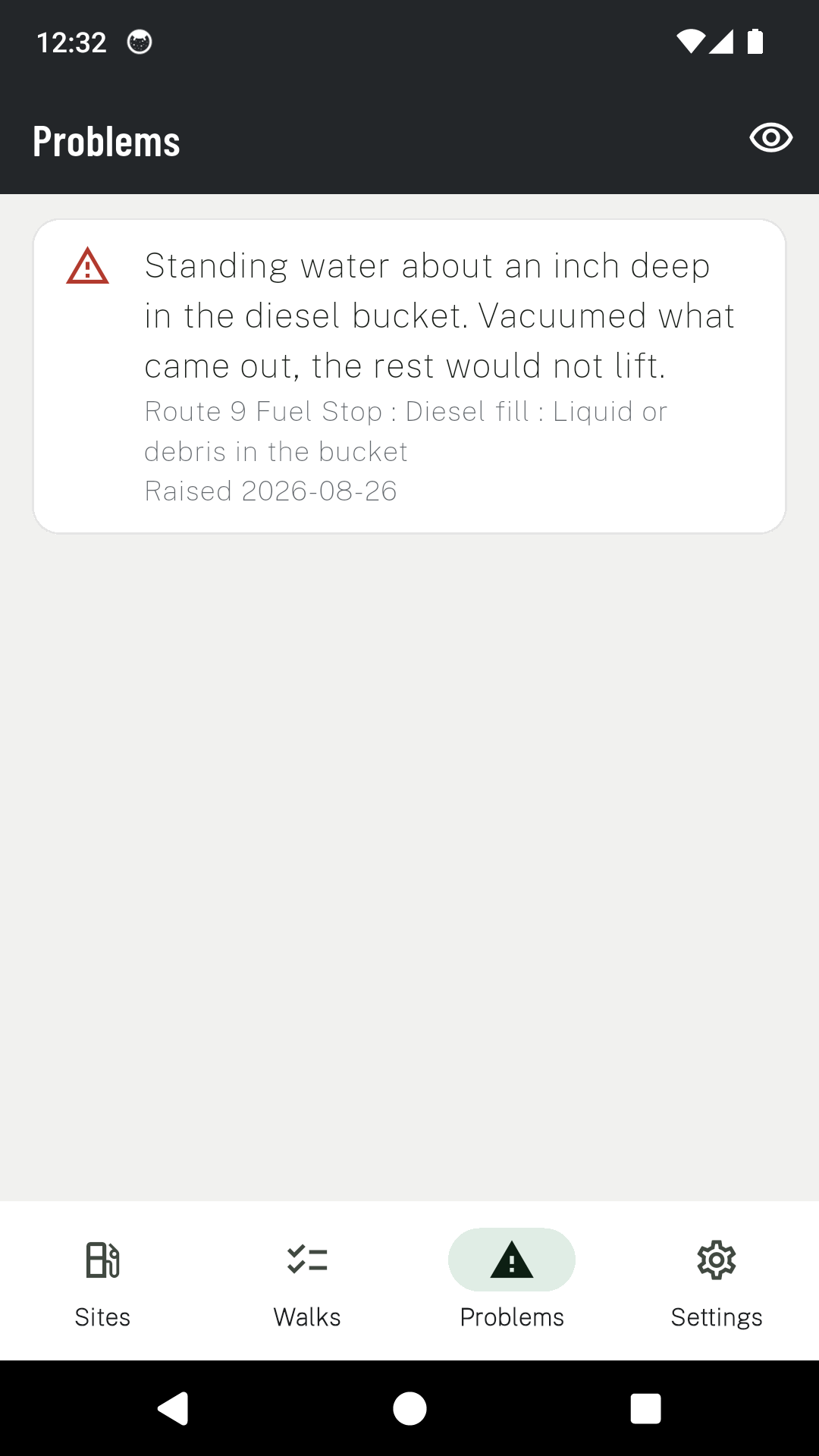
The line it does not cross
It records. It does not conclude.
The word compliant appears nowhere in the app, in any of its ten languages, and a test fails the build in each language against that language's own word for it. USTCheck never states that a site meets a rule, that a tank is sound, or that a release has or has not occurred.
A release detection alarm is recorded as observed and is never interpreted, because a suspected release carries reporting timelines that vary by state and the app must not imply it has handled that.
The federal checklist is also one of three lawful routes. 280.36(a)(2) allows a walkthrough run to a standard code of practice from a nationally recognised association, and (a)(3) allows one from the implementing agency. USTCheck's list is built from (a)(1), it says so, and it does not reproduce anybody else's copyrighted standard.
Price
One site, or a handful
A 14-day trial you start yourself, with no card. Without paying you keep one site and two completed walks, which is two months of the thing working before the gate arrives.
The cap applies only to completing a new walk. Nothing already recorded is hidden, locked or deleted, and the export is never paywalled.
Questions
Before you download it
Does USTCheck say whether my site is compliant?
No, and the word does not appear anywhere in the app in any of its languages. It records what the walker observed and when. Whether a site meets a rule is a judgement for the implementing agency and for you, and an app that made it would be asserting something it cannot know.
Why are dispenser sumps not on the 30 day list?
Because the regulation puts them on the annual one. 40 CFR 280.36(a)(1)(ii)(A) covers containment sumps, and a dispenser sump is a containment sump under the 280.12 definition. The 30 day list is spill prevention equipment and release detection equipment, and nothing else.
My site takes a delivery every six weeks. Does the walk move with it?
Only half of it. The exception in 280.36(a)(1)(i) names spill prevention equipment alone, so those buckets can be checked before each delivery. Release detection equipment has no exception at all, so its 30 day clock keeps running. USTCheck models the delivery cadence per site and applies it to the buckets only.
Does it carry my state programme?
No. A state may set a shorter interval, add items or require its own form, and no state figure could be verified from a primary source, so the app names none and says plainly that a state or tribal programme may require more.
How long does it keep a record?
One year from the day the walk was completed, which is what 280.36(b) asks for. Nothing is ever deleted automatically. Expiry moves a badge and offers the export, and that is the whole of it.
Who is supposed to do the walk?
The regulation does not say, so neither does the app. 280.36 places the duty on owners and operators and is silent on who physically walks the site. USTCheck records who walked and, separately, who is responsible, because those are often two people.
Start the clock on the next walk
Enter the site and its assets once. After that the app knows what is due, when, and under which clause.
Get it on Google Play