WIND SPEED LIMIT

BounceLog icon

BounceLog

Wind speed limit

Twenty-four miles an hour, and what to do with the number.

Wind is the only reading on a pre-use check that can call the day off, so it is worth knowing exactly where the line sits, what a reading of 24 counts as, and what the paperwork ends up saying. BounceLog does the Beaufort conversion the moment you type the speed in.

14-day trial, then £1.99/mo,
£9.99/yr or £24.99 once. Android.

  • BS EN 14960
  • AS 3533.4.1
  • Beaufort conversion
  • Per hire
  • Works offline
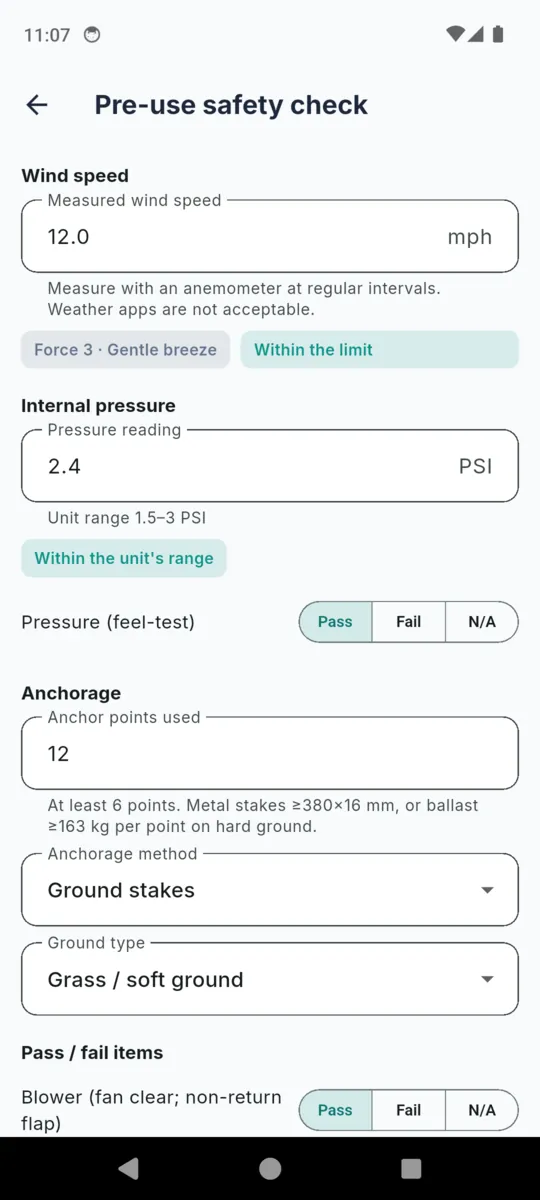
The Pre-use safety check form in BounceLog: a measured wind speed of 12 mph with Force 3 Gentle breeze and Within the limit chips, an internal pressure of 2.4 PSI within the unit range, and 12 anchor points on grass with ground stakes

Where the 24 comes from, and where it stops

BounceLog carries one wind figure per standard, and you pick the standard in Settings. It is a figure the app applies to your reading — it is not the app's judgement, and it does not override your unit's operating manual.

BS EN 14960

24 mph

The per-hire wind figure the app uses on the UK and European setting, alongside a minimum of six anchor points. Type in a reading at or above 24 and the wind row turns into a warning that reads: over the BS EN 14960 limit, do not operate. Below it, the row reads simply within the limit.

AS 3533.4.1

No numeric limit

Switch to the Australian and New Zealand setting and BounceLog shows no figure at all, because there is no single national number to show. It still records the reading, still converts it to a Beaufort force, and still expects six anchor points. Your state rules and the manufacturer decide the rest. Showing an invented number here would be worse than showing none.

Both figures are what the app applies to a reading you took. They are general operator guidance, not legal advice, and BounceLog does not certify that any hire meets BS EN 14960, AS 3533.4.1 or HSE guidance. The published standard and the manufacturer's operating manual govern, and the decision to put a unit up is yours.

What happens right on the line

The comparison is at-or-above, not above. A reading of exactly 24 mph is treated as over the limit, and the warning fires. There is no rounding in your favour, and no grace of a decimal place.

The Beaufort conversion works the other way at the same boundary, which is worth understanding if the two chips ever look like they disagree. Twenty-four mph is the top of force 5, so a reading of exactly 24 shows as Force 5, Fresh breeze — and as over the limit. Force 6 starts at anything above 24. Both statements are correct; they are just answering different questions.

The bands below are exactly the ones the app computes. Each runs from just above the previous figure up to and including its own.

F0

up to 1

Calm

F1

over 1, up to 3

Light air

F2

over 3, up to 7

Light breeze

F3

over 7, up to 12

Gentle breeze

F4

over 12, up to 18

Moderate breeze

F5

over 18, up to 24

Fresh breeze

F6

over 24, up to 31

Strong breeze

F7

over 31, up to 38

Near gale

F8

over 38, up to 46

Gale

The scale continues to force 12. Nobody is putting an inflatable up in any of it, but the app converts whatever you enter rather than capping the display.

How to get a reading worth recording

The form is blunt about this, and the instruction sits under the field where you cannot miss it: measure with an anemometer at regular intervals, and weather apps are not acceptable.

The reason is the gap between a forecast and a site. A regional forecast describes the town, not the corner of a garden between two houses where the gust funnels through, and it describes the hour rather than the moment. A handheld anemometer costs less than one cancelled hire, and it produces a number you can defend.

At regular intervals matters as much as the instrument. One reading at setup says nothing about three in the afternoon, which is why the handover the hirer signs includes a line about keeping within the wind limit and stopping if it gets windy, and another about deflating and calling if the weather turns. The reading records the moment; the handover covers the rest of the day.

What ends up on the record

One line in the audit pack

The exported PDF prints the speed, the Beaufort force and its name, then states whether the reading was within or over the limit for the standard you picked. A hire with no reading taken prints Not recorded rather than being left blank.

A chip on the hire

The hire itself carries the wind reading and its force alongside the pressure and the anchorage, so you can see what the conditions were without opening the check.

Anchorage, checked separately

Six points is the minimum on both standards, and the form guides at least six with metal stakes of 380 by 16 mm or more, or ballast of 163 kg or more per point on hard ground. Enter fewer and it says so.

Wind is one of nine

The check counts as nine things: wind, pressure, anchorage, and six pass or fail items — blower, visual damage, impact mats, electrical and RCD, deflation on power loss, and trained supervision. The counter reads a neutral number recorded, never all safe.

Per hire, not per unit

The reading belongs to the hire, because the weather does. The same castle at the same address next month gets its own check and its own number.

All on the phone

Units, hires, checks, handovers and photos stay on the device. No account, no signal needed in a field, and nothing leaves unless you share the pack yourself.

The rest of the pre-use check, the signed handover and the audit pack are on the BounceLog app page.

Why record the number at all

  • It is the reading that cancels hires. Worth having written down, with a time on it.
  • The conversion is instant. Type the mph, read the force back without a chart.
  • The boundary is not fudged. At the limit counts as over, every time.
  • No number is invented. Where a standard sets no figure, the app shows none.
  • It carries onto the paperwork. Speed, force and within or over, in the audit pack.
  • The call stays yours. The app warns and records; it does not decide.

Questions

What is the wind speed limit for a bouncy castle?

On the BS EN 14960 setting BounceLog uses 24 mph, and warns you at or above it. That figure comes from the standard, not from the app, and the manufacturer’s operating manual for your unit always governs.

Is 24 mph allowed, or is it already too much?

The app treats 24 mph itself as over the limit, not within it, because the comparison is at-or-above. Twenty-four is also the top of Beaufort force 5, so a reading right on the line shows as Fresh breeze and as over at the same time.

Can I use a weather app for the reading?

The form says not to. Its own instruction is to measure with an anemometer at regular intervals and that weather apps are not acceptable, because a forecast for the town is not the wind in that garden.

What is the limit in Australia and New Zealand?

On the AS 3533.4.1 setting BounceLog shows no numeric limit, because there is no single national figure to show. It still records your reading and its Beaufort force, and still expects at least six anchor points.

Does the wind reading appear on the paperwork?

Yes. The audit pack prints the speed, the Beaufort force and its name, and whether it was within or over the limit for the standard you selected. If you did not take a reading it prints Not recorded.

Does the app stop me operating in high wind?

No, and it does not pretend to. It shows a warning, records what you measured, and puts that on the record. Calling the hire off is your decision as the operator.

How many anchor points does the app expect?

Six on both standards. The form’s guidance is at least six points, with metal stakes of 380 by 16 mm or more, or ballast of 163 kg or more per point on hard ground.

BounceLog helps you record your own pre-use safety checks and handover for each hire. It is a record-keeping tool — it is not a safety inspection, does not certify that any inflatable is safe to use, and does not replace the annual inspection by a competent person (PIPA / RPII / ADiPS). You are responsible for following BS EN 14960 / AS 3533.4.1 and HSE guidance, for your anchorage and wind-speed decisions, and for the accuracy of every record. Always check the manufacturer’s operating manual.


Try it on this weekend's first hire

Take the reading, type it in, and let the record hold the number and the force for you.