BAKE TIMELINE CALCULATOR
BreadMath
Bake timeline planner
Work out what time to start so the bread is out when you want it.
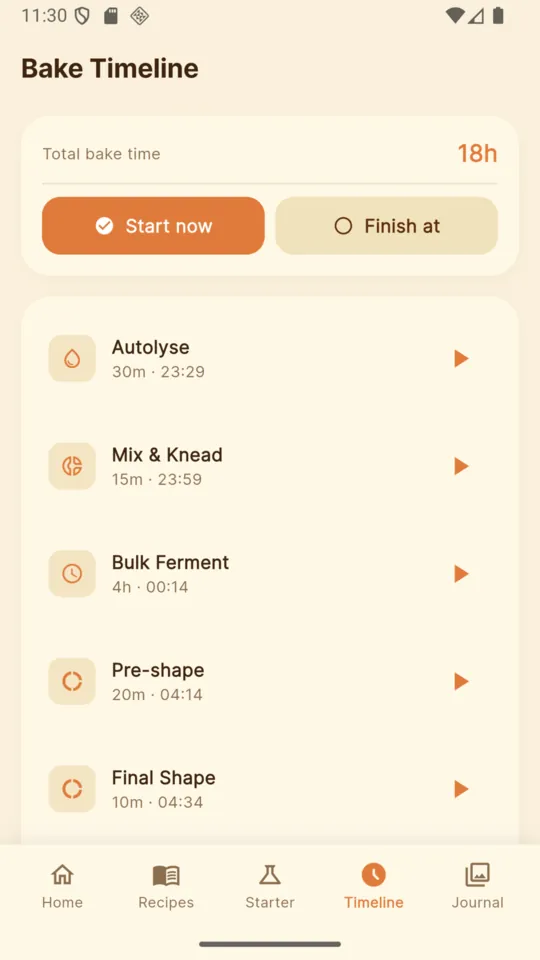
The timeline is seven steps that add up to 18 hours, each with its own length and its own clock time. Read it forwards from the moment you begin, or count the same chain backwards from the hour the loaf should leave the oven.

Free to use. $4.99 one-time unlock.
Android.
Where the 18 hours go
Most of a sourdough bake is waiting, and nearly all of the waiting sits in two places: the four-hour bulk ferment and the twelve-hour cold proof. Everything you actually do with your hands adds up to under two hours. Seeing it laid out is what makes the day plannable.
| Step | Length | Starts this long before the loaf is out |
|---|---|---|
| Autolyse | 30m | 18h 00m |
| Mix and knead | 15m | 17h 30m |
| Bulk ferment | 4h | 17h 15m |
| Pre-shape | 20m | 13h 15m |
| Final shape | 10m | 12h 55m |
| Cold proof | 12h | 12h 45m |
| Bake | 45m | 45m |
| Total | 18h |
The right-hand column is the one to plan with. Bake is the last 45 minutes, the cold proof is the 12 hours before that, and the whole chain begins 18 hours out.
Counting back from the hour you want bread
Working backwards is one subtraction. Take 18 hours off the time you want the loaf on the rack and that is when the flour and water go in the bowl. For bread out at nine in the morning, you start at three the afternoon before, and the dough goes into the fridge at quarter past eight that evening.
| Time | What is happening |
|---|---|
| 15:00 | Autolyse — flour and water in the bowl |
| 15:30 | Mix and knead |
| 15:45 | Bulk ferment begins |
| 19:45 | Pre-shape |
| 20:05 | Final shape |
| 20:15 | Into the fridge for the cold proof |
| 08:15 | Oven on, loaf in |
| 09:00 | Bread out |
The overnight fridge stretch is doing the heavy lifting here. It is also the step that lets you move the finish: an hour later in the fridge is an hour later out of the oven.
The two modes
The screen has two pills above the list. Start now stamps every step with a clock time running forward from the moment you begin, which is what you want once the flour is already in the bowl. Finish at reverses the arithmetic and lays the same seven steps out counting backwards instead. The lengths and the 18-hour total do not change between them; what changes is which end of the chain the clock is anchored to.
The seven steps and their lengths are fixed. That is deliberate — it is a plan you read a start time off, not a recipe editor. A four-hour bulk and a twelve-hour cold proof are ordinary room-temperature figures; a warm kitchen will get there sooner, and the dough, not the clock, has the final say.
Timing a step as you go
Every row has a play button. Tapping it starts a stopwatch for that step and ticks the step off once the elapsed time reaches its length, with a strike through the name so you can see at a glance where you are. A button under the list marks the running step done and starts the next one, which is the quickest way through a shaping session.
The stopwatch runs on the timeline screen rather than in the background, so treat it as a kitchen clock rather than an alarm. The part of BreadMath that does send notifications is the starter feeding calculator, which will wake you for the jar but not for the oven.
What the timeline is good for
- The whole chain on one screen. Seven steps, 18 hours, a clock time against each.
- Read it either way round. Forwards from now, or backwards from the finish.
- A stopwatch on every step. Tap play and it ticks the step off at its length.
- Nothing to load. The arithmetic happens on the phone, signal or not.
- No account. No sign-up, no email address, no password.
- Ten languages. The step names travel with the rest of the app.
Questions
How long does a sourdough loaf take from start to finish?
BreadMath's default chain runs 18 hours: 30 minutes autolyse, 15 mixing, 4 hours bulk ferment, 30 minutes shaping, 12 hours cold proof and 45 minutes in the oven.
What time should I start to bake tomorrow morning?
Take 18 hours off the time you want it out. For a nine in the morning loaf, mix at three the afternoon before, and the dough goes into the fridge at quarter past eight.
What does the Finish at button do?
It reverses the timeline, laying the same seven steps out counting backwards rather than forwards. The step lengths and the 18-hour total stay exactly the same.
Can I change how long each step takes?
No. The seven steps and their lengths are set. They are a plan to read a start time off rather than a recipe you edit.
Do the step timers alert me if I leave the app?
No. Each step has a stopwatch that runs on the timeline screen. Starter feeding reminders are the part of BreadMath that sends notifications.
Does the timeline work offline?
Yes. It is arithmetic on your phone, with nothing to load. A connection is only used to serve ads in the version you have not paid for.
Plan the next loaf backwards
Pick the hour it should come out of the oven, take 18 off, and you have the evening you need to give it.