STARTER FEEDING CALCULATOR
BreadMath
Starter feeding calculator
What a 1:2:2 feed means, and what to put on the scale.
A feeding ratio is three numbers by weight: ripe starter, flour, water. BreadMath keeps the four common ones on chips and works out the grams for whatever size jar you are building, so nothing gets divided in your head at seven in the morning.

Free to use. $4.99 one-time unlock.
Android.
How a feed is worked out
The three numbers are parts by weight, never volume. The first is the ripe starter you already have, the second is the fresh flour, the third is the water. So 1:2:2 is one gram of old starter for every two grams of flour and two grams of water. Flour and water are equal in all four ratios, which is why a 100% hydration starter stays at 100% whichever one you pick.
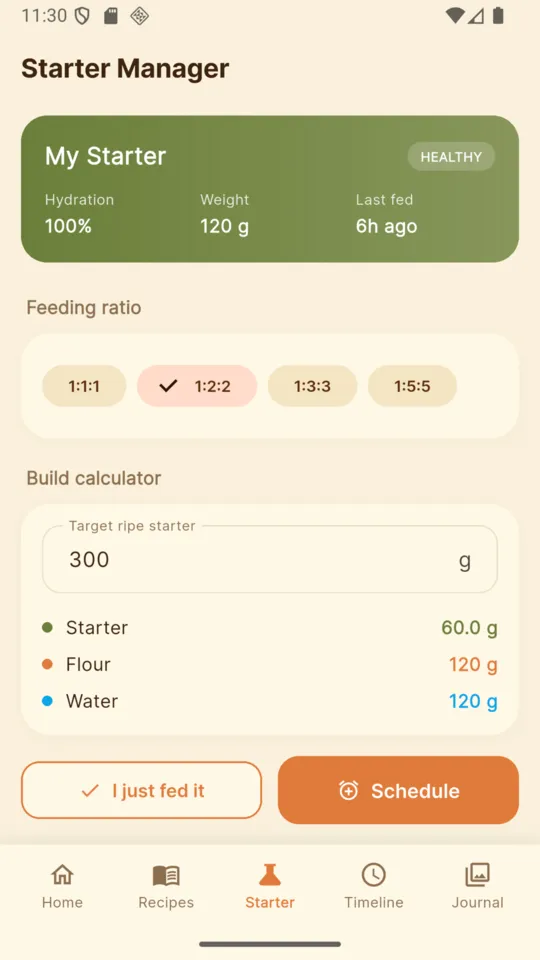
- 1 Decide how much ripe starter you want at the end. BreadMath calls this the target and starts you at 300 g. Type over it with whatever your recipe and your jar need.
- 2 Add the three ratio numbers together to get the number of parts. 1:2:2 is five parts, so one part of a 300 g build is 60 g.
- 3 Multiply each ratio number by that part. 60 g of ripe starter, 120 g of flour, 120 g of water. That is what the build calculator shows the moment you type 300.
| Ratio | Parts | Starter | Flour | Water |
|---|---|---|---|---|
| 1:1:1 | 3 | 100 g | 100 g | 100 g |
| 1:2:2 | 5 | 60 g | 120 g | 120 g |
| 1:3:3 | 7 | 42.9 g | 128.6 g | 128.6 g |
| 1:5:5 | 11 | 27.3 g | 136.4 g | 136.4 g |
Change the target and every figure in the row moves with it. The totals always come back to the number you typed.
Why the ratio changes how long it takes
The real difference between those rows is how much fresh flour each gram of culture has to get through. A 1:1:1 feed hands it one gram of flour per gram of starter; 1:5:5 hands it five. More food means a longer climb, so a wide ratio peaks later than a tight one at the same temperature. Warmth pulls the whole thing forward and a cold kitchen pushes it back.
That is why bakers pick the ratio to fit the gap they have rather than always feeding the same way. 1:1:1 for a starter you want ripe by the afternoon, 1:5:5 to leave it overnight without it peaking and sinking before you get to it.
BreadMath does not guess when your starter will peak, and it will not pretend to. You pick the interval you want to be reminded at and it holds you to that.
Keeping the jar on a schedule
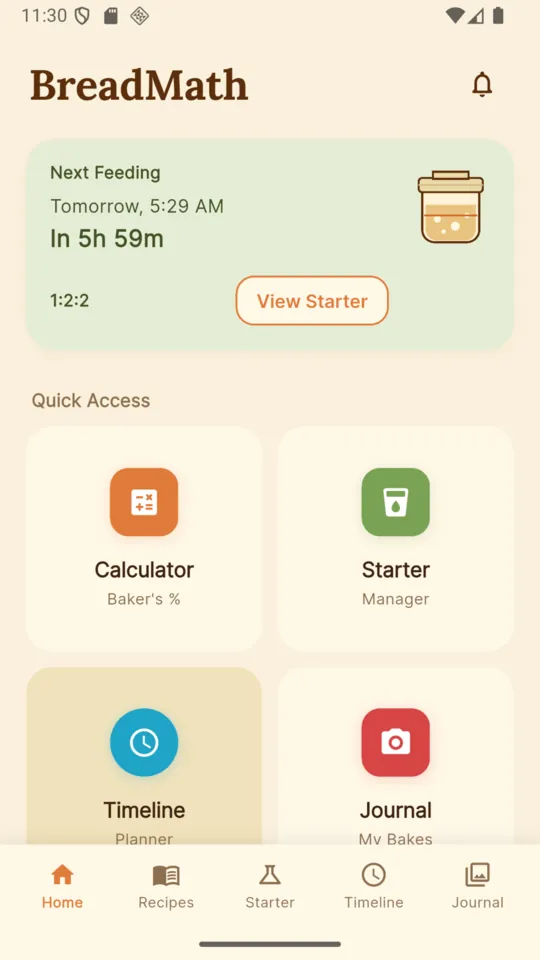
The Schedule button on the starter screen opens the reminder side. Choose an interval of 4, 6, 8, 12 or 24 hours and the next feeding is set that far ahead; the home screen counts down to it and shows the ratio it is set to. Tapping I just fed it writes the feed into the log with its ratio and its grams, and pushes the next reminder forward by the same interval. The last few feeds stay on screen underneath.
There is a Pause for fridge switch for the weeks the jar is cold. It cancels the pending reminder rather than buzzing at you through a fortnight in the door. Reminders are part of the $4.99 unlock; the ratio chips, the build calculator and the feeding log are free.
What the calculator is actually for
- Grams, not guesswork. Type the target and the three weights land underneath it.
- Four ratios on chips. 1:1:1, 1:2:2, 1:3:3 and 1:5:5, one tap apart.
- Your jar, your interval. 4, 6, 8, 12 or 24 hours, chosen by you and not by the app.
- Fridge weeks are handled. One switch pauses the reminder until the jar comes back out.
- A record of what you fed. Every log keeps its ratio and its flour and water weights.
- No signal needed. The arithmetic and the log both sit on the phone.
Questions
What does a 1:2:2 starter feed mean?
One part ripe starter, two parts flour, two parts water, all by weight. On a 300 g build that comes out at 60 g of starter, 120 g of flour and 120 g of water.
How do I work out the grams myself?
Add the three ratio numbers together, divide your target weight by that total, then multiply each number by the answer. BreadMath does the same arithmetic as you type.
Which feeding ratio should I use?
A bigger ratio gives each gram of starter more fresh flour to get through, so it takes longer to peak. Bakers reach for 1:1:1 to bake the same day and 1:5:5 to stretch a feed overnight.
Does BreadMath tell me when my starter is ready?
No. It does not predict rise time. You choose a reminder interval of 4, 6, 8, 12 or 24 hours and the app prompts you at the end of it.
What happens when the jar goes in the fridge?
Turn on Pause for fridge and the pending reminder is cancelled. Switch it off when the jar comes back out, then tap I just fed it to start the next interval.
Is the feeding calculator free?
Yes. The ratio chips, the build calculator and the feeding log cost nothing. Reminders are part of the one-time $4.99 unlock, which also removes the ads.
Feed the jar without the mental arithmetic
Pick a ratio, type the weight you want to end up with, and read the three numbers off the screen.