CAT & TNR COLONY TRACKER

CatColony icon

CatColony

Cat & TNR Colony Tracker

Which ear was tipped, and was she done in August or the August before?

CatColony is the notebook for cats you feed but do not own. It holds the ear tip, the spay date, the vaccination that is coming due, who fed whom on Tuesday, and the trapping round you are halfway through.

Fourteen days of everything.
No card required.

  • Pets
  • Android
  • Works offline
  • No account
The CatColony launch screen: three cats on a deep teal field, the wordmark, and the line Track every cat in your colony

Two different jobs, one toggle apart

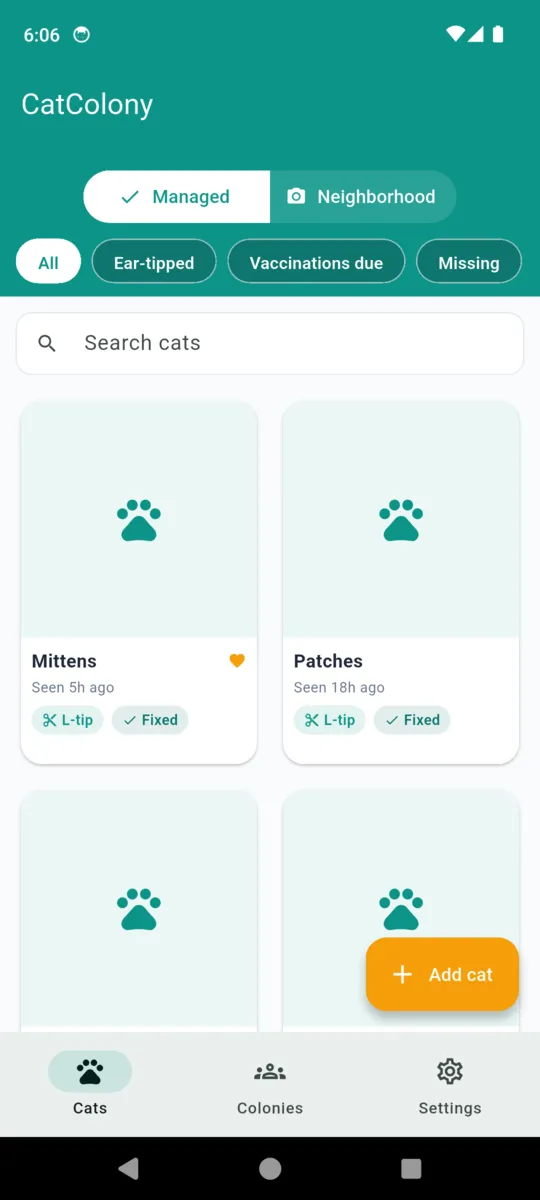
The switch at the top of the cats tab decides which kind of record you are keeping. Almost everyone ends up using both.

MANAGED

A colony you look after

Cats attached to a place — the bakery yard, the allotment, the parking lot behind the depot. They get the full record: ear tip, spay or neuter state and date, microchip, next vaccination due, medical history, feeding logs, observations and photos. This is the mode the statistics and the PDF are built for.

Free tier: one colony, five managed cats.

NEIGHBORHOOD

Cats you just keep seeing

The tabby on the wall by the bins. No colony, no caretaking commitment, just a name, a description, a first-spotted date and a last-seen tap so you can tell whether anyone has laid eyes on him this week.

Unlimited, free, and never behind the paywall.

A trapping round, logged as it happens

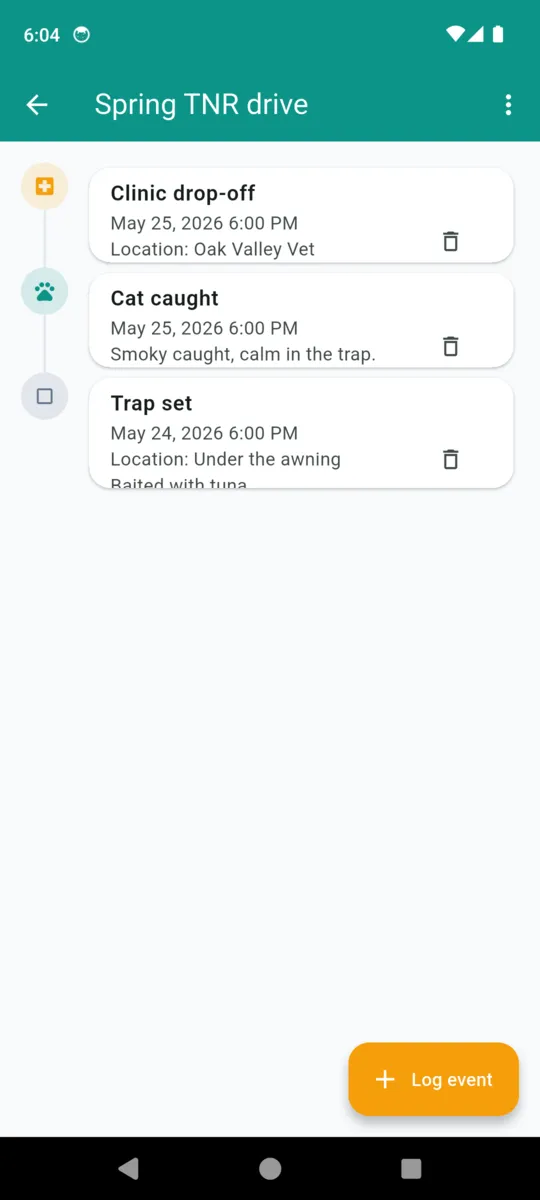
Name the drive — “Spring TNR drive” — and log events against it as the week goes. Each one carries a time, a trap location and a note. Six event types, in the order they usually fall.

  1. 1

    Trap set

    Where the trap went and when, so you know which ones to check tonight.

  2. 2

    Trap triggered

    Sprung, with or without a cat in it. Worth logging either way.

  3. 3

    Cat caught

    Which cat, and how it was — “smoky caught, calm in the trap”.

  4. 4

    Clinic drop-off

    The vet, the time, and what went with the cat.

  5. 5

    Recovery

    The hours indoors between surgery and going back out.

  6. 6

    Release

    Returned to the same place. That closes the loop on one cat.

Nothing here decides anything for you. It is a written trail of a night's work, which is what you want when a second feeder asks whether the grey one has been done, or a clinic asks when the cat came in.

What a colony page tells you

Every figure below is computed from the cats and logs you entered. None of it is estimated, and none of it comes from anywhere but your own phone.

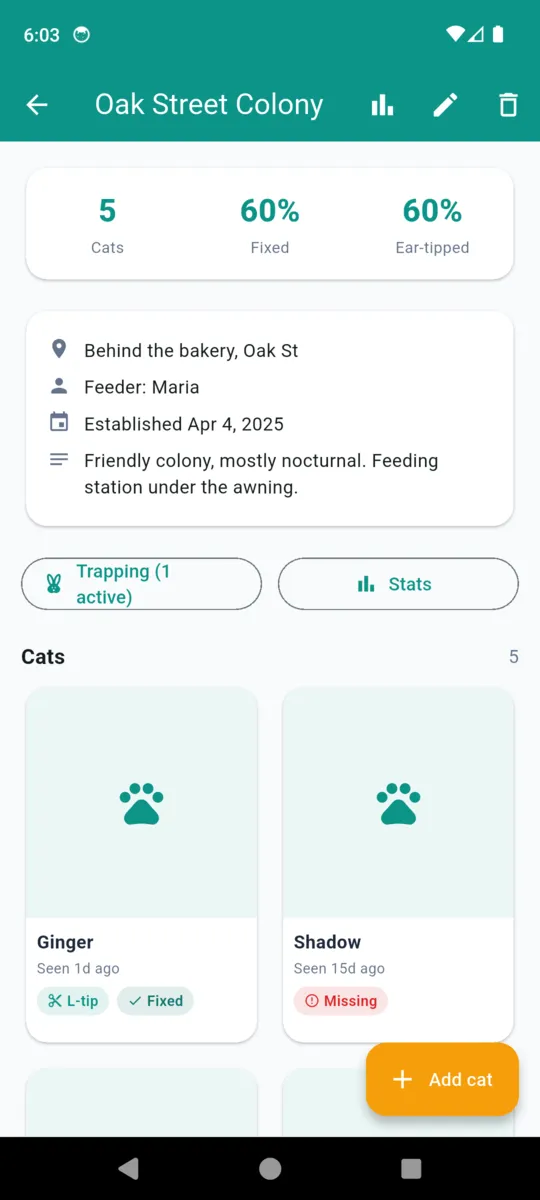
Cats

How many are on the colony's books right now.

Ear-tipped %

Share with a left or right tip recorded. The blunt measure of how far a TNR effort has got.

Fixed %

Share marked spayed or neutered, with scheduled and intact counted separately in the breakdown underneath.

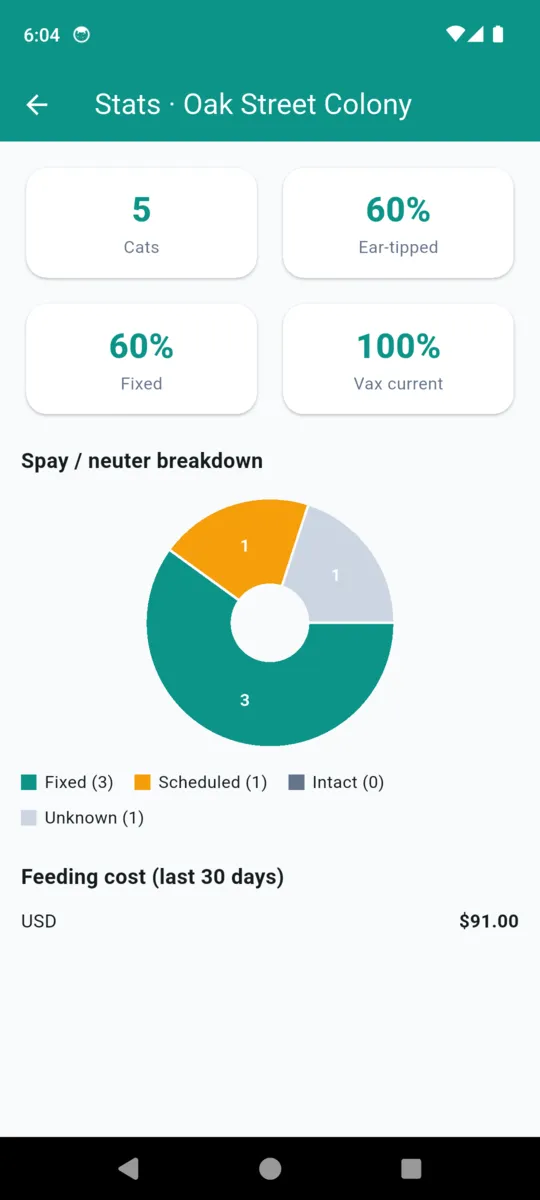
Vaccination current %

Share whose next-due date has not passed. Cats with no date recorded count as current rather than overdue.

Spay and neuter breakdown

A donut splitting the colony four ways — fixed, scheduled, intact, unknown — because the interesting number on a half-done colony is usually how many are still unknown.

Feeding cost, last 30 days

Added up from the feeding logs, and kept strictly per currency. If a colony is fed in dollars and pounds, you get two lines, never one blended number.

The rest of what it holds

A cat record built for field notes

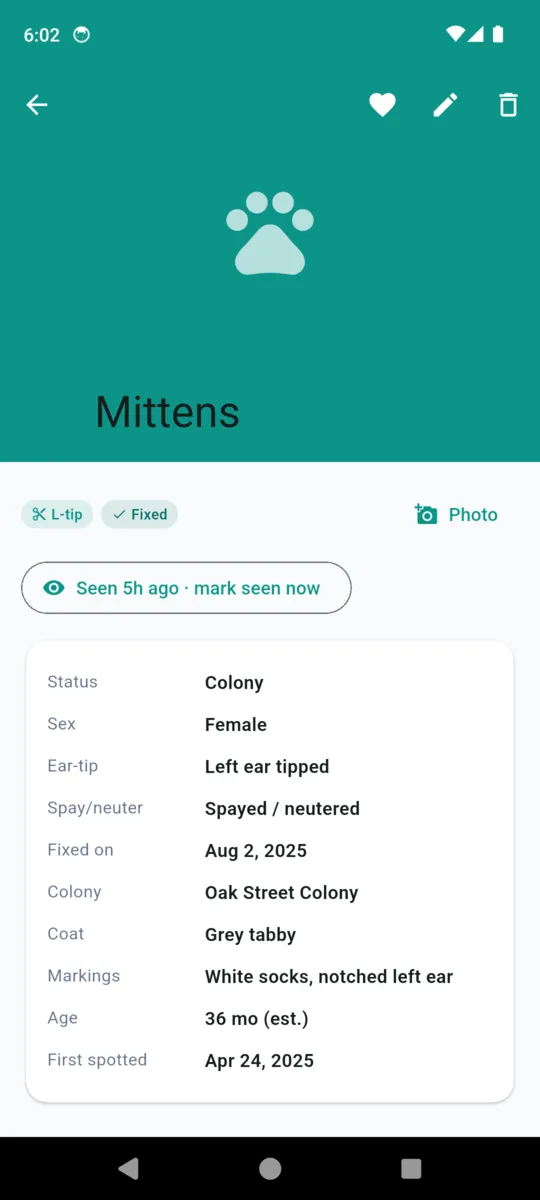
Coat and markings in your own words, an age estimate in months, weight in grams, ear-tip side, spay or neuter state and date, microchip, and a status that runs from lives here through colony, TNR monitoring, adopted, missing and deceased. Search and four filters sit above the list: all, ear-tipped, vaccinations due, missing.

Medical events and one reminder

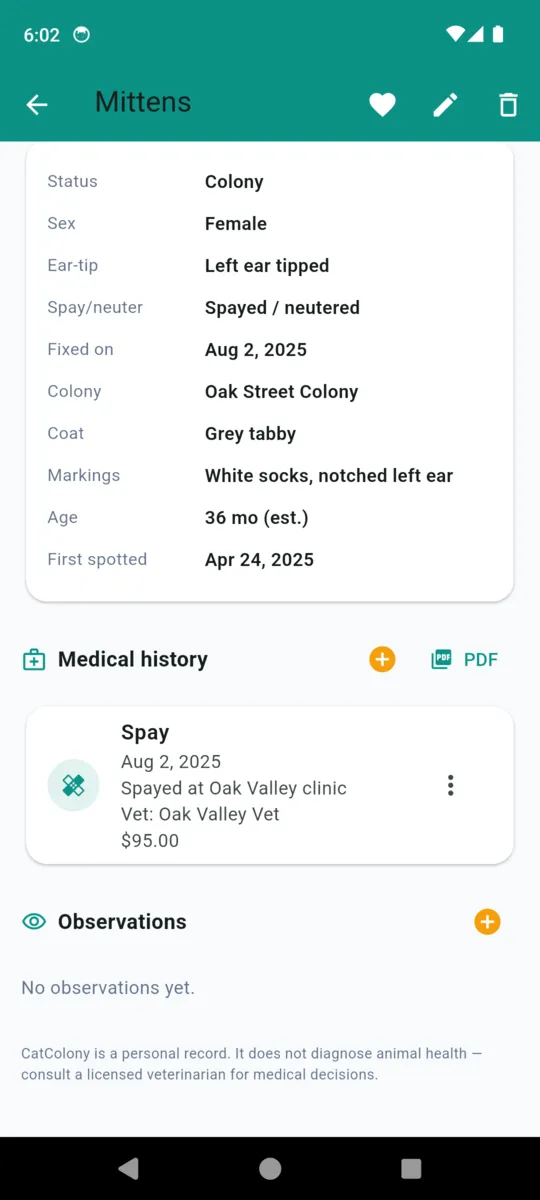
Vaccine, spay, neuter, dental, treatment, exam or other — each with the vet, the cost and a next-due date. Give a cat a next vaccination date and the app schedules a single reminder for it. Delivery is inexact, so Android may shift it by a few hours.

A vet-ready PDF per cat

Export one cat's history as a PDF with photos, ready to hand to a clinic. The disclaimer that this is a caretaker's personal record and not a veterinary document is printed on the cover and in every page footer, and cannot be switched off.

Feeding logs and observations

Wet cans, dry cups, who fed, what it cost and in which currency. Observations are separate: date, observer name, behaviour tags, health flags and notes — the place for “limping on the back left, will watch”.

Sharing by invite code

Generate a short code on a colony, like CAT-7QK2, and another feeder enters it in their Settings to pull the colony and its cats onto their phone. Be clear about what this is: a one-time copy, not live sync. Later edits stay on the phone that made them.

Photos, kept small

Photos are compressed to roughly 200KB before they are saved to the phone, which is what makes a colony of thirty cats stay a reasonable size. Nothing is uploaded unless you publish a colony for sharing.

A record, not a diagnosis

The app states it on the medical tab and prints it on every page of the PDF: CatColony is a personal record kept by a cat's caretaker. It does not diagnose animal health, and every medical decision belongs to a licensed veterinarian. What it does is make sure you can answer the vet's questions accurately.

  • Built for cats you do not own. First spotted and last seen, not owner and address.
  • Works with no signal. Which is what a car park at 10pm usually has.
  • No account. No sign-up and no email address to hand over.
  • Ten currencies, never mixed. Feeding costs total per currency or not at all.
  • Nothing you logged disappears. Trial records stay readable when the trial ends.
  • English only for now. The app has not been translated yet.

PRICING

14 daysthen choose

Everything is unlocked for the first two weeks, with no card. After that the free tier keeps one colony and five managed cats, and Neighborhood spotting stays unlimited.

  • Monthly$1.99
  • Yearly$9.99
  • Lifetime$19.99

Pro lifts the colony and cat limits and adds shared access, the vet PDF, the photo timeline, trapping campaigns and no ads.

Get CatColony

Questions

What is TNR?

Trap-neuter-return: humanely trapping free-roaming cats, having them neutered and vaccinated, and returning them to the same place. The tipped ear is the field mark that says a cat has already been through it. There is a fuller explanation on the ClearStack blog.

Do I have to own the cats?

No, and the app assumes you do not. A cat record has a first-spotted date, a last-seen date and a colony rather than an owner, and Neighborhood spotting exists for cats you only ever see in passing.

Can two feeders share a colony?

Partly. Generating an invite code on a colony publishes a snapshot of it and its cats; another caretaker enters the code and gets a copy on their own phone. It is a one-time copy, not live sync — changes made after that do not travel between phones.

What is in the vet PDF?

One cat's medical history: status, sex, ear-tip, spay or neuter state, coat, markings, age and first-spotted date, then every medical event with its date, type, vet, cost and next due date, plus photos. A disclaimer sits on the cover and in every page footer and cannot be removed.

Does it work without a signal?

Yes. Cats, colonies, medical events, feeding logs, observations, trapping events and photos are all stored on the phone. A connection is only needed to publish or join a shared colony, and to serve ads on the free tier.

What does it cost?

Fourteen days of everything on install, no card. After that a free tier keeps one colony and five managed cats, and Neighborhood spotting stays unlimited. Pro is $1.99 a month, $9.99 a year or $19.99 once.

New to this side of it?

Read what trap-neuter-return actually involves

Start with the cats you already know

Add the colony, add the ones you can name, tick off the ears you know are tipped. The percentages take care of themselves.