LAN Lanyard / SRL
- Webbing / cable / lifeline condition
- SRL retracts fully and smoothly
- Brake / lock-up engages on sharp pull
- Housing & anchorage loop sound
- Energy-absorber pack intact (not deployed)
- Manufacturer label present & legible
HARNESS INSPECTION CHECKLIST
GearCheck
Harness inspection checklist
This is the list GearCheck puts in front of you when you log a harness inspection. It is short on purpose. Every item is something that has taken gear out of service, and the wording is the app's own, unchanged.

14-day trial, then $1.99/mo,
$9.99/yr or $24.99 once. Android.
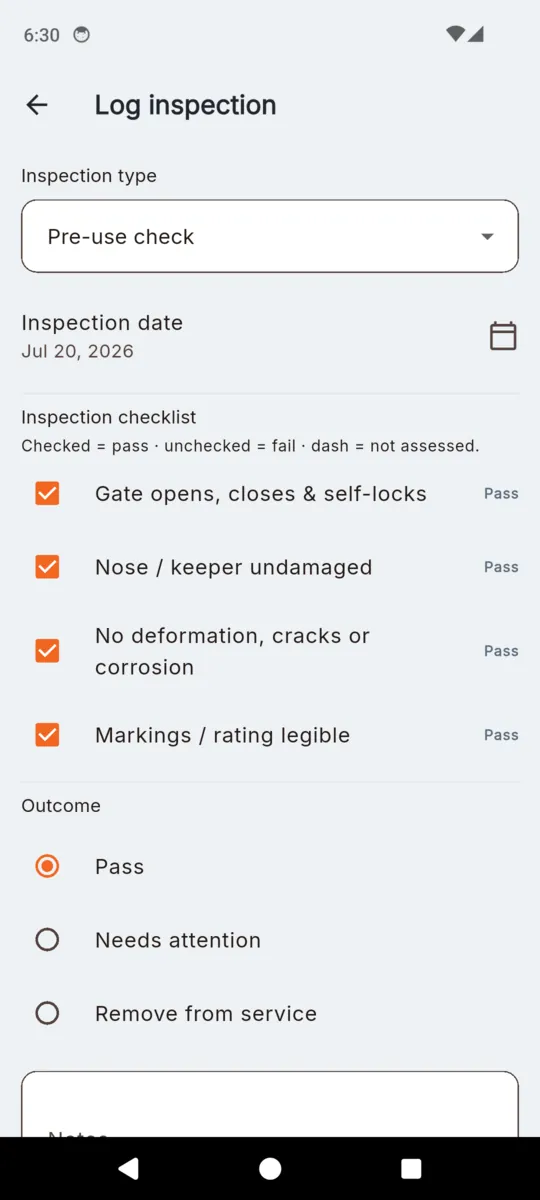
The criterion in bold is what the app shows and what prints on the report. The line under it is what a competent person is actually looking at when they mark it. The inspection is yours to perform and yours to judge — GearCheck only writes down what you found.
Webbing free of cuts, abrasion, burns
Run the whole length through your hands, inverting it a few inches at a time so the fibres open up. You are looking for cuts, frayed or pulled fibres, fuzzy abraded patches, glazing or hard spots from heat, and any change in colour or stiffness that suggests a chemical got on it.
Stitching intact (no broken/pulled threads)
Every load-bearing junction is stitched, and stitching is where a harness tells you it has been overloaded. Check for cut, pulled, worn or missing threads at the leg straps, the chest, and everywhere webbing folds back on itself.
D-rings / attachment points sound
The dorsal D-ring and any side, sternal or hip attachments. Look for cracks, distortion, sharp edges, rough or pitted surfaces, and corrosion, and check the ring moves freely in its keeper without being loose in it.
Buckles & adjusters work and hold
Every buckle, adjuster and grommet: no distortion, cracks or corrosion, tongues that seat properly, and adjusters that grip the webbing under load rather than creeping.
Manufacturer label present & legible
The label carries the model, the serial, the manufacture date and the instructions the whole inspection is measured against. An illegible label is a real finding, because without it nobody can confirm what the item is or how old it is.
Impact indicator NOT deployed
A deployed indicator means the harness has taken a fall. That is the end of that item, whatever the rest of the inspection says.
These are the criteria the app encodes, drawn from OSHA 1926.502 and 1910.140 and the removal criteria in ANSI/ASSP Z359.2. They are general guidance, not legal advice, and they do not replace the manufacturer's instructions for your particular harness — a manufacturer may require checks or a service life this list does not carry.
Each criterion takes one of three marks, and the outcome of the inspection is set separately from them. That separation is deliberate: a fail on one item is a finding, and what to do about it is a competent person's decision, not an app's.
Every item is tri-state. Not applicable is a real answer — a harness without an impact indicator has nothing to mark there — and it is recorded as N/A rather than quietly counted as a pass. All three marks print on the report, so a reader can tell the difference between something that was checked and something that was not.
You close the inspection with pass, needs attention, or remove from service. Remove from service is terminal: the item is retired, it drops off the due worklist, and its whole history stays readable. Needs attention keeps the item live but flags it. Even a clean inspection reads as a neutral pass rather than a green tick, because the app is a record, not a verdict.
The same checklist serves both cadences, and you say which one you are doing. A pre-use check is the one before you put the harness on. The formal documented inspection is the one GearCheck schedules, defaulting to every 12 months in line with the at-least-annually position in ANSI/ASSP Z359.2, and overridable per item when a manufacturer asks for six. Slings follow the pre-use-each-shift convention associated with OSHA 1910.184 instead of each use.
Soft goods also expire. GearCheck carries a default service life of ten years from first use for harnesses, lanyards and SRLs, rope and rope grabs, and synthetic slings, and no service life at all for connectors, anchors and chain or wire slings, which are wear-based. When a service life is reached it dominates: the item is due for removal whatever the last inspection said. Formal inspections warn 30 days ahead and service-life expiry 60 days ahead. Both defaults are typical manufacturer practice and both are editable per item — confirm them against your own manual.
The inspection carries your name, your credential line and your company, snapshotted at the time so a later profile edit cannot rewrite an old record, plus a signature captured on the phone, photos of anything you found, and an optional GPS stamp. From there you can generate a tag image to post on the gear, or a site report covering everything on the job.
A harness is one third of a personal fall arrest system, and the other two parts get their own criteria. Set the gear type once on the item and the right list appears every time.
LAN Lanyard / SRL
CON Connector / carabiner
Nine gear types are covered in all, including anchors, rope grabs and the three sling families. The full set and the cadence table are on the GearCheck app page.
Six criteria in GearCheck: webbing free of cuts, abrasion and burns; stitching intact; D-rings and attachment points sound; buckles and adjusters working and holding; manufacturer label present and legible; and the impact indicator not deployed.
GearCheck records two cadences. A pre-use check before each use, and a formal documented inspection it defaults to every 12 months, following the at-least-annually position in ANSI/ASSP Z359.2. You can shorten the interval per item if the manufacturer says so.
Yes. Every criterion is pass, fail or N/A, and whichever you pick prints on the report. An item left N/A is not counted as a pass.
You set the outcome yourself: pass, needs attention, or remove from service. Remove from service is terminal — it retires the unit and takes it off the due worklist, while the record stays readable.
Yes. Nine gear types each carry their own list, because a harness and a wire-rope sling fail in completely different ways. The type is set once on the item and every inspection after that shows the right criteria.
Because translating a removal criterion changes what it means. The app runs in ten languages, but the inspection wording and the report text stay in the standards’ own English.
No. You are the competent person. GearCheck records the inspection you carried out and computes next-due dates from what you entered. It does not inspect, judge or certify anything.
GearCheck helps you record fall-protection and rigging-gear inspections and compute next-due and service-life dates. It is not a certification, an inspection service, or legal/safety advice, and it does not guarantee that any item of gear or any record meets OSHA, ANSI/ASSP Z359.2, or your manufacturer’s or authority’s requirements. You are the competent person responsible for performing the inspection, deciding whether gear is fit for use or must be removed from service, and the accuracy and sufficiency of every record. Verify all criteria, intervals, and service-life limits against the current standards and the gear manufacturer’s instructions.
Register it, run the six items, and let the app hold both its dates from there.