SPORE TEST LOG

InkProof
Studio records
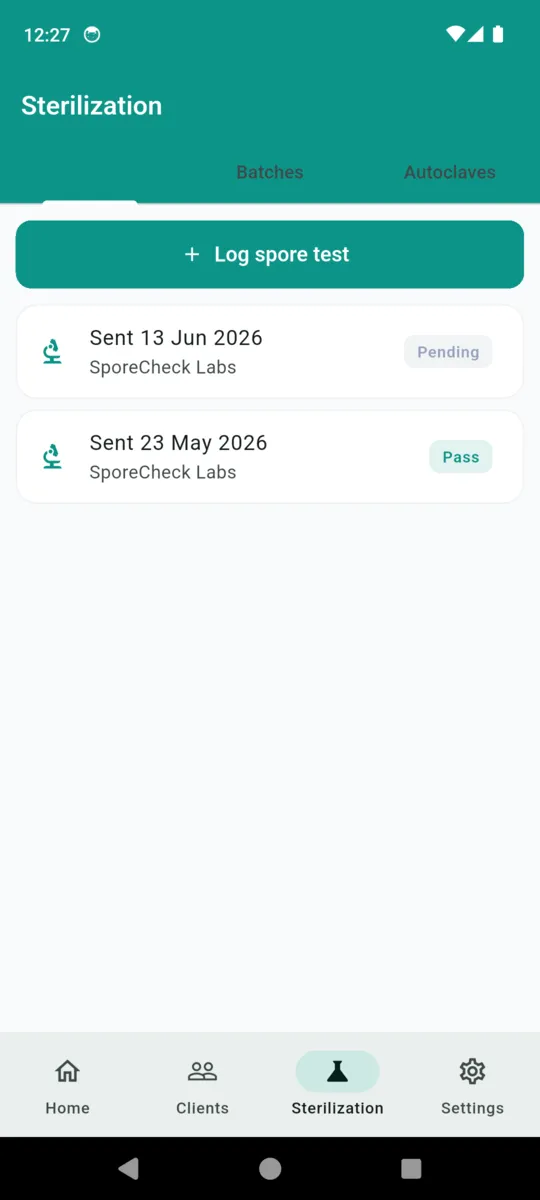
Every spore test, when it went, and what came back.
A biological indicator is the one check that tests whether the autoclave actually killed anything. InkProof keeps the run of them in date order, holds the lab certificate alongside each entry, and counts the next one due from the last one you logged.

$1.99/mo · $9.99/yr · $24.99 once.
14-day trial. Android.
Why the log exists at all
An autoclave can hit temperature, hold pressure, print a perfect cycle receipt and still fail to sterilise. Gaskets go, chambers overload, packs get wrapped too tight. A spore test is the check that does not care what the gauges said: live, heat-resistant organisms go through a real cycle, then a lab tries to grow them. If nothing grows, that cycle did its job.
Which means the log is not really a list of tests. It is a record of the gaps between them. A pass in March is worth very little on its own; a pass every month for two years, each with the certificate attached and the sterilizer named, is a picture of a machine that has been watched. That is what this screen is built to produce.
It is also the record you will want on the worst day. If a test comes back failed, the first question is which cycles ran between that test and the one before it. That answer only exists if both the tests and the cycles were written down as they happened.
What one entry holds
Seven fields, and only the date is required. It is deliberately short — a log people actually keep beats a form that asks for eleven things at the counter.
| Field | What it holds |
|---|---|
| Date sent | The day the vial went to the lab. This is the date the next due reminder counts from. |
| Lab | Who processed it. Free text, so a mail-in service and a local lab both fit. |
| Result | Pending, pass or fail. New tests start as pending, which is the honest state until the lab writes back. |
| Result date | When the answer arrived. Optional, and separate from the date sent so the turnaround is visible. |
| Autoclave | Which sterilizer the cycle ran on. Optional, and the field that matters the moment you own two. |
| Lab report photo | A picture of the certificate itself, attached to the entry and printed in the export. |
| Notes | Anything the other fields do not carry — a repeat test, a load that was unusual, a service visit. |
No lot number sits on a spore test. Needle and pigment lots are recorded against the procedure they were used on, and they print in the consent pack rather than the sterilization one.
Pending is a real state
A test logged the day it is posted sits as pending until the lab replies, and the list shows it that way. That gap is the useful part: a pending entry three weeks old is either a lab that has not answered or an envelope still on the desk, and either way it is worth knowing before somebody asks.
When the next one is due
The cadence is a number of days, set to thirty out of the box and editable in settings. The next due date is the date the most recent test was sent plus that number, so it tracks what you actually did rather than a calendar you were supposed to keep to. Log a test late and everything after it moves with you; log one early and the clock resets from there.
The home screen carries it as a card. Before the date it reads “next spore test due” with the date; after it, it flips to overdue and tells you what the due date was. With no tests logged at all it says so plainly rather than showing a green tick it has not earned. A notification is scheduled to the same date, and it is rescheduled whenever you save a test or change the cadence.
Thirty days is a starting point that happens to suit a lot of studios. It is not advice. Your own health authority or licensing board sets what the interval has to be, and the field is editable precisely so you can put their number in it rather than ours.
The cycles that run between tests
Spore tests are periodic. Cycles are daily. The batch log sits next to the spore log and records the ordinary loads, which is what makes a spore test result mean something about a specific stretch of work.
| Column | What it holds |
|---|---|
| Date | When the cycle ran. |
| Cycle | Your own cycle or load number. |
| Items | What was in it — tubes, grips, needles. |
| Indicator | Biological, chemical integrator, class chemical indicator, or other. |
| Parameters | Temperature, pressure and run time, joined into one line. |
| Result | Pass or fail. |
| Operator | Who ran it. |
The indicator column is where the distinction lives: a biological indicator is a spore test, a chemical integrator or class indicator only tells you conditions were reached.
Sterilizer profiles
Each machine can be saved once with its make, model, serial number, install date and last service date. Tests and cycles both link to it, so a studio with two autoclaves can tell which one a result belongs to, and the export prints each machine with its serial and service date underneath the tables.
Getting it out as a document
The export screen offers three packs — consent, sterilization, or the full set — over any date range you pick. The sterilization pack prints your studio name and permit number, the range, a spore test table of Sent, Lab, Result, Result date and Autoclave, then the lab report photos, then the cycle table, then the sterilizer list.
Everything is held on the phone, and viewing or exporting records you have already written is always free, trial or not. There is a passcode lock and an optional biometric unlock on the app itself, because a studio phone with client health histories on it should not be readable by whoever picks it up.
Shown in the app and printed on the export
InkProof is a private record-keeping tool. It does not provide legal, medical, or compliance advice and does not guarantee any record meets any legal standard. You are solely responsible for confirming what your jurisdiction requires.
Take that at face value. Keeping this log does not satisfy an inspector, a licensing board or a health department, and nothing here should be read as saying it does. Sterilisation protects real people; the app records what you did about it, and the doing is still yours.
Why keep it here
- Due date follows reality. Counted from the last test logged, not a fixed calendar.
- The certificate is attached. A photo of the lab report lives on the entry and prints with it.
- Overdue is loud. The home screen changes colour rather than staying quiet.
- Two machines stay separate. Tests and cycles both name the sterilizer they came from.
- One PDF for a date range. Tests, reports, cycles and machines in a single file.
- Locked and offline. Passcode or biometric, on the phone, no account.
Questions
What is a spore test?
A biological indicator: a sealed vial of heat-resistant spores run through a normal autoclave cycle and then sent to a lab. If nothing grows, the cycle killed them. It is the only check that tests the outcome rather than the conditions.
What does the log record for each test?
The date you sent it, the lab, the result as pending, pass or fail, the date the result came back, which sterilizer it came from, a photo of the lab report and any notes.
How often does it remind me?
Every thirty days by default, and the number is yours to change in settings. The due date is counted from the last test you actually logged, not from a fixed calendar date.
What is the difference between a spore test and a chemical indicator?
A chemical indicator changes colour when conditions were reached. A spore test proves organisms died. Both are logged in InkProof — the indicator type is a field on each cycle you record.
Does the log carry lot numbers?
Not on a spore test. Needle and pigment lot numbers are recorded against the procedure, not against the sterilizer test, and they print in the consent pack instead.
Does keeping this log make me compliant?
No. It is a private record-keeping tool. What has to be tested, how often, and how long records are kept is set by your own health authority or licensing board, and confirming that is on you.
Log the next test the day it goes in the post
Fourteen days of everything, then one active client and a month of sterilization entries stay free. Reading and exporting what you have already written never costs anything.