NFPA 101 · BS 5266
 LumiCheck
 Emergency lighting duration tests, fitting by fitting.
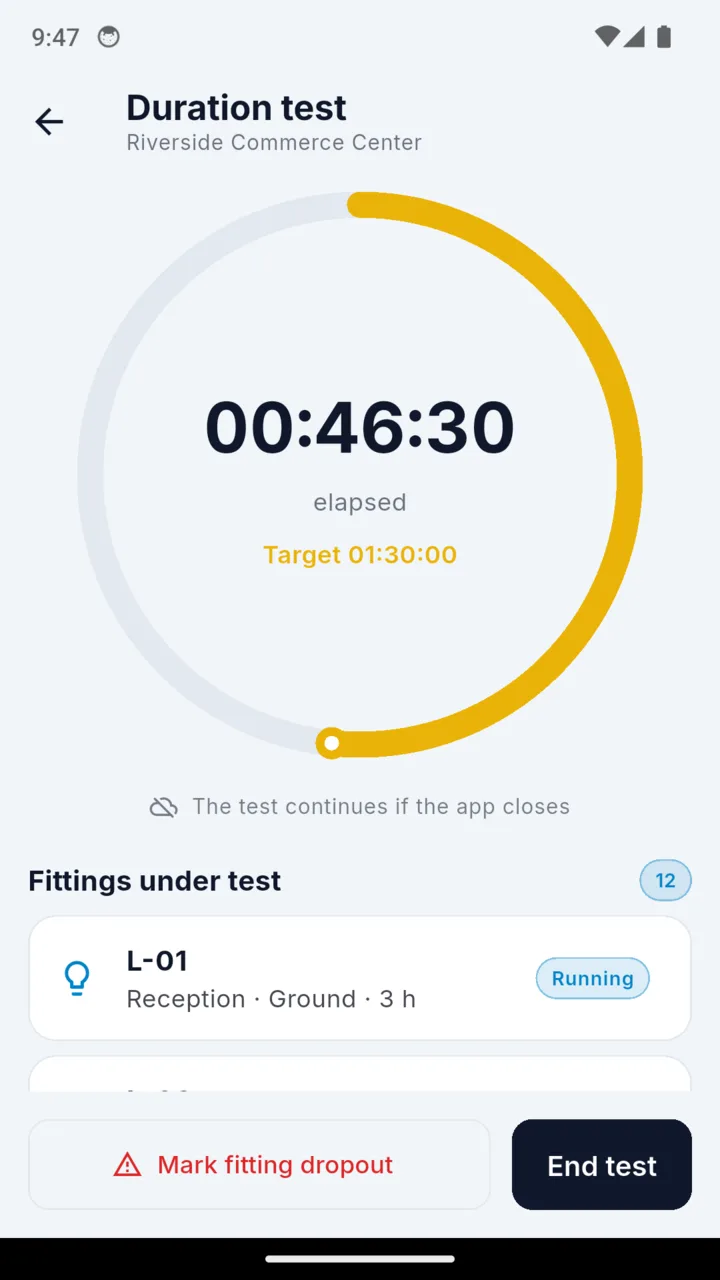
Start the discharge and walk the building. Elapsed time is worked out from the moment you pressed go, so locking the phone, closing the app or restarting it loses nothing. At the end you know which fittings did not hold their rated duration, and when each one was found dark.
Why the timer survives interruptions
A duration test is ninety minutes or more of walking a building.
Elapsed time is a subtraction
The instant you pressed start is written to disk. Nothing accumulates and nothing ticks, so there is no counter to lose when Android kills the process behind you.
It survives lock, close and reboot
Screen off, app swiped away, phone restarted: reopen it and the test is still running, at the right elapsed time. What it cannot survive is a phone you no longer have, because nothing is synced anywhere.
Prompts through the long middle
An hourly prompt while the test runs and one when the target elapses, so a ninety minute discharge does not depend on you remembering to look.
What it writes down
An upper bound you can defend, not a number you cannot.
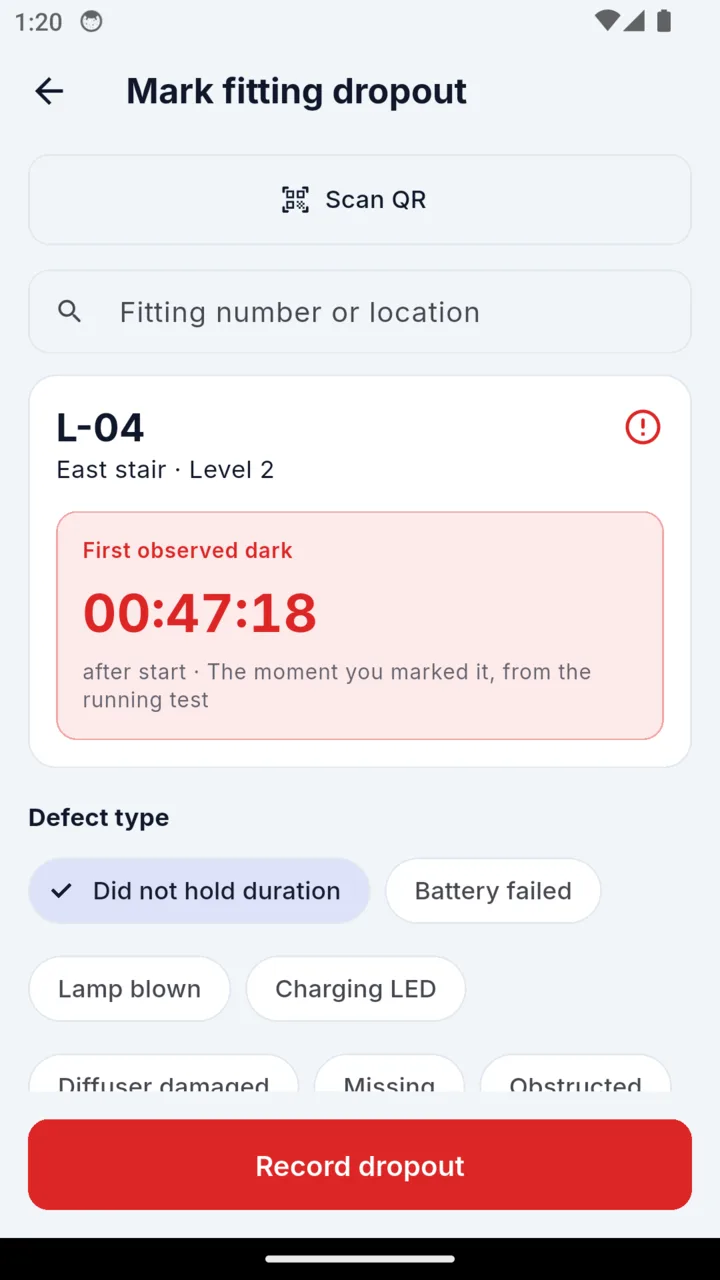
You are walking a building, so you mark a fitting when you find it dark. That is the first time it was observed dark, which is not the same as the moment it failed. The record says so, and the report prints it that way.
First observed dark, at 47 minutes
You mark the fitting when you find it out. The app records that instant and labels it as what it is: the first time it was seen dark.
The report says "at most"
The schedule prints the dropout as ≤ 00:47:18 with a footnote explaining it, because all that is known is the fitting was lit at your last look and dark at this one.
Runtime against that fitting’s own rating
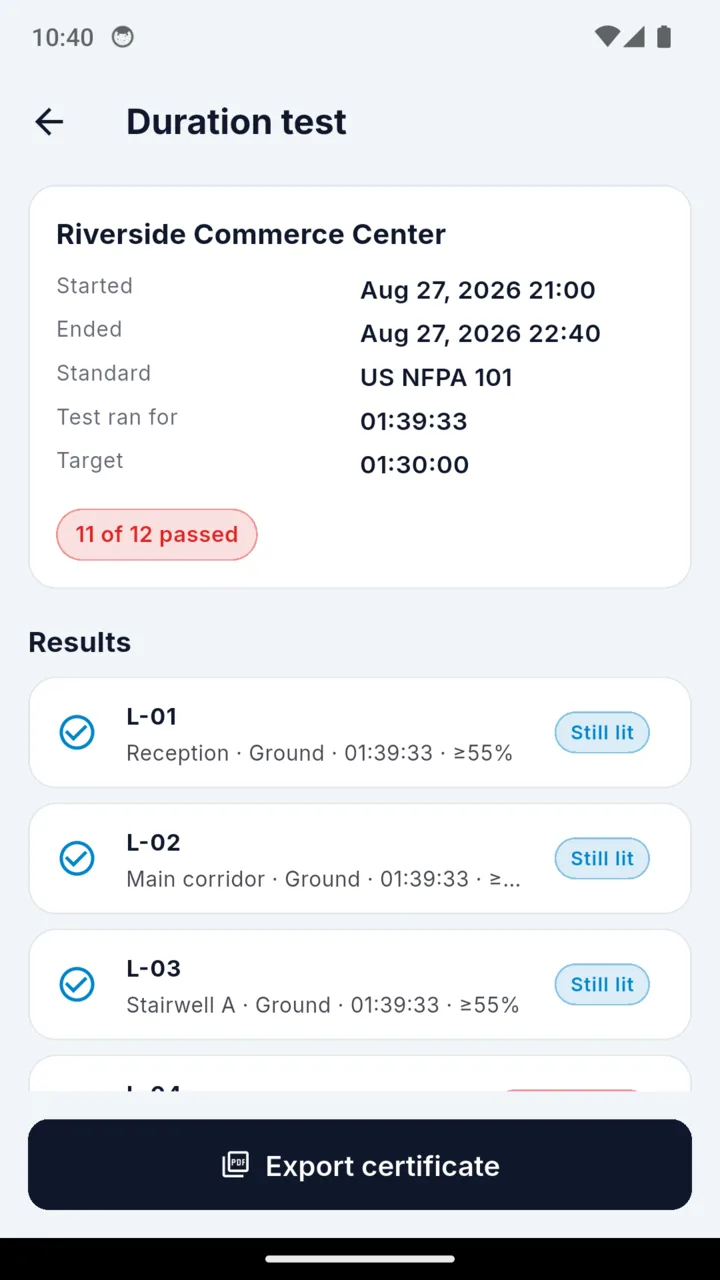
A three hour fitting and a one hour fitting are not judged against the same number. Held time is compared with the rated duration recorded on that fitting.
What is in it
The register, the test and the paperwork.
Duration test timer
Start the discharge, walk the building, mark fittings as you find them out. Hourly prompts, and a prompt at the target.
Per-fitting record
Each fitting carries its own first-observed-dark time, kept and compared across annual tests rather than collapsed into one verdict.
Luminaire register
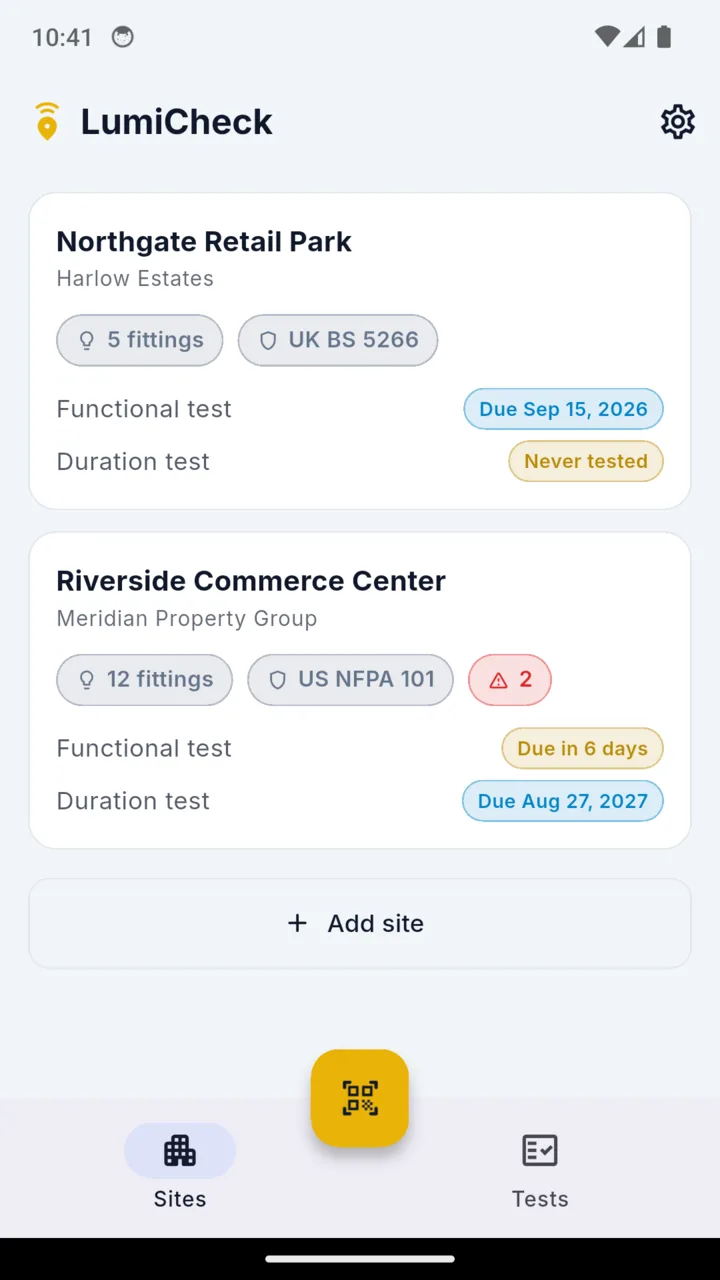
One register per site: maintained, non-maintained, sustained, exit sign and central battery fittings, with floor, zone, lamp and battery type.
QR labels
Stick a label on the fitting’s housing, not the diffuser, and scan it to open that fitting’s history.
Inspection and test report
The full luminaire schedule, held time, lux readings, per-fitting result, and a defects table for the quote.
Recharge re-check
An optional prompt 24 hours after a discharge, because a cell can hold its duration and then never take a charge again. It is a reminder, not a verdict.
The real screens
One test, from the clock to the verdict.
Chosen per site
Two regimes, kept apart.
The standard is recorded on a test when it starts, so switching a site later never alters a record that is already finished. US jurisdictions adopt different editions of NFPA 101, so the app names the edition it works to.
NFPA 101 (2021)
- Functional test not less than 3 weeks and not more than 5 weeks apart
- That test lasts at least 30 seconds
- Annual test of at least 90 minutes
BS 5266 and BS EN 50172
- Monthly functional test
- Annual test for the fitting’s full rated duration
- Rated duration is per fitting, commonly one or three hours
Deliberately absent
What it will not tell you.
It does not name the fault
A fitting going dark could be the charger, the lamp, the driver, the connection, the control gear or the central supply. The default record is “did not hold duration”, which is what you saw. Naming the battery would be a diagnosis the app cannot make.
It does not read light with the phone
Lux values are typed in from your own calibrated meter and the report names the instrument. A phone sensor is uncalibrated, varies by an order of magnitude between handsets, and cannot defend a figure to an inspector.
It does not report battery health on a central system
A fitting fed from a central battery has no cell of its own, so the health figure is suppressed and never stored for it.
It does not check your credentials
Technician name, company and accreditation number print exactly as you enter them. LumiCheck verifies none of them.
Price
One tool, three ways to pay for it.
- A 14 day trial of everything, which you start yourself. No card.
- The standard tier keeps one site and ten fittings, and shows ads.
- Anything you have already recorded stays readable and editable whatever the tier. Reading your own history back is never paid for.
Questions
Before you install it.
Does the test keep running if I lock the phone?
Yes. Elapsed time is worked out from the stored start instant, so locking the screen, closing the app or restarting the phone does not affect the result. Reopen it and the test is still going.
Does it record the exact moment a fitting failed?
No, and it does not claim to. You mark a fitting when you find it dark on the walk round, so the app records the first time it was observed dark. The report prints that as an upper bound on how long the fitting held.
What happens if I stop a duration test early?
Fittings that were still lit are recorded as untested rather than as failures, and their stored status is left alone. The test itself is kept and printed as incomplete.
Which standard does it follow?
NFPA 101 or BS 5266, chosen per site, so a mixed portfolio is handled correctly. The standard is recorded on a test when it starts, so a later change to the site never alters a finished record.
Does it need an internet connection?
No. Your site records stay on the device, with no account and no cloud sync. The app does send crash and usage diagnostics, and the standard tier shows ads.
Is this the same as FireBook?
No. FireBook is the fire logbook kept by whoever is responsible for one building. LumiCheck is the test log used by the contractor who tests emergency lighting across other people’s buildings.
Time the test, not the paperwork.
The clock, the register and the report in one app, on the phone already in your pocket.