01
The whole receipt, in focus
Header included, so the branch and the carrier are readable, not just the barcode. Long counter receipts can go in as two or three photos of the same slip.
PROOF OF POSTAGE

PostProof
Proof of postage
A proof of postage says you gave the parcel to the carrier on a particular day. It is worth almost nothing until something goes wrong, and by then it has usually faded, been thrown out, or lost the one number out of five that you needed.

£1.99/mo or £29.99 once.
14-day trial. Android.
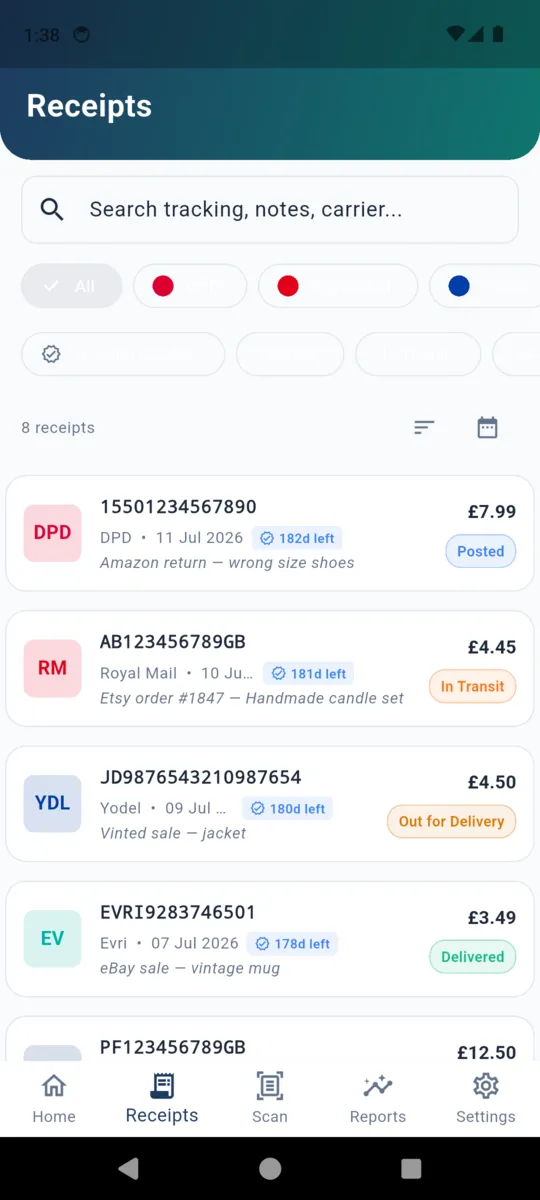
It is the record that an item was handed to a carrier on a given date. In the UK that is normally the slip printed at a Post Office counter when the transaction goes through; book online instead and Click & Drop or the carrier's own app produces a digital version of the same thing, as a PDF or a screen you can screenshot.
Whatever form it arrives in, it carries the same handful of facts: the date, the service you bought, usually what you paid, and a barcode or reference number for each item on it. Some of those numbers are tracking numbers. Some are only posting references, which identify the item on the carrier's own system and will never show a delivery scan because the service you bought was not a tracked one.
The distinction matters. A proof of postage is evidence of posting, not of delivery. It does not say the parcel arrived, and it does not oblige anyone to do anything. What it does is let you open a conversation about a missing item at all — carriers and marketplaces generally start by asking for it. Whether a claim is then accepted is their decision, under their own rules.
PostProof keeps the artefact readable and finds the numbers on it. It does not submit claims, does not talk to any carrier's systems, and cannot affect how a carrier or a marketplace decides one.
THE PART NOBODY PLANS FOR
A counter receipt is not printed with ink. The paper is coated with a dye that darkens where a hot printhead touches it, which is why the slip comes out warm and why it has that faintly slippery feel. The same chemistry works in reverse for the rest of the receipt's life: warmth, sunlight, friction and time all lift the image back off it.
So the failure mode is quiet. Nobody notices a receipt fading. You notice on the day you go looking for it — which, by definition, is months after you posted, because nothing went wrong until then. A slip that spent a summer in a car door pocket or a sunny window can come out of the shoebox as a clean white rectangle with a staple hole in it.
Nothing in any app slows that down. The only move available is to make a copy while the paper still reads, which takes about four seconds at the counter and is impossible to do afterwards.
Six things, and only the first is the photograph. PostProof reads the rest off the image where it can and puts them on a review screen for you to confirm before anything is saved.
01
Header included, so the branch and the carrier are readable, not just the barcode. Long counter receipts can go in as two or three photos of the same slip.
02
One Post Office run usually comes back as one slip covering several parcels. The number you need six months from now is rarely the first one printed.
03
Not the date you sold the item and not the date you photographed the slip. The claim window runs from the posting date.
04
Tracked 48, 1st Class, Special Delivery, Priority Mail. What a carrier will look at depends on which service you actually bought.
05
Where the receipt itemises it. It is also the figure that turns your postage into a monthly cost you can see.
06
A buyer name or an order reference in the notes. Without it you have a tracking number and no way to find which parcel it was.
Text recognition runs on the phone, so the queue at the counter and the dead spot in the sorting office both work. Long receipts are usually photographed sideways; if the first pass comes back with almost nothing, the app rotates the image and reads it again.
This is the part that makes a shoebox useless. A Post Office run comes back as one long slip with every item on it, and the number you will want in eight months is not reliably the first one printed.
PostProof pulls out every reference it can find rather than stopping at one, and shows you the list before saving. Each parcel then lives as its own line with its own carrier, service, price, status and note, while the receipt photo stays attached to all of them. On Post Office certificates and Royal Mail app PDFs it also reads the labelled blocks — the lines that begin Barcode Number or Item Reference Number — which is how untracked posting references get captured at all, since no carrier's number format describes them.
The formats it recognises are worth a page of their own, because several of them are the same length as each other.
There is no single answer, because the window belongs to the carrier and to whatever marketplace you sell through, and they do not agree with each other. Sellers commonly work to six months and some keep records for longer to line up with the tax year. PostProof does not decide this for you: you set the window in Settings to 6, 12 or 24 months, and it starts at 6.
Once it is set, every receipt carries its own countdown from the date it was posted rather than the date you scanned it. Inside the last fortnight the counter turns amber, and once the window passes it stops counting and says so.
A filter on the receipts list narrows it to the ones still inside the window, so the question "what could I still claim on" has an answer that takes one tap rather than an afternoon. Nothing is deleted when a window ends — the record stays, it just stops pretending to be current.
The countdown is a reminder you configured, not a legal deadline and not a carrier's policy. Check the window that actually applies to the service you bought.
PostProof knows the shape of these carriers' reference numbers and the wording that turns up on their receipts, so it can usually name the carrier without being told. It has no partnership or connection with any of them; what it can do is open their public tracking page in your browser.
It is the record that you handed an item to a carrier on a particular day. At a Post Office counter it is the slip printed with the transaction; carrier apps and Click & Drop produce a digital equivalent. It carries the date, the service, usually the price, and a barcode or reference number for each item.
No. It says the item was handed over. Tracking says where it went afterwards. Plenty of proofs of postage carry a reference number that no tracking service will show anything for, because the service was never a tracked one.
They are thermal prints. The paper is coated and the printer darkens it with heat rather than laying down ink, so heat, sunlight, friction and time all take the image away again. Six months in a warm car is enough to do it.
That depends on the carrier and the marketplace you sell through, and it is their rule rather than ours. PostProof asks you to pick 6, 12 or 24 months and starts at 6, then counts each receipt down from the date it was posted.
No. Whether a claim is accepted is entirely the carrier or marketplace decision, under their own rules. A legible proof reduces the chance of the claim failing on evidence alone; it does not decide the outcome.
No. There is no partnership and no integration. It recognises 19 carriers by the shape of their tracking numbers and the wording on their receipts, and it can open their public tracking page in your browser.
Fourteen days of everything, no card. Start with the pile already in the drawer, while it still reads.