Start
Date and time the session began. Set from the clock, editable if you are writing it up afterwards.
SURVEILLANCE LOG TEMPLATE
A surveillance log is a chronology of your own work: when you went on station, where you were, what you observed and at what time, and how the session ended. This page walks the whole structure (the case file it lives in, the session record, the observation line and its two timestamps) and shows a chronology laid out the way ProofPI keeps one.
Back to ProofPI →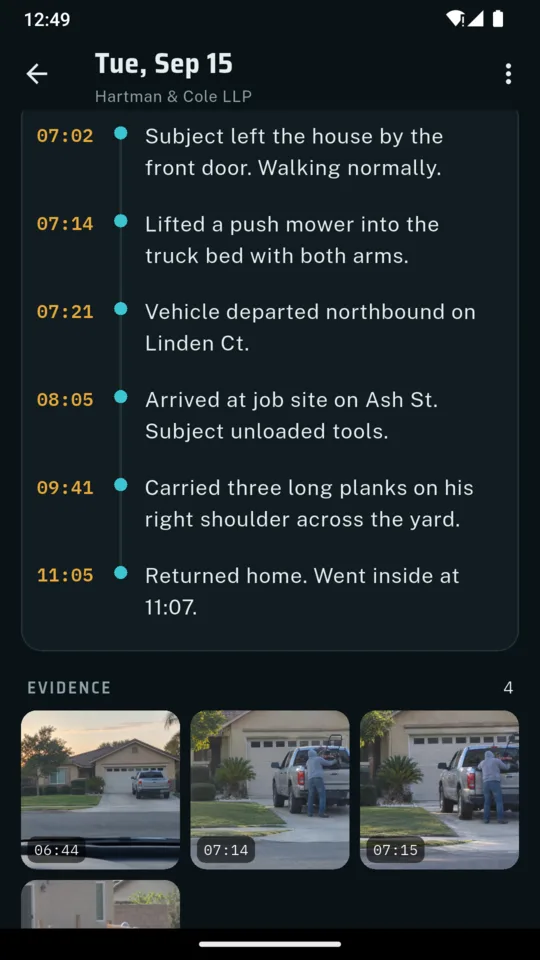
Investigators tend to search for a surveillance log template and find a single grid of times and notes. That grid is only the middle layer. A record that survives being asked about has three: the case file that says who instructed you and what for, the session that says when and where you worked, and the observation lines inside it.
Collapse them into one sheet and the questions that follow have nowhere to land. A page of times with no case header does not say who it was for. A page of observations with no session boundaries does not say how long you were there, or whether there was a gap.
The rest of this page is the field list at each layer. Use it as the ruling for a paper book, the columns for a spreadsheet, or read it as a description of the app that already has it as a form.
LAYER 1
One file per client matter. Ten fields, printed as the cover of the exported document. Anything you leave blank is left out rather than printed empty, so a thin file reads as a thin file and not as a form somebody rushed.
| Field | What belongs in it |
|---|---|
| Client / account | Who retained you. The record is kept per client, which is what keeps two matters for the same subject apart. |
| Matter no. | Your own reference. It is what a later request for the file will quote at you. |
| Case type | Surveillance, background, locate or skip trace, process of record, or other. |
| Subject(s) | Named as instructed, in the words the instruction used. |
| Client / attorney contact | Who to reach when a question arrives about the file eighteen months later. |
| Date opened | When the file was opened, not when the first session ran. |
| Date completed | Filled in when the work closes. An open file simply has nothing here. |
| Status | Open, on hold, completed or archived. |
| Billed fee | Optional, in your own currency. Six are offered, and mileage totals are kept per currency rather than mixed. |
| Scope | The instruction, in free text. The most useful field on the page and the one most often left blank. |
LAYER 2
One session is one period on station. It is the unit an invoice line, a report paragraph and a question in a deposition all refer to, which is why it carries its own start, stop and disposition rather than being inferred from the observations inside it.
Start
Date and time the session began. Set from the clock, editable if you are writing it up afterwards.
Stop
Date and time it ended. A session with no stop time is simply in progress, and the record says so rather than guessing.
On station
Worked out from the pair, in minutes. It is the number the invoice and the file both refer back to.
Start GPS
Your own position when you stamped it, to five decimal places, with the fix accuracy in metres alongside. Stamped on request, never in the background.
Stop GPS
The same at the end, if you take one. A session may carry one stamp, both, or neither.
Location
The address or area, in words. Coordinates say where precisely; this says where recognisably.
Subject observed
Free text describing what was lawfully observed. It is a description of your own work, not a dossier.
Vehicle
Make, model, colour, plate as observed. Kept separate from the narrative because it is the detail most often cross-checked.
Outcome
One of five dispositions, chosen at the end of the session.
The coordinates on a session are the position of the phone in your hand at the moment you asked for them. They document where you were while filling in your own record. ProofPI has no background location, no tracking, and no way of recording anybody else’s position. The app says as much on the dialog before it takes the first one.
Accuracy is stored alongside the fix in metres, because a stamp with a fifty-metre margin and a stamp with an eight-metre margin are not the same claim, and a record that hides the difference is worse than one that never took the reading.
LAYER 3
An observation is one timestamped note. It carries a time you can set (when the thing happened) and a time you cannot: the wall-clock moment the entry was actually written. That second stamp is set once and is never overwritten by a later edit.
Observed at
Editable, and back-dating it is legitimate. You put your phone down for forty minutes because putting it down was the job; the note goes in afterwards with the time the thing happened.
Recorded at
Stamped by the app when you save, shown next to the entry, and immutable. It is what makes “you wrote this three hours later” a question with an answer rather than an accusation with none.
One session, as a chronology
Sample data
09:12
Session start · GPS 37.77149, -122.41940 (±8 m) · Location: 400 block, residential
09:41 rec. 09:41
On station. No movement at the address.
10:26 rec. 10:27
Grey estate car, plate as recorded on the case sheet, departed the driveway northbound.
11:48 rec. 11:52
Same vehicle returned. Two bags carried in.
12:15
Session stop · On station 183 min · Outcome: Subject located
Two lines were written a minute or two after the event and one four minutes after. The record says so, which is the point of keeping both times.
Five dispositions, one per session. They exist so that a quiet day is recorded as a quiet day instead of disappearing.
Mileage is part of the same record because it is billed off the same days. It attaches to a case or stands alone, and it is kept in the currency you set rather than converted.
Odometer or miles
A start and end reading, or a direct figure when the odometer was not the thing you were looking at. The difference is worked out for you and never goes negative.
Rate and currency
Your own rate per mile, in one of six currencies. Totals are kept per currency, so a file with two of them shows two subtotals rather than one wrong number.
Purpose
What the trip was for. It is the line that turns a mileage table into something a client will pay without asking.
One PDF per case, built on the phone. It is laid out to be read in order rather than filtered.
Cover
The case caption, when it was generated, the ten header fields, then your signature above your name, licence number, board and agency. The disclaimer sits underneath.
Sessions
Each session as a heading of its date and outcome, then its facts as label and value: start, stop, on station, the GPS stamps, location, subject observed, vehicle.
Observations
Under each session, a two-column table: the observed time with the recorded time beside it in brackets, and the note. In the order they happened.
Mileage
Date, miles, rate and amount, with a total per currency underneath.
Evidence index
Photographs attached to the case, each captioned with the date and time it was captured and whatever caption you gave it.
ProofPI is a recordkeeping tool for your own case work. It is not legal or investigative advice, it does not make anything admissible, and the legality of an investigation is yours. A contemporaneous record is easier to testify from than one reconstructed later; that is the whole of the argument, and it is not a guarantee about anything.
ProofPI helps you record your own case work (surveillance sessions, observations, evidence, notes, mileage and expenses) and prepare a case-file document. It is not legal or investigative advice and does not guarantee that any record meets your state licensing board’s or any court’s requirements. Recordkeeping, retention and reporting rules are set by your state and licensing board, so review and adapt your records to your jurisdiction’s exact requirements. You are responsible for the legality of your investigation and the accuracy and sufficiency of your records.
The record lives on the phone. There is no account, no sign-up and no server holding your files, and a switch in Settings hides the app’s contents in the Android app switcher while you are working.
A start and stop time, where you were, what you were instructed to observe, a timestamped line for each thing you observed, and a disposition at the end. Everything else identifies the case the log belongs to.
Because they answer different questions. The observed time is when the thing happened; the recorded time is when you wrote it down. ProofPI stamps the second one itself and never lets an edit overwrite it.
One event, in plain words, without conclusion. What you saw belongs in the log; what you think it means belongs in the report, if anywhere.
Yours. It documents where you were while filling in your own record. ProofPI never tracks in the background and never locates anyone but the person holding the phone.
No. Nothing about a form determines that. A contemporaneous, internally consistent record is easier to testify from than a reconstruction, which is the whole of the claim being made here.
Your state and your licensing board. They set what must be kept, in what form and for how long. ProofPI keeps the record on the phone and exports it; what you are required to retain is not its call.
General information about investigative recordkeeping, not legal advice. Recordkeeping, retention and reporting rules are set by your state and your licensing board. ProofPI reduces the paperwork around your own case work; it does not make a record admissible and does not guarantee that any record meets a board’s or a court’s requirements.
Every field on this page is a row on one screen in ProofPI, and the case file is one tap from the case. 14-day full trial, no card. $1.99 a month, $9.99 a year, or $24.99 once.