FIRE DOOR INSPECTION CHECKLIST

What a fire door inspection actually looks at

A fire door assembly fails as a system, so the inspection has to cover the leaf, the frame, the seals, the hardware, the closing action, the glazing and the labels. This page sets out the eight sections DoorProof groups the NFPA 80 criteria into, what each one is looking for, and what happens to the items you fail.

Back to DoorProof
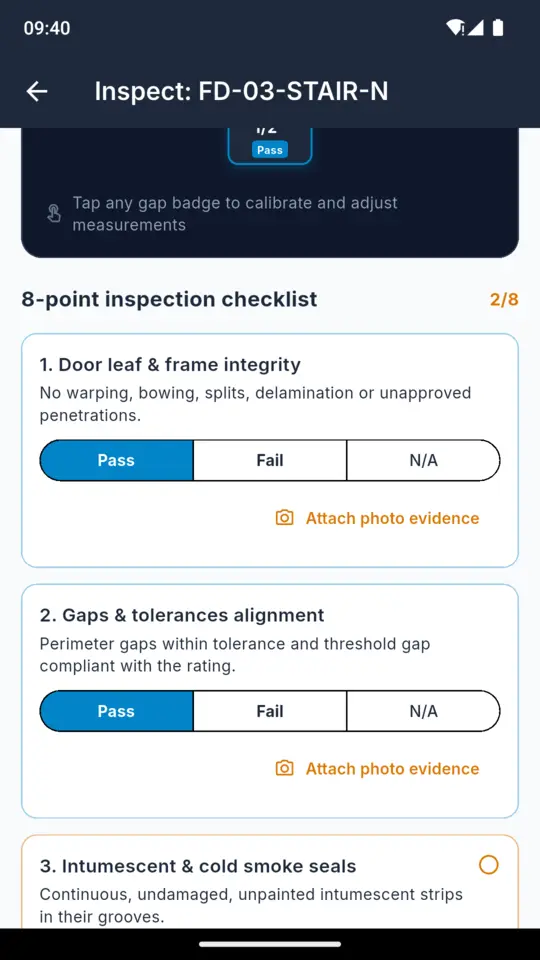
The DoorProof inspection checklist with numbered sections for door leaf and frame integrity, gaps and tolerances, intumescent and cold smoke seals and hinges and hardware, each offering pass, fail or not applicable
Eight sections, each pass, fail or not applicable

What this list is, and what it is not

NFPA 80 is a consensus standard rather than a form to fill in, and NFPA material describes thirteen items to verify on a fire door assembly. DoorProof does not present a statutory checklist, because there is no such thing to present.

What it does is group those criteria into eight sections that can be worked through standing at a door with one hand free. That is a layout decision made for the field, and calling it anything more official than that would be wrong. The requirements that apply on your job are the ones the authority having jurisdiction has adopted.

Every section takes pass, fail or not applicable, plus a note and photographs, and none of the three is chosen for you.

The eight sections

The heading and the grey line under each one are the words the app puts on screen. The paragraph is what that section is looking for in practice.

01

Door leaf and frame integrity

No warping, bowing, splits, delamination or unapproved penetrations.

The condition of the assembly itself. Holes drilled for a lock that was later swapped, a kick plate fixed through the leaf, or a frame that has been packed out are all penetrations somebody made after the door was listed.

02

Gaps and tolerances alignment

Perimeter gaps within tolerance and threshold gap compliant with the rating.

The gap readings, taken on the blueprint and compared with the rule set you selected. This is the only section that carries numbers, and it is the one the report leads with.

03

Intumescent and cold smoke seals

Continuous, undamaged, unpainted intumescent strips in their grooves.

Seals are checked for being there, being whole, and being able to work. Painted-over intumescent is the classic finding: it is present, it looks fine, and it cannot expand.

04

Hinges and hardware

Listed hinges in the correct quantity, no missing screws, no binding or oil leakage.

Count them, then look at them. A missing screw in a hinge leaf and a weeping closer body are both small findings that end with a leaf that no longer sits square in the frame.

05

Self-closing device operation

Closes from the open position and latches positively without hand pressure.

Released from the open position, unaided, the leaf has to close and latch. A door that swings shut but does not throw the latch has a serious operational deficiency, and DoorProof gives a failure here a higher default priority.

06

Hold-open device release

Acoustic or electromagnetic hold-open releases on alarm.

Only relevant where a hold-open is fitted, and marked not applicable where one is not. Where it is fitted, it has to let go on the alarm signal, every time.

07

Glazing and vision panels

Fire-resistant glass intact, beading intact, etched marks legible.

The glass, the beads holding it and the etched mark that says what it is. An unreadable mark is a finding on its own, because nobody after you can confirm the pane is the right one.

08

Signage and certification label

Keep-closed signage present and the certification label or plug legible.

The label is the door’s identity. Painted over, sanded off or missing, and the assembly can no longer be shown to be what the schedule says it is.

Section 02 is the one carrying numbers. The limits it applies, and the two places those numbers are usually got wrong, are set out in the NFPA 80 gap tolerances.

Nothing counts as a pass until you mark it

Every item starts unanswered, and unanswered is a stored state in its own right rather than a quiet pass. The inspection will not save while any of the eight is still blank. The app tells you how many are outstanding and takes you to them.

The alternative is worse than it sounds. A checklist that defaults to pass produces a clean record for an inspection nobody carried out, and nothing in the document says so. Unanswered is the only honest starting state.

Not applicable is a real answer too, and it is the correct one for a hold-open release on a door with no hold-open fitted. It is recorded as not applicable on the report, which is different from a pass and reads differently to whoever audits it.

What happens to an item you fail

Saving the inspection raises a corrective work order against that door for that item, carrying a default priority and a target date. They collect into a deficiency register for the building, ordered by priority, so a self-closer that will not latch is not sitting underneath a missing sign. Both the priority and the date are yours to change.

The self-closing device is weighted deliberately. A leaf that does not close and latch has a serious operational deficiency whatever the rest of the assembly looks like, so a failure there carries through to the inspection's overall result. That weighting is the app's default, not a ranking the standard supplies.

Close an action out and it is marked done against the door, with the history staying attached. Next year's inspection opens on a record that shows what was wrong and what was done about it.
The part that makes it a record

A checklist on its own is an assertion. What turns it into something an auditor can use is the evidence attached to it and the name against it.

Photographs attach to the individual item, so the picture of the painted seal sits under the seals section rather than in an unlabelled pile at the end of the document. The signature is drawn on the phone at the door, and your name and credentials come off your inspector profile onto the cover page.

All of it is built into the report on the phone. There is no account, no upload and no portal, so a plant room with no signal changes nothing about finishing the job.

Questions

How many items are on a fire door inspection?

NFPA 80 is a consensus standard rather than a fixed form, and NFPA material describes thirteen items to verify. DoorProof groups those criteria into eight sections so they can be worked through quickly in the field. It is a working layout, not a statutory list.

What happens if I skip an item?

You cannot save the inspection. Every item starts unanswered, and unanswered is a real state rather than a hidden pass. The app names how many are outstanding and scrolls you to them.

Can I attach photos to a specific finding?

Yes. Photos attach to the individual item, not to the inspection as a whole, so a picture of a painted seal sits under the seals section on the report instead of in an unlabelled pile at the end.

What happens to an item I fail?

Saving the inspection raises a corrective work order against that door for that item, with a default priority and a target date you can change. They collect into a deficiency register for the building, ordered by priority.

Work the list at the door

Eight sections, photographs where they belong, a signature at the end, and the report before you leave the building. 14-day full trial, no card. $3.99 a month, $29.99 a year, or $79.99 once.