NFPA 80 GAP TOLERANCES
The clearances a fire door is measured against
The clearance a fire door gap is allowed depends on where the reading is taken and how the assembly is built. This page sets out the limits DoorProof applies for supported assemblies, and the two places the numbers are most often got wrong: treating the hollow metal tolerance as a universal minimum, and tightening the bottom clearance because smoke gasketing is fitted.
Back to DoorProof →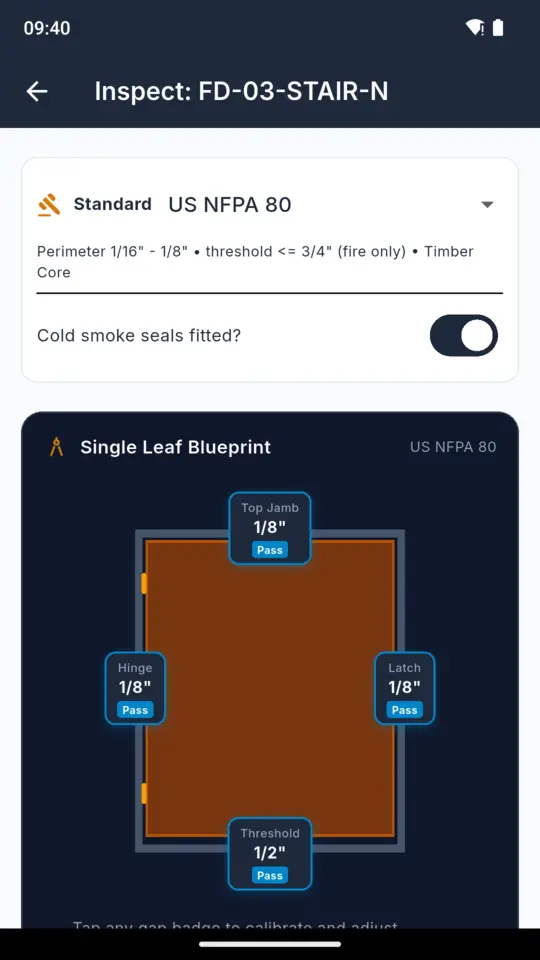
First, what NFPA 80 actually is
NFPA 80 is a consensus standard, not a statute. It carries force where a jurisdiction has adopted it, and the edition adopted is often not the current one. Two buildings a county apart can be inspected to different editions, both correctly.
NFPA 80 can also reach a job by being incorporated into another adopted code, a specification or a contract. So the useful question is never "what does the code say", it is "which edition applies here, how did it get here, and what does it require of this assembly". The figures below are the clearances DoorProof applies. They are a starting point for that conversation, not a substitute for it.
The same caution runs through the app. It compares your reading with the rule set you picked and shows where it falls. It does not determine code applicability, verify an assembly listing, or make the compliance finding. That is yours.
The limits, by where you are measuring
The perimeter readings share one limit and the undercut has one of its own that is six times wider. Mixing the two up is the most common way a gap inspection goes wrong, and carrying the hollow metal tolerance onto a wood leaf is the second.
| Where measured | Wood leaf | Hollow metal leaf |
|---|---|---|
| Top jamb | up to 1/8 in. | 1/16 in. to 3/16 in. |
| Hinge stile | up to 1/8 in. | 1/16 in. to 3/16 in. |
| Latch stile | up to 1/8 in. | 1/16 in. to 3/16 in. |
| Meeting stile, on a pair | up to 1/8 in. | 1/16 in. to 3/16 in. |
| Undercut, bottom of the leaf | up to 3/4 in. | up to 3/4 in. |
The difference between the two columns is the whole point. The wood provision is a maximum. The hollow metal provision is a nominal 1/8 in. with a tolerance of plus or minus 1/16 in. around it, so it has a lower bound as well as an upper one. Newer editions extend that tolerance to certain 20 minute wood doors hung in hollow metal frames, which is why the assembly listing matters and a plain wood-versus-steel split is not the end of it. In DoorProof the leaf material is a field on the door record, so the limits on the blueprint follow the door rather than a setting somebody has to remember to change.
Section references on this page are to NFPA 80 and NFPA 105. Section numbers move between editions, so confirm the edition your authority having jurisdiction has adopted before relying on any of them.
When a gap can be too small, and when that is not a code question
A hollow metal assembly is specified as a nominal 1/8 in. with a tolerance either side, so it has a lower bound as well as an upper one. The usual wood provision has no equivalent. It is a maximum, and a tight wood leaf is not failing a clearance figure the standard sets.
That does not make a tight leaf uninteresting. It binds, drags on the stop, or fails to latch under the closer, and a door that does not close and latch has a serious operational deficiency whatever its gaps measure. A leaf that swells in a damp stairwell reads tight in January and is the same door that will not close in July. All of that is worth raising. It is an observation you make, not a clearance the software can fail the door on.
DoorProof applies a lower bound only where the selected rule supplies one. An earlier version of this page, and of the app, applied the hollow metal minimum to wood leaves as well. That was wrong, and both were corrected.
Readings near the top of a limit still sit inside it, and the app marks them so the next visit knows to look again.
Sixteenths, not converted decimals
The standard is written in fractions, and the fractions are what the inspector's gauge reads. One sixteenth of an inch is 1.5875 mm. Round that to 1.6 mm, which is how the figure is usually quoted, and a gap measured at exactly the minimum now sits below it.
That is not a rounding curiosity. It fails a compliant door, at the bottom of the band, which is precisely where a real reading lands when a fitter has worked to the minimum. DoorProof holds every NFPA band as an exact inch conversion for that reason, and steps readings in sixteenths so the number you enter is the number on the gauge.
It prints the same way. A 1/8 in. gap reads as 1/8 in. on screen and on the report, not as 3.2 mm. Millimetres remain one setting away for anyone who works in them.
Smoke gasketing does not by itself tighten the undercut
This one catches people who have worked to both standards. The 3 mm bottom clearance widely quoted for a smoke door is a BS 8214 convention, and it is not the figure an NFPA rule set applies.
NFPA 80 gives the bottom clearance a maximum of 3/4 in., measured from the bottom of the door to the top of the finished floor or floor covering, and NFPA 105 permits that same 3/4 in. in the smoke door configuration DoorProof is configured for. Adding gasketing does not on its own replace it. What can be more restrictive is everything around it: the adopted building code, an occupancy provision, a leakage-rated assembly, the door's own listing, or the authority having jurisdiction.
Carrying the UK figure into an inspection intended to use an NFPA rule set produces a different result on the reading with the widest limit of the five, so the error is not a small one.
The optional UK rule set, for comparison
DoorProof also ships BS 8214:2016 for inspectors doing commissioned surveys in the UK. The two standards are not blended, and the one an inspection was taken under is stamped on that record.
| Reading | NFPA 80, wood leaf | BS 8214:2016 |
|---|---|---|
| Perimeter gap, wood leaf | up to 1/8 in. | 2 mm to 4 mm, 3 mm nominal |
| Bottom clearance | up to 3/4 in. | up to 10 mm |
| Bottom clearance with smoke gasketing | up to 3/4 in., not tightened by the gasketing | up to 3 mm |
| Unit the reading is entered in | inches, in sixteenths | millimetres |
Because the rule set is recorded with the inspection rather than read live from settings, switching a phone from one to the other leaves anything already filed alone. Earlier results stay tied to the rule set that was selected when they were saved.
Questions
What is the maximum gap around a fire door?
Under NFPA 80 the usual wood leaf provision is a 1/8 in. maximum. A hollow metal leaf is a nominal 1/8 in. with a tolerance of plus or minus 1/16 in., which reaches 3/16 in. at the top of that band. The bottom clearance is separate and allows up to 3/4 in.
Is a gap ever too small?
It depends on the assembly. The hollow metal provision has a tolerance either side of nominal, so it carries a lower bound. The usual wood provision is a maximum only. A leaf packed tight into its frame can still bind or fail to latch, which is an operational observation for you to raise rather than a clearance figure the app can fail it on.
Do smoke seals change the bottom clearance?
Adding smoke gasketing does not by itself replace the NFPA 80 bottom clearance the app is configured with. The 3 mm figure people quote is a BS 8214 convention. Other adopted codes, the assembly listing and smoke control requirements can still be more restrictive.
Is NFPA 80 the law?
No. It is a consensus standard. It carries force where a jurisdiction has adopted it, and the edition adopted is not always the current one. Confirm which edition and which requirements apply with the authority having jurisdiction for your job.
Does the app decide the verdict for me?
It shows where your reading falls against the limit you selected. The inspection and the finding stay yours, and the rule set each result was compared against is recorded with it.
Keep reading
GUIDE
Fire door inspection checklist
The eight sections DoorProof groups the NFPA 80 criteria into, what each one is looking for, and why nothing is a pass until you mark it.
THE APP
DoorProof
The logbook itself: the gap blueprint, the real screens, the report and the deficiency register, and what it costs.
Put the limit next to the reading
Tap the gap on the schematic, set the reading in sixteenths, and see it against the limit before you move to the next door. 14-day full trial, no card. $3.99 a month, $29.99 a year, or $79.99 once.