QURAN LEARNING FOR KIDS

HifzPal icon

HifzPal

Learn, recite, memorise

From the first letter to the first surah.

HifzPal starts a child at alif and stays with them: the Qaida lessons in a qari’s recorded voice, a reader for the whole Quran, and revision that quietly brings each ayah back before it slips. A parent has their own view of how it is going.

Free. No ads, nothing behind a paywall.
Android.

  • Kids & Learning
  • Android
  • Real qari recitation
  • App in 10 languages
The HifzPal launch screen: a child reciting from an open Quran under a lit arch and a crescent moon, with the line Learn, recite, memorize the Quran together

The path through the app

The five tabs along the bottom are in the order a child moves through them. Nothing further along is locked, so an older child who already reads can start at step two.

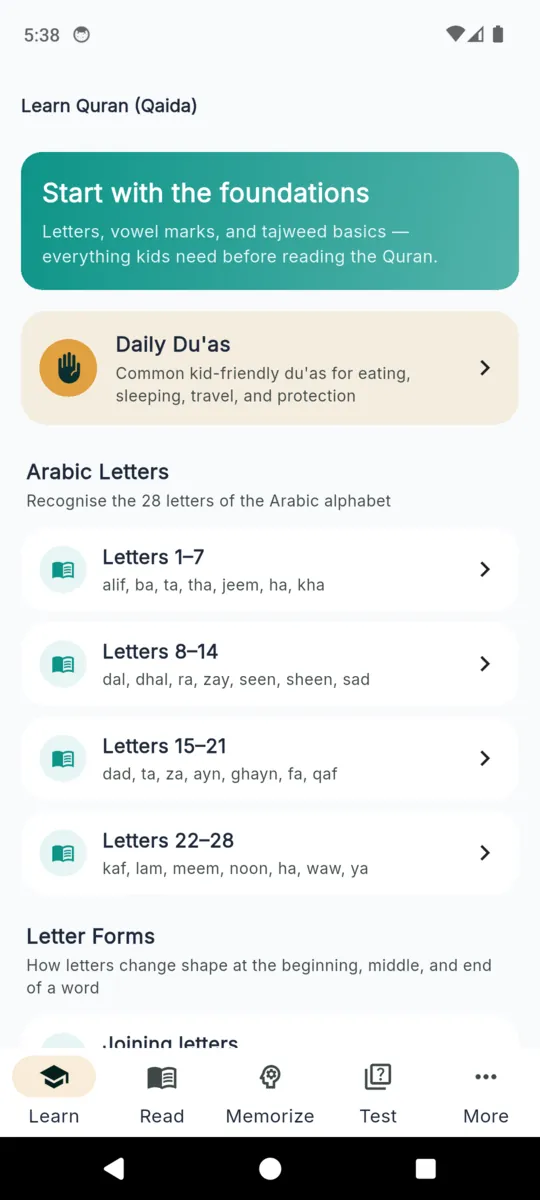
  1. 01 Learn tab

    Learn the letters

    The Learn Quran (Qaida) screen in HifzPal, with a card reading Start with the foundations, a Daily Du’as card, and the Arabic Letters lessons listed as Letters 1 to 7, 8 to 14, 15 to 21 and 22 to 28

    Seventeen Qaida lessons in eight groups: the 28 letters, how they change shape at the start, middle and end of a word, the vowel marks, tanween, shaddah, madd, two tajweed lessons, and three short surahs to try it all on.

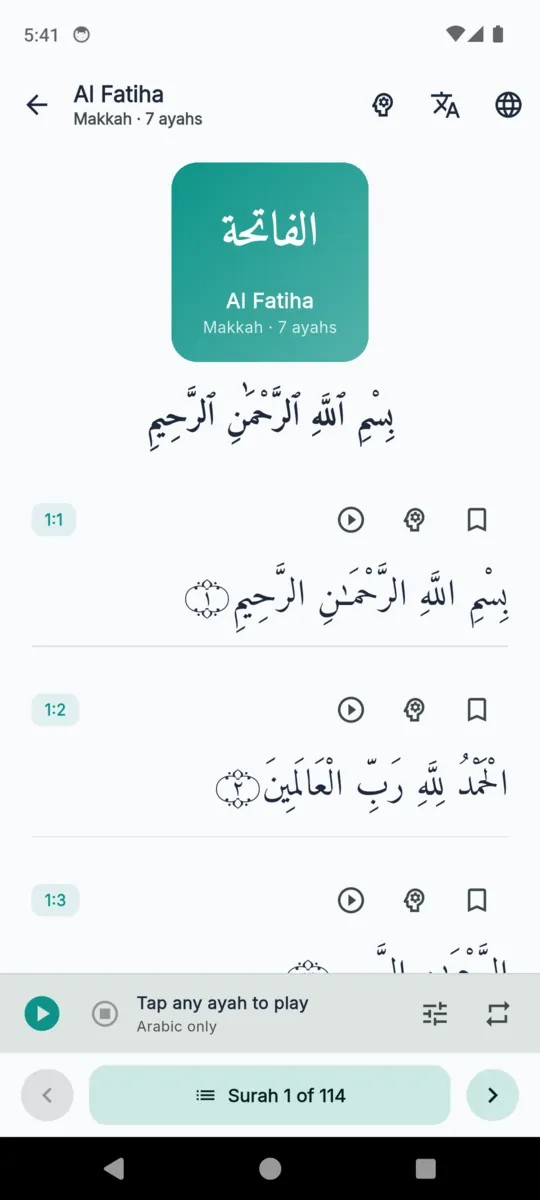
  2. 02 Read tab

    Read a surah

    The HifzPal reader open on Al Fatiha, headed Makkah, 7 ayahs, with the Arabic text set ayah by ayah and an audio bar reading Tap any ayah to play, Surah 1 of 114

    All 114 surahs in the Uthmani Arabic text, stored on the phone. Each ayah has its own play button, bookmark and add-to-revision button, and a translation can sit underneath or be hidden entirely.

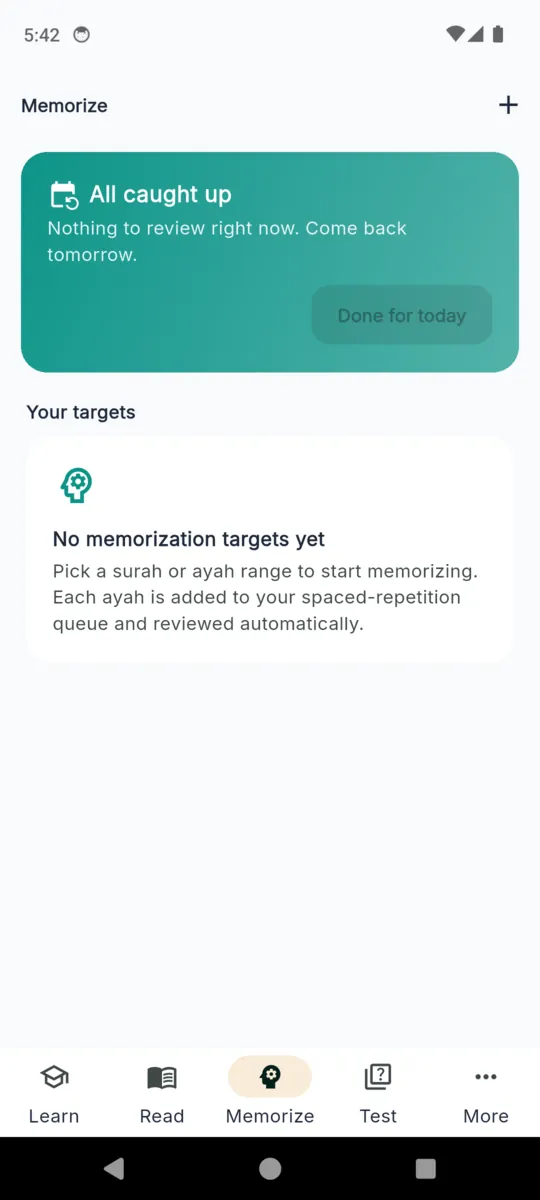
  3. 03 Memorize tab

    Revise what sticks

    The Memorize tab in HifzPal showing an All caught up card reading Nothing to review right now, come back tomorrow, above a Your targets section explaining that each ayah joins a spaced-repetition queue

    Add a whole surah or a range of ayahs, and every ayah gets its own review date. After each one you say how it went, and the next date moves out through 1, 2, 4, 7, 14, 30, 60 and 120 days. When nothing is due, the screen says so and stops asking.

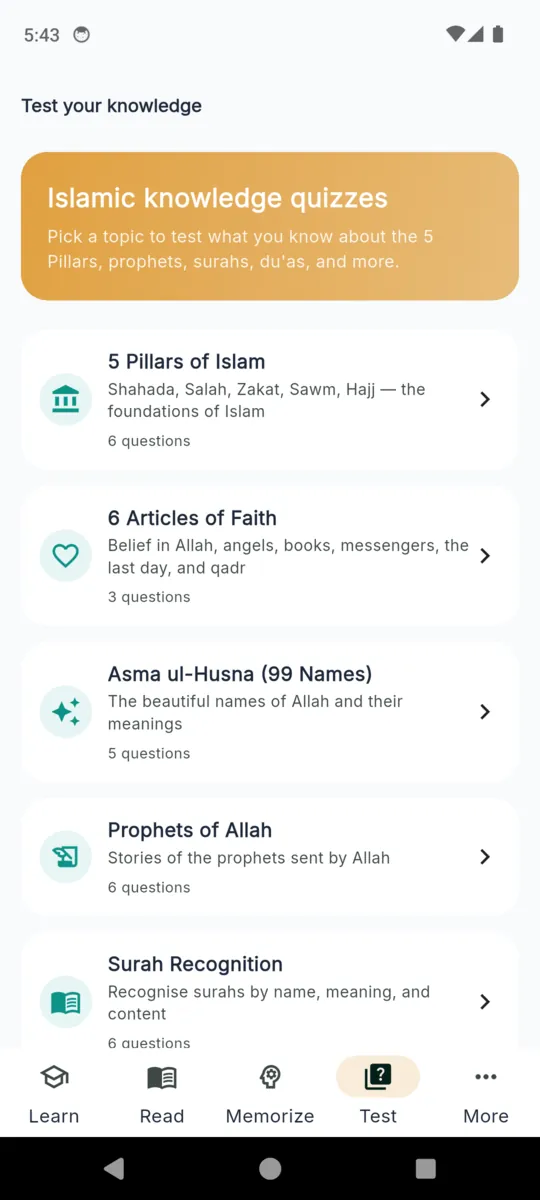
  4. 04 Test tab

    Check what is understood

    The Test your knowledge screen in HifzPal listing quiz topics: 5 Pillars of Islam, 6 Articles of Faith, Asma ul-Husna, Prophets of Allah and Surah Recognition

    150 questions across seven topics: the five pillars, the six articles of faith, the names of Allah, the prophets, recognising surahs, daily du’as, and manners. Multiple choice, one topic at a time, no timer.

How the hifz revision schedule spaces each ayah
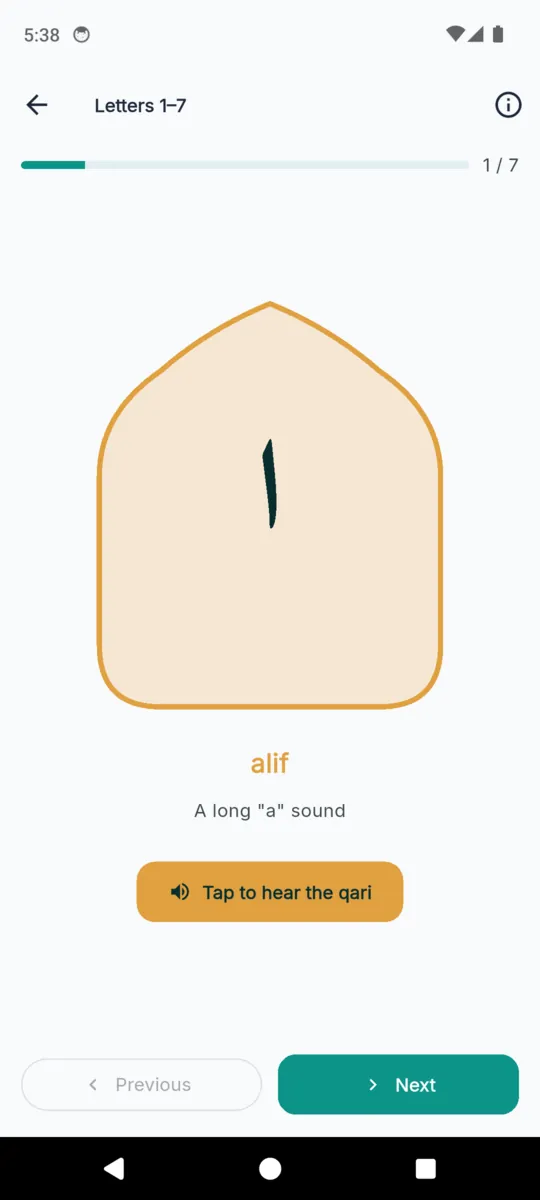
A HifzPal Qaida lesson showing the letter alif alone inside a gold arch, labelled a long a sound, with a gold Tap to hear the qari button and Previous and Next controls

One letter at a time

A lesson shows a single letter inside an arch, names the sound it makes, and offers one button: tap to hear the qari. Seventy-five recordings ship inside the app, so the sound plays instantly and works with the phone in flight mode.

Drill audio is from the Qamar Apps “Noorani Qaida” (CC BY-SA 4.0), recited by Mufti Mohammed Ghiyas Mohiuddin (Madrasa Arabia Hifzul Quraan, India). The same attribution is shown inside the lesson screen. Arabic is never spoken by a synthetic voice anywhere in this app.

What the Noorani Qaida teaches, lesson by lesson
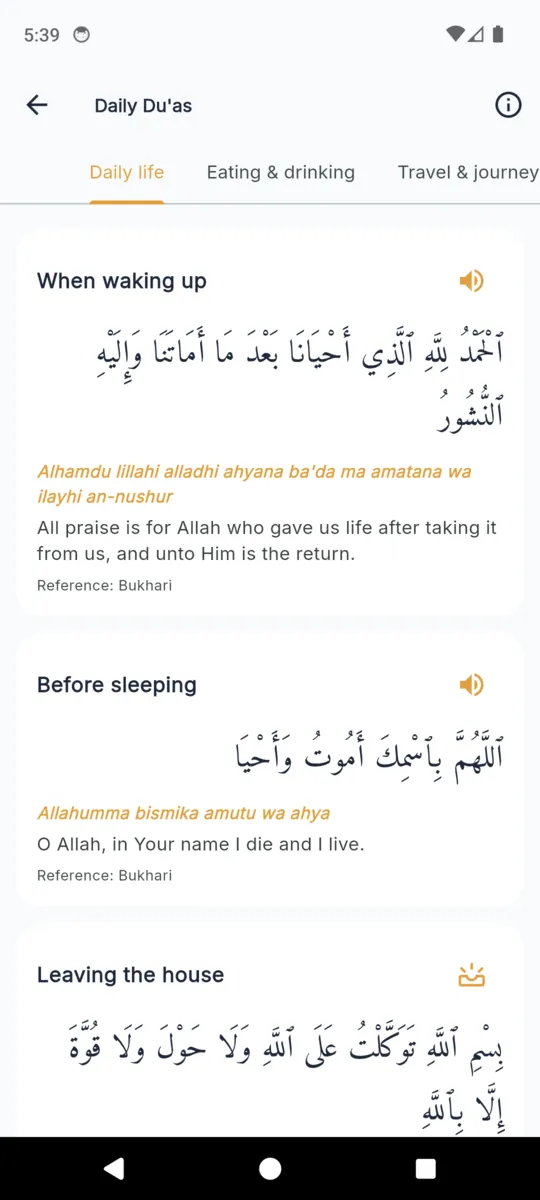
The Daily Du’as screen in HifzPal with tabs for Daily life, Eating and drinking and Travel and journey, showing the du’a for waking up and the du’a before sleeping, each with Arabic, transliteration, English meaning and a reference

The du’as of an ordinary day

Twenty-two du’as in five groups: daily life, eating and drinking, travel, prayer, and protection. Each card carries the Arabic, a transliteration a child can sound out, the meaning in English, and the reference it comes from. Fourteen have a bundled recitation; the ones drawn from the Quran play the qari reciting those ayahs.

The texts are taken from widely-trusted Sunni du’a compilations (Hisnul Muslim, Fortress of the Muslim). The bundled recitations come from Dawat-e-Islami’s “Kalma and Dua” kids app, used with permission for this free non-profit app, and each card’s Arabic matches the recited text.

What the parent sees

A dashboard, not a report card

The parent screen shows the current streak, the longest one and the number of sessions, then how many ayahs are strong, how many are still being learned, and how many are due today. Under that sit the ayahs that keep being missed, so you know what to sit down and go over together.

Focus mode

Set a four-digit passcode and a session length, and HifzPal pins itself to the screen for that time using Android’s own screen pinning. Leaving early needs the passcode. In the app’s own words: best paired with supervision, not a guaranteed kiosk.

Encouragement without pressure

Ten achievements mark real moments: finishing the Qaida foundations, a first surah memorised, ten ayahs, fifty, a hundred. There is no leaderboard, no ranking against other children, and nothing is taken away for a missed day.

Nothing leaves the phone

Progress, revision dates, bookmarks and quiz results are kept on the device. There is no account to make, no profile to fill in and no child data to hand over.

What needs a connection, and what does not

Worth knowing before a car journey, so here it is plainly.

Already on the phone

  • The Uthmani Arabic text of all 114 surahs
  • Every Qaida lesson and all 75 drill recordings
  • The du’as and their 14 bundled recitations
  • Your revision queue and every review date
  • All 150 quiz questions
  • Streaks, achievements and the parent dashboard

Fetched when you ask for it

  • Full-ayah recitation, streamed from everyayah.com
  • Word-by-word recitation audio
  • A translation the first time you open a surah in it — after that it is kept and reads offline

Six reciters

Pick the voice your child is used to hearing. Whichever is set is the one the reader and the revision screen use.

  • Mishary Alafasy
  • Abdul Basit (Murattal)
  • Abdul Rahman Al-Sudais
  • Mahmoud Khalil Al-Husary
  • Mohammed Siddiq Al-Minshawi
  • Saad Al-Ghamdi

Ten translations, each one named

A translation is a translation, so HifzPal never shows one without saying whose it is. All ten come from Quran.com, and the translator sits beside the language when you choose it.

  • English Saheeh International
  • English Mufti Muhammad Taqi Usmani
  • English Prof. M.A.S. Abdel Haleem
  • English Marmaduke Pickthall
  • Urdu Mufti Muhammad Taqi Usmani
  • Urdu Maulana Muhammad Junagarhi
  • Indonesian Indonesian Ministry of Religious Affairs
  • Turkish Diyanet İşleri Başkanlığı
  • French Muhammad Hamidullah
  • Arabic Tafsir al-Muyassar — a tafsir, not a translation

Tafsir al-Muyassar is published by the King Fahd Quran Printing Complex. It explains the Arabic in Arabic, so it is offered as a tafsir and labelled as one.

If you would like to support it

HifzPal is free for every family and stays that way. Under More there is a Support screen with three one-time gifts and a monthly one. None of them unlock anything, because there is nothing locked: the Qaida, the reader, the revision, the quizzes, the parent dashboard and focus mode are all open the moment the app is installed.

The app’s own wording: it has no ads and no paywall, and donations fund development so it stays free for every family. Using it and never giving anything is completely fine.

Questions

Does my child need to read Arabic already?

No. HifzPal starts at the 28 letters. The Qaida section runs through the letters, how they change shape when joined, the vowel marks, tanween, shaddah, madd and two tajweed lessons, then three short surahs to practise on.

Is the recitation a real reciter or a computer voice?

A real reciter throughout. The Qaida drills are recorded by Mufti Mohammed Ghiyas Mohiuddin and ship inside the app. Full ayahs are streamed in whichever of six qaris you choose. Arabic is never read by a synthetic voice.

How does the revision work?

You add a surah or a range of ayahs, and each ayah gets its own review date. After a review you say how it went: missed, hesitated or clean. Clean pushes the next review further out, through 1, 2, 4, 7, 14, 30, 60 and 120 days. Missed brings it back to tomorrow.

What can a parent see and control?

A dashboard with the streak, how many ayahs are strong, learning or due today, which ayahs keep being missed, recent quiz results and achievements. Focus mode pins the app to the screen for a set time behind a four-digit passcode. The app itself says it is best paired with supervision and is not a guaranteed kiosk.

Does it work without internet?

Mostly. The Arabic text, every Qaida lesson and its recording, the du’a recordings, the quizzes and your revision schedule are all on the phone. Full-ayah recitation and a translation you have not opened before need a connection; translations are kept once fetched.

Is anything paid for or advertised?

No. There are no ads, nothing is locked and there is no account. A Support screen offers optional gifts, and they unlock nothing because everything is already open.


Start at alif

Install it, open the Learn tab, and the first lesson is one letter and one button. Everything after that is already there when your child is ready for it.