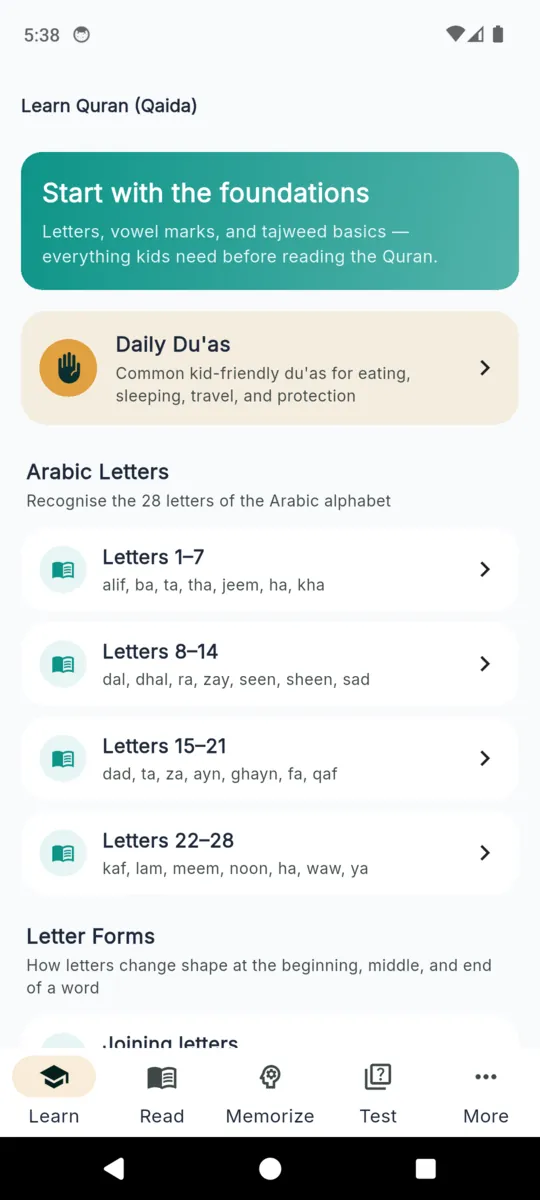
What is the Noorani Qaida?
+
It is the beginner primer used in maktabs and madrasas to teach reading Quranic Arabic before a child opens the mushaf. It works up in small steps: the letters, how they change shape when joined, the vowel marks, tanween, sukoon, shaddah, elongation, and a first look at tajweed.
How is it normally taught?
+
By ear, in short sittings, with a teacher. The teacher says the sound, the child repeats it, and the same drill comes round again until it is steady. Very little of it is explanation — most of it is hearing and saying.
What does HifzPal actually include?
+
Seventeen lessons in eight groups: the 28 letters over four lessons, joined letter forms, the three vowel marks and sukoon, the three tanween, shaddah, madd, two tajweed lessons, and three short surahs to try it all on. Eighty cards in all.
Whose voice is on the recordings?
+
The letter and drill recordings are from "Noorani Qaida" by Qamar Apps, recited by Mufti Mohammed Ghiyas Mohiuddin (Madrasa Arabia Hifzul Quraan, India), used under Creative Commons Attribution-ShareAlike 4.0. Arabic is never read by a synthetic voice in HifzPal.
Does it work without a connection?
+
The Qaida section does. All 75 drill clips are bundled inside the app, along with the practice surah recitation, so a lesson plays with the phone in flight mode.
Does the app check whether my child is reading correctly?
+
No. It plays the sound and marks a lesson complete when you tap the button; it does not listen, score or correct anything. It is a practice tool to use alongside a teacher, not in place of one.