Missed
- Strength
- Back to the first step
- Next review
- Tomorrow
You could not get through it, or you needed the page. The ayah starts its climb again from the bottom.
HIFZ REVISION SCHEDULE

HifzPal
Hifz revision schedule
HifzPal gives every ayah you are working on its own review date, then moves that date according to how the review actually went. Lines that are solid step back out of the way. Lines that wobble come round again sooner.

Free. No ads, nothing behind a paywall.
Android.
Anyone who has memorised a page knows the shape of the problem. Getting it in takes an afternoon. Keeping it takes years, and the failure is invisible while it is happening — a line does not announce that it is going, it is simply not there the next time you reach for it. Revision, murajaah, is the actual work of hifz, and the whole question is how to spend a limited amount of it.
Revising everything every day is the honest answer and quickly becomes impossible; by ten juz it is more time than anyone has. Revising whatever you happen to think of is the common answer, and it systematically over-visits the pages you like and under-visits the ones you find hard, which are the pages that need it. Spacing is a third option: meet each line again shortly before you would have lost it, and stretch the gap every time it holds.
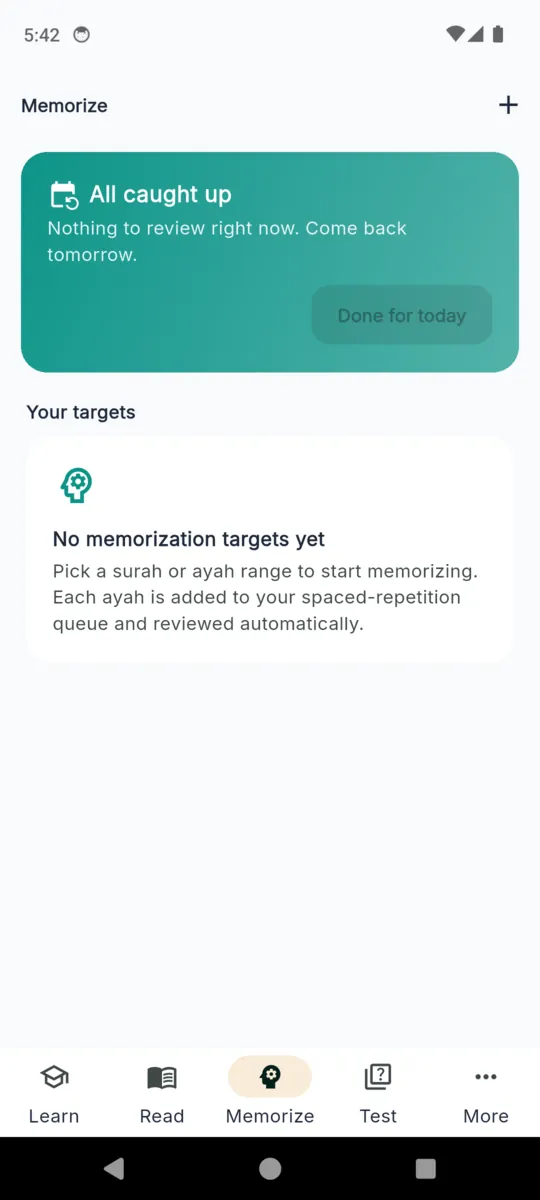
That is all HifzPal's memorise tab is. It keeps a date against every ayah you have added and shows you the ones that have come due today. On a day when nothing has, it says so and asks nothing of you.
AFTER EACH AYAH
The app reveals the ayah, waits, and then asks. It does not listen to you recite and it does not score anything — the grade is yours, and it is the only input the schedule has.
You could not get through it, or you needed the page. The ayah starts its climb again from the bottom.
It came, but slowly. The step is not lost; the ayah simply comes back sooner than it would have. Never sooner than a day.
It came without effort. The gap widens, and the ayah takes up less of tomorrow.
Being honest with the middle button is what makes the whole thing work. Marking a shaky ayah clean pushes it a month away, and you will meet it again having lost it.
Each ayah sits on one of eight steps, and the step decides how far away the next review is. A clean review moves it up one. These are the intervals as shipped.
Assume it goes perfectly: you add the ayah today, it is due immediately, and every review after that is clean. Seven reviews take it roughly eight months out.
| Review | Happens on | Next gap | Comes back |
|---|---|---|---|
| 1st | Day 0 | 2 days | Day 2 |
| 2nd | Day 2 | 4 days | Day 6 |
| 3rd | Day 6 | 7 days | Day 13 |
| 4th | Day 13 | 14 days | Day 27 |
| 5th | Day 27 | 30 days | Day 57 |
| 6th | Day 57 | 60 days | Day 117 |
| 7th | Day 117 | 120 days | Day 237 |
After that it stays on the top step and returns every 120 days. A single missed review sends it back to the first step and it climbs again — which is the mechanism, not a punishment. Hesitated is the middle path: the ayah keeps its step and comes back at half the gap, so an ayah sitting on the 14-day step returns in seven days rather than starting over.
Alongside review there is a practice screen for the ayahs you are still learning, with hide modes that take away the translation, the Arabic, or just the vowel marks, so you can lean on progressively less. Each ayah there carries a plain label as its step climbs: new, learning, familiar, and memorized once it reaches the last two steps.
The parent dashboard turns the same records into the two questions a parent actually asks: is anything due today, and which ayahs keep going wrong. It shows how many ayahs are strong and how many are still being learned, lists the ones last graded as missed with how many times they have been reviewed, and carries the streak, recent quiz results and achievements.
That last list is the useful one. An ayah that has been reviewed nine times and is still being missed is not a discipline problem, it is a line that needs a teacher to look at it — and it is exactly the ayah a child would never volunteer.
None of this is a judgement of anyone's recitation. The app records what a child told it about their own review and nothing more. It cannot hear whether an ayah was recited correctly, and it does not try to.
Hifz has been taught for a very long time without any of this. The established pattern is a daily structure worked with a teacher: a new portion, the recent portion, and a rotating share of everything older, recited aloud to someone who can hear the mistakes. That method has produced every hafiz who has ever lived, and nothing on this page improves on it.
Spaced repetition is a different tool, and it is good at a narrower thing: deciding what to look at on your own, between lessons, when the amount you are carrying has outgrown what you can hold in your head. It is bookkeeping. It does not correct pronunciation, it cannot tell whether an ayah was recited well, and it has no view on how a child should be taught.
If a teacher has given a revision plan, follow the teacher. HifzPal is there for the days in between, and it is free, without ads, with nothing held back behind a payment.
Instead of revising everything you have memorised every day, each ayah carries its own next-review date. An ayah you keep getting right comes back less and less often; one you stumble on comes back sooner. The point is to meet a line again just before it would have slipped.
Eight steps: 1, 2, 4, 7, 14, 30, 60 and 120 days. An ayah moves up one step each time you mark it clean, and stays at 120 days once it reaches the top.
Three buttons after each ayah: Missed, Hesitated or Clean. You report it yourself — the app does not listen to your recitation and does not judge it.
It drops back to the first step and is due again tomorrow. Hesitated is gentler: the ayah keeps its step, but the next review comes at half the current interval, rounded up, and never sooner than a day.
No. The traditional pattern is a daily portion structure — new lesson, recent revision, older revision — worked with a teacher. Spaced repetition is a different approach that suits self-paced revision between lessons. HifzPal offers the second and is not a substitute for the first.
No. A target can be a whole surah or any range of ayahs, and every ayah in that range gets its own schedule from the day you add it.
Add one surah and see what comes back tomorrow. Free, with no ads and nothing held back.