How the appliance is handled
Something carried, dragged and dropped ages faster than something bolted to a bench. Handling is the single strongest signal in the list, which is why handhelds sit near the top of every published table.
PAT TESTING INTERVALS
The short answer nobody wants: there is no legal PAT testing frequency in the UK. The duty is to maintain equipment so it does not cause danger, and how often you inspect and test to achieve that is a judgement made from risk. Published intervals are guidance to start from, not a number to comply with.
Back to PATBook →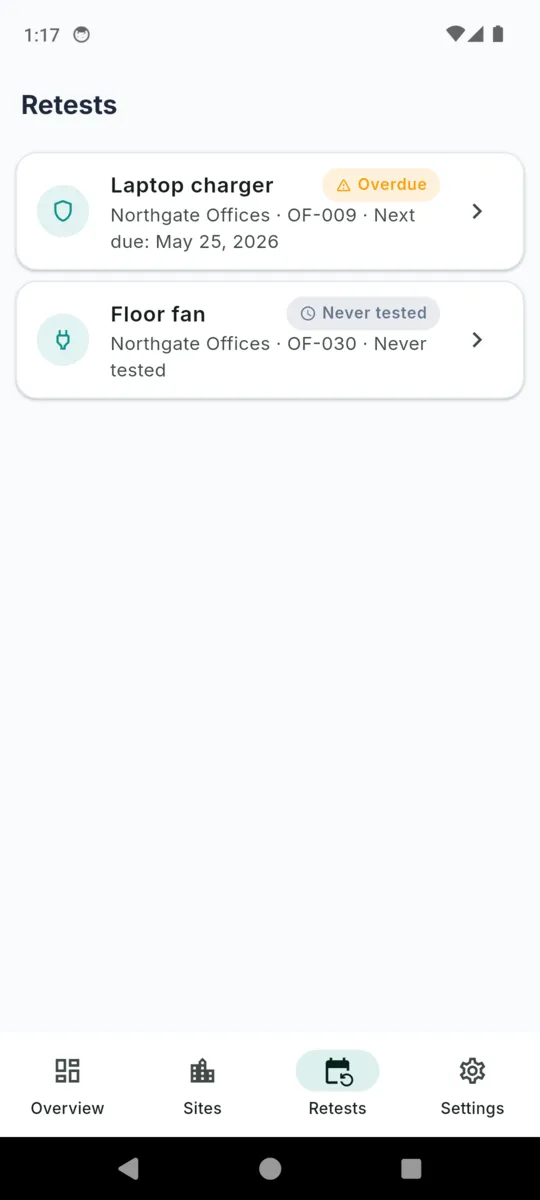
Portable appliance testing sits under general electrical safety duties, which say equipment must be maintained in a condition that prevents danger. They do not name a month, a class or an appliance. The frequency is left to the duty holder because the same kettle is a different risk in an office kitchen and on a building site.
That gap is what the IET Code of Practice and HSE guidance on maintaining portable electrical equipment exist to fill. Earlier editions of the Code carried a table of fixed frequencies, which is where most of the numbers circulating online come from; the fifth edition moved away from it in favour of intervals set by the responsible person from risk, with the initial figures treated as a starting point to be reviewed against what testing actually finds.
In practice this means two things. Anyone quoting you a legal interval is repeating a table, not a law. And an interval you can explain (from the environment, the handling, the users and the history) is defensible in a way that “we always do it annually” is not.
This page is general information, not legal or safety advice. The figures below are the starting points PATBook ships with, not requirements. Your own control scheme is set by a competent person and your own risk assessment, following the current IET Code of Practice.
PATBook ships these as chips on the test form, so the common case is one tap and the unusual case is a typed number. Every one of them is a suggestion, and the app says so in the same line: risk-based guidance, not a legal requirement.
3 months
Construction 110V
Site transformers, task lights, breakers and the tools plugged into them. Hard use, wet and dusty, moved daily, plugged and unplugged by whoever is nearest.
6 months
Class I handheld
Earthed tools carried around and used in the hand: the flex is flexed, the plug takes knocks, and the earth path is the thing keeping the user out of trouble.
12 months
Class II handheld
Double-insulated handhelds. Same handling, no earth to lose, so the same use pattern sits on a longer clock.
24 months
Office / IT
Monitors, chargers, desk kit. It sits on a desk in a dry room, is rarely unplugged, and is used by people who are not moving it about.
48 months
Stationary / low-risk
Things that are put somewhere once and stay there. Nothing about them changes between visits except dust.
A sixth option on the same row is Custom, which takes any number of months. The interval you pick is stored on the test itself, so an appliance whose risk changed is recorded as having changed rather than quietly re-dated.
Six things do most of the work. None of them produces an arithmetic answer; together they produce an interval you can write down and stand behind.
Something carried, dragged and dropped ages faster than something bolted to a bench. Handling is the single strongest signal in the list, which is why handhelds sit near the top of every published table.
A dry office is not a wet plant room, a kitchen, a workshop or a building site. Damp, dust, heat and traffic all move the answer.
Staff who know the kit, members of the public, hire customers, or nobody in particular. The less the user has to lose by carrying on with a damaged lead, the shorter the interval usually gets.
A Class I appliance has an earth to keep intact, so it is checked for earth continuity. A Class II appliance has none and is judged on insulation. A Class III appliance takes neither reading.
A history is a risk assessment nobody had to write. An asset that keeps coming up marginal earns a shorter interval; a cupboard full of untouched kit that has passed four times running is the argument for a longer one.
User checks, formal visual inspections and a maintenance regime all sit alongside the electrical test. Intervals are set for the whole scheme, not for the meter reading on its own.
Review runs the other way too. If a full round of testing finds nothing on a class of equipment for several cycles, that is evidence for lengthening the interval, the same evidence that would shorten it had the results gone the other way.
Nothing clever, but the edge cases matter when a spreadsheet is doing it and nobody is checking.
| Step | What happens |
|---|---|
| Interval chosen | A preset chip or a typed number of months, stored against that test rather than against the appliance. |
| Date computed | Months are added to the test date, with the day-of-month clamped: a test on the 31st of a month gives a due date on the last day of the target month, never in the month after it. |
| Date overridden | The next-due date is editable on the test. Set it to whatever the risk assessment says and the interval you picked stays recorded alongside it. |
| Appliance updated | The appliance carries the date from its most recent test, which is what the register and the retest list read. |
| Flagged | Anything inside thirty days shows as due soon and anything past its date as overdue, on the overview and on the Retests screen across every site. |
| Reminded | With reminders on, one notification is armed per appliance for its own due date and re-armed whenever a test is logged, so re-testing early never leaves a stale alert behind. |
An appliance that has never been tested is treated as needing attention rather than being left off the list, and one taken out of service drops off it entirely while keeping its history.
The date you set is not just a diary entry. It prints in the last column of the test certificate, and it is the column the asset register sorts on, so the register always opens on whatever falls due first.
The register PDF carries the same sentence in its page footer that the app shows on the form: retest intervals are risk-based guidance, not a legal requirement. That line is there so the document cannot be read as a schedule someone else imposed, which is exactly what an interval is not.
Background reading and the relevant guidance are collected on the PATBook resources page.
There is no legal interval. UK electrical safety law requires equipment to be maintained so it does not cause danger, and leaves the frequency of inspection and testing to a risk assessment. Published tables are guidance, not a rule.
No. A yearly cycle is common because it is easy to administer and it suits a lot of equipment, but nothing makes it the correct answer. Some things justify three months, others four years.
From the IET Code of Practice and HSE guidance on maintaining portable equipment. The fifth edition of the Code moved away from a fixed frequency table towards intervals set by the duty holder from risk.
Five starting points: three months for construction 110V, six for Class I handhelds, twelve for Class II handhelds, twenty-four for office and IT, and forty-eight for stationary low-risk. Every one is editable, and any other number can be typed in.
Yes. Choosing an interval fills the next-due date in; you can then change that date directly, so a risk assessment that says something else always wins.
A Retests screen lists everything overdue, due within thirty days or never tested, across every site at once. Turn on reminders in Settings and the phone tells you before the customer does.
General information about portable appliance testing practice, not legal or safety advice. No interval on this page is a legal requirement. Test methods, pass limits and retest intervals must follow the current IET Code of Practice and your own risk assessment. PATBook reduces the paperwork around testing; it does not carry out a test, decide a result, or guarantee that any appliance is safe.
Pick an interval on the test, edit the date if the assessment says otherwise, and let the phone tell you when it comes round. £2.99 a month, £29.99 a year, or once for £24.99 on Android (£74.99 on iPhone), with an optional 14-day trial on Android that starts when you choose, no card.