ShoeMile
Running Shoe Mileage Tracker
Track mileage. Rotate pairs. Know exactly when to retire each shoe. Standalone — works with whatever you already use.
How It Works
Add your shoes
Brand, model, purchase date, price, target lifespan. Snap a photo so you can spot the pair in your closet.
Log miles in 3 taps
After every run, open Quick-Log, drag the slider, pick a pair. Pull miles from Garmin, Strava, or a paper notebook.
Get retire alerts
Warned at 80% wear, again at 100%. Retire the pair, move to the next. No more running on dead foam.
ShoeMile in Action
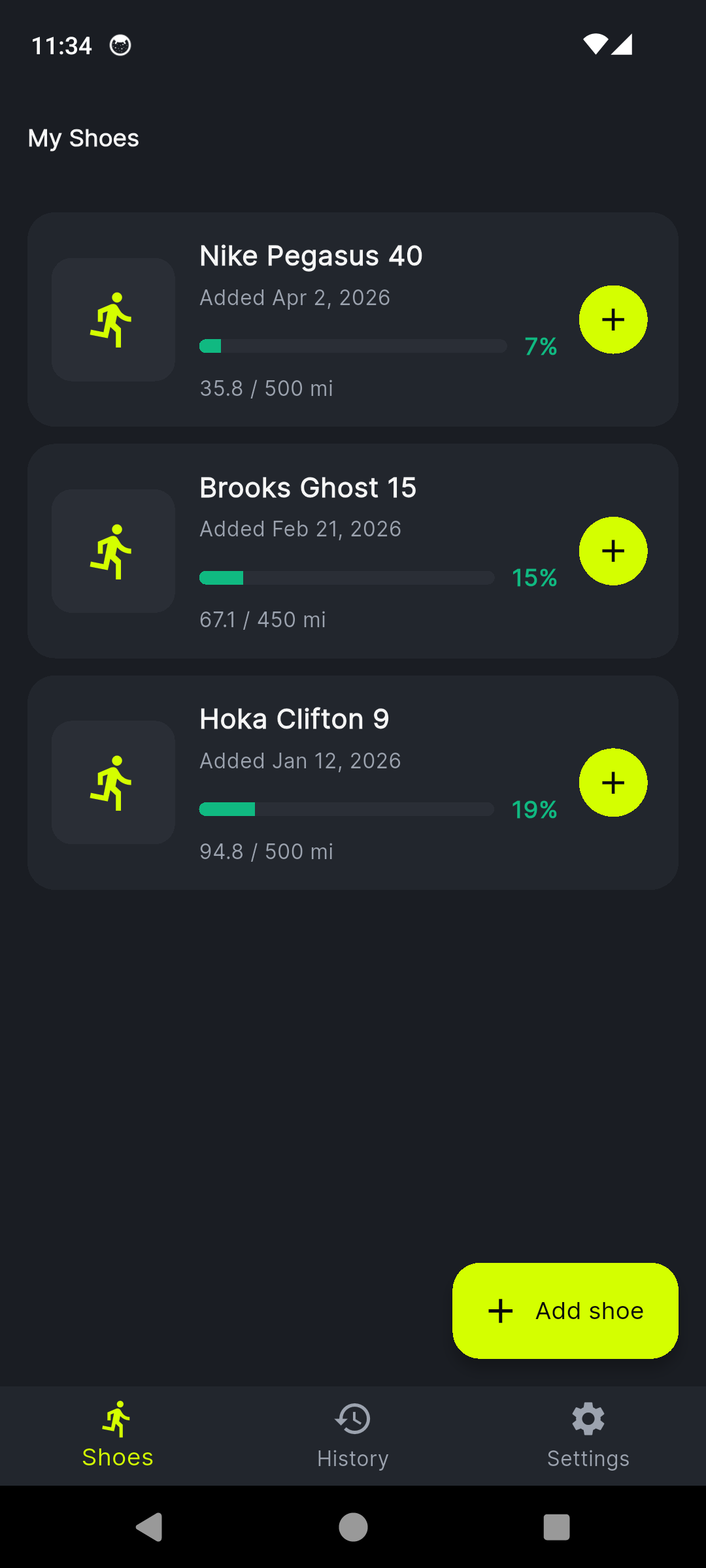
Home — every pair, live wear bars
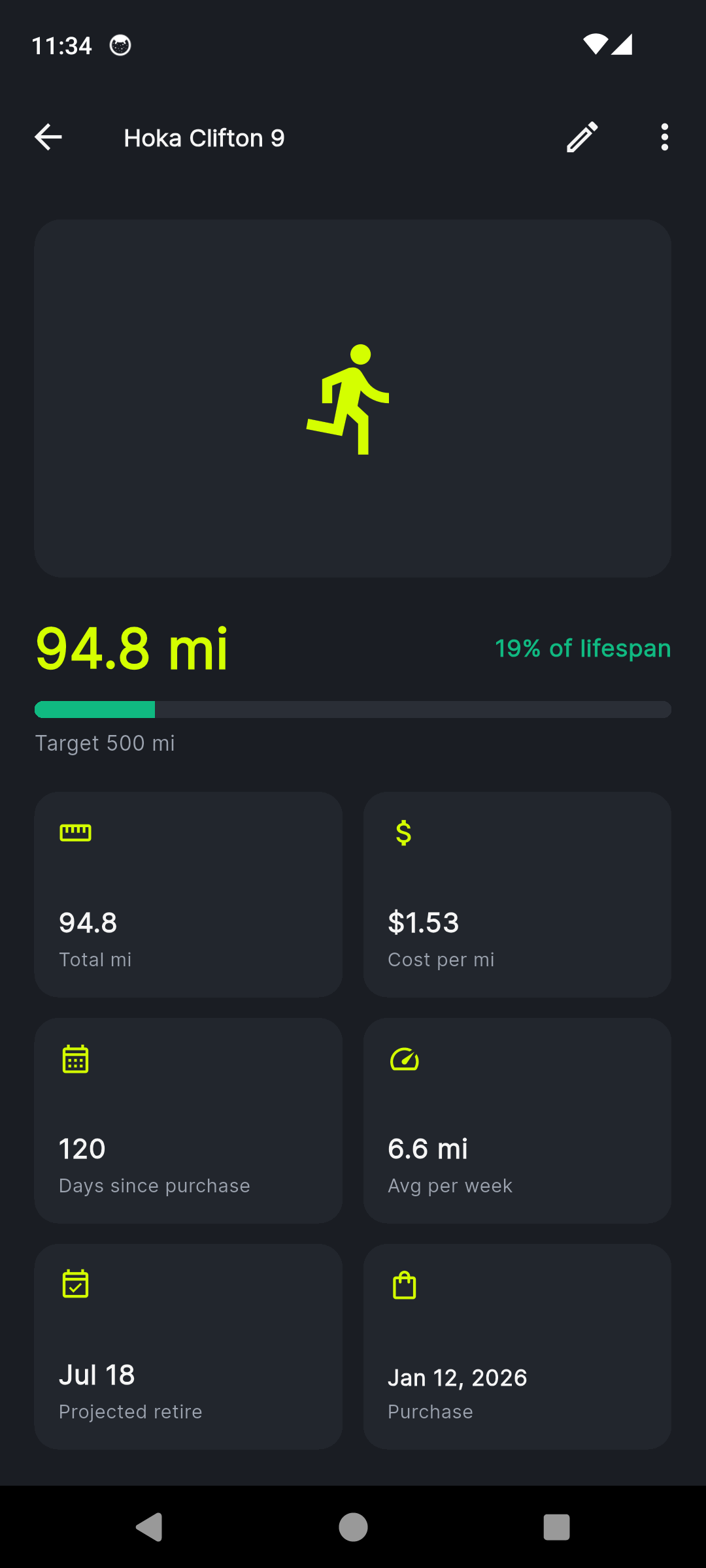
Detail — miles, lifespan %, $ per mile
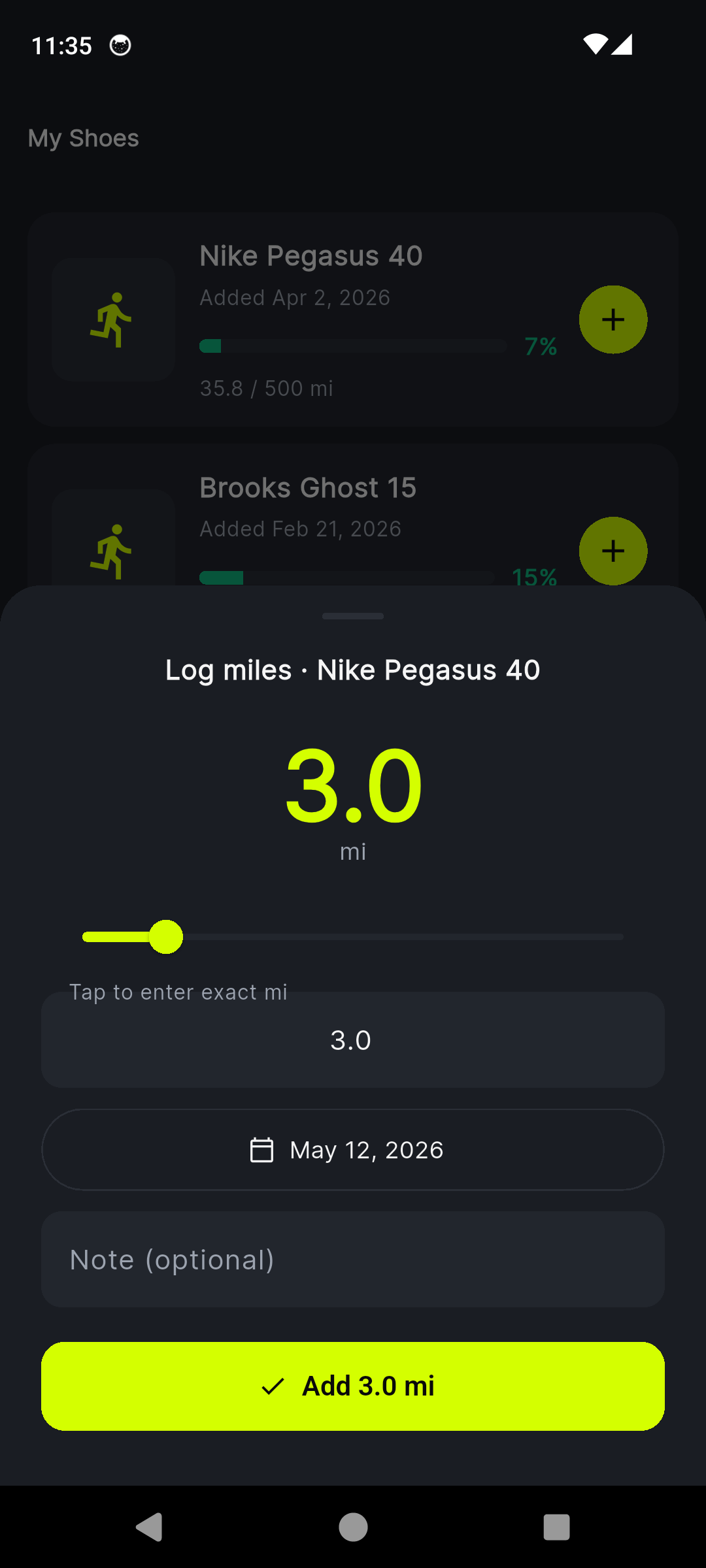
Quick-Log — slider, save, done
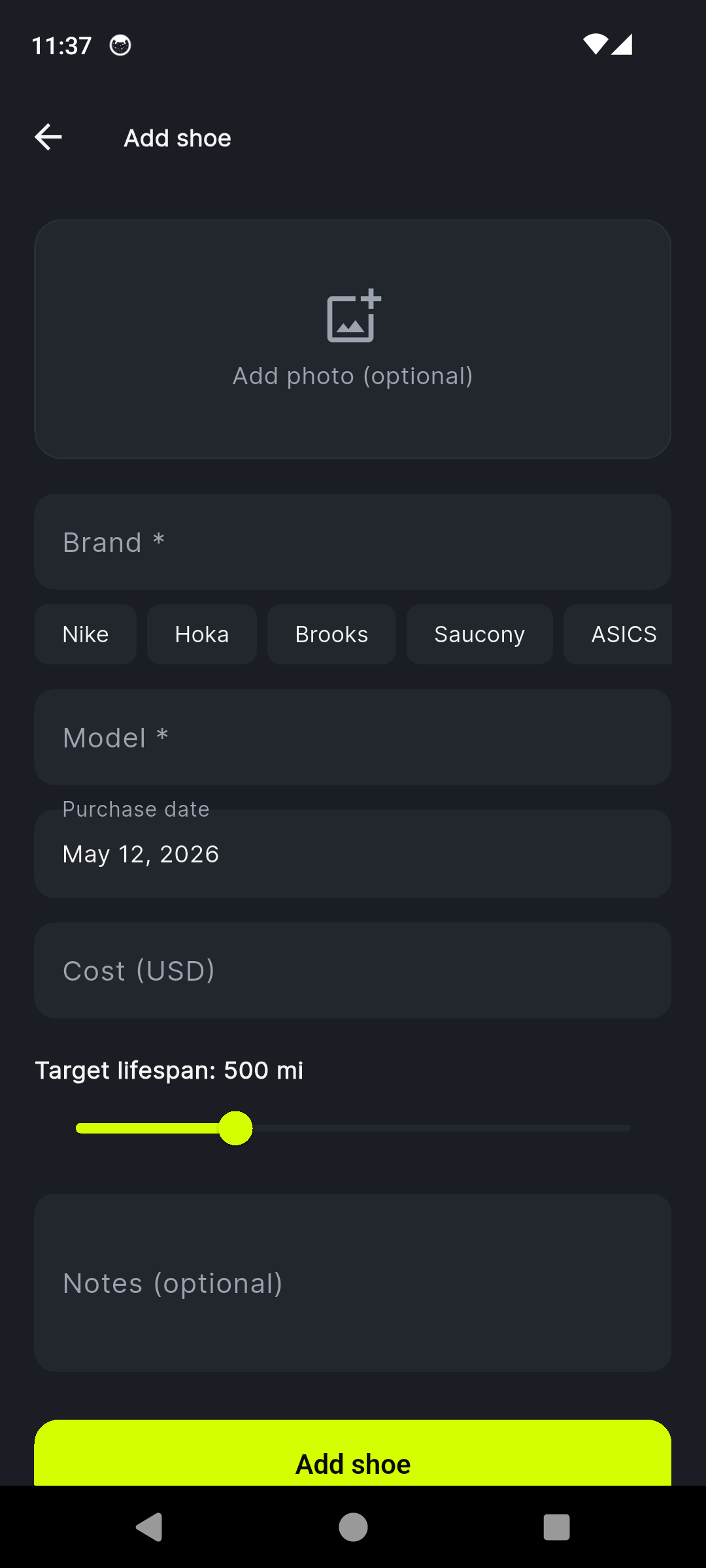
Add Shoe — brand chips, lifespan
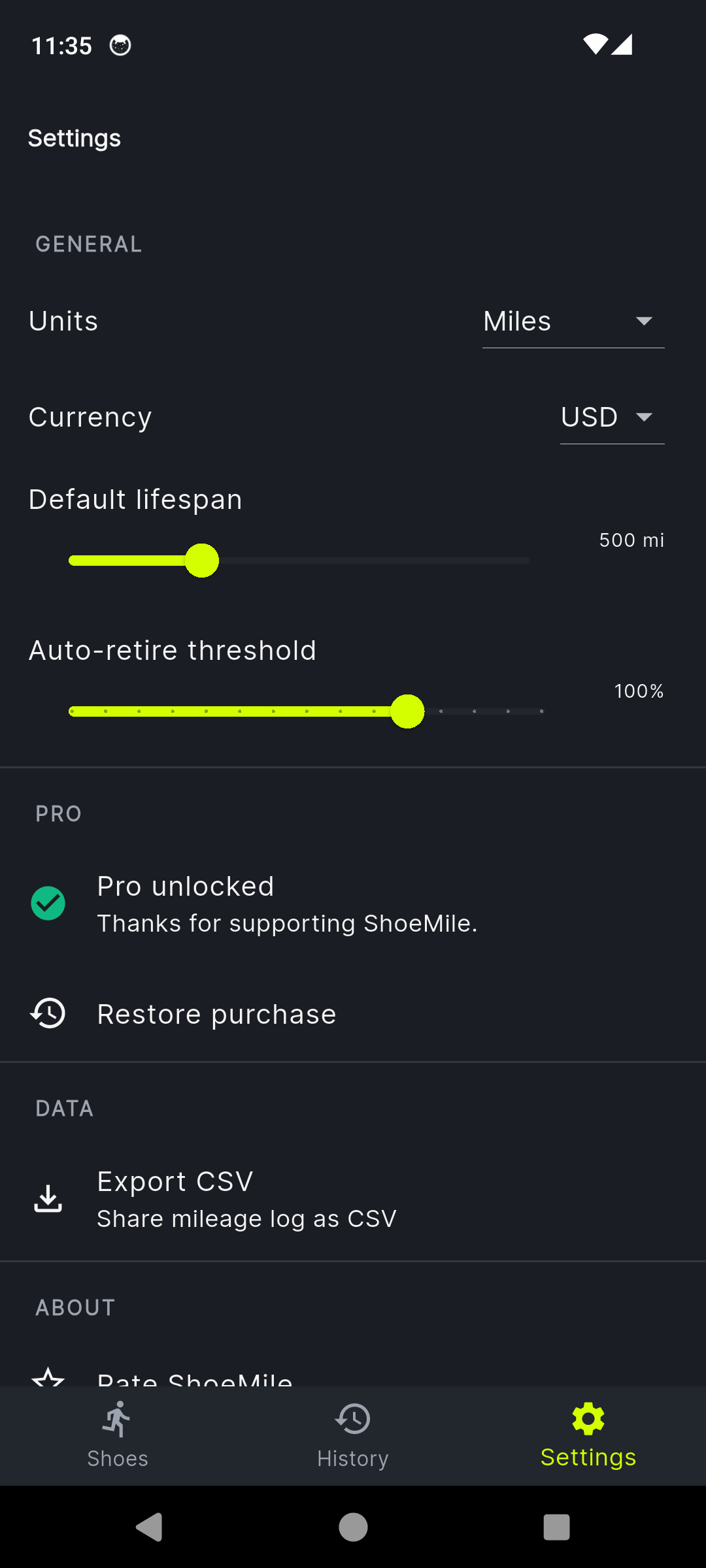
Settings — units, currency, Pro

History — every retired pair
Built for Runners, Not Trackers
Home Dashboard
Every active pair with live wear bar, mileage, and projected retirement date. Filter by road, trail, race, trainer. Tap a card to drill into stats.
Shoe Detail
Per-pair stats grid — total miles, lifespan %, cost-per-mile, weekly average, projected retirement based on your current pace.
Quick-Log Mileage
After every run, open the slider sheet, drag to the run distance, tap save. Three taps. Pull miles from any source — Garmin, Strava, watch, notebook.
Add Shoe
Brand chips for Nike, Hoka, Brooks, Asics, Saucony, Adidas, New Balance. Purchase date, price, target lifespan, optional photo. Categorise by road/trail/race.
Settings
Miles or kilometres. USD, GBP, EUR, AUD, INR currency. Default lifespan per shoe type. Light or dark theme. Restore Pro purchase.
History
Every retired pair side by side — total miles served, weeks owned, final cost-per-mile. See which shoes lasted, which died early.
Retirement Reminders
Smart alerts at 80% wear (start watching for a replacement) and 100% (retire today). Customise per shoe — trail shoes wear faster than road.
Multi-Pair Rotation
Juggle 3, 5, even 10 active pairs. Free tier supports 2; Pro unlocks unlimited. Rotation is proven to extend total shoe life by 20–40%.
Simple, Honest Pricing
No subscription. Pay once, own it forever.
Free
Up to 2 active shoes
- Quick-Log slider
- Live wear bars
- Retire alerts at 80% & 100%
- Cost-per-mile stats
- Shoe history
- Miles or kilometres
- Banner ad on Home
ShoeMile Pro
One-time purchase — yours forever
- Everything in Free, plus:
- Unlimited active shoes
- CSV export
- Ad-free
- Multi-pair rotation
- Priority support
- Lifetime — no subscription
One pair of $140 running shoes ruined by 100 extra miles costs more than Pro fifty times over. ShoeMile pays for itself the first time it stops you running on dead foam.
Common Questions
Frequently Asked Questions
When should I retire my running shoes?
The widely cited rule is 300–500 miles, but the real answer depends on your weight, gait, the shoe's foam (EVA vs PEBA vs supercritical), and the surface you run on. ShoeMile lets you set a custom lifespan per shoe and warns you at 80% wear and again at 100%. Lighter runners on softer surfaces often get 500+ miles; heavy heel-strikers on concrete sometimes need to retire at 250.
How is this different from Strava or Garmin shoe tracking?
Strava buries shoes three menus deep and only logs miles from activities recorded inside Strava. Garmin requires a Garmin watch and ties shoes to Garmin Connect. ShoeMile is standalone — log miles from any source (Garmin, Apple Watch, Coros, Polar, Strava, paper notebook) in three taps. It works for cross-platform runners who don't want to be locked into one ecosystem.
Can I track multiple pairs at once?
Yes — that's the core use case. The Home dashboard shows every active pair with a live wear bar, projected retirement date, and cost-per-mile. Free tier supports 2 active pairs; Premium unlocks unlimited so you can rotate trainers, race-day shoes, and trail shoes side by side.
Does it pull miles from Strava or Garmin automatically?
Not in v1 — ShoeMile is intentionally a manual logger. After every run, open the Quick-Log sheet, drag the slider, pick a pair, save. Three taps. The trade-off is no API drama, no broken sync, no battery drain from a GPS your watch is already running. The runners who asked for this app explicitly wanted it standalone.
Does it work for trail shoes too?
Yes. Trail shoes typically wear out faster (200–400 miles is common with aggressive lugs and rocky terrain), so set a shorter lifespan when you add the shoe and ShoeMile will warn you earlier. You can categorise pairs as road, trail, race, or trainer and filter the Home dashboard by category.
Is there a subscription?
No. ShoeMile Pro is a single $2.99 one-time purchase. Unlocks unlimited shoes, CSV export, and removes the banner ad. One payment, lifetime access. The free tier already includes the full tracking math — Pro just removes the cap and the ad.
Does it work offline?
Completely. All shoe data and mileage logs live on your device. No account, no cloud sync, no analytics on your run data. Works on a flight, on a trail with no signal, in a basement gym — anywhere. The only network calls are anonymous crash reports and the AdMob banner on the free tier.
What about cost-per-mile tracking?
Enter the purchase price when you add a shoe and ShoeMile tracks your running cost-per-mile as you log runs. A $160 super-shoe at 200 miles is $0.80/mi; a $90 daily trainer at 500 miles is $0.18/mi. The comparison surfaces which shoes actually earn their price tag — and which expensive ones are hidden money sinks.
Stop Running on Dead Foam
Download ShoeMile and know exactly when each pair has to go.
Have questions? Get in touch
The Standalone Running Shoe Mileage Tracker
Every runner eventually meets the same problem: the shoes you love quietly stop being safe to run in. The midsole foam compresses, the rebound dies, the cushioning that protected your knees a hundred miles ago is now thin felt over a flat rubber outsole. You can't see it. You can sometimes feel it, but by the time you do, you're a few weeks into nursing a tweak in your Achilles or a hot spot under your heel. ShoeMile is the standalone tracker that puts the mileage on the screen, the warning before the injury, and a date next to every pair you own.
The 300–500 Mile Rule and Why It's a Rule of Thumb
Coaches and running magazines have repeated the 300–500 mile retirement window for thirty years, and it's a reasonable default, but the truth is messier. A 200-pound heel-striker pounding concrete in an old-school EVA midsole shoe might be on borrowed time at 250 miles. A 130-pound forefoot runner on soft trails wearing a Hoka with thick supercritical foam can comfortably hit 600. Modern PEBA-based super-shoes — the Vaporfly, the Alphafly, the Adios Pro — are often rated by manufacturers at 200 miles before the energy return drops, even though the shoe still looks new. ShoeMile lets you set a custom lifespan per pair so the warning matches reality instead of folklore.
Shoe Rotation Across Multiple Pairs
The strongest evidence-based intervention for extending shoe life and reducing injury risk is shoe rotation. A 2013 Scandinavian Journal of Medicine and Science in Sports study found runners who rotated between multiple shoes had a 39% lower injury rate over 22 weeks. The mechanism is simple: different shoes load different tissues, the foam decompresses between runs (modern EVA recovers about 40% of its compression in 24 hours), and small variations in geometry distribute stress instead of repeating it. ShoeMile is built around rotation — the Home dashboard shows every active pair side by side and Pro removes the 2-pair cap so you can rotate 5, 8, even 10 shoes through a marathon block.
Why Mileage Tracking Beats Memory
Ask any runner halfway through a marathon training cycle how many miles they have on their daily trainers. They'll say "uh, maybe 200? 300?" The honest answer for most people is they don't know within 100 miles, and 100 miles is the difference between safe foam and dead foam. Manual logging is the friction that makes the tracking actually happen. ShoeMile is designed to make the friction as small as possible — three taps after a run, no GPS, no syncing, no battery drain. The runners who tried this app and gave feedback consistently said the same thing: once they could see the wear bar, they stopped guessing and the injuries that always seemed to land around mile 450 stopped landing.
Training-Cycle Shoe Planning
A 16-week marathon block at 40 miles a week is 640 total miles. That's two pairs of daily-trainers minimum, ideally a third pair as a rotation, plus a race-day shoe that you save for tempo work and the marathon itself. ShoeMile lets you project the retirement date for every pair based on your weekly mileage — open a shoe detail and you'll see "Projected retirement: April 14" alongside "Race day: April 22". If the projection lands before race day, that's the signal to order the replacement pair this week, not the week before the race when stock might be gone. Training-cycle planning that used to live on a spreadsheet now lives on the home screen.
Road Versus Trail Mileage
Trail shoes wear differently from road shoes — the outsole rubber gets hammered by rocks and roots, the upper takes more abuse, and the midsole sees more torsional load. Most trail shoes are toast in 200–400 miles even though the foam still feels fine, because the lugs are gone and the rock plate has bowed. ShoeMile lets you categorise each pair as road, trail, race, or trainer and set independent lifespans. A 350-mile lifespan on a Salomon Speedcross, a 500-mile lifespan on a Saucony Endorphin, a 200-mile lifespan on a Vaporfly — three different shoes, three different rules, one tracker that handles all of them.
The Cost Case for Tracking
Modern running shoes are not cheap. A pair of daily trainers is $130 to $160. A race-day super-shoe is $250 to $300. If you replace shoes 100 miles too late and pick up an injury that costs you four weeks of training and a physio visit, you've burned more money than ten copies of ShoeMile and more fitness than you can buy back with any amount of money. If you replace them 100 miles too early because you're guessing, you're throwing $30 of midsole life in the bin. The cost-per-mile column tells you which $160 shoes were actually a bargain at $0.32/mi and which $90 shoes were a hidden disaster at $0.45/mi. Over a year of running, that's real money.
Why Most Running Watches Don't Track Per-Shoe
Garmin watches do offer shoe tracking through Garmin Connect, but the experience is locked to the Garmin ecosystem and most runners who own a Garmin also use Strava, where the same data has to be re-entered. Apple Watch and Workouts have no native shoe tracking at all. Coros and Polar bury it in app settings. The reason none of them treat it as a first-class feature is that shoe tracking is a tiny slice of the market for a watch company — it doesn't sell hardware. A dedicated app can take it seriously in a way that a feature inside a $600 watch never will. ShoeMile is that dedicated app.
Integrating With Strava, Garmin, and Apple Health Manually
ShoeMile is intentionally a manual tracker for v1. Three taps after your run — Quick-Log slider, pick the pair, save — and the miles are on the dashboard. The workflow is the same regardless of where the miles came from. Pulled from a Garmin watch synced to Connect: open Connect, see the distance, log it. Pulled from Strava: open Strava, see the distance, log it. Pulled from a paper notebook: read the page, log it. The reason there's no automated import in v1 is that every API integration is a maintenance burden that breaks (Strava changes its OAuth flow, Garmin deprecates Connect IQ endpoints, Apple HealthKit permissions get tighter), and the runners we asked overwhelmingly said they'd rather have a small, focused, offline tool that always works than a big platform that needs babysitting. Pro CSV export means you can take your data anywhere if you ever want to.
Privacy and Offline Use
Every shoe, every mile, every retirement date lives on your device. No account, no cloud sync, no analytics on your run data. The only network calls are anonymous crash reports (so we can fix bugs) and the AdMob banner on the free tier. Pro removes the banner. The app works completely offline — on a flight, on a trail with no signal, in a hotel gym in a country where your data plan doesn't work. Your shoes are yours. So is your mileage.