



























































































Baker's Percentages and Hydration, Explained Simply
Once baker's percentages click, you can read any bread recipe, scale it to any size, and change a dough on purpose instead of by luck. Here's the idea in plain terms.
Calculator
Baker's percentage calculator
Set your flour weight and the percentages. Everything is a percentage of total flour, so flour is always 100%.
Total dough weight
—
Starter carries its own flour and water. The two lines above are what goes on the scale after that has been taken off.
Baker’s percentages sound like something you’d need a calculator and a bad memory of school maths for. They’re actually the most useful idea in bread, and the whole thing rests on one move. Once it lands you can read any recipe at a glance, resize it to whatever flour you’ve got, and adjust a dough deliberately instead of hoping.
Here’s the move: the flour is always 100%, and everything else is measured against it.
Not against the total dough. Against the flour. So a plain loaf might look like this:
| Ingredient | Baker’s % | At 500g flour |
|---|---|---|
| Flour | 100% | 500g |
| Water | 70% | 350g |
| Salt | 2% | 10g |
| Yeast | 1% | 5g |
The percentages add up to more than 100, and that’s fine. It always happens, because nothing is measured against the whole. Once you stop expecting them to total 100 the system gets a lot friendlier.
Hydration is just the water percentage
Water divided by flour, times 100. At 350 grams of water and 500 of flour, that’s 70% hydration. This one number tells you most of what the dough will feel like and how the crumb turns out.
| Hydration | Handling | Typical breads |
|---|---|---|
| 55-60% | Stiff, almost dry | Bagels, pretzels |
| 60-65% | Firm, shapes cleanly | Sandwich loaves, rolls |
| 68-72% | The comfortable middle | Everyday sourdough, pan loaves |
| 75-80% | Slack and sticky | Rustic country loaves |
| 80%+ | Batter-like, needs technique | Ciabatta, focaccia |
None of these is better than another. Higher just means wetter and harder to handle, so match it to the loaf you actually want. If your dough spreads into a puddle instead of holding a dome, you are either above your skill level for now or your flour cannot absorb what you gave it, which brings up the thing the percentage does not tell you.
The number is not the whole truth
Two doughs at 75% can behave completely differently, because flour is not one substance.
Protein content matters. A strong bread flour drinks more water than a soft plain flour, so 75% in one can feel like 68% in the other. Wholemeal matters more still: the bran is thirsty, and a dough with a decent share of wholemeal will take another five percent or so before it feels the same. Rye is thirstier again. This is why an American recipe can feel wrong made with European flour, and why the honest advice is to hold back a little water at first and add it once the dough tells you.
So use hydration as a dial you can set deliberately and compare against your own past bakes. It is not a universal constant.
Scaling a recipe becomes trivial
Because everything hangs off the flour, resizing a recipe is almost no work. Pick the flour weight you want and apply the same percentages.
Say you want to go from 500 grams of flour to 800, keeping the ratios above. Water is 800 times 0.70, so 560 grams. Salt is 800 times 0.02, so 16. Yeast is 800 times 0.01, so 8. The dough behaves exactly as it did before, because the ratios never changed, only the batch size. This is how a bakery turns out the same bread whether they’re making two loaves or two hundred.
Working backwards is just as easy, and more useful than it sounds. If you know your tin takes about 900 grams of dough, and your percentages add up to 173% of the flour weight, then your flour is 900 divided by 1.73, which is roughly 520 grams. Everything else follows from that. No more guessing why the loaf domed over the edge of the tin.
The sourdough catch
If you bake with a starter, it brings its own flour and water to the party, and those belong in your totals. Skip them and your hydration figure quietly lies to you.
The shortcut is worth memorising. A starter kept at 100% hydration is half flour, half water by weight. So 100 grams of starter is 50 grams of flour plus 50 grams of water. Fold those into your flour and water totals before you divide.
Take a recipe with 500g flour, 350g water and 100g of 100% starter. The naive reading is 350 over 500, which is 70%. The honest one adds the starter in: total flour is 550, total water is 400, and 400 over 550 is 72.7%. Not a disaster at this size, but the gap widens fast with more starter, and it is exactly why a recipe that claims 75% can be sitting closer to 80 and feel looser than you were promised.
If you keep a stiff levain rather than a liquid one, the split changes but the method does not. A 50% hydration starter is two parts flour to one part water, so 150 grams of it is 100 flour and 50 water. Work out the split, add it to the totals, then divide.
Why salt sits at 2%
Salt is nearly always about 2% of the flour. Much less and the loaf tastes flat and races through its ferment. Much more and the yeast crawls. When you scale a recipe, scaling the salt by the same percentage keeps both the flavour and the timing where they should be, which is one more reason the whole flour-is-100 habit earns its keep.
The same logic runs through the rest of the ingredients. Commercial yeast lands around 1% fresh or a third of that dried. Oil and sugar in an enriched dough are percentages of flour too, and once they climb past about 8% they start slowing fermentation, which is why a brioche takes its time.
Keep the numbers honest
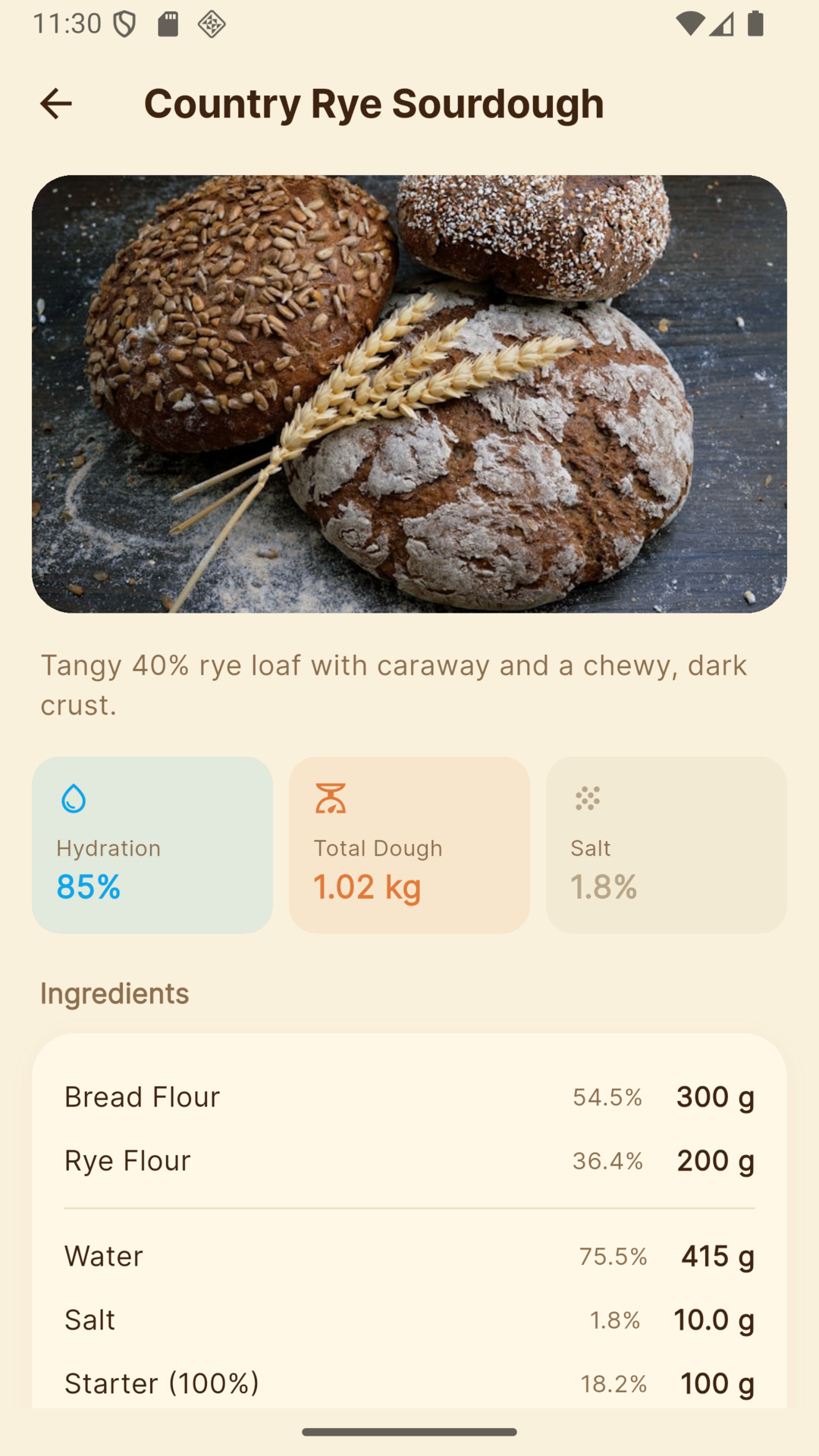
That’s the entire foundation. Flour is 100%, everything else follows, and hydration is just the water line. It’s simple enough to do on paper and fiddly enough over a few bakes that most people end up letting something track it. BreadMath keeps the percentages, the hydration and the starter maths straight and logs how each loaf came out, so you can see which hydration actually worked in your kitchen with your flour.
The rule above, though, is the part worth carrying in your head. Everything else in bread is a refinement on it.
Common questions
What does 75% hydration mean?
It means 75 grams of water for every 100 grams of flour. At 500 grams of flour that's 375 grams of water. Wetter doughs give a more open crumb but stick to everything; drier doughs are tighter and easier to shape.
How do I work out a baker's percentage?
Call the flour 100%, then divide each other ingredient by the flour weight and multiply by 100. Water divided by flour is your hydration. Salt usually lands around 2%.
Does the flour in my starter count?
Yes, if you want the number to be honest. A starter kept at 100% hydration is half flour and half water, so 100 grams of it adds 50 flour and 50 water to your totals. Leave it out and a recipe that reads 75% is really running wetter than that.
Why do bakers use weight instead of cups?
Because a cup of flour is not a fixed amount. Depending on whether it was scooped or spooned it can vary by twenty percent or more, which at 500 grams is the difference between a 70% dough and an 85% one. Percentages only work if the underlying numbers are weights.