






















































































Motorcycle Maintenance Schedule by Mileage and Time
Every service item runs on two clocks (miles and months) and whichever comes first wins. Here's a realistic interval guide, why the valve check is the one nobody should skip, and when your manual beats any chart.
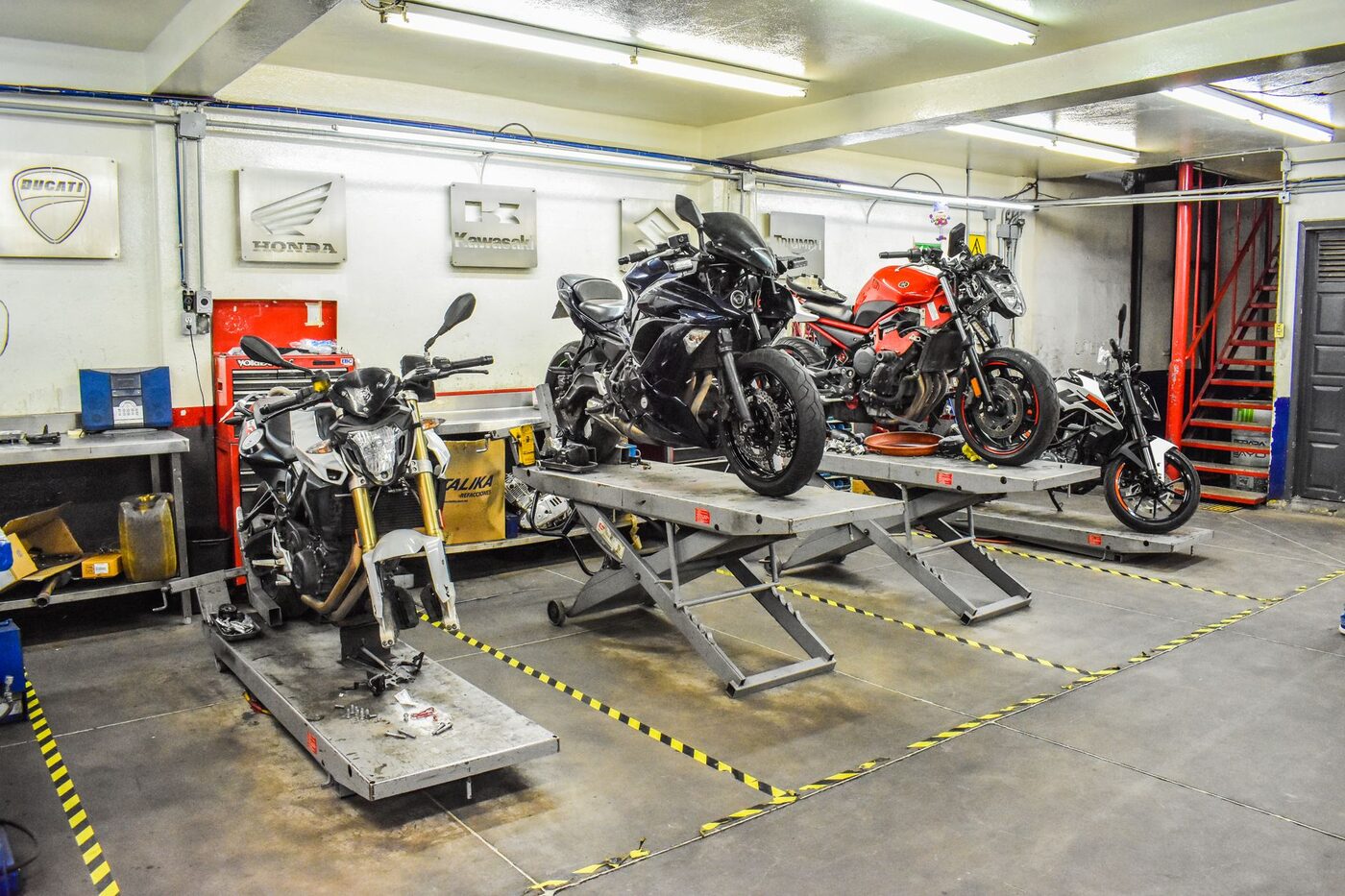
A motorcycle that’s neglected rarely warns you politely. It runs fine, starts on the button, pulls cleanly, right up to the morning it doesn’t, and by then the cheap fix has usually become an expensive one. The whole point of a service schedule is to do small jobs on a clock instead of big jobs on an ambush.
The thing to understand before any list of intervals is that every item runs on two clocks at once. There’s a mileage clock and a calendar clock, and the rule is always whichever comes first. Riders who do big miles tend to watch the odometer and forget the calendar. Riders who barely ride assume low mileage means low maintenance, which is exactly wrong. Oil oxidises, brake fluid drinks water, tyres harden and rubber seals dry out whether the wheels turn or not. A bike doing two thousand miles a year needs its fluids changed on time, not on distance.
What runs on which clock
Here’s a realistic picture of the common items. Treat these as typical ranges, not gospel. Your owner’s manual has the numbers that actually apply to your engine, and where they disagree with any chart, the manual wins. More on why that’s not just a disclaimer further down.
| Item | Typical interval | The clock that catches people |
|---|---|---|
| Engine oil + filter | 3,000–6,000 mi | or once a year |
| Chain clean + lube | 300–600 mi | and after every wet ride |
| Chain tension check | every few hundred mi | — |
| Tyre pressure | weekly, cold | — |
| Brake fluid | — | every 2 years regardless of miles |
| Coolant (liquid-cooled) | per manual | every 2–3 years |
| Air filter | 10,000–15,000 mi | sooner in dust |
| Spark plugs | 8,000–16,000 mi | iridium often double that |
| Valve clearances | 16,000–24,000 mi | varies enormously by engine |
| Brake pads | by wear | inspect regularly |
Two of those deserve more than a row in a table, because they’re the ones that quietly cost the most money when ignored.
Brake fluid is on a pure time clock, and here’s why
Brake fluid is hygroscopic. It pulls moisture out of the air through the seals and hoses over time. That water lowers the fluid’s boiling point, and on a long descent or hard braking, fluid that’s soaked up a few percent water can boil, put compressible vapour in a system that only works because liquid doesn’t compress, and give you a lever that sinks to the bar with nothing behind it.
This has nothing to do with mileage. A bike parked in a garage all year is absorbing moisture the whole time. That’s why the interval is two years, full stop, no matter how little you rode. It’s one of the cheapest jobs on the bike and one of the few where the failure mode is “the brakes stop working”, so it’s a strange one to defer. Coolant lives on a similar time-based cycle for its own reasons: the corrosion inhibitors in it deplete whether the engine runs or not.
The valve check is the one people gamble on
Valve clearance is the gap between the valve and what operates it, and it needs to sit in a small specified window. Ride enough miles and the valve seat wears, which on most engines makes the clearance close up (get tight). A valve that’s too tight can end up held slightly open when it should be shut. It loses the moment of full contact with its seat, which is also how it sheds heat into the head, and an exhaust valve that can’t dump its heat will eventually burn. That’s a top-end rebuild.
The reason so many riders skip the check is that nothing feels wrong beforehand. The bike runs fine on tight valves. Some even start a touch easier. By the time you get hard starting, lost power or a misfire, the damage is often already done. So the check is scheduled by mileage precisely so it happens before symptoms, and “it runs great” is not evidence you can skip it. It’s the normal condition right up to the failure.
There’s a wrinkle worth knowing. Some engines make the check cheap and some make it dear, and it depends on the adjustment design. Screw-and-locknut valves are adjusted with hand tools in an afternoon, so their intervals are often shorter and the job is trivial. Shim-under-bucket engines need the cam removed and shims swapped to correct a clearance, which is labour-heavy, so manufacturers tend to spec longer intervals, but when it does need doing, it’s a real job. Knowing which your bike has tells you whether a due valve check is a Saturday or a shop visit.
The chain: small job, big consequences
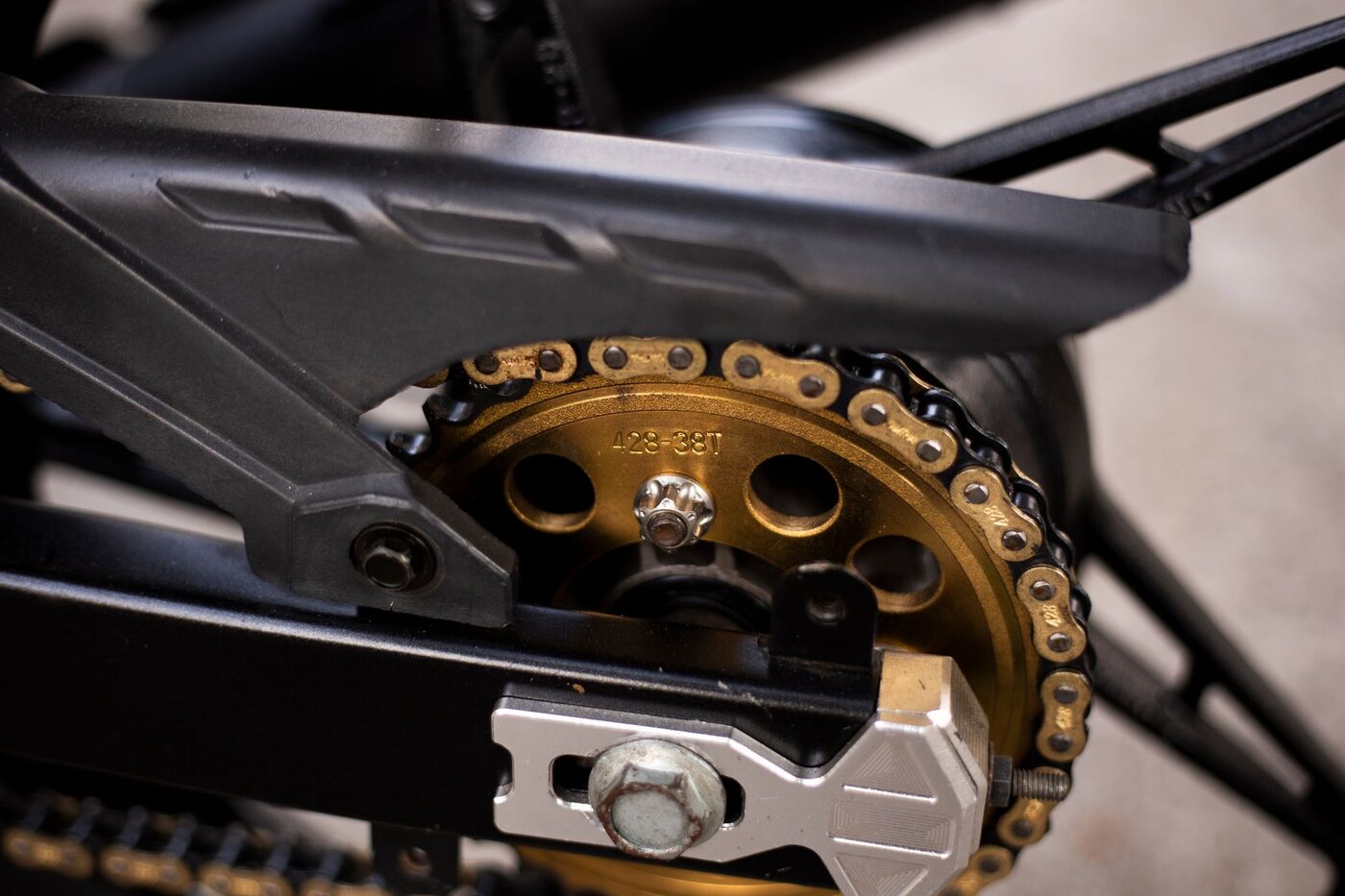
A drive chain is the highest-maintenance part on most bikes and the one that punishes neglect fastest. It wants cleaning and lubing every few hundred miles and every single time it gets wet, because a rusty, dry chain wears itself and grinds both sprockets, and once the sprocket teeth hook over you’re buying a chain and two sprockets as a set. Lube alone isn’t enough. Spraying oil over grit just makes grinding paste. Clean first, then lube a warm chain so it creeps into the rollers, and wipe the excess so it doesn’t fling onto your tyre.
Slack matters too. A chain adjusted too tight stresses the gearbox output bearing at full suspension compression; too loose and it slaps and can jump. The manual gives a slack figure measured at a specific point, and it’s worth checking every few hundred miles because chains stretch fastest when new and again near the end of their life.
The pre-ride check that costs two minutes
None of the scheduled stuff replaces a quick look before you ride. The riding schools teach a mnemonic, T-CLOCS, and it’s genuinely useful: Tyres and wheels, Controls, Lights and electrics, Oil and other fluids, Chassis (chain, suspension, fasteners), and Stands. Thirty seconds around the bike catches the soft tyre, the dragging brake, the chain that’s suddenly loose, the puddle under the engine, the things that turn a ride out into a bad day. Tyre pressure especially rewards a weekly cold check, because bike tyres have small air volumes and lose pressure faster than a car’s, and a few psy low changes how the bike steers and how hot the tyre runs.
Storing it over winter without wrecking it
A bike laid up for months needs its own short routine or it deteriorates in place. Fresh oil before storage, not after, so it doesn’t sit all winter full of combustion acids. Fuel stabiliser in a full tank keeps the fuel from going stale and the tank from rusting. A battery on a smart maintenance charger, or disconnected, because a bike battery left alone will self-discharge and sulphate and often won’t come back. Bump the tyres up a little and, ideally, get the weight off them so they don’t flat-spot. Come spring, that de-winterising is its own small checklist rather than just turning the key.
Why the manual beats any chart, including this one
Every interval above is a typical range, and the reason it’s a range rather than a number is that the right figure depends on things a generic chart can’t know. Air-cooled engines run hotter and shear oil faster than liquid-cooled ones. Wet-clutch bikes (most Japanese machines) share their engine oil with the clutch and gearbox, so the oil takes a beating from clutch material and clamping loads that a car engine never sees, which shortens its life. The oil specification your engine wants, the plug type fitted, whether the valves are shim or screw, how and where you ride, all of it moves the numbers. A dusty gravel commute murders an air filter that would last years on motorway miles.
So use a chart like this to understand the shape of the thing: what runs on miles, what runs on time, what’s cheap now versus catastrophic later. Then open the actual manual for your actual bike and follow its numbers. The two clocks and the reasons behind them don’t change between machines. The intervals do.
Keeping track without a shoebox of receipts
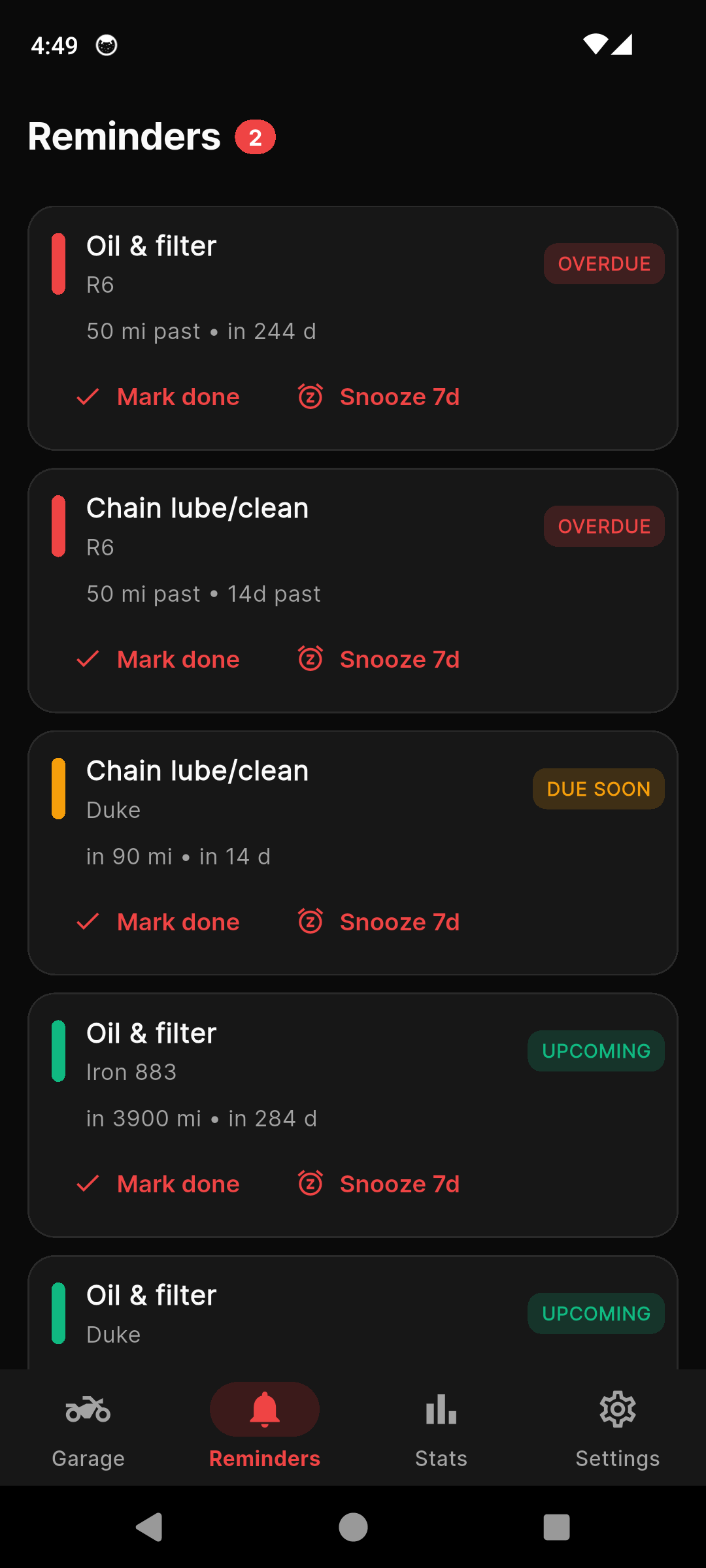
The hard part isn’t knowing the intervals, it’s remembering where each of them is right now, which service happened at what mileage, when the brake fluid was last done, whether the valve check is creeping up. That’s what turns into a burnt valve or a seized chain: not ignorance, just losing track across a couple of riding seasons. MotoGarage keeps a log per bike and counts each item down against both its mileage and its calendar interval, so the thing that’s due surfaces before it becomes the thing that stranded you. A good service history also pays for itself at resale. A documented bike sells for more than an identical undocumented one, because the buyer can see it was never neglected.
Common questions
How often should I change motorcycle oil?
Most bikes call for an oil and filter change every 3,000 to 6,000 miles or once a year, whichever comes first. The time limit matters as much as the mileage. A bike that only does 1,500 miles a year still needs its oil changed annually, because oil degrades sitting in the sump. Check your owner's manual for the exact figure, as wet-clutch bikes and hard-ridden engines are often on the shorter end.
How often does a motorcycle chain need lubricating?
Clean and lube the chain roughly every 300 to 600 miles, and always after riding in the rain or washing the bike. Check the slack at the same time. A neglected chain wears itself and both sprockets, and replacing all three costs far more than a can of chain lube.
What happens if I skip the valve clearance check?
A bike with tight valve clearances often runs perfectly right up until it doesn't. As clearance closes up, a valve can stop seating fully, lose its cooling path into the head, and eventually burn, an expensive top-end repair. That's why the check is scheduled by mileage and done before symptoms appear, not after.
Photos: Shandy Galicia / Pexels , Nguyễn Bin Exciter / Pexels