Board Feet Explained: How to Measure and Buy Hardwood
A board foot is a volume, not a length, and mixing the two is how you end up with the wrong pile at the till. Here's the formula, the quarter system, and how to buy hardwood without overpaying.
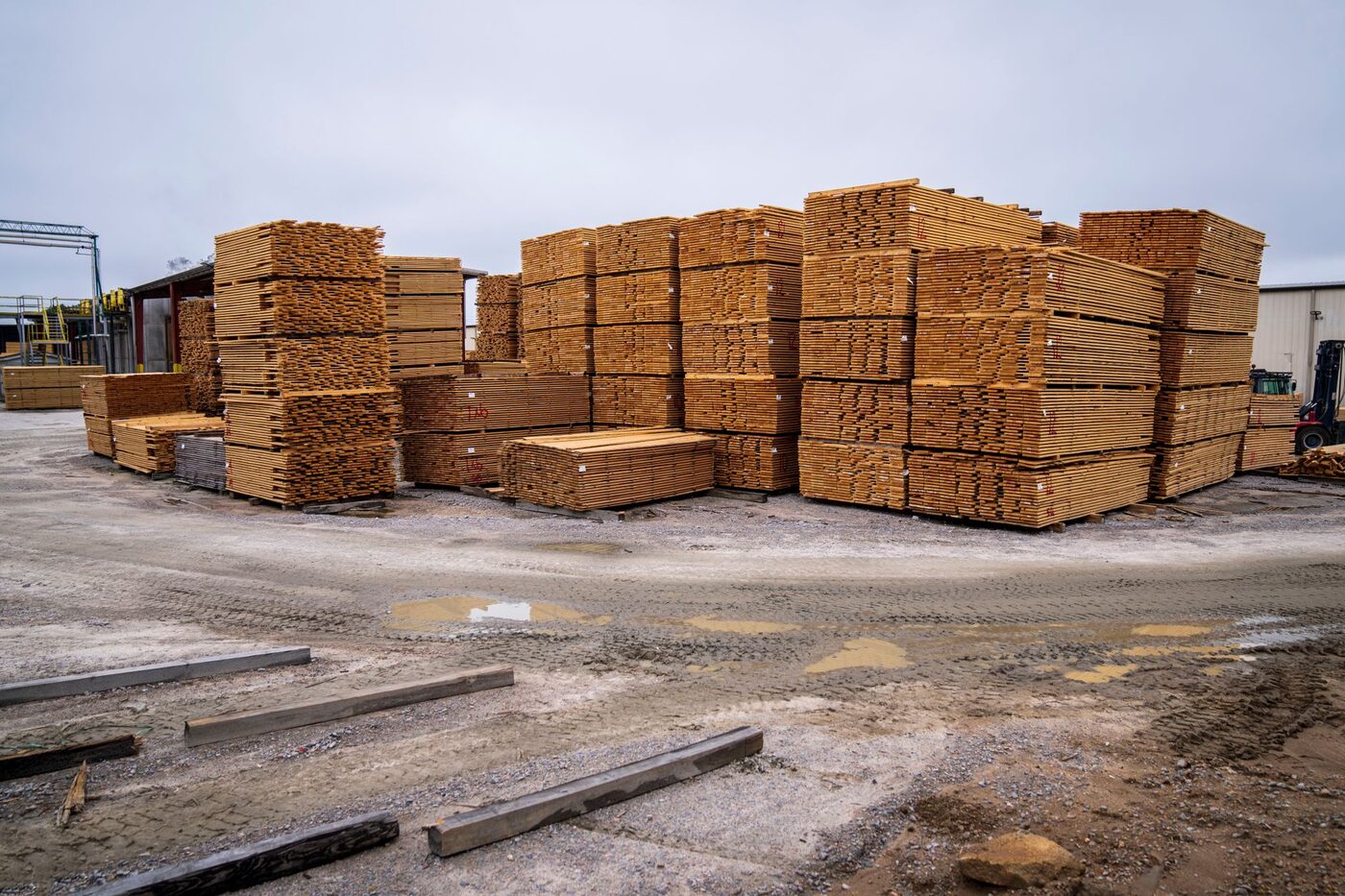
Walk into a proper hardwood dealer for the first time and the pricing makes no sense. The walnut is marked at a number per board foot, the boards are all different widths, none of them are a tidy length, and the fellow behind the counter tallies the pile in his head faster than you can follow. Then the total is nearly a third more than the arithmetic you did in the car park. Nothing was wrong with the price. You measured the wrong thing.
A board foot is where most people trip, because the name sounds like a length and it is not. It’s a volume. Once that clicks, the rest of the hardwood counter stops being intimidating and you can walk in knowing roughly what a project should cost before anyone picks up a tape.
A board foot is a block of wood, not a length of it
One board foot is 144 cubic inches of timber. The mental picture is a piece one inch thick, twelve inches wide and twelve inches long — a square foot of wood, an inch thick. That’s the unit.
Because it’s a volume, the same length of board can be worth very different amounts of board feet. A plank that’s twice as wide holds twice the board feet over the same run. A plank that’s twice as thick, the same. This is the whole reason hardwood is sold this way and softwood mostly isn’t: hardwood comes off the log in random widths and lengths, and a volume measure is the only fair way to price a wide clear board against a narrow one.
Contrast that with a linear foot, sometimes called a running foot, which is just length and ignores the other two dimensions entirely. A hardware store sells you pine trim by the linear foot because every stick is the same profile. A hardwood yard can’t, because no two boards are the same size.
The formula, and the shortcut worth memorising
The full version multiplies all three dimensions in inches and divides by 144:
board feet = (thickness in × width in × length in) ÷ 144
Nobody measures an eight-foot board in inches, though, so the version people actually use keeps the length in feet and divides by 12 instead:
board feet = (thickness in × width in × length ft) ÷ 12
They give the same answer. Take a board an inch thick, six inches wide and eight feet long. One times six times eight is forty-eight, divided by twelve is four board feet. Do it the long way and it’s 1 × 6 × 96 ÷ 144, still four. The divide-by-12 form is the one to carry in your head, because you can run it on a board as you pick it up.
A couple more to fix the pattern. A two-inch-thick board, ten inches wide, ten feet long: 2 × 10 × 10 ÷ 12 = 16.7 board feet. A three-quarter-inch board — well, hold that thought, because three-quarter-inch is a trap, and it’s the next section.
The quarter system, and why your wood is thicker than it looks
Here’s the part that catches everyone. Hardwood thickness is quoted in quarters of an inch, written as a fraction over four and said out loud as “four-quarter”, “five-quarter” and so on. The number is the rough sawn thickness, straight off the mill’s saw before anything is planed smooth.
| Called | Rough thickness | Typical surfaced (S2S) |
|---|---|---|
| 4/4 | 1” | 13/16” |
| 5/4 | 1-1/4” | 1-1/16” |
| 6/4 | 1-1/2” | 1-5/16” |
| 8/4 | 2” | 1-3/4” |
| 12/4 | 3” | 2-3/4” |
The catch is that board feet are figured on the rough thickness, not the finished one. If you buy 4/4 walnut and have it surfaced on both faces, it lands somewhere around thirteen-sixteenths of an inch, and a lot of yards plane it to a flat three-quarters. You will build with a three-quarter-inch board. You will pay for a full inch. That isn’t a swindle — the mill sawed a full inch and the wood between one inch and three-quarters became shavings on their floor. The quarter system just makes the convention explicit so everyone’s counting the same thickness.
Which means the surfaced board in your hand lies to you about its board footage. Measure that finished three-quarter board at 3/4 and you’ll under-count every time. Always figure hardwood at its quarter call: a 4/4 board is an inch thick for the purposes of the sum, full stop.
Width has its own quiet convention. Rough boards get measured to the nearest inch, sometimes the nearest half inch, and a board that mikes out at 7-1/4 inches is often written up as 7. Length usually rounds down to the nearest foot. None of this is you getting cheated; it’s just where the tallies land, and it’s why the counter’s number and your number can differ by a bit even when you both did the arithmetic right.
Grade decides how much of it you can actually use
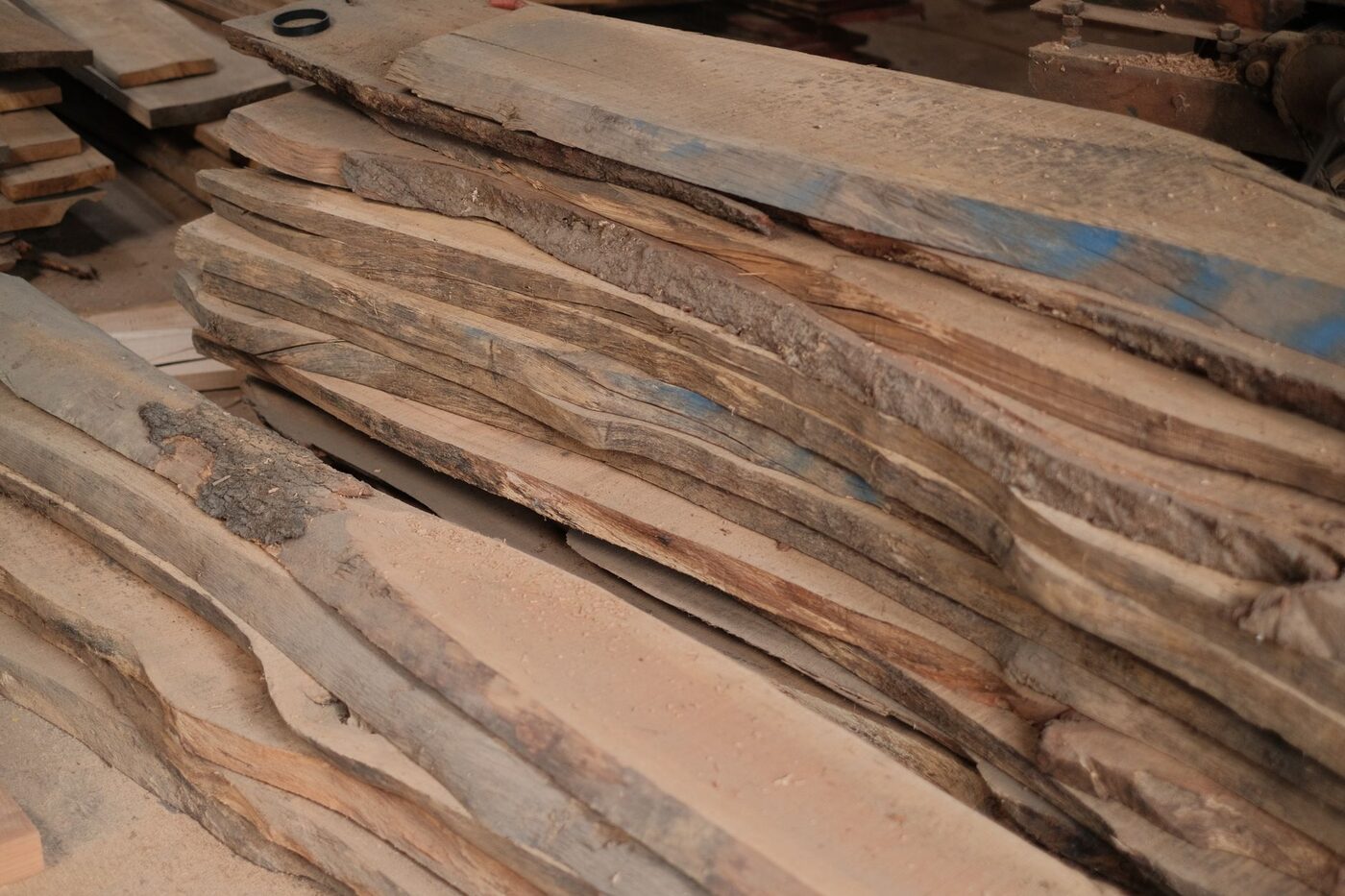
Two boards can be the same board footage and the same price and still be a completely different deal, because grade controls how much clear, usable wood is in them. The top hardwood grade, FAS (it stands for Firsts and Seconds), guarantees long, wide, mostly clear cuttings — you can get full-length clear parts out of it. Drop to Number 1 Common, the so-called cabinet grade, and the board is cheaper per foot but studded with knots and defects you have to cut around, so more of what you bought ends up in the offcut bin.
That’s the number people forget: a cheaper grade isn’t cheaper if you have to buy forty percent more of it to get the same clear parts. For long rails and wide panels, paying up for FAS often works out level or better. For small parts and drawer sides, Number 1 Common is money well saved, because the short clear sections between the defects are exactly the size you need anyway.
Add for waste before you leave home
Whatever your parts add up to on paper, you buy more. Grain has to be matched, ends check and get cut off, a knot appears exactly where a tenon was going to be, the planer takes a bite. For most furniture in a decent grade, adding twenty to thirty percent over the net footage of your parts is about right. Narrow parts, curved parts, or anything where you’re selecting for figure, push it towards forty or fifty. Skip this step and you’ll be back at the yard mid-build hunting for a board that matches the one you had, which is a worse problem than a couple of spare board feet in the rack.
So the honest project estimate is: tally the board feet in your cut list, add your waste factor, then multiply by the price per board foot. That’s the number to expect at the till.
When board feet is the wrong tool entirely
Not everything wood is sold this way, and reaching for board feet where it doesn’t belong is its own mistake.
Construction softwood — your 2x4s, 2x6s, studs and joists — is nominal-sized and usually sold by the piece or the linear foot. A 2x4 is not two inches by four; it’s 1.5 by 3.5 after surfacing, and everyone in the trade prices it by length because every stick is identical. You can convert it to board feet if a spec demands it, using the nominal size, but you rarely need to.
Sheet goods — plywood, MDF, melamine — are sold by the sheet or the square foot, because thickness is fixed and it’s a two-dimensional buy. Mouldings, dowel and trim go by the linear foot. The rule of thumb: if the boards come in random widths and lengths and you’re choosing them one at a time, it’s board feet. If they come in fixed, repeatable sizes, it’s length or area.
Doing the tally without losing the plot
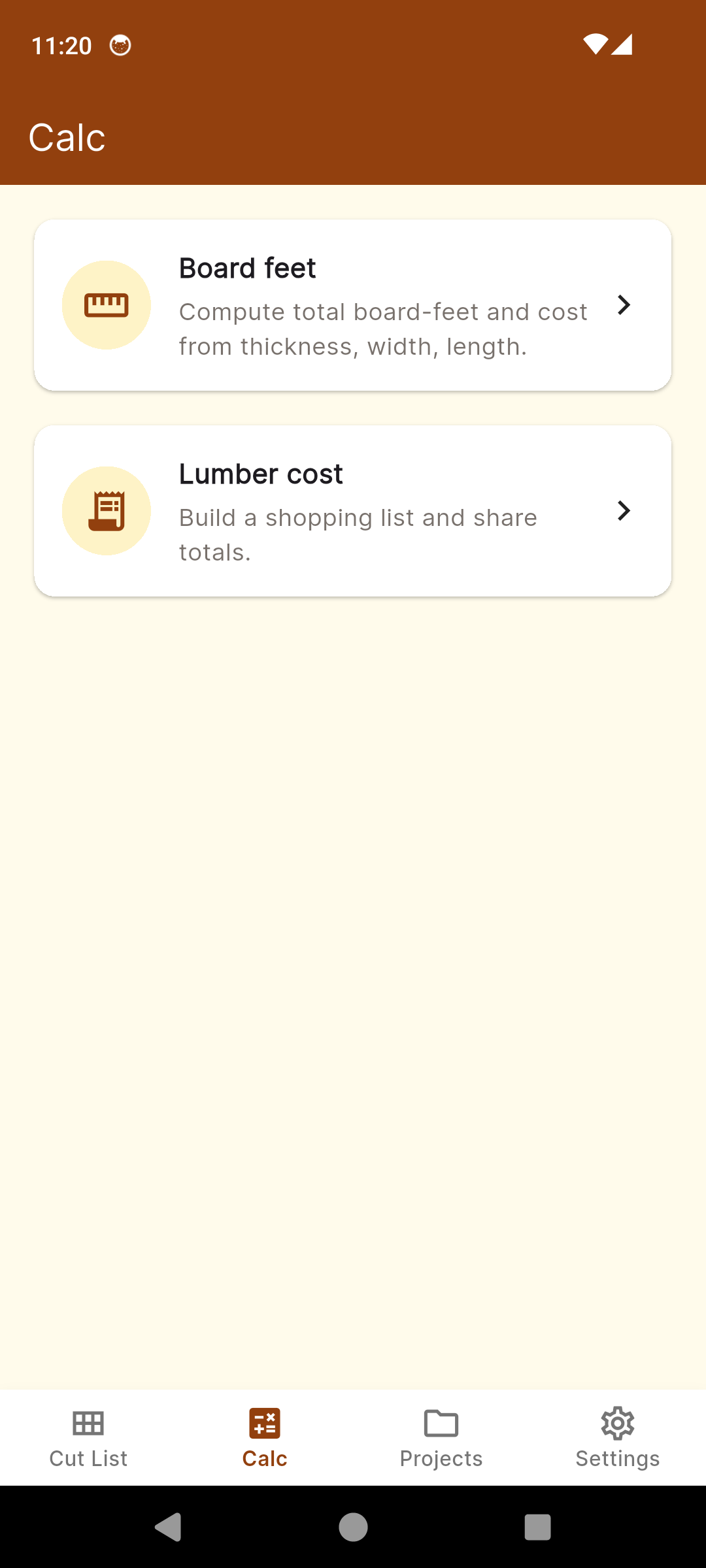
One board is a ten-second sum. A cut list for a dresser is thirty boards at three thicknesses and a dozen widths, each rounded its own way, all needing a waste factor and a price applied, and doing that in the car with a phone calculator is where the errors creep in. That’s the case for letting something keep the running total. LumberList takes each board’s dimensions and price and keeps the board-foot count and the cost ticking as you add them, so the number you walk in with is the number you leave with.
The maths underneath is just the divide-by-twelve you now know, though, and it’s worth carrying regardless. The board foot only bites the people who think it’s a length. You’re no longer one of them.
Frequently asked questions
What is one board foot?
It's a volume of wood equal to 144 cubic inches — the amount in a piece 1 inch thick, 12 inches wide and 12 inches long. Because it's a volume, a thicker or wider board packs more board feet into the same length. It is not the same as a linear or running foot, which only measures length.
How do you calculate board feet?
Multiply thickness in inches by width in inches by length in inches, then divide by 144. If your length is already in feet, the shortcut is thickness times width times length-in-feet, divided by 12. A 1-inch board, 6 inches wide and 8 feet long works out to 4 board feet.
Why is my hardwood priced thicker than it measures?
Hardwood is sold by its rough sawn thickness, not the finished thickness after surfacing. A board that measures three quarters of an inch was almost certainly cut as 4/4 (a full inch) and planed down, so you pay for the full inch. That rough-to-surfaced loss is normal and built into how the quarter system works.
Do 2x4s get sold in board feet?
Rarely. Construction softwood like 2x4s and 2x6s is usually sold by the piece or the linear foot at a nominal size, where a 2x4 is really 1.5 by 3.5 inches. Board feet is the language of the hardwood yard, where boards come in random widths and lengths and you're buying volume.
Photos: Mark Stebnicki / Pexels , Pew Nguyen / Pexels