


























































































NFPA 10 Fire Extinguisher Inspection Requirements Explained
Monthly inspection, annual maintenance, six-year internal, hydrostatic test: four different jobs on four different clocks. Here's what each one means, who does it, and how the intervals differ by extinguisher type.

Most people think a fire extinguisher has one maintenance requirement: the tag a technician signs once a year. That tag is real and it matters, but treating it as the whole job is how buildings fail a fire marshal’s walkthrough. NFPA 10, the standard that governs portable fire extinguishers in the US, actually sets out four separate obligations running on four different clocks, and three of them are quietly your responsibility between annual visits.
Getting the vocabulary straight is half the battle, because the words get used interchangeably and they are not the same thing. Inspection, maintenance, internal examination and hydrostatic testing each mean something specific, each happens on its own schedule, and each has different rules about who is allowed to do it. Sort those out and the requirements stop feeling like a maze.
The four jobs, from most frequent to least
The monthly inspection is a quick visual check, done at least every 30 days, and it’s the one you can and should do yourself. The annual maintenance is a thorough hands-on examination by a certified technician. The internal examination empties and inspects the inside of the cylinder on a multi-year cycle. And the hydrostatic test pressure-tests the shell itself, the longest interval of all. Frequent and shallow at the top, rare and deep at the bottom.
| Job | How often | Who does it |
|---|---|---|
| Visual inspection | Monthly (30-day intervals) | Any competent person on site |
| Maintenance | Annually | Certified technician |
| Internal examination | Every 6 years (stored-pressure dry chemical) | Certified technician |
| Hydrostatic test | Every 5 or 12 years, by type | Certified facility |
The monthly inspection is on you
This is the check that actually catches problems, because it happens twelve times as often as anything else. NFPA 10 wants it at least monthly, and any competent person can do it. You don’t need a certificate to look at an extinguisher.
What you’re confirming, in about a minute per unit: that the extinguisher is actually there and hasn’t wandered off; that it’s in its assigned spot and the signage points to it; that nothing is blocking it and you could grab it in a hurry; that the pressure gauge needle sits in the green operable band; that the tamper seal and pin are intact, which tells you it hasn’t been discharged; that there’s no dent, rust, corrosion or leak on the body; that the nozzle and hose are clear and undamaged; and that the operating instructions on the label are legible and facing out. On CO2 and larger units, weight is part of it, because a slow leak shows up as lost weight before the gauge moves.
Then you record it. The date and your initials go on the tag attached to the extinguisher, or onto an inspection log kept on file. That record is not bureaucratic box-ticking. It’s the evidence that the monthly requirement was met, and it’s the first thing an inspector or your insurer looks for. A wall of extinguishers with no monthly marks reads as neglected even if every one is fully charged.
The single most common finding on these checks is depressingly simple: the extinguisher is blocked. Someone parked a pallet in front of it, stacked boxes against it, or it disappeared behind a coat rack. An extinguisher you can’t reach in the ten seconds a fire gives you is functionally not there, and no amount of internal testing fixes that.
Annual maintenance is a different, deeper thing
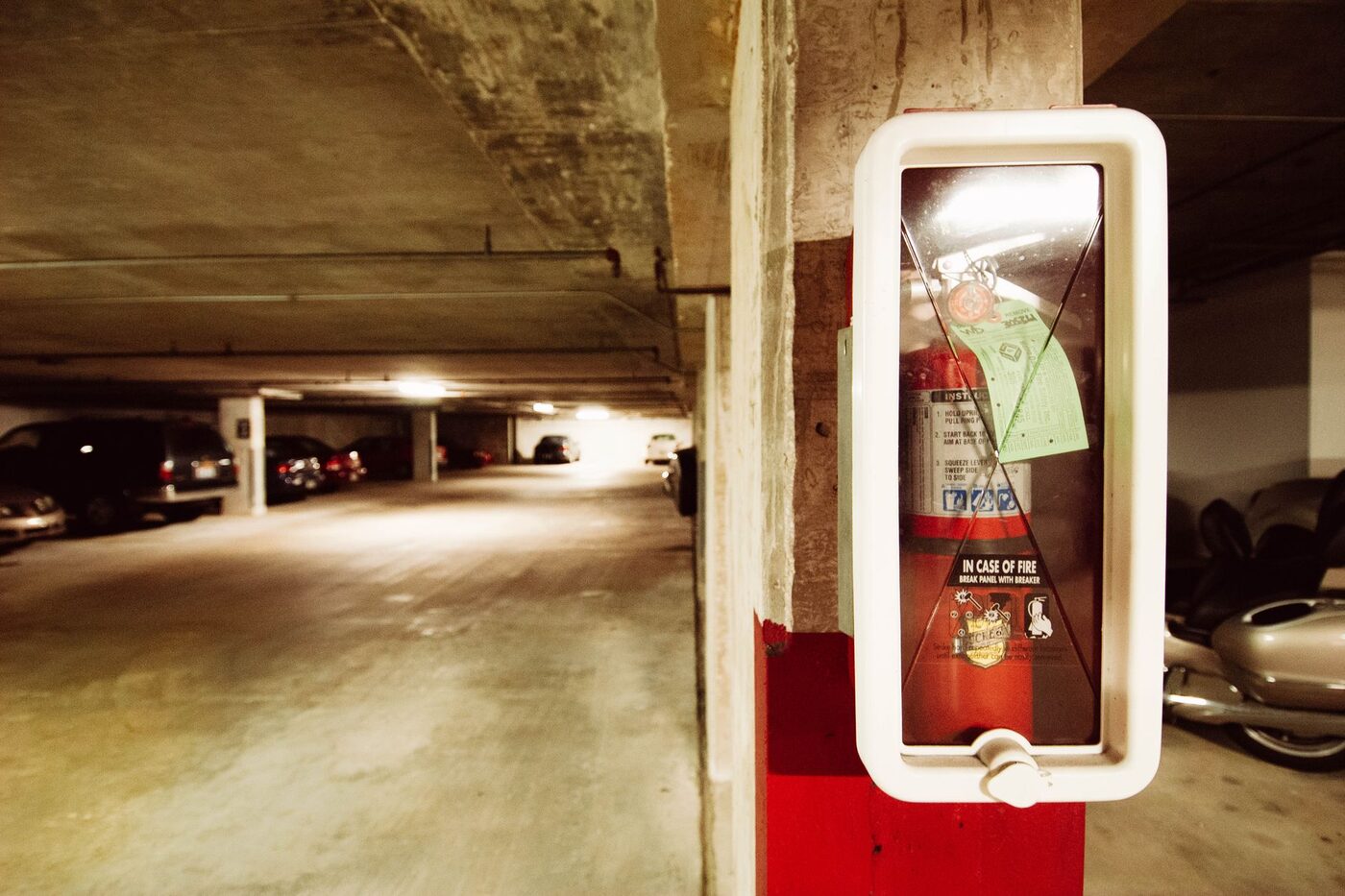
Once a year, a certified technician does what the standard calls maintenance: a thorough examination that goes well past the visual. They check the mechanical parts, the condition and amount of the extinguishing agent, and the expelling means, the mechanism that actually pushes the agent out. Depending on the type and its history, this can involve partial disassembly. When it passes, they attach a durable service tag showing the date and who did it. That tag is the one most people picture, and it’s proof the annual step happened, but it does not replace the monthly inspections you owe in the eleven months between.
A point that trips up facility managers: a fresh annual tag does not mean you can stop the monthly checks until next year. The two run in parallel. The annual is thorough but infrequent; the monthly is shallow but catches the fast-moving problems: the discharged unit, the blocked access, the gauge that dropped into the red last week.
The long clocks: internal exam and hydrostatic testing
Below the annual layer sit the multi-year jobs, and this is where the extinguisher type finally matters, because different agents and cylinders age differently.
A stored-pressure dry chemical extinguisher (the ubiquitous ABC red bottle in offices, corridors and garages) gets an internal examination at six years: emptied, inspected inside, and recharged. Its cylinder then gets a hydrostatic test at twelve years, where the shell is pressurised to prove it can still safely hold its charge. Carbon dioxide, water and wet chemical extinguishers are on a shorter five-year hydrostatic cycle instead.
| Extinguisher type | Internal examination | Hydrostatic test |
|---|---|---|
| Stored-pressure dry chemical (ABC/BC) | 6 years | 12 years |
| Dry powder (cartridge/cylinder) | per maintenance | 12 years |
| Carbon dioxide (CO2) | at 5-yr test | 5 years |
| Water / foam | at 5-yr test | 5 years |
| Wet chemical (kitchen Class K) | at 5-yr test | 5 years |
The date of the last hydrostatic test is recorded on the cylinder, usually stamped or on a permanent label. An extinguisher past its hydrostatic date is out of compliance regardless of how full it looks, and a technician will pull it from service. These are not jobs to attempt yourself. The internal exam and hydrostatic test need trained personnel and proper test equipment, and the whole point is verifying the cylinder is still safe to keep under pressure.
Where they go and how high they hang
NFPA 10 governs placement as tightly as it governs testing, because an extinguisher only counts if someone can reach it fast. Travel distance is the key idea, measured along the actual walking path, around walls and equipment, not as the crow flies. For ordinary Class A hazards (wood, paper, cloth), no one should have to travel more than 75 feet to reach an extinguisher. For Class B flammable-liquid hazards the limit is shorter, up to 50 feet, and it tightens further as the hazard rises. Cooking-oil (Class K) hazards in commercial kitchens have their own shorter limit again.
Mounting height is specified too. An extinguisher weighing 40 pounds or less should have its top no more than 5 feet above the floor; a heavier one, no more than 3.5 feet, because you have to be able to lift it off the bracket. The bottom of any extinguisher should sit at least 4 inches clear of the floor, which keeps it out of mop water and corrosion. Getting these wrong is one of the more common citations, and unlike a lapsed test date, it’s free to fix.
The mistakes that fail an inspection
The recurring ones are rarely exotic. Access is blocked. The monthly log is missing or has gaps that show nobody actually looked. The hydrostatic date has quietly passed. The wrong class of extinguisher sits by the wrong hazard. A water extinguisher near an electrical panel or a fryer is worse than useless. And the gauge is in the red and nobody noticed, which is exactly what the monthly check exists to catch. None of these need a specialist to spot. They need someone to look, on schedule, and write down that they did.
Keeping the four clocks straight
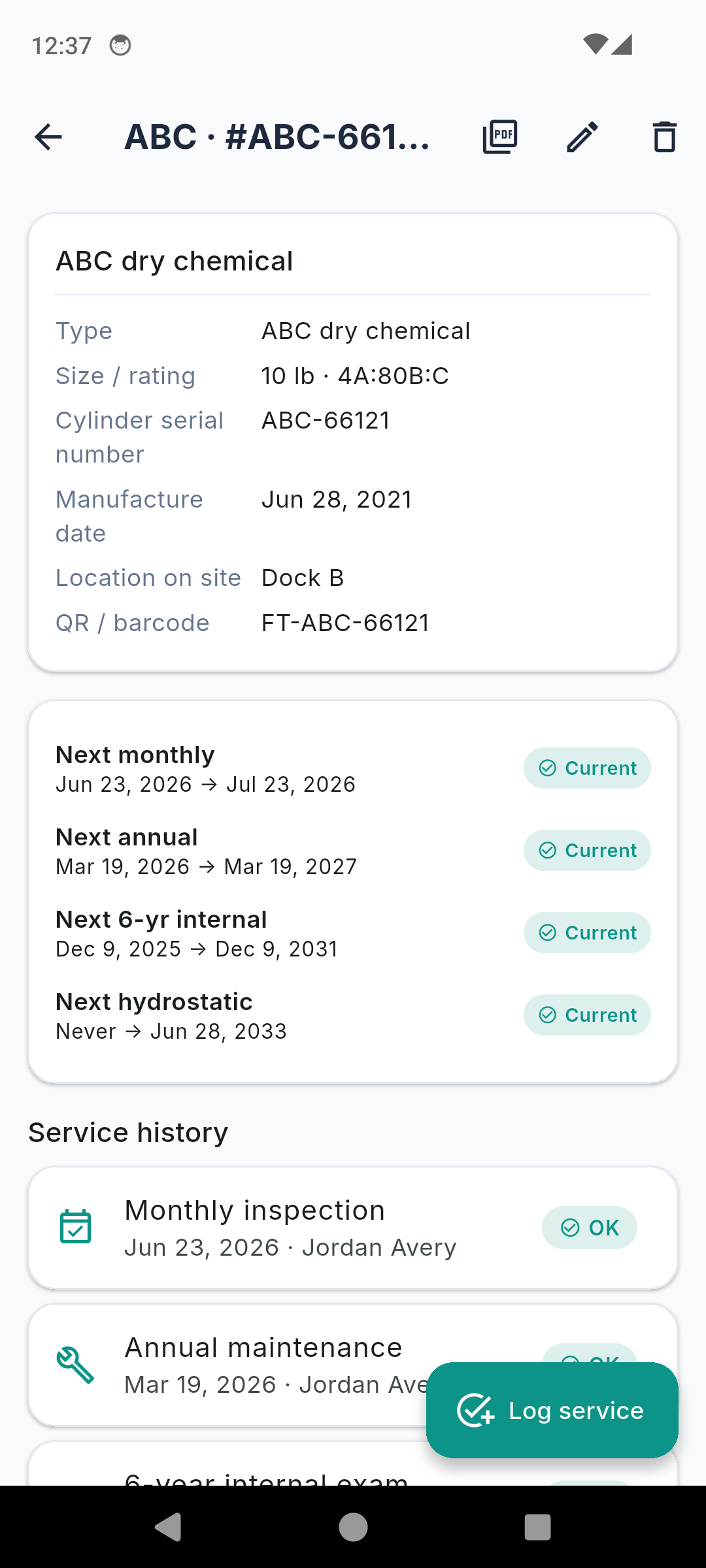
The genuine difficulty here isn’t understanding the intervals, it’s holding four of them per unit across a building full of extinguishers, each installed on a different date, each on its own count to the next due job. That’s what turns into a failed inspection: not ignorance of the rule, just losing the thread on which bottle is due for what. FireTag keeps each extinguisher’s four clocks together and surfaces what’s coming due, with the monthly inspection checklist built in so the log is created as you do the walk rather than reconstructed afterwards.
This is general information, not professional or code-compliance advice. NFPA 10 is a detailed standard, it’s revised periodically, and local codes and your Authority Having Jurisdiction (AHJ) can add requirements on top. Verify the intervals and placement rules that apply to you against the current edition of NFPA 10 and your local fire code, and have the annual maintenance, internal examinations and hydrostatic testing carried out by certified professionals.
Common questions
How often do fire extinguishers need to be inspected?
Under NFPA 10, portable extinguishers get a quick visual inspection at least monthly (at 30-day intervals) plus a thorough maintenance check once a year by a qualified technician. The monthly inspection can be done by any competent person on site; the annual maintenance and the deeper tests must be done by someone trained and certified.
What is the difference between inspection and maintenance?
An inspection is a quick monthly look to confirm the extinguisher is present, accessible, charged and undamaged. Maintenance is a thorough annual examination of the mechanical parts, the extinguishing agent and the discharge mechanism, carried out by a certified technician who then attaches a dated service tag. They are separate requirements. Passing one does not cover the other.
How often does a fire extinguisher need a hydrostatic test?
It depends on the type. Stored-pressure dry chemical extinguishers are hydrostatically tested every 12 years and get an internal examination at 6 years. Carbon dioxide, water and wet chemical extinguishers are tested every 5 years. The test date is stamped or labelled on the cylinder.
Can I do the annual fire extinguisher service myself?
No. The monthly visual inspection is fine to do yourself and should be logged. The annual maintenance, the six-year internal examination and the hydrostatic test all require trained, certified personnel and proper equipment, and the results have to be recorded on the extinguisher's tag. Doing these yourself would not satisfy NFPA 10.