BendPro
Conduit Bending Calculator for Electricians
Offsets, saddles, stub-ups, kicks, rolling offsets — the math, marks and a clean diagram on one screen.
How It Works
Pick the Bend
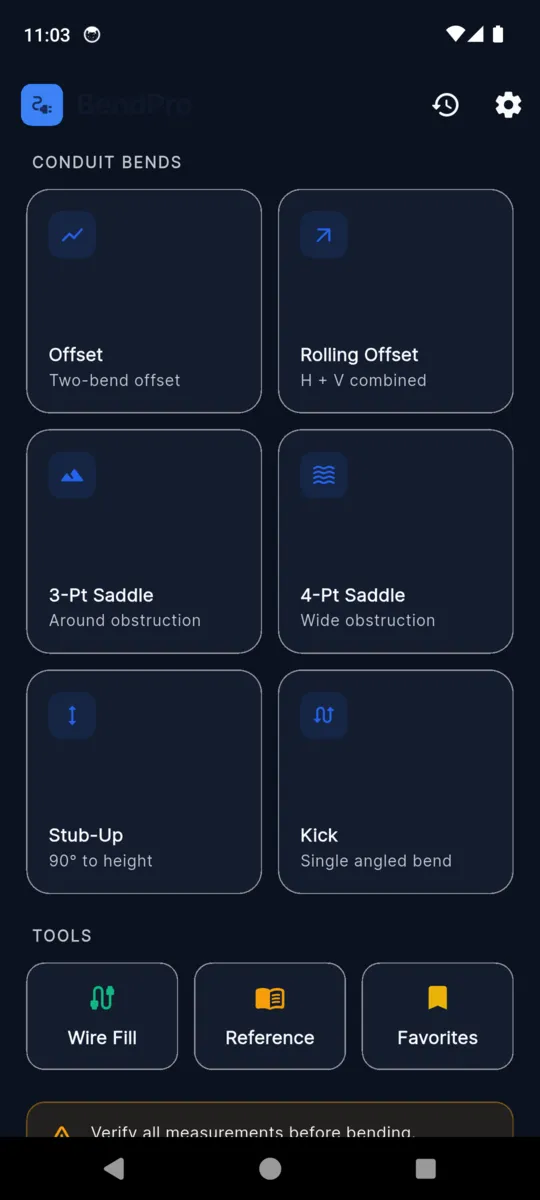
Tap the bend type — offset, rolling offset, 3-point saddle, 4-point saddle, stub-up, or kick. Every calculator opens in one tap from the home grid.
Enter the Numbers
Offset depth, conduit size, bender brand, angle. BendPro reads take-up straight from the manufacturer table — Klein, Greenlee, Ideal, Gardner Bender.
Read the Marks
Mark-to-mark distance, shrink, multiplier, and a labelled diagram appear instantly. Save it, share it, run the bend.
BendPro in Action
The Bender App Electricians Actually Reach For
Offset Bend Calculator
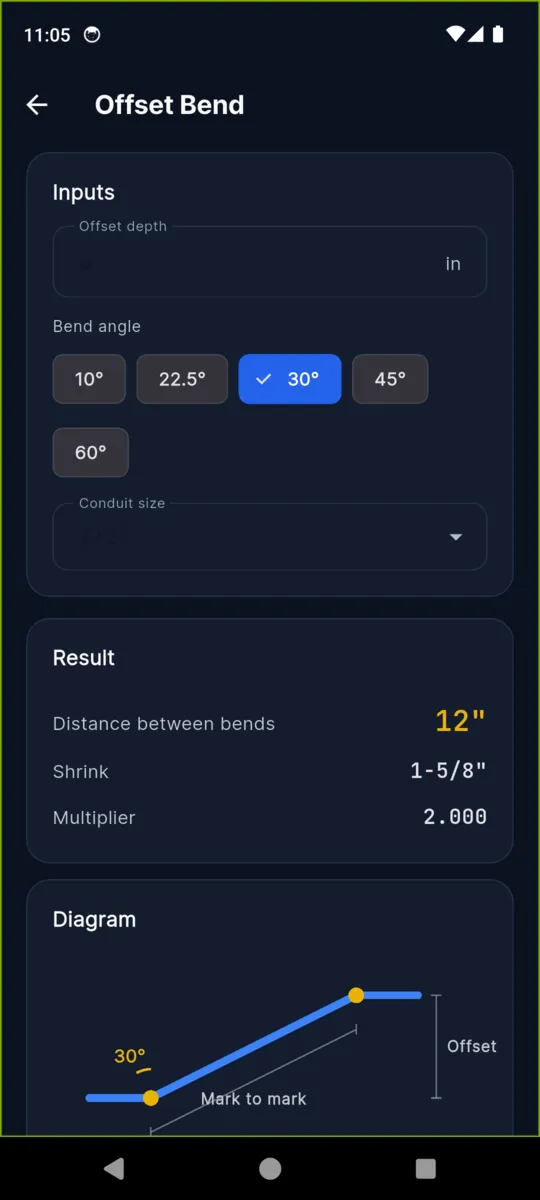
Enter offset depth and angle (10°, 22.5°, 30°, 45°, 60°). Get distance between bends, shrink, multiplier, and a labelled diagram instantly.
3-Point and 4-Point Saddles
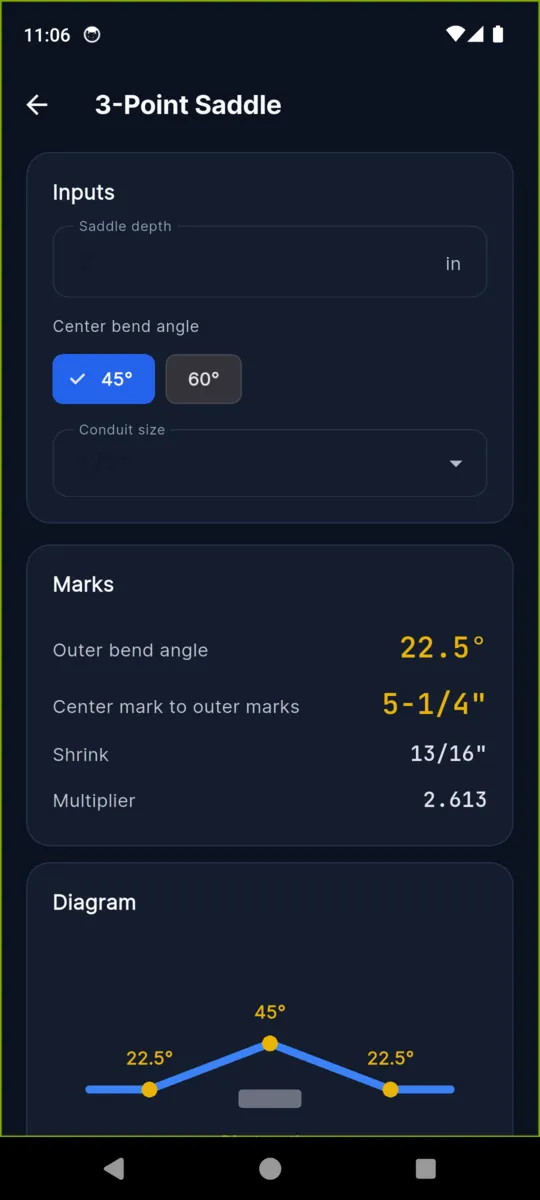
Saddle around obstructions without guessing. Centre and outer bend angles, mark spacing, and shrink — with a diagram showing the obstacle.
90° Stub-Up Calculator
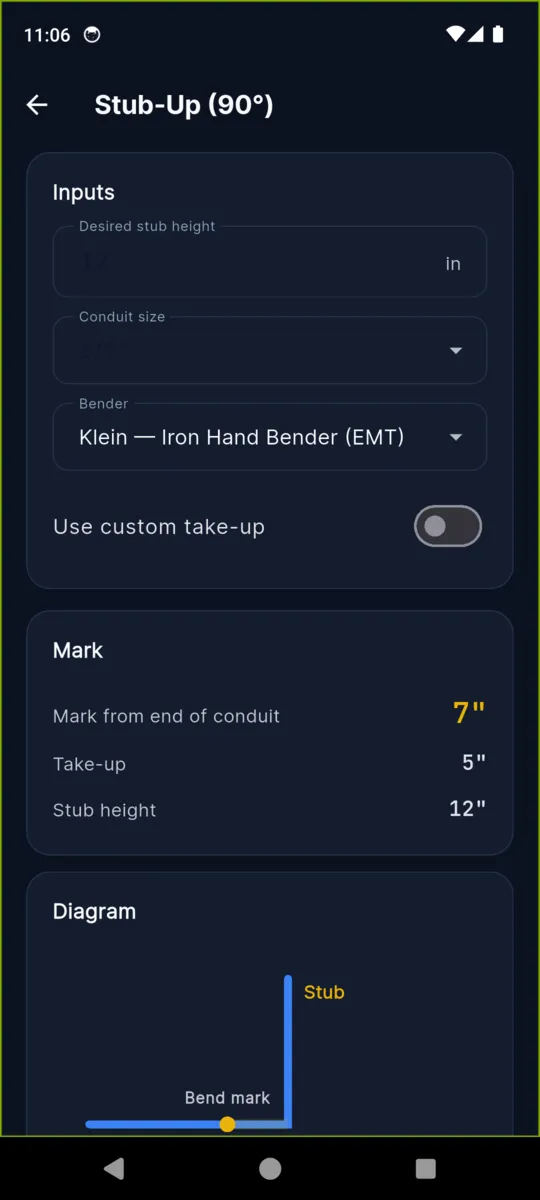
Pick your bender (Klein, Greenlee, Ideal, Gardner Bender) and conduit size. Take-up is read from the manufacturer table — subtract from the stub height for the mark.
Kick and Rolling Offset
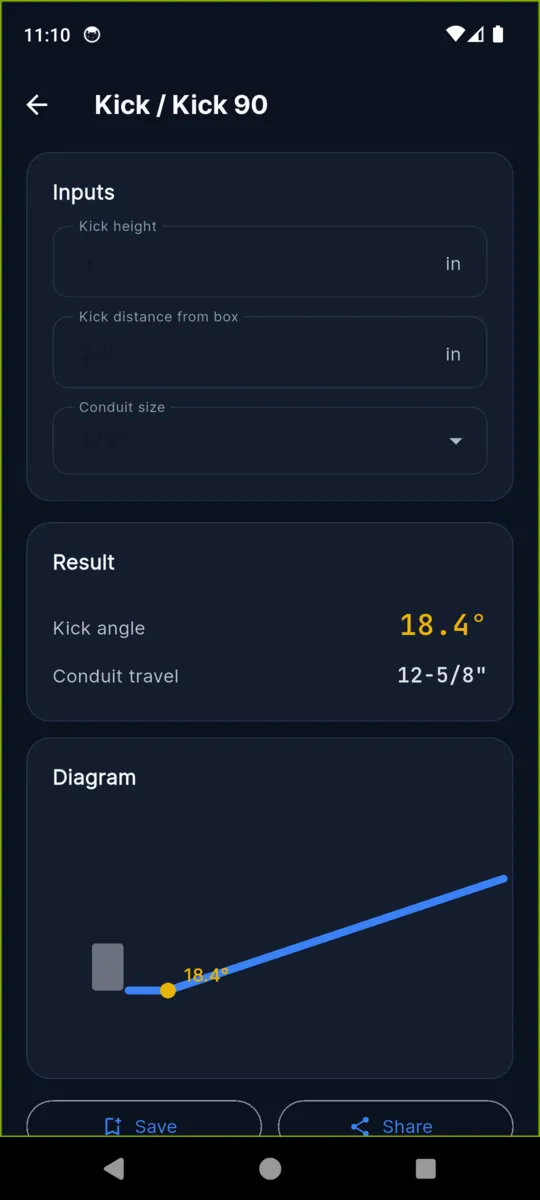
Kick height and distance returns the angle and conduit travel. Rolling offsets handle horizontal AND vertical run in one bend with roll angle.
NEC Wire Fill Calculator
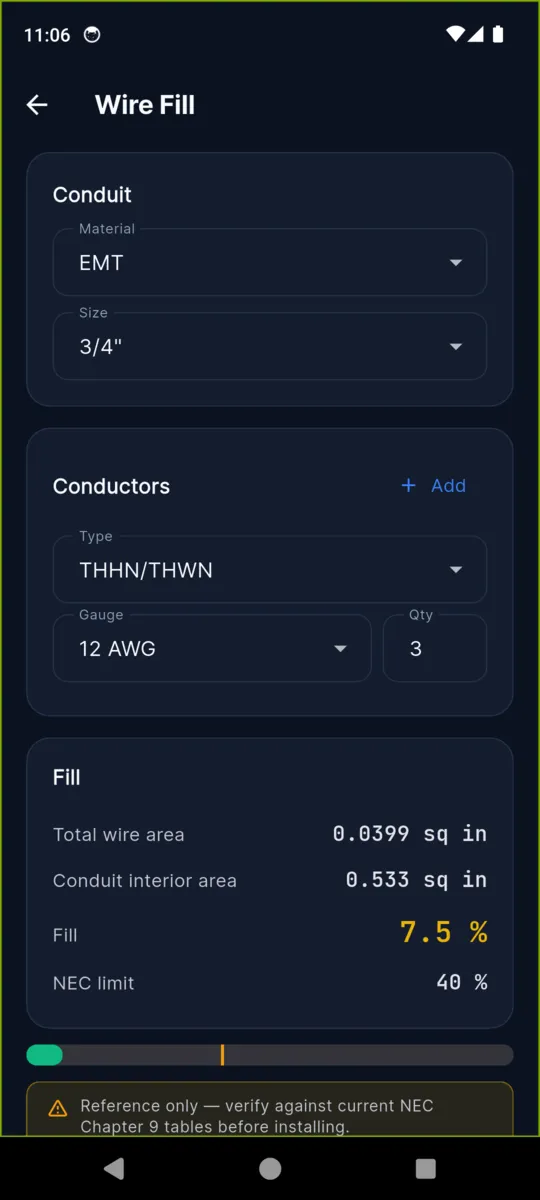
EMT, IMC, Rigid, PVC × THHN/XHHW conductors. NEC Chapter 9 fill limits enforced (53/31/40 %), over-fill flagged in red.
Quick Reference Tables
Take-up and gain values for every supported bender, plus the offset multiplier table — the values you keep on a sticker on your bender, on your phone.
History & Favorites
Every calculation auto-saves. Bookmark the ones you re-run. One-tap reopen, edit values, share results with the apprentice.
Dark Mode by Default
Easier on the eyes in a basement, an attic or on a roof at sunset. Imperial fractions or metric millimetres — toggle in Settings.
Simple, Honest Pricing
No subscriptions. No hidden fees. Pay once, own it forever.
Free Forever
No credit card required
- Every bend calculator (offset, saddle, stub, kick, rolling)
- NEC Chapter 9 wire fill calculator
- Deduction reference tables
- History (last 20 calculations)
- 5 favorites
- Imperial & metric units
- 10 languages
BendPro Premium
One-time purchase — yours forever
- Everything in Free, plus:
- Ad-free experience
- Unlimited favorites
- Unlimited calculation history
- Custom bender profiles
- Diagram export and sharing
- Priority support
Less than a coffee on a cold morning — BendPro Premium pays for itself the first time you don't have to redo a stick of EMT because the math was off.
Common Questions
Frequently Asked Questions
Which bend types does BendPro calculate?
BendPro covers offset bends, rolling offsets, 3-point saddles, 4-point saddles, 90° stub-ups, and kicks (kick 90s). Every calculation returns the mark-to-mark distance, shrink, multiplier, bend angles, and a clean labelled diagram on the same screen.
Where do the take-up and gain values come from?
The deduction tables in BendPro are sourced from manufacturer data sheets — Klein Tools, Greenlee, Ideal and Gardner Bender — and cross-validated against Ugly's Electrical References (2023 ed.). For sizes or benders the app doesn't list, you can enter a custom take-up. Always verify against the deduction stamped on your bender shoe before bending.
Does the wire fill calculator follow the current NEC?
Yes — BendPro uses NEC Chapter 9 Table 4 (conduit interior areas) and Table 5 (insulated conductor dimensions). The fill limit changes automatically with conductor count: 53% for 1 wire, 31% for 2 wires, 40% for 3 or more, per Note 4. Over-fill is flagged in red.
Is it accurate enough to use on the job?
All bend math uses exact trigonometry — multiplier = 1/sin(angle), shrink = tan(angle/2) per inch of offset, true offset = √(H² + V²) for rolling offsets. Deduction values match published manufacturer figures. That said, BendPro is for estimation: verify every measurement against your bender's stamped deduction before you bend.
Can I use it without internet?
Yes. Every calculation, every reference table, every saved bend lives on your phone. No account, no cloud, no tracking. The app loads instantly even when you're three storeys underground or up on a roof with no signal.
Does it work in inches and millimetres?
Yes. Default is imperial fractions (12-3/16"), with a one-tap toggle to metric millimetres in Settings. Bender deductions convert automatically — you don't have to re-enter anything.
What's in the free version vs Premium?
The free version gives you every bend calculator, the wire-fill calculator, the deduction reference, history (last 20 calcs), and 5 favorites — fully functional, ad-supported. Premium ($3.99 one-time) removes all ads, unlocks unlimited favorites and history, lets you add custom bender profiles for unlisted benders, and adds diagram export for sharing with your crew.
Is BendPro good for electrical apprentices?
Yes — apprentices use it as a hand-held reference for the math their instructors teach by formula. The diagrams show what each measurement actually represents, and the multiplier table (10° → 6.0, 22.5° → 2.6, 30° → 2.0, 45° → 1.4, 60° → 1.2) is one tap away when you need to recall the values.
Stop Cutting EMT Twice
Download BendPro and bend with confidence on your next run.
Have questions? Get in touch
Conduit Bending Math, Without the Index Card
Every electrician learns the offset multipliers and the take-up values somewhere — trade school, an apprentice handbook, or a 3×5 card taped to the side of the bender. Most of us still keep that card, because remembering that 30° offsets multiply by 2.0 and shrink 1/4" per inch of offset, while 22.5° offsets multiply by 2.6 and shrink 3/16" — when you also have to remember Klein's 1/2" EMT take-up is 5", but Greenlee's RMC bender is 6" — is exactly the kind of detail that disappears the moment you're holding a 10-foot stick of conduit and a foreman is asking what mark to draw. BendPro replaces the index card with one app that does the math live, in front of you, with a labelled diagram showing what every number means.
The Six Bends That Cover 95% of Conduit Work
Most commercial and residential conduit runs come down to six bend types: the offset (two equal-angle bends to step the run around an obstacle), the rolling offset (an offset that travels horizontally AND vertically at the same time), the 3-point saddle (two outer bends and a centre bend at twice the angle, used to skip over a single obstruction), the 4-point saddle (two equal offsets back-to-back around a wider obstacle), the 90° stub-up (a single 90° bend producing a vertical leg), and the kick (a small angled bend that picks the run up off a deck or away from a box). BendPro has a dedicated calculator for each one, with the right inputs, the right outputs, and a diagram that labels every angle and mark.
Offset Multipliers, Explained
An offset bend uses two equal-angle bends to shift the conduit by a target depth. The distance between the two bend marks is the offset depth times a multiplier that depends on the angle: 1/sin(angle). For 30°, sin(30°) = 0.5, so the multiplier is 2.0 — you mark twice the offset depth. For 45° it's about 1.41, for 22.5° about 2.6, for 10° about 5.76. The smaller the angle, the more conduit you use to make the offset and the less the run shrinks. BendPro shows the multiplier on every offset result so you can sanity-check the calculation against your trade-school memory.
Why Take-Up Matters on a 90° Stub
When you bend a 90° in a piece of conduit, the bend isn't a perfect right angle at a single point — it's a curved arc with a radius matched to your bender shoe. The "take-up" (sometimes called "deduction") is how much the bend "uses up" of the conduit between the start of the bend and the back of the 90°. To make a 12" stub on 1/2" EMT with a Klein bender (5" take-up), you measure 7" from the end of the conduit and place your mark there. With a Greenlee Rigid bender (6" take-up on 1/2"), you'd measure 6". Use the wrong take-up and your stub is off by an inch. BendPro reads the take-up directly from the manufacturer's published table for the bender brand and conduit size you select.
Rolling Offsets and the Pythagorean Trick
A rolling offset is what you use when a run has to step over AND step sideways in one motion — think conduit running along a beam that has to drop down and roll out around a column. The "true" offset (the distance the conduit actually moves) is the Pythagorean diagonal: √(horizontal² + vertical²). The roll angle (how much you twist the conduit between the two bends) is arctan(horizontal / vertical). BendPro does both calculations and shows you a top-down view (the H/V crosshair) and a side view (the bend angle) so you can visualise both motions at once.
3-Point and 4-Point Saddles for Obstructions
When you have to clear an obstruction in the middle of a run — a beam, a duct, a smaller pipe — a saddle is what you reach for. A 3-point saddle is the simpler version: a centre bend at twice the angle, two outer bends at half the centre angle, with a standard 22.5°/45°/22.5° configuration shrinking 3/16" per inch of saddle depth. A 4-point saddle is two offsets back-to-back, used when the obstruction is wider than a 3-point can clear cleanly. BendPro calculates both, returns the exact mark spacing for the saddle depth and obstruction width you enter, and draws the obstacle in the diagram so you can see how the conduit clears it.
Wire Fill: the NEC Chapter 9 Calculator
The 2023 NEC Chapter 9 caps the cross-sectional area of insulated conductors inside a conduit at a fraction of the conduit's interior area: 53% for one wire, 31% for two, and 40% for three or more (Note 4). BendPro's wire-fill calculator picks the right limit based on the conductor count you enter, looks up the conduit interior area from Table 4 (EMT, IMC, RMC, PVC schedule 40, all common trade sizes), looks up the conductor area from Table 5 (THHN/THWN-2 and XHHW for AWG 14 through 4/0), totals everything up and shows the fill percentage with the NEC limit drawn on a coloured bar. Over-fill flips to red — pull a larger pipe.
Bender Brands and Custom Profiles
BendPro ships with deduction tables for Klein Tools, Greenlee, Ideal Industries and Gardner Bender — the four brands that cover most North American electrical contractors. EMT and rigid/IMC variants are both included where the manufacturer publishes separate values. If your shop runs a brand that isn't listed (Premium feature), you can add a custom bender profile with the take-up and gain values stamped on the shoe — once added, every calculator can use it.
History, Favorites, and Sharing
Every calculation is saved automatically — the inputs you typed, the outputs the app produced, the conduit size and bender brand. Open any saved entry to recalculate at a different angle, or one-tap the bookmark to favorite it for the next time you're running the same job. Premium unlocks unlimited favorites, unlimited history, and diagram export — a labelled image you can drop in a text or share to the apprentice doing the cuts.
Inches, Millimetres, and Reading the Marks
Default display is imperial fractions to 1/16" — the same precision you'd read off a Stanley tape (12-3/16" reads as 12-3/16, not 12.1875). One toggle in Settings switches the entire app to metric millimetres for international jobs or for working off mm-marked European tape. The bender deduction values convert automatically — Klein's 5" take-up becomes 127 mm, no manual maths.
Dark Mode and the Job Site
Default theme is dark, because the places electricians actually use a phone — basements, attics, plenums, the back of a panel, a roof at sunset — are not well-lit. Buttons are big enough for gloved fingers, fonts read clearly without squinting, and the contrast holds up under direct daylight if you do find yourself in it. The app is one-handed-friendly so you can hold a piece of conduit in your other hand.
Privacy and Offline Use
BendPro stores every calculation, every saved bend, and every setting locally on your device. No account, no cloud sync, no analytics, no tracking. The whole app loads instantly — no spinners, no waiting — and works completely offline, which matters when you're three storeys underground in a parking garage with concrete walls and no signal.
Phone, Tablet, and the Trade
On phones, BendPro uses a clean single-column layout sized for one-handed use. On tablets — useful for shop estimating or reviewing larger plans — content centres with comfortable margins so the diagrams have room to read clearly. Works on Android 8 (Oreo) and later. Designed by ClearStack Apps for working electricians, electrical apprentices, and DIY homeowners running their own conduit.