StringerPro
Stair Stringer Calculator
Total rise and total run in. IRC-checked, fraction-native stair stringer layout out — ready to cut.
How It Works
Measure & enter
Total rise, total run, tread thickness, riser thickness. Fraction-native picker — feet + inches + sixteenths in two taps.
Code-check live
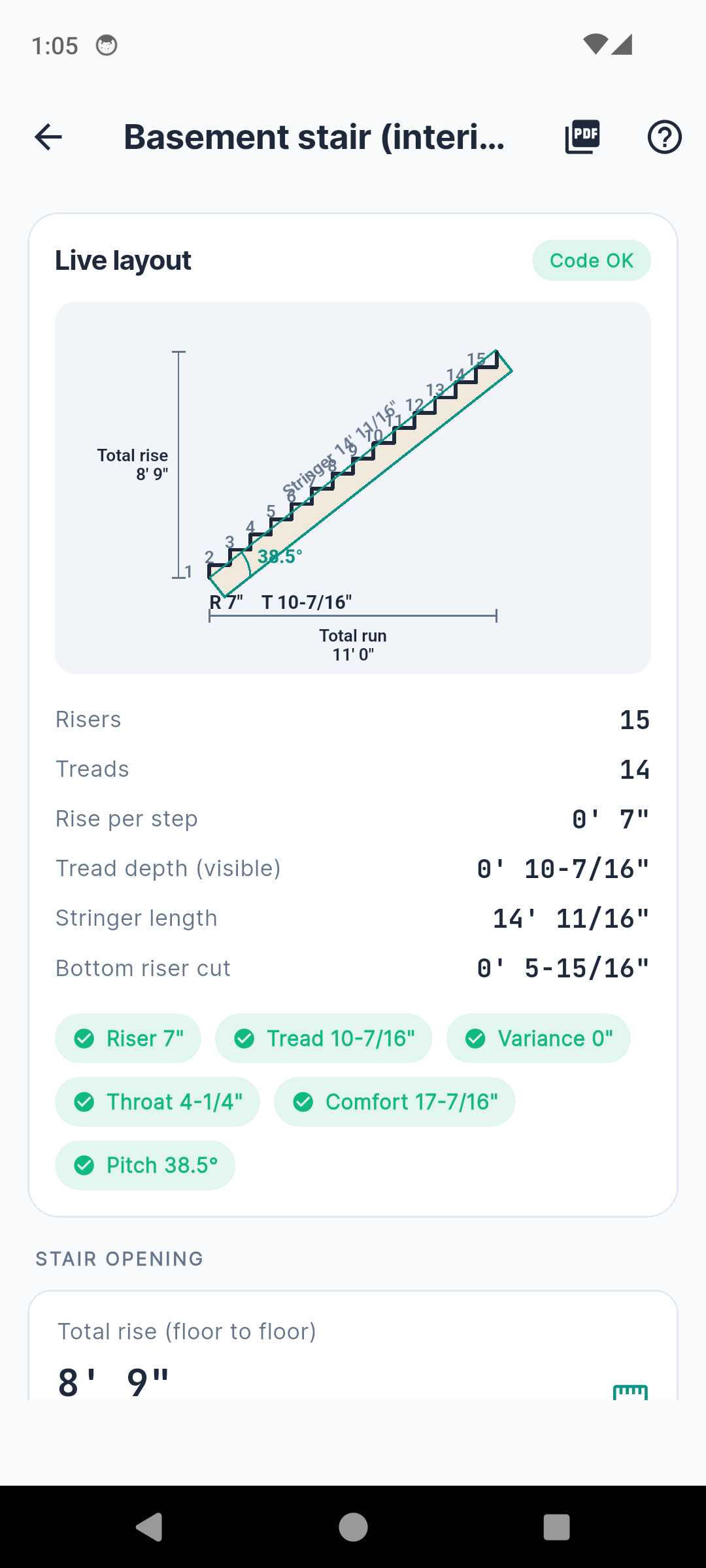
IRC R311.7 green / yellow / red badges for riser, tread, variance, throat, comfort, and pitch — updated as you type.
Cut & build
Framing-square cut sheet with heel positions, side-view diagram, and a 1:1 print template you can tape together and trace.
StringerPro in Action
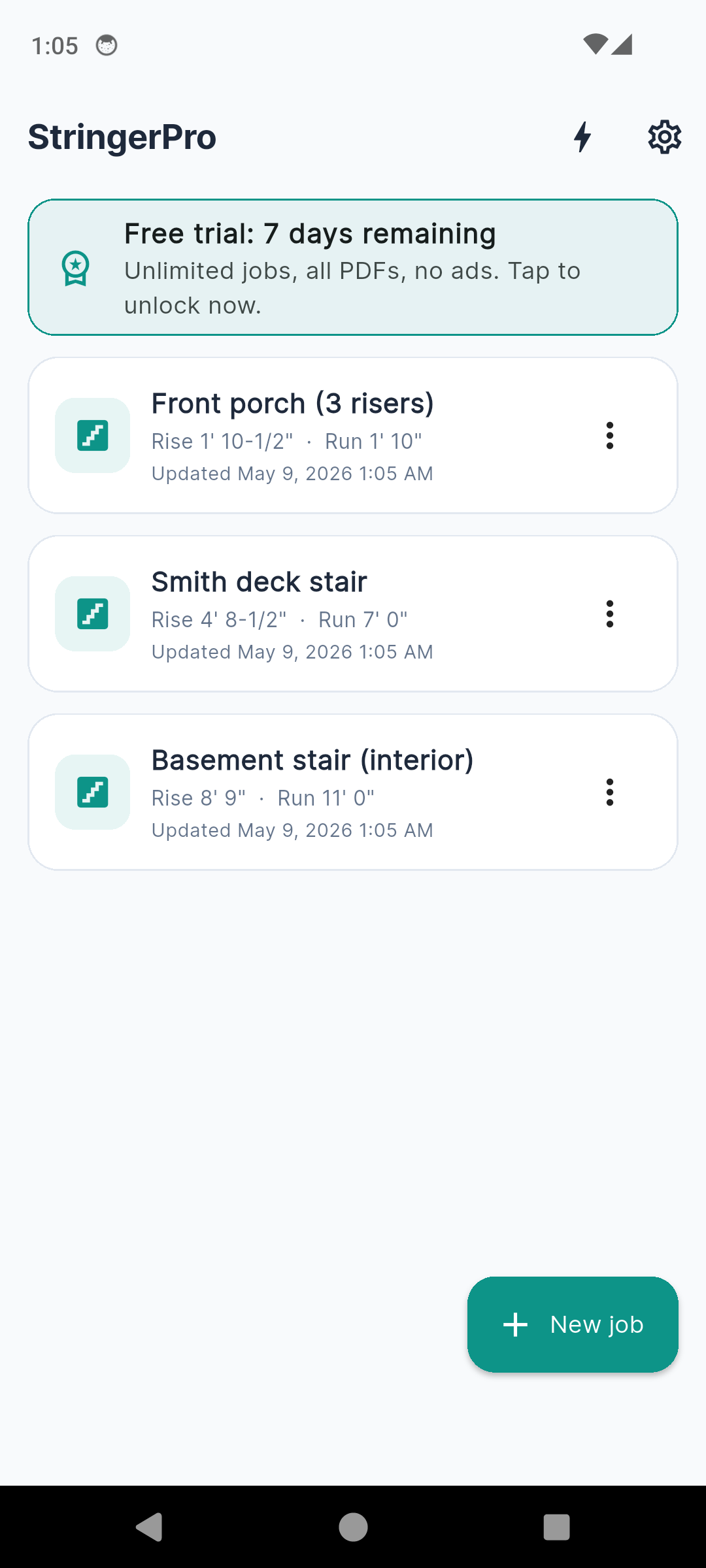
Home — saved jobs at a glance
Fraction-native input
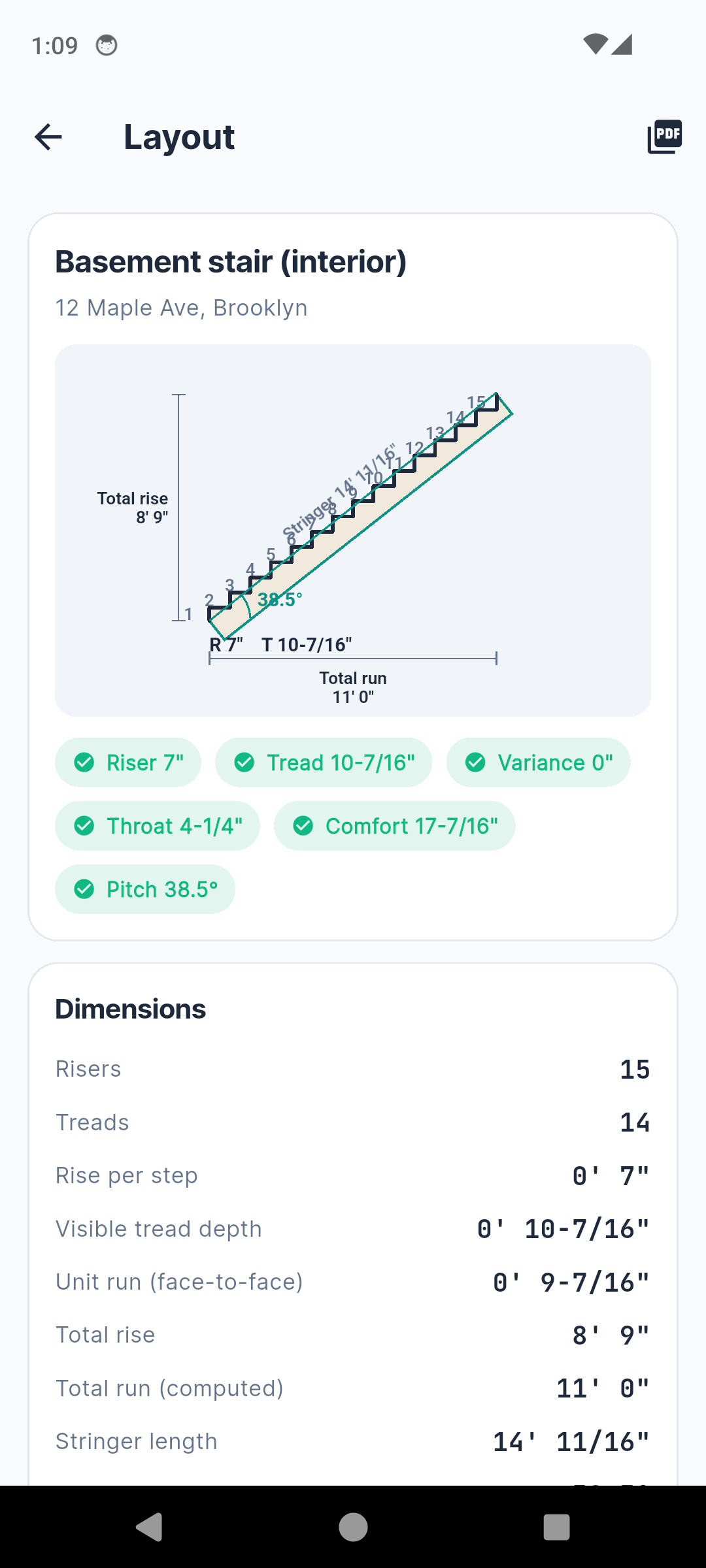
IRC code-checked results
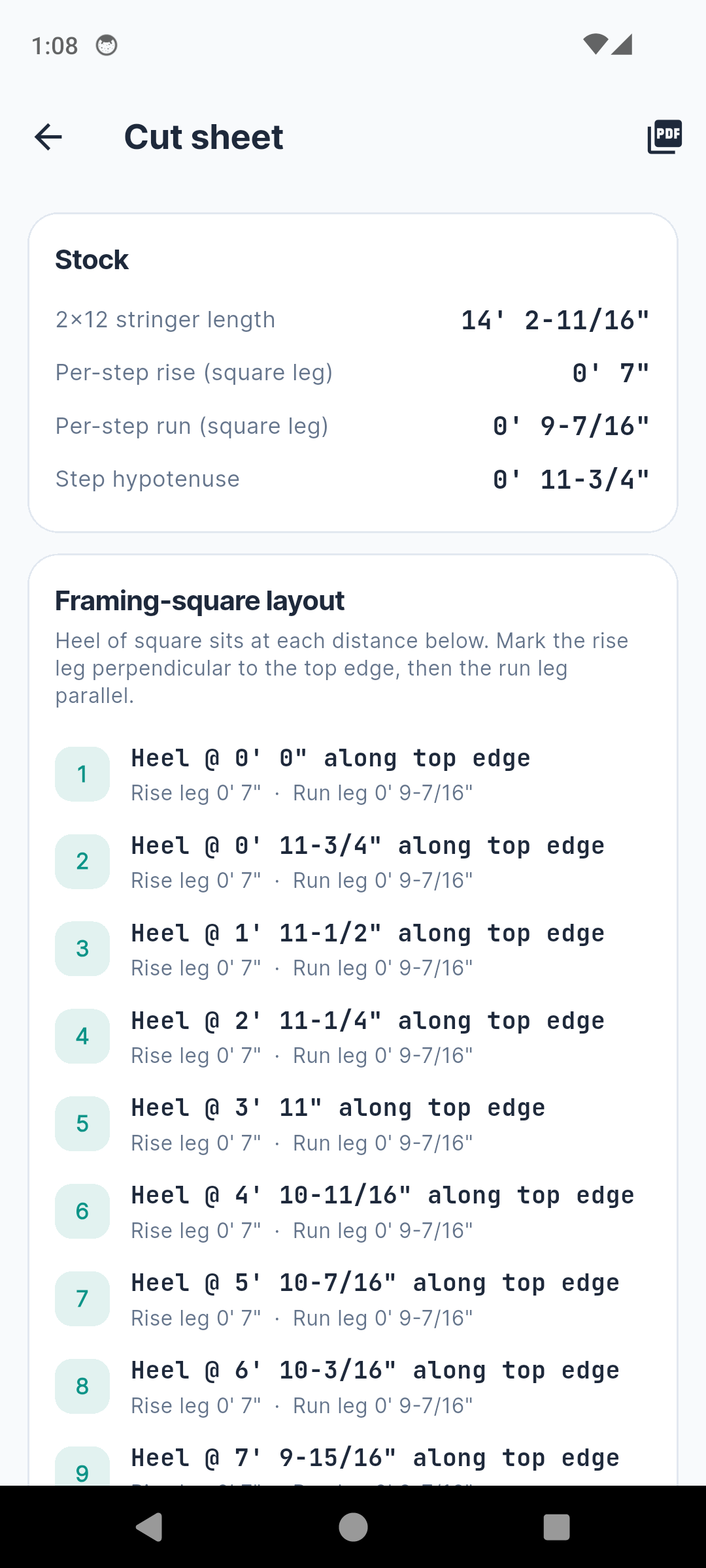
Framing-square cut sheet
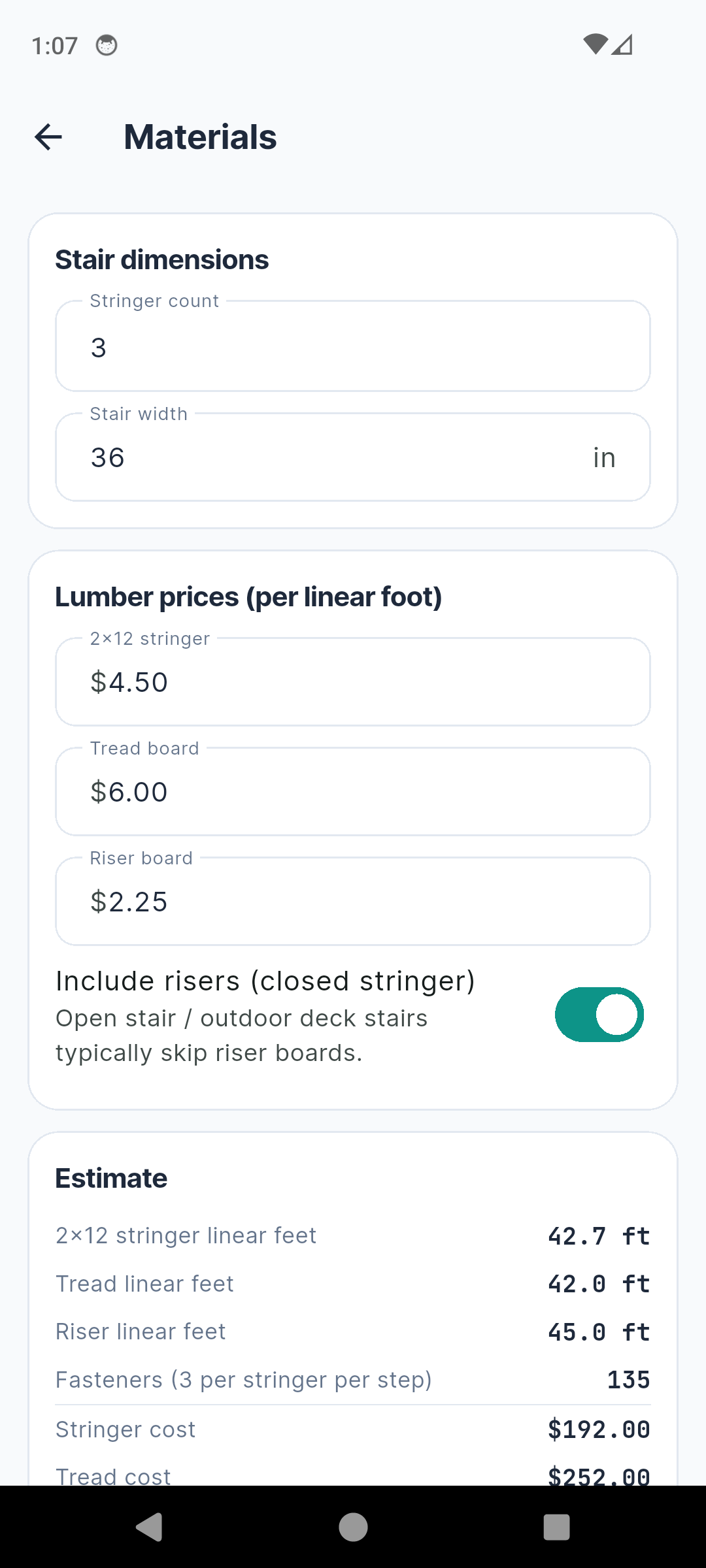
Material estimator

Three PDF exports
One Tool That Does the Stringer Job Exceptionally Well
Fraction-Native Input
Feet + whole inches + sixteenths picker that feels as fast as a Construction Master. Common stops (0, 1/4, 1/2, 3/4) are one tap. Metric supported with a toggle.
IRC R311.7 Code Validation
Real-time green / yellow / red badges for riser height (max 7-3/4"), tread depth (min 10"), variance (max 3/8"), 2x12 throat (min 3-1/2"), comfort, and pitch.
Bottom Step Done Right
Bottom riser auto-shortened by tread thickness so walking rises stay uniform. Fixes the most common code violation in competing apps.
Framing-Square Cut Sheet
Step-by-step heel positions along the top edge of the 2x12, with rise leg + run leg dimensions for every notch. Plus end cuts for seat and plumb.
1:1 Print Template
Tile the side view across letter or A4 pages at full scale, tape together, and trace directly onto the 2x12. Crop marks on every corner.
Material Estimator
Stringer count, stair width, lumber prices in — linear footage, board feet, and total job cost out. Includes fasteners. (Premium.)
Saved Jobs
Job name, address, photo, and notes. One job free; unlimited with Premium. Pick up an old job and rerun the math when scope changes.
Deck Stair Mode
Deck-board nosing standard, concrete-pad seat cut, IRC R311.7.5 deck stair rules. One tap from the main calculator.
Simple, Honest Pricing
No subscription. Pay once, own it forever.
Free
Full calculator, one saved job
- IRC R311.7 code validation
- Fraction-native input
- Side-view diagram
- On-screen cut sheet
- One saved job
- Imperial & metric
- Light, dark & jobsite themes
StringerPro Premium
One-time purchase — yours forever
- Everything in Free, plus:
- Unlimited saved jobs with photos
- PDF summary export
- PDF cut sheet export
- 1:1 PDF print template
- Material estimator
- Custom default thicknesses
- Ad-free
One miscut 2x12 costs more than Premium. StringerPro pays for itself the first stair where you'd otherwise eyeball it and have to recut.
Common Questions
Frequently Asked Questions
Does StringerPro check my layout against IRC code?
Yes. StringerPro checks every layout against IRC R311.7 in real time: max 7-3/4-inch riser height, min 10-inch tread depth, max 3/8-inch variance between any two risers, min 3-1/2-inch throat for a 2x12 stringer, the rise + tread comfort sum, and pitch angle. Each rule shows a green / yellow / red badge as you type. Local building codes may vary — always verify with your AHJ.
Why does StringerPro shorten the bottom riser automatically?
Because the bottom riser has to be cut shorter by the tread thickness so that walking rises stay uniform once treads are installed. Most stair calculators ignore this and produce a stringer where the first step is 3/4 to 1 inch taller than every other step — the most common code violation in DIY stair builds. StringerPro handles it automatically using your specified tread thickness.
What's a framing-square cut sheet?
A printable step-by-step list of where to position your framing square along the top edge of the 2x12 to mark every notch. Each entry shows the heel position, the rise leg dimension, and the run leg dimension — plus the seat cut at the bottom and the plumb cut at the top. It's how stairs were laid out for a hundred years before calculators, but with the math done for you.
Can I print a 1:1 template to trace onto the lumber?
Yes. Premium unlocks a 1:1 print template that tiles the side-view stringer across letter or A4 pages at full scale. Tape the pages together, lay the template on your 2x12, and trace directly. Crop marks on every corner make alignment foolproof. Eliminates measurement errors when transferring dimensions from a phone screen.
Does it support fractions of an inch?
Yes — fraction-native. Feet + whole inches + sixteenths picker that feels as fast as a Construction Master calculator. Common stops (0, 1/4, 1/2, 3/4) are one tap. Type 92-1/4 inches as 92 ft 0 in 4/16 — or just 92 1/4. Metric is also supported with a one-tap toggle.
Is it different for deck stairs?
Yes. Deck stair mode uses the deck-board nosing standard, the concrete-pad seat cut for stairs landing on a slab, and IRC R311.7.5 deck stair rules. Switch from the main calculator with one tap.
What's in the material estimator?
Stringer count, stair width, and lumber prices in — linear footage, board feet, and total job cost out, including fasteners. Useful for material lists at the lumber yard or quotes you give to a customer.
Is there a subscription?
No. Premium is a single $5.99 in-app purchase. Pay once, own it forever, no annual renewal. Carpenters spend $5 on coffee daily — this is one job's saved-lumber cost.
Build Stairs That Walk Right the First Time
Download StringerPro and lay out your next stringer in under a minute.
Have questions? Get in touch
Stair Stringer Math, Done Right
A stair stringer is the diagonal 2x12 (or 2x10) that holds the treads. Cutting one wrong is expensive — a single 16-foot 2x12 #1 SYP runs $35 to $55, and most stair builds need three. The rise needs to be uniform (within 3/8 inch by IRC R311.7), the tread depth needs to clear the minimum, the throat needs to be wide enough that the stringer isn't structurally compromised, and the bottom riser needs to be shorter than the others by exactly one tread thickness so the finished stair walks evenly. Every one of those rules has a way to fail. StringerPro keeps you out of trouble.
Why Most Stair Calculators Get the Bottom Step Wrong
The single most common DIY stair mistake is forgetting that the bottom riser has to be cut shorter by the tread thickness. If your treads are 1 inch thick and your unit rise is 7-1/4 inches, the bottom riser on the stringer needs to be cut at 6-1/4 inches — so that once the tread sits on top of the bottom step, the walking rise from the floor up to the first tread is the same 7-1/4 inches as every other step. Skip this and your bottom step is 8-1/4 inches tall while every other step is 7-1/4 inches. The 1-inch difference is enough to trip people, fail an inspection, and force a recut. StringerPro handles this automatically using whatever tread thickness you specify.
IRC R311.7 in Plain English
The 2018 International Residential Code section R311.7 sets the rules for residential stairs in most of the United States. Maximum riser height is 7-3/4 inches. Minimum tread depth is 10 inches. The variation between the tallest and shortest riser, or the deepest and shallowest tread, is 3/8 inch — meaning every step has to be uniform within that tolerance. The minimum throat for a notched 2x12 stringer (the wood remaining below the deepest notch) is 3-1/2 inches, otherwise the stringer is structurally weakened. StringerPro shows a green / yellow / red badge for each of these rules in real time as you type — change a number and watch the badges update instantly.
Fraction-Native Because Lumber Is
2x12 lumber isn't 2 inches by 12 inches — it's 1-1/2 by 11-1/4. Stair tread depth in finished form is usually 11-1/4 inches with a 1-inch nosing for an effective 10-1/4. Total rise from a finished basement floor to the underside of the upstairs subfloor is something like 108-3/8 inches. None of these numbers fit cleanly into a decimal calculator. StringerPro's input screen is fraction-native — feet + whole inches + a sixteenths picker that defaults to the most common stops (0, 1/4, 1/2, 3/4) and lets you scroll for the in-between values. It feels like a Construction Master calculator built for stairs.
The Framing-Square Cut Sheet
Before stair calculators, carpenters laid out stringers with a framing square — the 16-inch and 24-inch L-shaped tool every framer carries. You'd set the rise dimension on one leg and the run dimension on the other, walk the square down the top edge of the 2x12 marking each notch, and then cut. StringerPro's cut sheet is the modern equivalent: a step-by-step list of every framing-square heel position along the top edge, with the exact rise leg and run leg for each step. Plus the seat cut at the bottom (where the stringer meets the floor or pad) and the plumb cut at the top (where it meets the upper floor framing). Print it, take it to the cut station, work down the list.
The 1:1 Print Template
For builders who want to skip the math entirely, Premium unlocks a 1:1 PDF print template. The side view of the stringer is tiled across letter or A4 pages at full scale, with crop marks on every corner. Print, tape together, lay the template on your 2x12, trace the outline, and cut to the line. Used carefully, it eliminates every measurement transfer error that creeps in when you're reading dimensions off a phone screen with one hand and marking lumber with the other.
Material Estimator for Quotes
If you build stairs for a living, you spend half your time figuring out how much material a job needs and what it'll cost. The material estimator takes stringer count, stair width, and lumber unit prices and gives you total linear footage, board feet, and a job total including fasteners. Useful for handing a customer a quote without needing a separate spreadsheet, or for grabbing the right amount of lumber on the way to the jobsite without a second trip.
Deck Stair Mode
Exterior deck stairs follow IRC R311.7.5 with a few key differences from interior stairs: nosing dimensions match the deck board standard (typically 5/4 or 2x decking with a 1-inch overhang), the seat cut at the bottom usually lands on a concrete pad instead of a finished floor, and the maximum riser height stays the same but tread depth is often increased to 11 inches for safety in wet conditions. Switch from the main calculator with one tap and the inputs and code rules update accordingly.
Built for One Job, Done Exceptionally Well
There are construction calculator apps that try to do everything — stringer layout, drywall takeoff, paint coverage, concrete volume, lumber pricing, framing math. They're useful for the rare problem you encounter once a year, and they always feel like a museum of half-finished features when you actually try to lay out a stair. StringerPro does one thing — turn rise and run into a code-checked, ready-to-cut stringer layout — and does it better than any general-purpose calculator. If you build stairs more than once or twice a year, that's worth one $5.99 in-app purchase.
Privacy and Offline Use
StringerPro stores every saved job locally on your device. No account, no cloud sync, no analytics on your job data. The app works completely offline, which matters because the basement of a remodel rarely has signal. The free tier includes a banner ad; Premium removes it.