



























































































Home Inventory for Insurance: What to Document and How
After a loss the burden of proof is yours. Here is what to record per item, why purchase dates matter as much as values, and the sub-limits an inventory exposes.

The awkward moment in a contents claim comes early. An adjuster hands over a form and asks for a list of what you owned, with an age and a value against each line. Not a summary. A list.
People fill it in from memory, sitting at somebody else’s kitchen table, days after a fire or a flood. Memory is bad at this. Walk any room of your house in your head right now and you will get the furniture, the television and maybe the rug. You will not get the contents of the sideboard, the tools in the garage, the four winter coats, the pile of kitchen gadgets that quietly cost several hundred dollars over five years. Those omissions do not get paid, because nobody knew to claim for them.
That gap is the entire argument for building an inventory while everything is still intact and boring.
The proof runs one way
An insurance policy pays for a loss you can demonstrate. The formal version of that demonstration is the proof of loss, a signed statement of what you lost and what it was worth, usually due within a set window after the event, often thirty to sixty days depending on the policy and the jurisdiction. The adjuster verifies, but the schedule of items comes from you.
So the inventory is not admin. It is the document your settlement is calculated from, prepared under no pressure, at a time when you can still open the cupboard and read the model number off the back of the thing.
Why the purchase date matters more than the price
Most policies cover personal belongings at actual cash value by default. That means replacement cost minus depreciation for age and wear, not what you paid and not what a new one costs.
A worked example makes it concrete. Say a television that would cost $900 to replace today is six years old, and the insurer assigns it a ten year useful life. Six tenths of its life is spent, so roughly sixty percent comes off. The cheque is around $360.
Replacement cost cover changes the arithmetic, though usually not in one step. The common mechanism is that the insurer pays the actual cash value first, then releases the held-back portion, the recoverable depreciation, once you have actually bought a replacement and sent in the receipt. In the example above that is $360 now and $540 after you buy the television and show what you spent.
Two consequences follow, and they shape what you record:
The age of an item drives the settlement as much as its value does, so a purchase date on every line is worth more than a precise valuation. If you cannot recall a date, an approximate year is far better than a blank, because a blank invites the adjuster’s own assumption.
Under replacement cost cover, receipts get you the second payment. Photograph receipts when you get them. Thermal till paper fades to blank in a couple of years in a warm drawer, which is a genuinely common way to lose money on a claim.

The sub-limits nobody reads until it is too late
Contents cover is not a single pot. Inside it sit special limits on particular categories, and they are far lower than people expect. Jewellery is the classic: a typical policy caps theft of jewellery somewhere around $1,500, with $1,000 to $2,500 the usual range across insurers. Cash is often capped at a couple of hundred. Similar limits commonly apply to watches, furs, silverware, firearms and collectibles.
The maths is unkind. An unscheduled $3,000 ring, stolen, against a $1,500 sub-limit and a $1,000 deductible, pays $500.
The fix is to schedule the item, an endorsement variously called a rider or a floater, which lists it individually at an appraised value. Scheduled items are usually covered for a broader set of causes, including accidental loss and simple disappearance, and often with no deductible.
Here is the part that connects back to the inventory: you cannot schedule what you have not noticed. Almost nobody sits down and thinks about whether their watch collection has drifted past a sub-limit. Building the list is what surfaces it. In practice the inventory earns its keep before any loss, by telling you which four or five things need to come out of the general pot.
The same applies to the overall limit. Personal property cover is commonly set as a percentage of the dwelling amount, often somewhere in the range of half to seventy percent, chosen by formula rather than by anyone counting your possessions. Totalling an actual inventory is the only honest way to find out whether that number resembles what is in the house.
What goes on each line
For every item worth recording:
- What it is, with make and model
- Serial number, photographed from the plate rather than typed from memory
- Quantity, where it is a set
- Purchase date, exact or approximate
- What you paid, and where you bought it
- A photograph of the item as it sits in the room
- The receipt, warranty or manual, attached
Serial numbers deserve the extra minute. They tie an item to you rather than to a category, they go into a police report, and they are what makes a recovered item traceable back. For anything with a plate on the underside or the back, take that photograph while the item is accessible, because it is a joyless task to do later with a phone torch behind a cabinet.
A method that survives contact with a Saturday
The reason most home inventories do not exist is that people start at the front door meaning to do the whole house, and stop in the hallway.
One room per session works far better. Twenty minutes, one room, done. If you only ever manage one session, make it the room with the electronics or the jewellery, because value is concentrated and the sub-limits bite hardest there.
Open things. The contents of drawers, wardrobes and toolboxes is where claims quietly get underpaid, because the aggregate is large and the individual items feel too small to bother listing. Photograph the open drawer and list the contents in one line with a total, rather than skipping it.
Do not stop at the rooms you sit in. The garage, loft, shed, garden equipment, bicycles, the tools in the back of the car, anything currently lent to somebody else. Items away from the home are often covered on a different basis, which is another reason to know they exist.
A narrated video walk-through is a decent first pass and takes ten minutes. Treat it as raw material rather than the finished article, because an adjuster works from a schedule of items, not from footage. The video helps you build the list and backs it up; it does not replace it.
The mistakes that cost the most
Recording a value but no age, so depreciation gets applied on someone else’s assumption rather than your date.
Wide room shots only, with no close-ups and no serial numbers, which proves a room existed but not what was in it.
Keeping the whole thing in the house it documents. Cloud storage or an offsite copy is the entire point.
And building it once, in a burst of enthusiasm, then never touching it again. The items you buy after the list is written are the newest and least depreciated things you own, which makes them the ones most worth having on it.
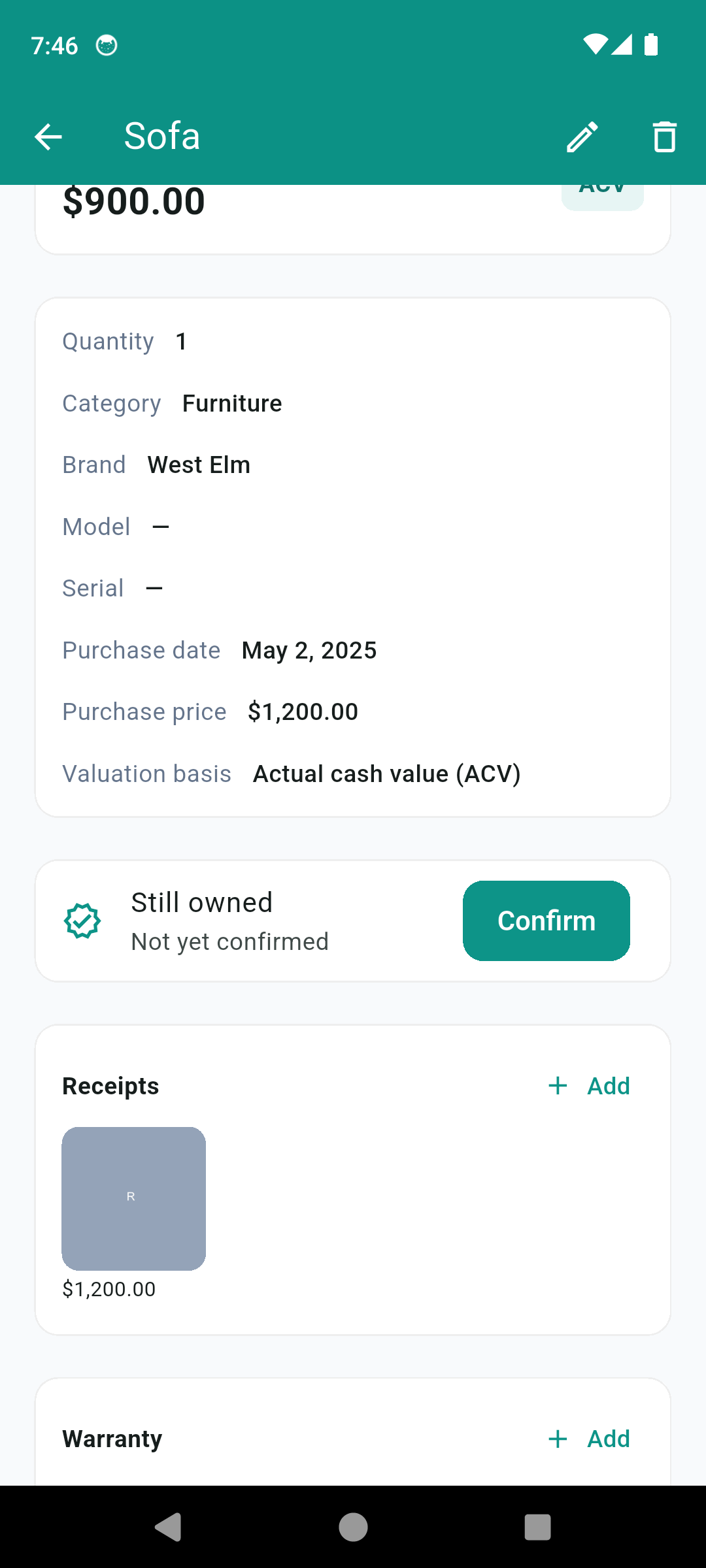
Doing this in a spreadsheet works, and plenty of people manage it. The friction is photographs, which is where a phone beats a laptop by a distance. HomeStock is built around that: photograph the item, attach the receipt and warranty, record the purchase date and whether the item is covered on an actual cash value or replacement cost basis, then export the whole thing room by room as a PDF you can send to an adjuster or a broker in one go. It works offline, and the export is the bit that matters, because a claim needs a document rather than an app.
This is general information rather than insurance advice. Policy wordings, sub-limits, deadlines and valuation rules vary by insurer and by country, so read your own schedule of cover, and ask your insurer or broker what applies to you before relying on anything above.
Common questions
What should a home inventory include for each item?
A description with make and model, the serial number where there is one, the purchase date, what you paid, and a photograph. Attach the receipt if you still have it. The purchase date is the field people skip and the one that decides how much depreciation gets applied to your settlement.
Do I need receipts for an insurance claim?
They help but they are not the only proof. Photographs of the item in your home, the serial number, bank or card statements, warranty registrations and the original packaging all support ownership. Receipts matter most for items with replacement cost cover, where the insurer holds back part of the payout until you actually replace the item.
How often should a home inventory be updated?
Add anything significant when you buy it, which takes a minute while the box is still open, and do a walk-through once a year. An inventory that is three years stale still beats no inventory, but it will be missing exactly the recent purchases you would most want covered.
Where should the inventory be stored?
Somewhere that survives the event you are insuring against. A list in a drawer burns with the house. Keep it in cloud storage or on a device that travels with you, and make sure you can produce it as a single document you can email to an adjuster rather than a folder of loose photos.
Photos: Helena Jankovičová Kováčová / Pexels , Pixabay / Pexels