




























































































How Often Should a Mechanical Watch Be Serviced?
The old answer was every five years. Modern manufacturers say much longer. Here is what actually changed, what a service involves, and the symptoms that override any interval.

Ask ten collectors how often a mechanical watch needs servicing and you’ll get “every five years” from most of them, usually said with confidence. It is the most repeated figure in the hobby, and for a modern watch it is probably wrong.
The manufacturers themselves have moved. Rolex now advises servicing roughly every ten years. Omega quotes a five to eight year window and points at its co-axial escapement as the reason it can. Several traditional houses still recommend three to five, which tells you something useful: there is no universal interval, and anyone quoting one without asking what you own is repeating folklore.
What changed
Two things, and both are about friction.
The first is lubrication. A mechanical movement is a machine with dozens of pivots turning in jewelled bearings, and everything depends on the oil in those bearings staying where it was put and staying the consistency it started at. Older natural oils spread, oxidised and eventually dried, which is what the five-year rule was really about. It wasn’t wear. It was the oil giving up long before the metal did. Modern synthetic lubricants are far more stable and hold their position on the jewel much longer.
The second is escapement design. The Swiss lever escapement, which is in the vast majority of mechanical watches, works by sliding contact between the pallet jewels and the escape wheel teeth. Sliding contact needs oil, and it is the oil in the hardest-working part of the watch. Omega’s co-axial layout replaces most of that sliding with radial impulse, which reduces friction at the point where friction matters most, and lets the lubricant last longer before the rate starts to wander.
None of which means a modern watch is maintenance-free. It means the calendar moved out. What has not changed is that a movement running on degraded oil is a movement wearing its pivots against dry jewels, and that damage does not undo itself.
The intervals worth knowing
| Type | Common guidance | Why |
|---|---|---|
| Current Rolex | Around 10 years | Modern lubricants, sealed case, in-house regulation |
| Current Omega co-axial | 5 to 8 years | Reduced escapement friction |
| Other modern Swiss automatics | Commonly 5 to 7 years | Varies by house; check the maker |
| Vintage, pre-1980s | 3 to 5 years, often shorter | Older oils, worn gaskets, scarcer parts |
| Chronographs | Shorter end of the range | More components under load, extra wear paths |
| Watch worn daily and hard | Shorter end of the range | Shock, moisture, temperature swings |
| Watch left unworn for years | Service before returning it to use | Static oil congeals; sitting is not rest |
That last row surprises people. A watch put in a drawer for a decade is not being preserved. Oil that never moves migrates and thickens, and the first thing that happens when you wind it is that dried lubricant gets dragged through the train. If a piece has been dormant a long time, have it looked at before wearing it rather than after it starts running badly.
Symptoms outrank the calendar
An interval is a planning tool. The watch itself will tell you when it actually needs attention, and that always wins.
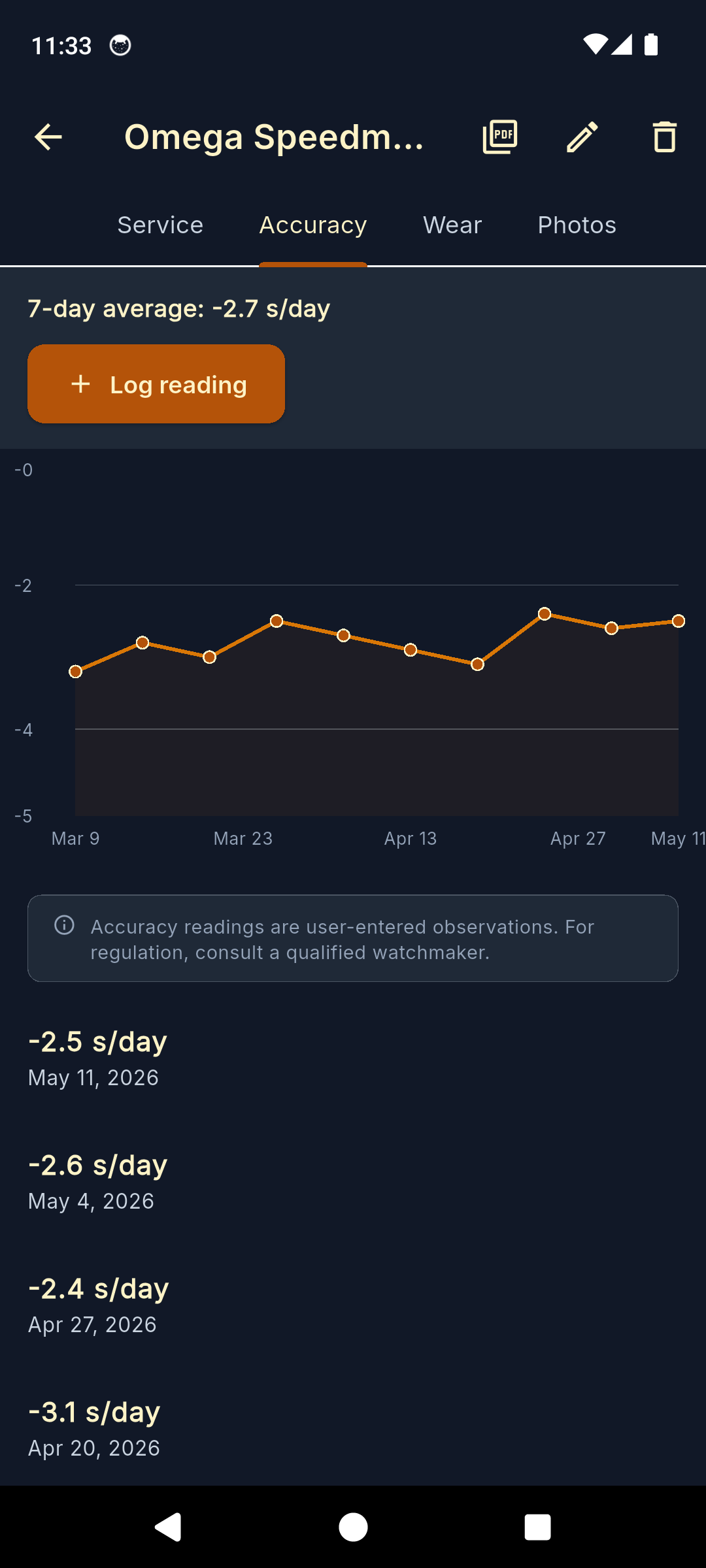
The most reliable early sign is a change in rate against its own history. Not the absolute number, the change. A watch that has run at minus three seconds a day for four years and is suddenly at minus twelve is telling you something, even though minus twelve is still inside the tolerance a lot of movements are sold with. This is the reason it’s worth knowing your watch’s normal figure. Without a baseline, a drifting rate looks like a watch that was always a bit slow.
Power reserve dropping off is the next one. If a full wind used to see you through the weekend and now runs out on Sunday morning, the mainspring or the train is losing efficiency somewhere.
Then the tactile symptoms. A rotor that grinds or rattles rather than sweeping. A crown or pusher that feels gritty when it used to feel smooth. A chronograph that hesitates on start, creeps when stopped, or won’t return to zero in one clean jump.
And the one that means stop wearing it today: any fogging under the crystal, or any evidence of moisture inside the case. Water and a steel movement produce rust quickly, and rust turns a service into a parts replacement. Nothing else on this list is urgent. That one is.
What you’re actually paying for
“Service” gets used loosely, and it covers two quite different jobs.
A full service means complete disassembly. Every component comes out, goes through ultrasonic cleaning to strip old oil and residue, gets inspected for wear, and goes back with fresh lubricant applied in specific quantities to specific points. Worn parts are replaced, and the mainspring usually is as a matter of course. Gaskets are renewed, the case and bracelet are cleaned and often refinished, the movement is regulated in several positions, and the whole thing gets a pressure test before it goes back to you. It takes a skilled person a long time, which is where the cost comes from.
A pressure test on its own is a different thing entirely. It checks the case seals hold, and it is quick. Gaskets flatten and harden with age and with every crown operation, and they do that on their own schedule regardless of how the movement is doing. Annually is the usual advice, and before any holiday where the watch is going in the sea. It is the cheapest insurance in the hobby.
Some watchmakers will also offer partial work: a regulation, a crystal, a crown and stem. That is fine for a specific fault, but it isn’t a substitute for a full service, and a regulation on a movement running dry just moves the number without fixing the cause.
The case against servicing too often
There is a real argument on the other side, and it deserves an airing rather than a dismissal.
Every service is an intervention. The movement is dismantled, cleaned, handled and reassembled, and each of those steps carries a small chance of a scratch, a mis-set component, or a replacement part that isn’t the original. On a collectible or vintage piece, over-servicing can strip away exactly the originality that gives the watch its value, particularly where a dial or hands get “refreshed” without being asked for.
Which is why the sensible approach for anything with collector value is: service on evidence, not on a calendar reminder, and tell the watchmaker explicitly to leave the dial, hands and case finish alone unless you’ve agreed otherwise. For an everyday modern watch the calculus is different and following the manufacturer’s interval is fine.
Keep the paperwork, because resale asks for it
Whenever a mechanical watch changes hands, the first question after authenticity is service history. A documented full service within a sensible window is worth real money at sale, and its absence gets priced in as risk by every buyer who knows what a service costs.
That history is easy to lose. Receipts fade, watchmakers retire, and box papers separate from the watch. Whatever system you use, record the date, who did the work, what was replaced, and the rate the watch came back at. That last figure is what makes the next drift meaningful. WatchLog keeps a service record and an accuracy history per watch and puts the next service target on the watch’s own interval, which is handy across a collection where a vintage piece and a current automatic are on completely different clocks.
The short answer, if you want one: follow the maker’s number, halve it if the watch is old or lives a hard life, pressure test yearly regardless, and go early if the rate shifts. And if you see moisture, don’t finish reading the sentence, take it off.
Common questions
How many years between mechanical watch services?
It depends on the maker. Rolex now advises roughly every ten years, Omega quotes a five to eight year window, and several traditional houses still suggest three to five. Older and vintage movements generally want shorter intervals than modern ones. Check what your specific manufacturer publishes rather than applying a single rule.
Is the five-year service rule still valid?
It was sound advice for movements built before modern synthetic lubricants and sealed cases, and it is still reasonable for vintage pieces. For a current production watch worn normally it is conservative, and most manufacturers have publicly extended their own recommendations well past it.
What are the signs a watch needs servicing?
A rate that suddenly shifts by several seconds a day from its own established baseline, a power reserve that falls noticeably short, a rotor or crown that feels gritty, moisture or fogging under the crystal, and a chronograph that hesitates or fails to reset cleanly. Moisture is the one to act on immediately.
Does water resistance need testing separately?
Yes. Gaskets age and compress whether or not the movement needs attention, so a pressure test is an annual job on its own schedule, and it is worth doing before any trip involving swimming or diving. It is quick, and it is far cheaper than the corrosion damage it prevents.
Photos: Gizem toprak / Pexels , Thang Cao / Pexels