



























































































3D Print Filament Storage: Moisture, Drying and Shelf Life
Why wet filament pops at the nozzle, which materials go off fastest, safe drying temperatures for each, and the storage setup that actually holds under 20% RH.
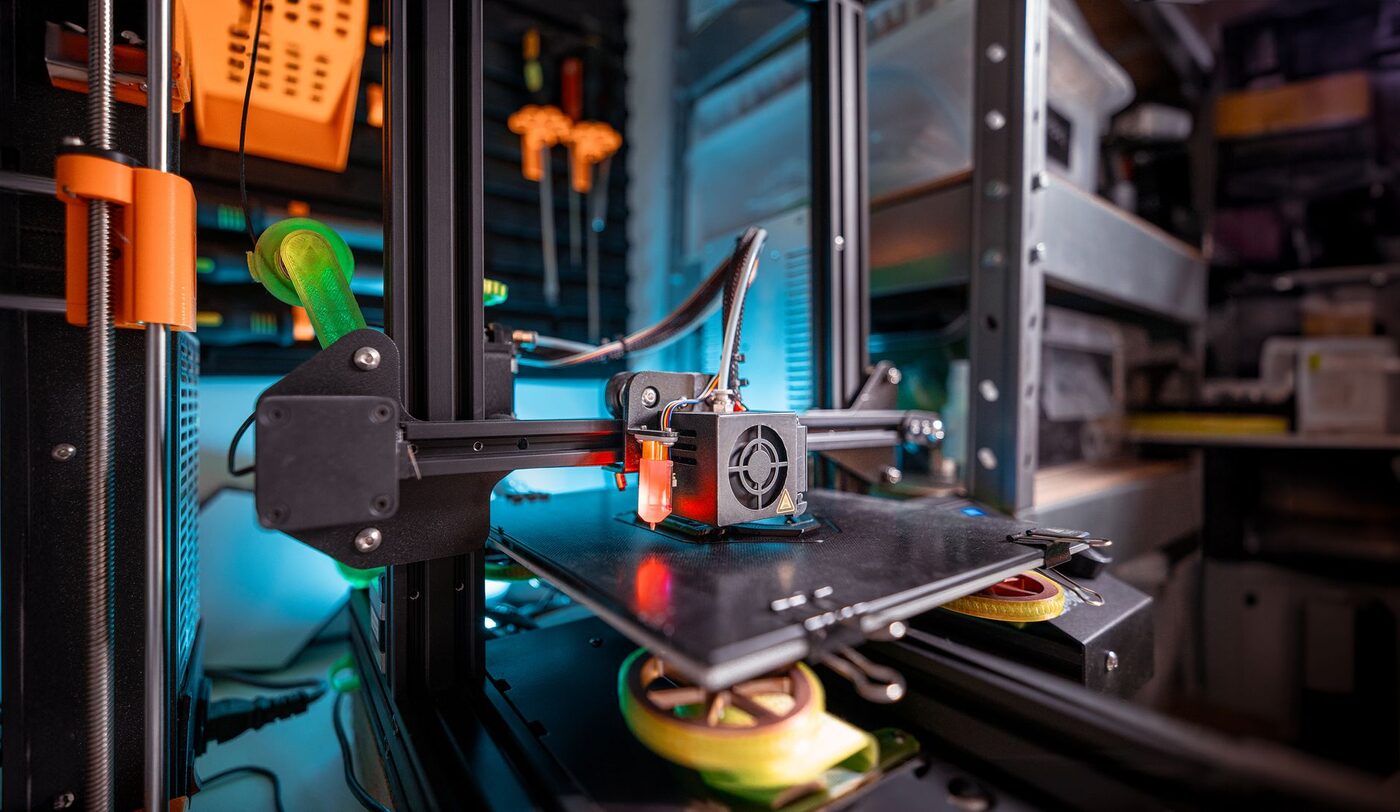
There is a sound that tells you almost everything. Stand next to the printer with the fan off and listen to the nozzle. A faint crackle, an occasional pop, maybe a thread of steam that catches the light. That is water in the filament reaching 220°C and flash-boiling on its way out.
Most of what gets blamed on cheap filament is wet filament. The spool was probably fine when it arrived. It has been sitting on a shelf in a room at 50% humidity ever since.
What the water is actually doing
Two separate things happen, and only one of them is reversible.
The physical problem is steam. Water absorbed into the filament expands violently when it hits melt temperature, blowing bubbles in the extrusion. Those bubbles disrupt flow, so the extruded width wanders, the surface goes rough and pitted, and molten strands get flung about, which is where the sudden stringing comes from. Voids inside the walls also mean less solid plastic bonded to the layer below, and published testing puts the strength loss from badly wet filament somewhere in the range of 20% to 50%.
The chemical problem is hydrolysis, and it is the part people miss. PLA, PETG, nylon and polycarbonate are condensation polymers, which means water at high temperature does not just make bubbles, it cleaves the polymer chains and permanently shortens them. Shorter chains make a weaker, more brittle part. Drying the spool afterwards stops any further damage but cannot reassemble the chains you already broke. ABS and ASA are not built that way, so for those the water really is only a physical nuisance and drying restores them properly.
That distinction is worth carrying around: for ABS, drying is a fix. For PLA and nylon, drying is prevention, and the value is in doing it before you print rather than after you notice.
How fast each material goes off
Hygroscopy varies enormously, and the ranking is not intuitive. PLA gets treated as immune and it is not, it is just slow. Nylon is at the other end and it is genuinely dramatic: a spool left out overnight in a humid room can be visibly worse the next morning.
Roughly in order of how quickly they spoil in open air: PVA and nylon are the worst by a wide margin, then TPU, then polycarbonate and PETG, then ABS and ASA, with PLA the slowest. Slowest is not the same as safe. An open PLA spool in a damp garage will print noticeably worse after a few months.
Drying temperatures, and the ceiling you must not cross
Every material has a glass transition temperature where it starts to soften. Dry above it and the spool welds itself into a solid disc, which is an expensive way to learn the number.
| Material | Dry at | For | Softens near |
|---|---|---|---|
| PLA | 45 to 50°C | 4 to 6 h | 60°C |
| PETG | 60 to 65°C | 6 h | 75°C |
| ABS / ASA | 70 to 80°C | 4 to 6 h | 105°C |
| TPU | 50 to 55°C | 6 to 8 h | 60°C |
| Nylon (PA) | 70 to 80°C | 12 to 16 h | see below |
| Polycarbonate | 70 to 80°C | 6 to 8 h | 145°C |
| PVA | 45 to 50°C | 6 to 8 h | 45°C |
PLA is the one that catches people, because 60°C sounds like a comfortable margin above a 55°C dial setting and it is not. Household ovens are the usual culprit. They cycle around the setpoint rather than holding it, and at the bottom of the range many overshoot by 20 to 30°C, which turns a PLA spool into scrap in half an hour. A cheap food dehydrator holds temperature far better than an oven, and a dedicated filament dryer better still.
Nylon looks like it breaks the rule, since its glass transition sits somewhere around 50 to 70°C depending on grade and how wet it is, yet everyone dries it at 80°C. It gets away with it because nylon is semi-crystalline: the crystalline regions keep the shape of the winding even when the amorphous regions have gone soft. Do not extend that logic to PLA, which is mostly amorphous as extruded and has no such scaffolding.
Storage that actually works
The target is under 20% relative humidity, and under 10% if you run nylon. Getting there is not complicated, but every part of the usual setup has a failure mode.
An airtight tub with a rubber gasket and clips is the workhorse. Vacuum bags are better for long-term storage of spools you are not touching, and worse for anything in rotation, because a bag that gets opened weekly is not really sealed.
Desiccant is where most setups quietly fail. The sachet that came in the filament bag is small, was already partly used protecting the spool in transit, and saturates within weeks in a container you keep opening. Silica gel does not wear out, it just fills up, and regenerating it means baking it at 120 to 150°C until the indicator colour returns. Do not go much past 150°C, which starts degrading both the dye and the pore structure. Modern indicating gel runs orange when dry and green when saturated. The old blue type used cobalt chloride, which is why it has been restricted in a number of markets, and it is not worth seeking out.
Put a hygrometer inside the tub, and do not trust it out of the packet. Cheap ones are routinely 10 points out, which is the difference between a container that is working and one that is not. Calibrate it with the salt test: half fill a bottle cap with table salt, add just enough water to wet it without dissolving it, seal the cap and hygrometer together in a small bag for eight hours, and it should read 75%. Note the error and apply it thereafter.
Two smaller things. Cardboard spools absorb moisture themselves and hold it against the filament, so they are worth transferring or at least storing with more desiccant than a plastic spool needs. And filament in use needs the same protection as filament in storage. A spool sitting on top of the printer for a three-day nylon print is exposed for three days, which is why drybox feeding through a PTFE tube exists.
Reading the symptoms correctly
Not everything gets blamed on moisture correctly, and chasing the wrong cause wastes an afternoon.
| What you see | Usually | Also consider |
|---|---|---|
| Popping, crackling, visible steam | Moisture, almost always | Nothing else does this |
| Rough, pitted, bumpy surface | Moisture | Over-extrusion, partial clog |
| Heavy stringing that tuning will not fix | Moisture | Nozzle too hot, retraction settings |
| Layers separating under light load | Moisture | Nozzle too cool, draughts, no enclosure |
| Extrusion width wandering | Moisture | Partial clog, worn extruder gear |
| Filament snapping on the spool | Age and hydrolysis in PLA | Tangle, too tight a bend radius |
What shelf life really means
An unopened, factory-sealed spool with intact desiccant keeps for years. PLA sealed properly in 2023 will print fine today. The clock does not start at manufacture, it starts when the bag comes off.
After that it depends entirely on where it lives. Open nylon in a humid room is compromised in a day. Open PETG is usable for months and gradually declines. Open PLA in a dry cupboard can go a year and still print acceptably, and the same spool in a damp garage will not.
Which is the practical reason to write down when you opened something. Six months later, standing in front of a rack of half-used spools, you cannot tell by looking which one has been open since spring, and that is exactly the one causing your layer adhesion problem.
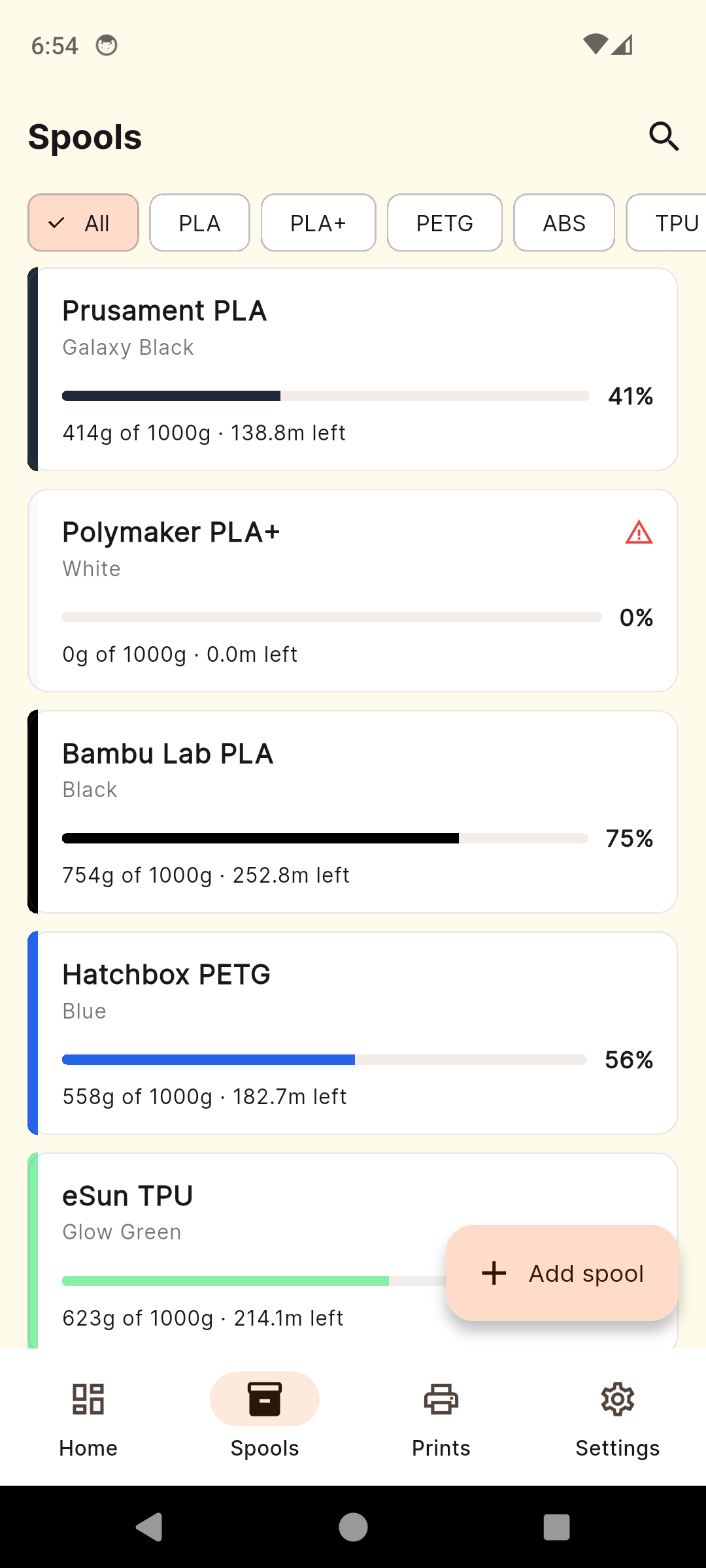
PrintVault keeps that record alongside how much is left on each spool and what you printed with it, which turns a shelf full of anonymous plastic into something you can reason about.
None of this requires an expensive setup. A gasketed tub, a few hundred grams of silica gel you actually regenerate, a calibrated hygrometer and a note of when each spool was opened will put you ahead of most workshops. The failure is almost never the storage box someone bought. It is the desiccant that has been saturated since March.
Common questions
How do I know if my filament is wet?
Listen at the nozzle. Faint popping, crackling or a wisp of steam as it extrudes is close to conclusive, because that is water flashing to steam. Supporting signs are a rough bumpy surface, heavy stringing that tuning does not fix, and parts that snap along layer lines under light load.
What humidity should filament be stored at?
Under 20% relative humidity suits most materials, and nylon wants under 10%. A sealed tub with regenerated desiccant and a hygrometer inside will hold that. Ordinary room air at 50% RH is enough to spoil nylon within a day of opening.
Can I dry filament in a kitchen oven?
It works but it is the riskiest option. Household ovens cycle around the setpoint and many overshoot by 20 to 30°C at the low end of the dial, which is enough to fuse a PLA spool into a solid block. A food dehydrator or a dedicated filament dryer holds temperature far more reliably.
Does drying fully restore wet filament?
It restores printability, not strength. In PLA, PETG, nylon and polycarbonate, water at melt temperature breaks polymer chains through hydrolysis, and that damage is permanent. Drying stops it happening again. ABS and ASA are different, since the water there is only physical and drying genuinely returns them to as-new.