



























































































How to Winterize an RV, Step by Step
What actually splits when RV plumbing freezes, why pink antifreeze freezes at +16°F, and the order of operations that leaves nothing holding water.
The damage almost never announces itself. You close the rig up in October, everything is fine, and in April you turn the pump on and hear it running without ever building pressure. Somewhere behind a panel, a fitting let go months ago.
Where it lets go is worth knowing, because it shapes the whole job. PEX tubing is surprisingly forgiving. It can stretch a little and often survives a freeze that destroys everything attached to it. What splits is the rigid stuff: brass and plastic fittings, the water pump head, the low point drain valves, the city water inlet with its backflow preventer, and the outside shower that everyone forgets. Water expands about 9% when it freezes and something has to give, so it gives at the least flexible point in the system.
That is why draining the tanks and calling it done is not enough. Draining removes the bulk of the water. Winterizing removes the last cupful sitting in a valve body.
The label on the pink jug is not saying what you think
RV antifreeze sold as −50°F does not stay liquid to −50°F. It starts to slush somewhere around +16°F to +20°F. What the rating describes is burst protection: the slush keeps expanding gently rather than forming the hard crystals that crack a fitting, and it does that down to the stated temperature.
This matters in practice because people see antifreeze in the lines, then see it looking frozen on a cold morning, and assume the product has failed. It has not. It also means a partly diluted mix, which is what you get if you pump antifreeze into lines still holding water, has real protection well above the number on the jug. Push through until what comes out of each tap runs undiluted pink, not pale pink.
Use propylene glycol, which is what pink RV and marine antifreeze is, and never automotive coolant. Ethylene glycol is toxic and has no business in a system you will later drink from.
Compressed air or antifreeze
The two approaches get argued about endlessly. The honest summary is that compressed air is cheaper and leaves nothing to flush out in spring, while antifreeze is more forgiving of the spots you miss.
If you blow the lines out, keep the regulator low. RV plumbing is not built for shop pressure. Keystone specify no more than 30 psi, and most other guidance lands between 30 and 50. Going higher does not clear the lines better, it just finds the weakest fitting for you.
My preference for anyone doing this for the first few times is antifreeze, or both. Air does a good job of the pressurised side and a poor job of anywhere water can sit still. It cannot empty a P-trap, because a trap exists precisely to hold water. It leaves pockets in low spots, in the pump head, and behind valves. Anyone who blows out their lines is still going to pour antifreeze down every drain, so the question is really whether you also want it in the supply lines.
The order that leaves nothing behind
- Drain the fresh water tank, and drain it before anything else so it is not still emptying while you work.
- Drain and flush the black and grey tanks. Antifreeze goes into the traps later, so empty the tanks first or you are just diluting sewage.
- Deal with the water heater, which gets its own section below because it is where most of the mistakes live.
- Remove any water filter cartridge and bypass the filter housing. Antifreeze ruins a cartridge, and a filter in the path restricts a blow-out.
- Open every low point drain, plus every tap, hot and cold, and let the system gravity drain. Give it longer than feels necessary.
- Close everything up, then either blow the lines out at 30 to 40 psi or connect the pump’s winterizing siphon hose to a jug of antifreeze.
- If pumping antifreeze, work one fixture at a time, furthest first, hot then cold, until each runs solid pink. Do not skip the outside shower, the toilet sprayer, or the black tank flush line.
- Pour a cup or two of antifreeze down every drain to fill the traps, and flush the toilet until pink sits in the bowl.
- Drain the pump if it has a drain, turn it off, and leave the taps slightly open so nothing is under pressure all winter.
Do not pour antifreeze into the fresh water tank and pump it from there. It wastes gallons, coats the tank, and leaves you flushing the taste out for weeks in spring. The siphon kit exists for this reason.
The water heater is where the money gets wasted
If you have poured six gallons of antifreeze into a rig and it still is not running pink, stop. You are filling the water heater. It holds six to ten gallons, it does not need antifreeze, and the bypass valves exist so you can skip it entirely. Find them behind the heater or under a nearby bed, and set them before you pump anything.
Let the tank cool first. A heater that has been on holds water well above scalding temperature, and pulling the plug on that is a genuine injury. Once cool, open the pressure relief valve to break the vacuum, otherwise it dribbles out over an hour instead of draining properly.
Then the part that trips people up: whether your heater has an anode rod depends on the brand. Suburban units use a steel tank and are protected by a magnesium or aluminium anode, which doubles as the drain plug and should be inspected each year and replaced when it is largely eaten away. Atwood and Dometic units use an aluminium-clad tank that does not need one and uses a plastic drain plug instead. Fitting an anode to an aluminium tank achieves nothing useful, so check which you have before buying parts.
The spots that get missed
| Item | Why it gets forgotten | What to do |
|---|---|---|
| Outside shower | Behind a hatch, out of sight | Run both taps until pink, leave the valve open |
| Toilet sprayer wand | Holds water in the hose | Squeeze the trigger until pink runs through |
| Black tank flush inlet | Has its own check valve | Run antifreeze through it, or blow it out |
| Ice maker line | A single thin tube to the fridge | Follow the manual, most have a dedicated drain |
| Washing machine | Rare, so nobody thinks of it | Run a winterize cycle per the manual |
| Water filter housing | Traps a cup of water | Remove the cartridge, bypass or drain the housing |
| Low point drain valves | Left closed after the tanks empty | Open and leave open over winter |
Batteries freeze at whatever charge you left them at
A flooded lead-acid battery is protected by its own acid. Fully charged, the electrolyte is concentrated enough that it will not freeze until roughly −70°F. Fully discharged, it is mostly water and freezes at about +20°F, which is an ordinary winter night in a lot of places. A frozen battery case usually cracks, and even when it does not, the plates are finished.
| State of charge | Electrolyte freezes near |
|---|---|
| 100% | −70°F (−57°C) |
| 75% | −55°F (−48°C) |
| 50% | −10°F (−23°C) |
| 25% | +5°F (−15°C) |
| Discharged | +20°F (−7°C) |
So the rule is not “remove the battery”, it is “do not store it discharged”. Either pull it and keep it on a maintainer somewhere sensible, or leave it in with a charger and disconnect the parasitic loads that will otherwise flatten it by February.
Lithium is a different animal. LiFePO4 tolerates sitting in the cold far better, but most cells must not be charged below freezing without an internal heater, so leaving one connected to solar through the winter can quietly damage it. Store it at roughly half charge and disconnect it.
The rest of the layup
Inflate the tyres to spec and get the weight off them if you can, since flat spots form over a long stand. Cover them from UV. Turn the propane off at the tank. Pull every crumb of food out and stuff steel wool or foam into the cable and pipe penetrations, because a mouse needs a gap the width of a pencil and dryer sheets do not deter anything.
Leave some ventilation. A sealed RV over a wet winter grows mould with impressive speed, and vent covers or a couple of moisture absorbers cost far less than replacing soft furnishings.
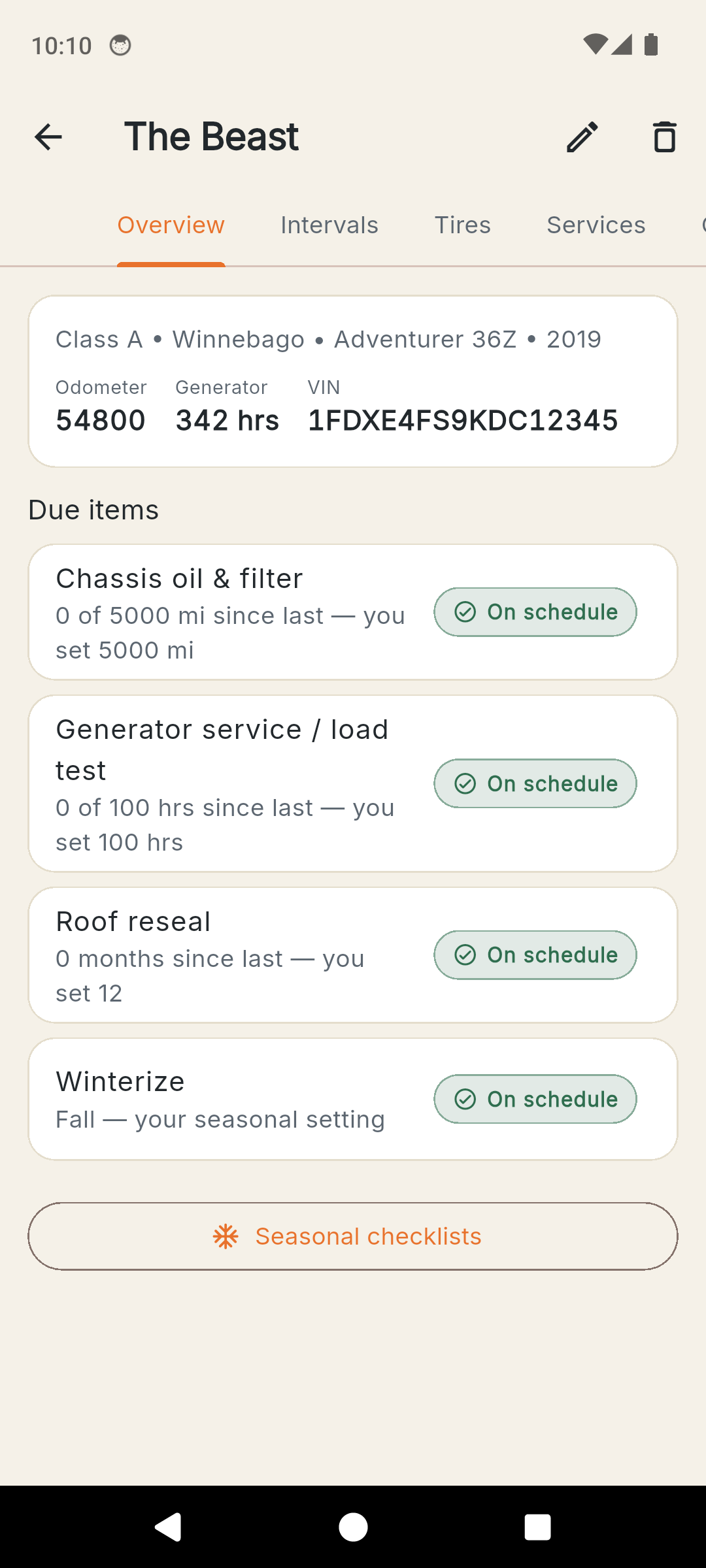
Winterizing is one of those jobs where the cost of forgetting one fixture is out of all proportion to the effort of checking it, which is why it belongs on a written list rather than in your head. RVKeep keeps it as a seasonal task next to the interval-based work, so it turns up in autumn whether or not you remembered, along with the record of what you did last year.
This is general guidance and your own manual wins any disagreement. Layouts, bypass arrangements and water heater types vary a lot between manufacturers, so check yours before draining or pressurising anything.
Common questions
How much RV antifreeze do I need?
Two to three gallons covers most trailers and motorhomes if the water heater is properly bypassed. Long rigs with extended plumbing runs can want four or more. If you find yourself pouring in six gallons, the water heater is almost certainly not bypassed and you are filling a tank you were supposed to skip.
Can I use regular car antifreeze in my plumbing?
No. Automotive coolant is usually ethylene glycol, which is toxic and must never enter a drinking water system. RV and marine antifreeze is propylene glycol, sold pink, and rated as food grade. The two are not interchangeable in either direction.
Is blowing out the lines enough on its own?
Not quite. Compressed air clears the pressurised lines but cannot empty a P-trap, which is designed to hold water, and it tends to leave pockets in low spots and in the pump head. Most people who blow out their lines still pour antifreeze down every drain and into the toilet.
What if my RV is stored somewhere that only freezes occasionally?
Water expands whether it freezes once or twenty times, and a single hard night is enough to split a fitting. If there is any realistic chance of a sustained freeze, do the full job. A mild climate mainly changes how urgently you need it done, not whether.