



























































































Pool Water Chemistry Basics: pH, Chlorine and Alkalinity
Five numbers run a pool, and they are not independent. Here is what each one does, how they pull on each other, and the order to fix them in.
Ask a pool owner what their chlorine level is and most will tell you straight away. Ask what their cyanuric acid reading is and you usually get a pause. That gap is responsible for more green water than any other single thing, because the chlorine number on its own does not mean anything until you know the CYA number sitting behind it.
Pool chemistry gets described as a checklist of five readings to keep in five boxes. It is closer to a set of levers wired together underneath the deck. Move one and two others shift. Once you can see the wiring, the weekly routine stops being a guessing game and the “why did that not work” moments mostly disappear.
The five numbers and what each is actually for
| Reading | Usual range | What it does |
|---|---|---|
| Free chlorine (FC) | 2-4 ppm, scaled to CYA | The sanitiser. This is what kills things |
| pH | 7.2-7.8 | Sets how hard chlorine works, and whether water eats plaster or scales it |
| Total alkalinity (TA) | 80-120 ppm | The buffer that stops pH swinging |
| Calcium hardness (CH) | 200-400 ppm plaster, lower for vinyl | Whether water dissolves your surfaces or coats them |
| Cyanuric acid (CYA) | 30-50 ppm, higher with a salt cell | Sunscreen for chlorine, and a brake on it |
Two of those are daily-ish concerns and three are settings you establish and then leave alone. Chlorine and pH move constantly. Alkalinity drifts slowly. Calcium and CYA only change when you add something containing them, or when you drain and refill.
Chlorine and CYA are one reading, not two
Cyanuric acid binds to chlorine and protects it from ultraviolet light. Without any, an outdoor pool can lose most of its free chlorine in a single sunny afternoon. So you want some.
The catch is that bound chlorine is not available to sanitise. Only the small unbound fraction does the work, and the more CYA in the water, the smaller that fraction is at any given FC reading. The practical consequence is that your target chlorine level has to scale with your CYA, roughly in proportion, at about 7.5% of the CYA reading as an absolute minimum.
| CYA | Minimum FC | Comfortable target |
|---|---|---|
| 30 ppm | 2 ppm | 3-4 ppm |
| 50 ppm | 4 ppm | 5-6 ppm |
| 70 ppm | 5 ppm | 6-8 ppm |
| 100 ppm | 7.5 ppm | 9-11 ppm |
Someone running 100 ppm CYA and holding a proud 3 ppm of chlorine has, functionally, an unprotected pool. They will insist they have been dosing all summer, and they will be telling the truth. It has just been the wrong dose for their water.
CYA creeps up on its own if you use stabilised chlorine. Trichlor tablets and dichlor granules both carry stabiliser with them, so every dose raises the bar you then have to clear. That is fine for a season or two and then it is not. Nothing removes CYA except dilution: drain some water, refill, retest.
Salt pools are the exception to the usual target. A salt chlorine generator produces chlorine continuously in small amounts, so a higher CYA in the 60-80 range makes sense to hold on to what the cell makes, with the FC target raised to match.
pH and alkalinity are the same argument
People treat these as two independent readings and then wonder why fixing one breaks the other. Total alkalinity is the water’s resistance to pH change. It is the buffer, and pH is the thing being buffered.
Run TA too low, below about 60, and pH becomes unstable. A small acid addition sends it plummeting, a rainstorm moves it, and you spend the season chasing it up and down. Run TA too high, above about 150, and you get the opposite problem: pH climbs relentlessly and refuses to stay where you put it.
The mechanism behind that climb is worth knowing because it explains a lot of frustrated Saturday mornings. Alkalinity in pool water is mostly bicarbonate, which is in equilibrium with dissolved carbon dioxide. Whenever CO2 leaves the water, pH rises. Anything that agitates the surface drives CO2 out faster: waterfalls, spa jets, fountains, an aggressive return jet pointed up, and the gas bubbles from a salt cell. High TA means more dissolved CO2 available to escape, so a high-TA pool with a water feature will climb from 7.4 to 8.0 in a week no matter how much acid you pour in.
Which leads to the single most useful trick in pool chemistry, and one almost nobody works out by themselves. Muriatic acid lowers both pH and TA together. Aeration raises pH and leaves TA alone. So to bring a high TA down without ending up with acidic water, you alternate: add acid to push pH down to around 7.0, then aerate hard, by pointing the returns up or running the water feature, until pH comes back to 7.4 on its own. TA falls a little each cycle while pH ends up where it started. Repeat over a few days until TA sits in range. It feels like cheating. It is just gas chemistry.
Going the other way is simpler. Sodium bicarbonate, ordinary baking soda, raises TA with only a mild effect on pH. Sodium carbonate, soda ash, raises pH sharply and TA modestly. Reach for bicarbonate when alkalinity is the problem and carbonate when pH is.
Calcium hardness, and who can ignore it
Water with too little dissolved calcium will go looking for some, and it takes it from plaster, grout and concrete. Water with too much deposits it as scale on tile lines, heater elements and salt cells.
If you have a plaster or pebble pool, this matters and 200-400 ppm is the working band. A vinyl liner has no calcium for the water to strip, so a low reading is not the same threat, though you still want to avoid the high end for the sake of the heater.
The complete picture is the Langelier Saturation Index, which combines pH, alkalinity, calcium and water temperature into a single number describing whether the water is corrosive or scale-forming. Aim to stay within about 0.3 either side of zero. The temperature term is why a heated spa scales up while the pool attached to it behaves perfectly on identical chemistry.
A routine that keeps it boring
Test free chlorine and pH twice a week in summer. Test total alkalinity every couple of weeks. Test calcium hardness and CYA monthly, or after any refill.
When several things are out at once, order matters. Fix alkalinity first, because adjusting it moves pH anyway. Then set pH. Then look at calcium. Chlorine comes last, once you know the CYA reading that sets its target. Adjusting pH before alkalinity means doing the pH job twice.
Add one thing at a time, with the pump running, and give it a full turnover before you retest. Most over-corrections come from testing an hour after dosing, deciding nothing happened, and doubling up.
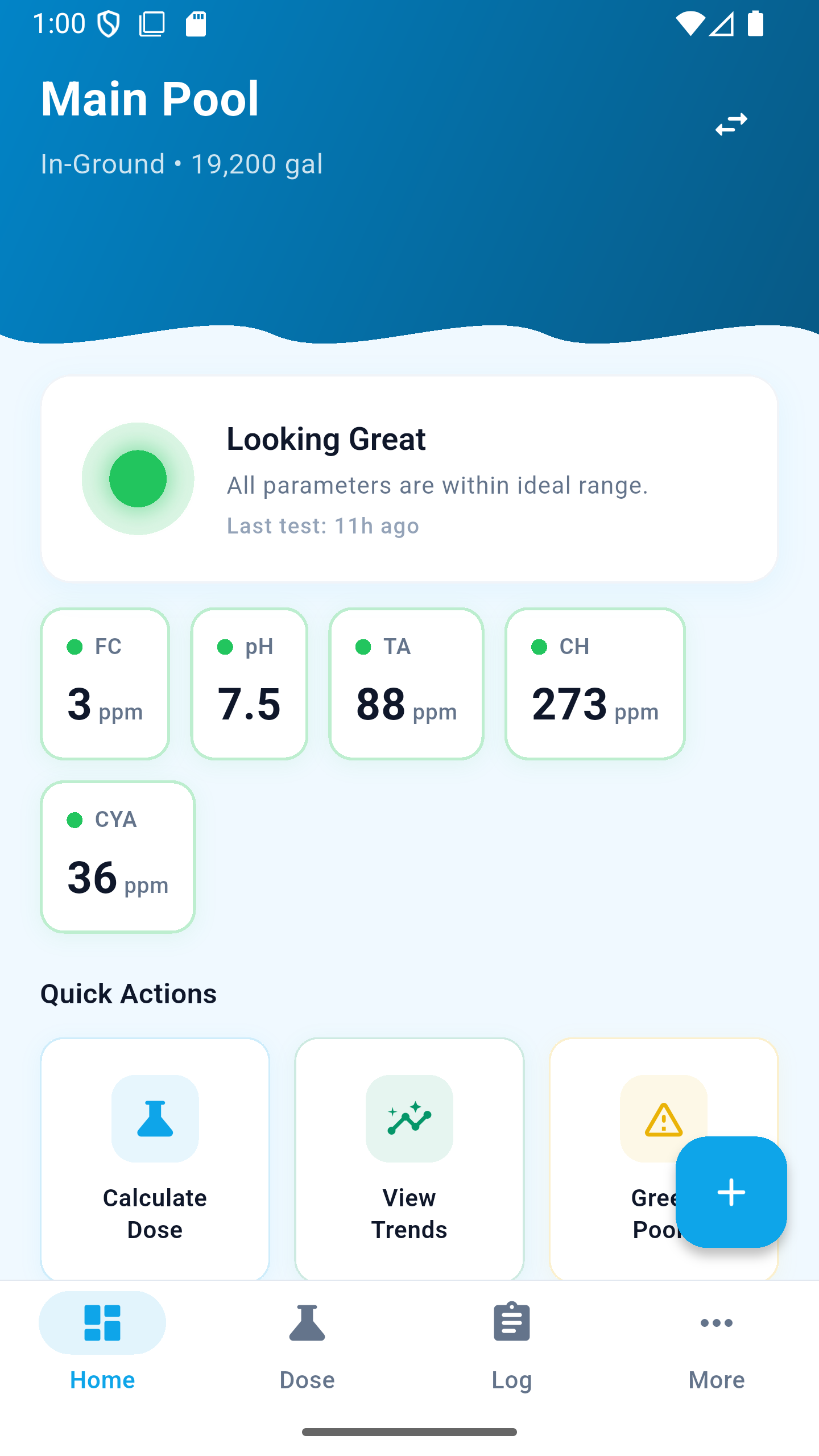
The reason for writing readings down rather than eyeballing them is that everything above is about trends, not snapshots. A single pH of 7.8 tells you very little. A pH of 7.8 that has crept up every week for a month tells you your alkalinity is too high and your water feature is doing the rest. That is the pattern ClearPool is built to surface, working the dose out from your own numbers and keeping the history so the drift is visible before it turns into a problem. If the water has already gone green, the green pool clear-up sequence is the other half of this.
One last habit worth forming: test after rain and after a busy weekend, not on a fixed day regardless. Those two events do more to a pool’s chemistry than the previous fortnight of sunshine, and they are exactly when nobody feels like fetching the kit.
Common questions
How often should I test my pool water?
Chlorine and pH twice a week in summer, weekly in cooler months, and after heavy rain or a busy weekend. Alkalinity every couple of weeks. Cyanuric acid and calcium hardness only change when you add something containing them or refill the pool, so monthly is plenty.
Why does my pH keep rising?
Almost always carbon dioxide leaving the water. Anything that agitates the surface, meaning waterfalls, fountains, aeration jets and the return pointed upward, drives CO2 off and pulls pH up. High total alkalinity makes it happen faster. Salt chlorine generators do it too, because they aerate as they run.
Should I add chlorine or shock first?
They are the same chemical at different doses. Shocking just means raising free chlorine high enough to burn through combined chloramines and algae. If your combined chlorine reading is above about 0.5 ppm or the water smells strongly of chlorine, that is your cue.
Do test strips work?
For a rough pH and chlorine check between proper tests, yes. They lose accuracy badly at the high chlorine levels you use during a clear-up, and most strips read cyanuric acid poorly. A drop-based kit with a FAS-DPD chlorine test costs more once and then tells you the truth.