




























































































How to Stack Public Holidays Into Longer Breaks
Public holidays are not worth the same. Fixed-date ones create long breaks, floating Mondays barely help. Here is the arithmetic and where the leverage sits.

Book five days of leave in a random week and you get nine days off. Book three days in the right week of December and you can get ten. Same allowance, same employer, completely different outcome, and the only thing that changed is where the days landed.
That ratio, calendar days off divided by leave days spent, is the whole game. Once you start looking at the year through it, the calendar stops being a flat list of holidays and turns into a set of opportunities with wildly different prices.
Not all public holidays are equal, and it is not close
Public holidays come in two kinds, and almost nobody distinguishes between them when planning leave.
Some are pinned to a date. Christmas Day, Boxing Day, New Year’s Day, Independence Day, Juneteenth, Veterans Day, St Patrick’s Day. Because they sit on a fixed date, the weekday they land on rotates through the year, and that rotation is where all the value comes from.
Others are defined as a weekday in the first place. The UK’s early May, spring and summer bank holidays are all Mondays by definition. Martin Luther King Jr Day, Presidents’ Day, Memorial Day, Labor Day and Columbus Day are all specified Mondays. Thanksgiving is the fourth Thursday of November. These are already welded to a weekend and can never do anything else, which makes them permanently mediocre for stacking purposes. You get your three-day weekend and that is the ceiling.
The practical consequence: put your planning effort into the fixed-date holidays and treat the Monday ones as a pleasant given.
What a fixed-date holiday is worth, by weekday
Here is the arithmetic for a single fixed-date holiday, assuming a standard Monday to Friday week.
| Holiday lands on | Leave needed to bridge | Consecutive days off | Ratio |
|---|---|---|---|
| Monday or Friday | none | 3 | — |
| Tuesday | 1 (the Monday) | 4 | 4.0x |
| Thursday | 1 (the Friday) | 4 | 4.0x |
| Wednesday | 2 (either side) | 5 | 2.5x |
| Wednesday | 4 (whole week) | 9 | 2.25x |
| Saturday or Sunday | depends on substitution | varies | varies |
Tuesday and Thursday are the sweet spots and it is not particularly close. One day of leave buying a four-day break is the highest return available anywhere in the calendar outside the Christmas cluster.
A Wednesday holiday is the one people misread. It feels like the ideal midweek prize, and it is actually the worst of the weekday landings, because it needs two days of leave to reach either weekend and the whole-week version costs four days for nine. Perfectly reasonable, just not remarkable.
The Christmas cluster is where the real leverage is
Two fixed holidays sitting a few days apart behave completely differently from two isolated ones, because the leave you spend bridges both at once.
Take late December 2026 in England and Wales. Christmas Day falls on a Friday. Boxing Day falls on a Saturday, so it rolls forward to a substitute bank holiday on Monday 28 December. New Year’s Day 2027 falls on a Friday. Book leave on Tuesday 29, Wednesday 30 and Thursday 31 December and the picture looks like this:
Friday 25 December through Sunday 3 January is one unbroken run of ten days, bought with three days of leave. A ratio of 3.3, from a period most people book on autopilot without checking whether it is a good year for it.
Some years it is not. When Christmas Day falls on a Tuesday and New Year’s Day the following Tuesday, the same stretch needs more leave for fewer days. The lesson is not that Christmas is always the answer, it is that you should count before you book rather than assuming this December works like the last one.
Easter is the European equivalent and it comes pre-stacked. Good Friday and Easter Monday are both bank holidays across England, Wales and Northern Ireland, so a four-day weekend arrives with no leave spent at all. Add the following Tuesday to Friday and you have ten consecutive days for four days of leave. Worth knowing if you work in Scotland: Good Friday is a bank holiday there but Easter Monday is not, which quietly removes the second half of that trick.

Substitution rules are quietly worth days
When a fixed-date holiday lands on a weekend, what happens next differs by country and it materially changes the maths.
In the UK, a bank holiday falling on a Saturday or Sunday gets a substitute weekday, normally the following Monday, or the Tuesday if the Monday is already taken by another bank holiday. That is how Christmas periods with weekend landings still produce good runs: the substitutes push into the working week instead of evaporating.
In the US, the federal rule works in both directions. A holiday on a Saturday is observed the Friday before, and a holiday on a Sunday is observed the Monday after. The backwards shift for a Saturday holiday catches people out, because it means the extended weekend runs Friday to Sunday rather than Saturday to Monday, and a leave day booked on the Monday buys nothing.
Private employers in the US are not obliged to follow the federal calendar at all, so this is one to check in your own handbook rather than assume.
The leave-year boundary is a feature, not a problem
A Christmas stack straddles two calendar years, which means some of the leave comes out of one year’s allowance and some out of the next if your leave year runs January to December. People treat this as an annoyance. It is closer to an advantage: it lets you build one long break using days from two separate pots without denting either.
If your leave year runs April to March, the whole Christmas period sits inside one year and you need to plan it against the same allowance as your summer holiday. Worth knowing before you book both.
The other thing to check is your carry-over rule. Many employers cap what rolls into the next year, and a fair number let it expire entirely. Days that expire are worth less than days spent badly, so a deadline in the calendar changes what the optimal plan is.
Where this advice breaks down
Two caveats, and both matter more than the arithmetic.
Everyone is chasing the same days. If four people on your team read this, the Tuesday-before-a-Thursday-holiday is going to be contested, and in most workplaces it is decided by who asked first rather than by who did the better calculation. The genuinely useful move is not a cleverer optimisation, it is submitting the request in January.
The weeks with the best ratio are also the weeks travel costs the most. Leave efficiency and money efficiency point in opposite directions almost perfectly, because the whole country is trying to fly on the same three days. If the point of the break is a trip rather than the time off, the best-ratio week can be the wrong week.
Which leads to the thing I would actually recommend: do not spend the entire allowance on stacking. A single Wednesday in a dead week in February, when nothing is happening and nobody else is off, does something that a chain of long weekends does not. Optimise most of the year, then deliberately waste a few days on nothing in particular.
One more practical check before you plan anything. Look at whether your contract counts public holidays inside your total allowance or on top of it. Plenty of contracts, particularly in retail and hospitality, quote a headline number that already includes the bank holidays. If yours does, then the holiday is not a bonus day you are building around, it is one of your own days being spent for you, and the ratios above no longer apply. Part-time staff should check the pro-rata arrangement too, since a calendar this heavy on Mondays treats a Tuesday-to-Thursday worker unevenly unless the employer adjusts for it.
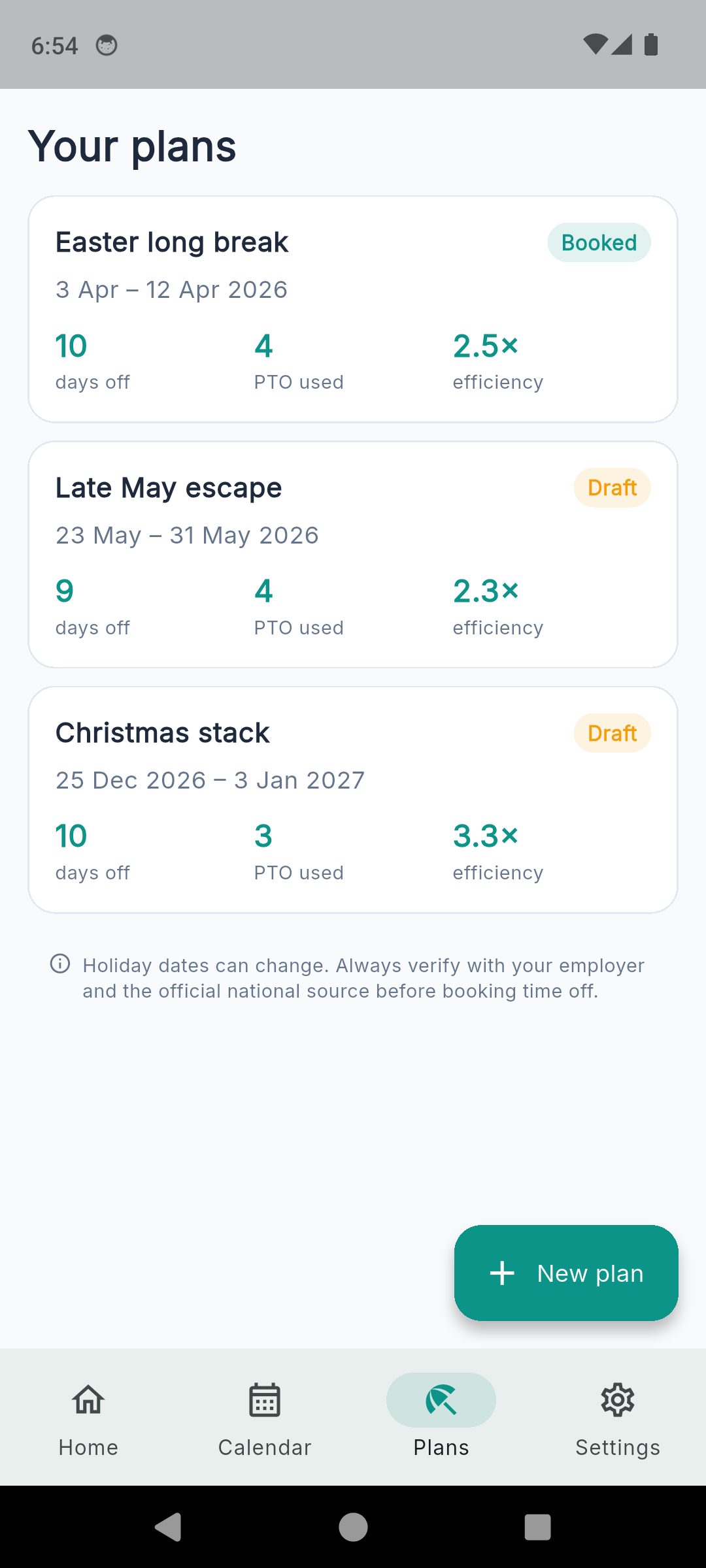
Working this out by hand for one holiday is easy. Working it out for a whole year, across a leave-year boundary, with a carry-over cap and a country whose substitution rules you half remember, is where it gets tedious, and tedious is why most people just book the same weeks they booked last year. HolidayStack does that search against your own allowance and your own country’s calendar.
The underlying idea is small enough to keep in your head, though. Find the fixed-date holidays, check which weekday they landed on this year, spend your leave bridging the Tuesdays and Thursdays, and leave the Monday holidays alone.
Common questions
Which public holidays are worth building a break around?
The fixed-date ones, because their weekday changes year to year. Christmas Day, Boxing Day, New Year's Day, Independence Day, Juneteenth and Veterans Day all move around the week, and a midweek landing is what lets a couple of leave days bridge into a long run. Holidays defined as a particular Monday are already attached to a weekend and can never do better than that.
How many days off can three days of leave actually buy?
Around Christmas, ten. In late December 2026 the bank holidays land so that leave on the 29th, 30th and 31st runs a break from Christmas Day through to 3 January. Outside that cluster, a realistic ceiling for three days is seven or eight, and most of the year it is five.
Does it matter if a public holiday falls on a weekend?
It matters a lot, and the rules differ by country. In the UK you get a substitute weekday, normally the following Monday, or the Tuesday if Monday is already a bank holiday. For most US federal employees a Saturday holiday is observed on the Friday before and a Sunday holiday on the Monday after. Private employers are not bound by the federal rule, so check your own handbook.
Should I spend my whole allowance on stacking?
No. Stacking optimises for days off per day of leave, which is not the same as optimising for rest or for cost. The weeks with the best ratio are also the weeks everyone else is off and travel prices peak. Keeping a few days back for an ordinary quiet week is usually a better use of them.
Photos: Pixabay / Pexels , Oscar Chan / Pexels