























































































Coast FIRE Explained: When You Can Stop Saving
Coast FIRE is the point where your existing investments will grow into your retirement number on their own, even if you never contribute another pound.

There is a moment in a long savings plan that almost nobody marks, because it doesn’t look like anything from the outside. You don’t retire. Your life doesn’t change. But on that day, the money you have already invested becomes enough to grow into your entire retirement number by itself, and every pound you save from then on is optional.
That’s Coast FIRE. Not financial independence, which is being able to stop working. It’s the earlier and much more reachable milestone of being able to stop saving.
The distinction matters because the two arrive years apart. Full FIRE might be twenty years out. Coasting might already be behind you.
The maths, which is just compounding backwards
Your full number is what you need on the day you retire. Coast FIRE asks a smaller question: how much do I need invested today so that compound growth alone gets me there?
Take the full number and divide by growth over the years remaining:
Coast number = FIRE number ÷ (1 + real return)^years
Real return means after inflation, which is the part people get wrong. If you assume 5% real, you’re already accounting for inflation eroding the value, so your target stays in today’s money and the whole thing stays comparable.
Say your FIRE number is £750,000 and you’re 20 years from retiring. At 5% real, the divisor is 1.05^20, which is about 2.65. So £750,000 ÷ 2.65 is roughly £283,000. Reach that, and you could in theory never contribute again and still land on £750,000.
The shape of it by age is the interesting part:
| Years to retirement | Divisor at 5% real | Coast number for a £750k target |
|---|---|---|
| 30 | 4.32 | £173,600 |
| 25 | 3.39 | £221,200 |
| 20 | 2.65 | £283,000 |
| 15 | 2.08 | £360,600 |
| 10 | 1.63 | £460,100 |
| 5 | 1.28 | £587,700 |
Look at the top row. Someone at 35 planning to retire at 65 needs about £174,000 invested to coast the rest of the way. That’s a large sum, but it is nothing like £750,000, and plenty of diligent savers pass it without noticing.
Why time does more work than money
The table shows something worth sitting with: the earlier you are, the smaller the coast number, and not gently so. Thirty years out it’s under a quarter of the target. Five years out it’s most of it.
This is the practical case for front-loading. Money invested in your twenties does the majority of the lifting, not because it is special, but because it has the most years to double. It’s also why “I’ll get serious about saving later” is expensive in a way that doesn’t feel expensive at the time. Later means fewer doublings, and the coast number climbs to meet you.
What people actually do with it
Almost nobody hits Coast FIRE and stops saving entirely. What it really buys is options.
Some take a pay cut for work they prefer, because the savings rate no longer has to be defended. Some go part time. Some stay in the same job but stop optimising every decision around the savings rate, which is its own kind of relief after a decade of it.
That’s usually where Barista FIRE enters. The two get muddled constantly, so: Coast FIRE is a statement about your portfolio, that it’s large enough to grow unaided. Barista FIRE is a statement about your income, that you work enough to cover living costs without touching investments, often for the health cover. They’re independent, and hitting Coast is what makes Barista viable.
The assumption holding it all up

Every number above rests on one input: the real return you assumed. Change it and the whole thing moves.
At 7% real, twenty years out, the divisor is 3.87 and the coast number for £750,000 drops to about £194,000. At 3% real, the divisor is 1.81 and the same target needs £414,000. That’s a swing of more than double, from an assumption nobody can verify in advance.
So treat 5% real as a middling estimate rather than a fact, and be aware which direction the error hurts. Assume too high a return and you’ll coast on a portfolio that turns out too small, discovering it with fewer years left to correct.
Two habits deal with this sensibly. Re-check the number every year or two against what your portfolio actually did, rather than setting it once. And coast partially rather than absolutely: even modest continued contributions give you an enormous buffer against a disappointing decade, while still letting you take the lower-stress job.
Knowing which milestone you are at
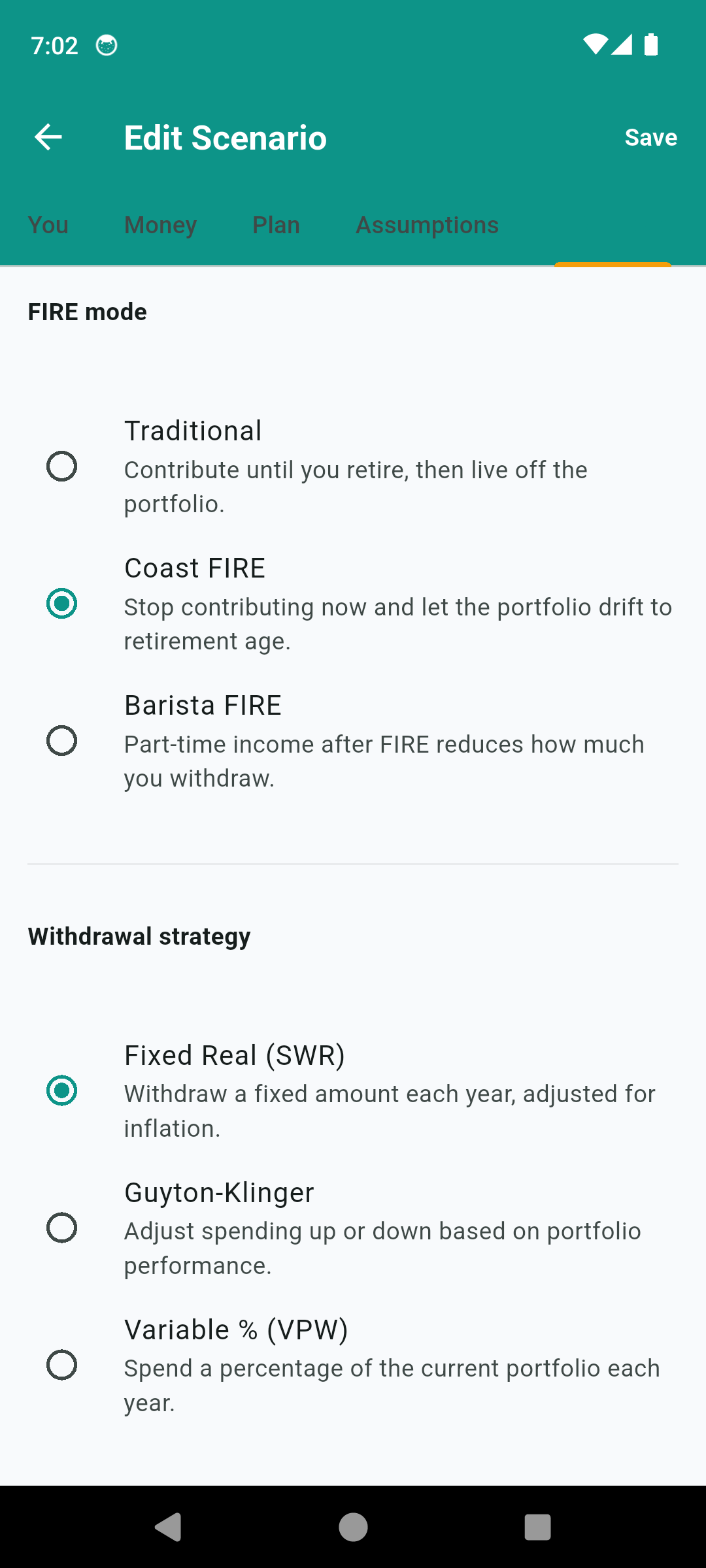
The reason to bother with any of this is that the three milestones sit years apart, and most people only ever calculate the last one. FireCalc models Coast and Barista as separate modes alongside a traditional plan, so you can see which you have already passed rather than staring at a full number that still looks impossibly far away.
The honest summary is that Coast FIRE is a permission slip, not a finish line. It doesn’t mean stop. It means the compounding has taken over, and from here your saving is buying you time rather than buying you the retirement.
If you haven’t pinned the full target yet, start with working out your FIRE number, since the coast number is derived from it. And the 4% rule is where the target multiple comes from in the first place.
This is general information, not financial advice. Assumed returns are assumptions, not promises; check anything consequential with a regulated adviser.
Common questions
What is Coast FIRE?
It is the point where the money you have already invested will compound into your full retirement number by your target date without any further contributions. You still need to cover your living costs, but you no longer need to save for retirement.
How do I calculate my Coast FIRE number?
Take your full FIRE number and divide it by (1 + real return) raised to the number of years until you retire. At a 5% real return with 20 years to go, that divisor is about 2.65, so a £750,000 target needs roughly £283,000 invested today.
What is the difference between Coast FIRE and Barista FIRE?
Coast FIRE is about the portfolio: it is already big enough to grow on its own. Barista FIRE is about the income: you work part time to cover living costs, often for benefits like health cover. People frequently hit Coast FIRE and then use it to go Barista.
Is Coast FIRE risky?
Its weakness is that it depends entirely on an assumed real return over a long stretch. A decade of poor returns leaves you short with less time to fix it. Most people who coast keep saving something, or re-check the number every year or two rather than stopping and never looking again.
Photos: Matias Mango / Pexels , DΛVΞ GΛRCIΛ / Pexels