






















































































Funding the Bridge Years Before You Can Touch Your Pension
Retire at 48 and your pension may stay locked until 57. How to size the gap, decide which pot to draw first, and avoid the ordering mistake that costs most.

Say you hit your number at 48. The portfolio clears the target, the spreadsheet turns green, and you hand in your notice. Then somebody asks the question you have not properly worked through: what are you living on for the next nine years?
For a UK saver, the pension might not open until 57. For an American, 59½. Either way there is a long stretch, often the healthiest and most interesting years of the whole plan, where the biggest pot you own is legally out of reach. That stretch is the bridge. It is the part of an early retirement plan that people size last and get wrong first, usually because the headline FIRE number treats every pound as if it were spendable on day one.
It is not. Roughly half of a typical accumulator’s wealth sits in accounts with an age lock on them.
Work out how long the gap really is
Count from the age you stop earning to the age your locked money opens, then check what else lands in between.
In the UK the relevant number is the normal minimum pension age. It is 55 today and rises to 57 on 6 April 2028. If you were born on or after 6 April 1973, you are almost certainly looking at 57. If you were born before 6 April 1971 you will already be 57 by the time the change lands, so nothing shifts for you. Anyone in between should check their date carefully rather than assume.
There is one exception worth knowing about. Some schemes carry a protected pension age, which applies where the scheme rules as at 11 February 2021 gave members an unqualified right to take benefits earlier. It is scheme-specific and it can be lost when you transfer, so if you think you have one, confirm it in writing before moving anything.
In the US the general line is 59½ for both 401(k)s and IRAs, with two exceptions that matter to early retirees. The rule of 55 lets you draw from your current employer’s plan without the 10% penalty if you leave that employer in the calendar year you turn 55 or later. It does not cover IRAs, and it does not cover plans left behind at old jobs, which catches people who rolled everything into an IRA the moment they resigned. The other route is a 72(t) schedule of substantially equal periodic payments, which has to run for five years or until 59½, whichever is longer. Break it and the penalties come back retroactively with interest.
The state pension or Social Security is a separate, later date again. The UK state pension age is heading to 67. So a 48-year-old is not planning one step up in income, they are planning two: the private pension at 57, then the state pension at 67. A plan built as though retirement is one flat line will be wrong in both directions.
The bridge is not simply years multiplied by spending
The intuitive sum is nine years times £40,000, so £360,000 in accessible accounts. That figure is usually too high and occasionally dangerously low, and it is worth understanding why before you either over-save for years or retire on a shortfall.
It is too high because the bridge pot is not sitting in a shoebox. Money you will not spend for eight years keeps growing while you spend the first year’s slice. It is also too high because the final bridge years often overlap with something: a small defined benefit pension, a spouse reaching their own access age, rental income, part-time work you did not plan but ended up enjoying.
It can be too low because bridge spending is rarely flat. The early retirement years are the expensive ones. People travel, replace the car they nursed through the last two years of work, pay for a wedding, help with a deposit. A mortgage that ends at 55 changes the shape again. Averaging all of that into one annual figure hides the fact that year three might cost half as much again as year seven.
Here is what a fairly ordinary bridge looks like when you write it out year by year rather than as one multiplication.
| Age | Spending need | Other income | From the bridge pot |
|---|---|---|---|
| 48-50 | £46,000 | — | £46,000 |
| 51-54 | £40,000 | — | £40,000 |
| 55-56 | £31,000 | — | £31,000 (mortgage ends at 55) |
| 57 | £31,000 | Pension opens | £0 |
| 67 | £31,000 | State pension | Reduced draw |
Total from the bridge pot: about £340,000 in today’s money over nine years, with the last two years noticeably cheaper than the first three. The flat-multiplication answer was £360,000, which is close by accident. Change the mortgage end date by five years and the two methods diverge badly.
Which pot you empty first is a real decision
The instinct is to spend the taxable account down to zero, then start on the pension. That is roughly right, and the details are where the money is.
A UK bridge usually runs on ISAs and a general investment account. The ISA is the more valuable wrapper because withdrawals are tax free and never show up on a tax return, so the temptation is to spend it first. The better habit is often the reverse: use the general investment account early, harvesting gains against the annual capital gains exemption while you have years of low taxable income, and leave the ISA intact for later. An ISA allowance you do not use is gone at the end of the tax year and never comes back, and there is a specific reason to care about that right now. The allowance is £20,000 for 2026/27, but from 6 April 2027 the amount under-65s can put into a cash ISA drops to £12,000, with the overall £20,000 limit unchanged across all ISA types. If part of your bridge is deliberately held in cash, that reshapes where it lives.

A US bridge has a sharper version of the same decision. The years between stopping work and turning 59½ are usually the lowest-income years of your adult life, which makes them the cheapest years you will ever get to move money out of a traditional account. That is the whole logic of the Roth conversion ladder: each year you convert a slice from traditional to Roth, pay tax on it at a low rate, and each conversion becomes available penalty free five tax years later. Every conversion has its own clock and it starts on 1 January of the conversion year, not the date you did the paperwork. Directly contributed Roth principal, as opposed to converted amounts, can come out at any time.
The mistake that costs the most is not choosing the wrong account. It is running the bridge years at a zero taxable income you were quietly proud of, then arriving at pension age with a large traditional pot that has to come out at a much higher rate for the rest of your life. Empty tax brackets do not roll over. A bridge year with no income used is an allowance you burned.
What the bridge should be invested in
A bridge has something a normal portfolio does not: a known length and a known bill. You know you need roughly £46,000 next spring, and no market outcome changes that.
Which is why the standard answer, hold everything in equities because you have a long horizon, does not apply to the front of it. The money for the next two or three years has no time to recover from a 35% fall, and selling into a crash at exactly the moment you have no salary is how sequence risk turns from a chart into a problem. A common shape is two to three years of spending in cash or short bonds, the middle of the bridge in something more balanced, and the far end left invested, because eight years is a long time to sit in cash and inflation is a real cost too.
The other reason to keep the front end boring is behavioural. The first two years after leaving work are when doubt is loudest. Having next year’s spending sitting in an account that cannot fall is what stops a rough January turning into a decision to go back to work.
Model the steps, not the average
Any projection that treats your income as one smooth line will misprice the bridge, because the entire problem is that income is not smooth. It is zero, then it steps up at 57, then it steps up again at 67, while spending steps down when the mortgage ends and up when the roof needs doing.
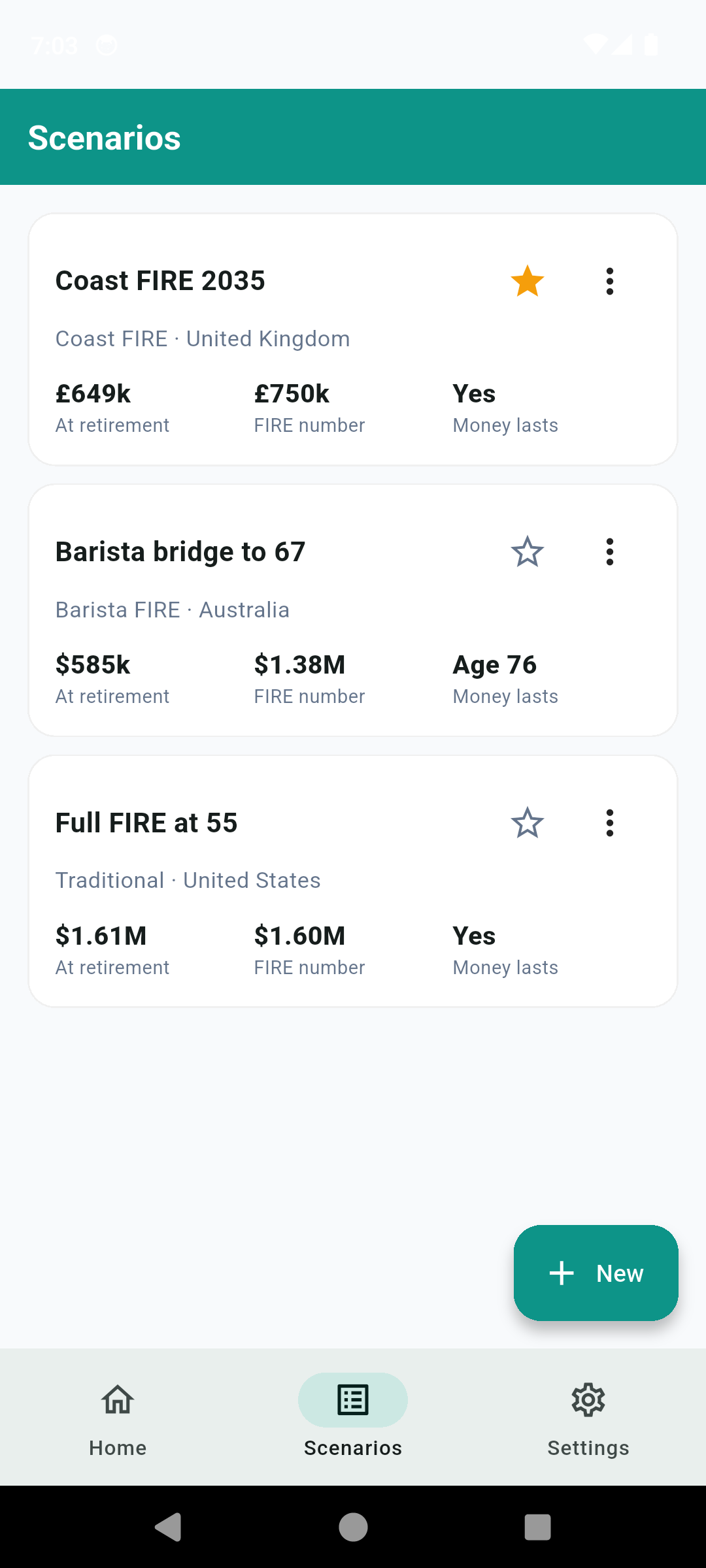
That is what income streams with a start age are for. In FireCalc each income line carries the age it begins and optionally the age it ends, and expense lines do the same, so a pension arriving at 57 and a mortgage finishing at 55 both show up as steps in the projection rather than being smoothed into an average that describes no actual year. Running the same scenario through a Monte Carlo pass tells you something more useful again, which is how often the bridge specifically runs dry, as opposed to whether the plan works on average. If you want the background on why the average is the wrong thing to look at, the piece on sequence of returns risk covers it.
Whatever tool you use, test the plan against a bad first five years rather than an average forty. The bridge is the only part of an early retirement where you have no flexibility at all: you cannot draw the pension, you cannot wait it out, and going back to work is the only lever left. Build it a year longer than the arithmetic demands.
This is general information, not financial advice. Pension access ages, allowances and tax rules change and depend on your circumstances. Confirm your own normal minimum pension age with your scheme, check current rules with HMRC or the IRS, and speak to a regulated adviser before acting.
Common questions
How many years does my retirement bridge need to cover?
Count from the age you stop working to the age your locked pensions actually open, then check whether anything else arrives in between. In the UK that end point is 55 now and 57 from 6 April 2028 for most people. In the US it is 59½, unless you qualify for the rule of 55 or run a 72(t) schedule. Nine or ten years is common for someone retiring in their late forties.
Can I access my pension early if I really need to?
In the UK, generally no. Companies offering pension release before the normal minimum pension age are usually either scams or trigger an unauthorised payment charge that can take more than half the money. In the US there are legitimate exceptions, mainly the rule of 55 for your current employer's plan and a 72(t) substantially equal periodic payment schedule, but both come with conditions you cannot casually break.
Should the bridge money stay invested in shares?
Not all of it. Money you have to spend in the next two or three years has no time to recover from a fall, so it is usually held in cash or short bonds. Money you will not touch for eight years can stay invested. The bridge is a known bill with a known date, which makes it closer to a liability-matching problem than a growth problem.
What happens if I run out of bridge money before my pension opens?
You go back to work, usually on worse terms than the job you left, or you take an unauthorised payment and lose a large slice of it to charges. This is why the bridge is worth over-funding by a year or two rather than sizing it to the exact figure a spreadsheet produces.
Photos: Imad Clicks / Pexels , Kaboompics / Pexels