



























































































FIRE in the UK vs the US: SIPP and ISA Against 401k and Roth
Most early-retirement advice is written for the American tax system. Here is what actually changes for a UK saver, from the age 57 lock to why the ISA carries the plan.
There is a particular moment a British reader of American financial independence content hits a wall. They have absorbed the 4% rule, the Rule of 55, the Roth conversion ladder. They sit down to work out which of those applies to a SIPP, and the answer is none of them. Not approximately, not with adjustments. The mechanisms do not exist in UK pension law, and a plan built on them fails quietly, years before anyone notices.
The advice was never wrong. It was written for a different tax system by people who had no reason to say so. Three things genuinely differ between the two, and the one everyone argues about online is the least important of them.
The locked pot has no side door
American retirement accounts are nominally sealed until 59½, and then the tax code hands you three ways round it.
You can separate from your employer in or after the year you turn 55 and draw from that employer’s 401k without the 10% penalty, which is the Rule of 55. It applies only to the plan at the job you left, and it does not survive a rollover into an IRA, which trips up a lot of people who tidied up their accounts first. You can start substantially equal periodic payments under §72(t) at any age, accepting a rigid schedule that has to run for the longer of five years or until 59½, with retroactive penalties if you modify it. Or you can build a Roth conversion ladder: convert a slice of traditional money to Roth each year, wait out a five-year clock on each conversion, then withdraw the converted amount penalty-free. Each conversion has its own clock, which is why the ladder needs starting five years before you need the first rung.
UK pension rules have none of this. The normal minimum pension age is 55 and rises to 57 on 6 April 2028, and there is no negotiation. No penalty-and-proceed option, no equivalent of the Rule of 55, no conversion route into something accessible. Serious ill health is the only real exception and it is not a plan. If you are 46 with everything in a SIPP, that money is not yours for another eleven years.
A protected pension age exists for a minority: broadly, if your scheme’s rules on 11 February 2021 gave you an unqualified right to take benefits before 57, that can be preserved, and it can be lost by a careless transfer. Anyone who thinks they might have one should check with the provider in writing rather than assume, because the protection is scheme-specific.
That single fact reshapes a British plan more than any withdrawal-rate debate. An American retiring at 45 can hold most of the pot in tax-advantaged accounts and engineer access. A British saver retiring at 45 has to fund twelve years from money the pension rules cannot reach, and only then hand over to the pension.
The wrappers, side by side
| UK | US | |
|---|---|---|
| Locked retirement pot | SIPP, workplace pension | 401k, traditional IRA |
| Earliest access | 55, rising to 57 on 6 Apr 2028 | 59½, or 55 via Rule of 55 |
| Early-access route before that | none | Rule of 55, §72(t), Roth ladder |
| Annual contribution cap | £60,000 annual allowance, tapered to as little as £10,000 for high earners | $24,500 employee 401k plus $7,500 IRA in 2026 |
| Tax on the way out | 25% tax-free up to a £268,275 lump sum allowance, the rest as income | traditional taxed as income, Roth withdrawals untaxed |
| Flexible wrapper for the bridge | ISA, £20,000 a year, no tax on growth or withdrawal, no age limit | taxable brokerage, no cap, capital gains tax on sale |
| Big missing cost | none comparable | health insurance premiums before Medicare at 65 |
Two lines in that table do most of the work. The UK has no early-access route and a hard £20,000 annual cap on its best wrapper. The US has three early-access routes and no cap at all on its taxable one, but a health insurance bill that can run to five figures a year for a couple in their fifties.
The ISA is genuinely better, with a much tighter tap
The stocks and shares ISA is the single best thing in the UK system for someone retiring early, and it gets undersold because Americans have no reference point for it. Money goes in from taxed income, grows without capital gains or dividend tax, and comes out at any age with no tax and nothing to report. Not deferred. Done.
The closest American equivalent is a taxable brokerage account, which still generates a capital gains bill when you sell, and forces early retirees into careful gain harvesting around income thresholds. Roth contributions can be withdrawn at any time, but only up to what you put in, and the annual limit is small.
The catch is the tap. £20,000 a year, no carry-forward, use it or lose it. Suppose you plan to stop at 45 and your pension unlocks at 57: twelve years at £30,000 a year is £360,000 that has to be sitting outside the pension, and you cannot buy that in a hurry near the end. Twelve years of a maxed ISA gets you there with growth to spare; four years of it does not, no matter how much you earn. A high-earning American in the same position can shovel $200,000 a year into a brokerage account in the final stretch and catch up. That option does not exist here.
So the ordering advice inverts. Standard guidance says fill the pension first for the tax relief, and for someone retiring at 60 that is right. For someone targeting their forties, the ISA allowance is the scarce resource, because it is the only thing that can pay for the bridge years. The pension still deserves whatever would otherwise be taxed at 40% or 45%, but it stops being the default destination for everything.
One change worth knowing: from 6 April 2027 the amount under-65s can put into a cash ISA drops from £20,000 to £12,000, with the overall £20,000 allowance unchanged and the remainder usable in stocks and shares, innovative finance or a LISA. If your bridge money is invested rather than in cash, which for a twelve-year horizon it probably should be, this changes nothing for you. If you had been parking the bridge in cash, it changes your plan.

The 4% rule is an American number
The withdrawal research everyone quotes was run on US market history: US equities, US bonds, US inflation, mostly 30-year windows. It is the best-documented long record we have, and it is also the record of the century’s most successful stock market. Studies applying the same method to other countries’ data generally land on lower sustainable rates, which is unsurprising once you look at what UK inflation did in the mid-1970s to anyone drawing a fixed real income.
None of that means inventing a British number to two decimal places. It means treating 4% as a ceiling rather than a floor, holding a globally diversified portfolio rather than reasoning from one country’s history, and modelling in the currency you actually spend. Our walk through the 4% rule covers what the original research did and did not test.
There is a correction pulling the other way, too, and it is bigger than most people expect. The state pension is index-linked income for life, and it arrives whether the portfolio has had a good decade or a terrible one. Every pound of it is a pound the portfolio no longer has to fund. UK state pension age is currently rising from 66 to 67 between May 2026 and April 2028, sits flat at 67 for anyone born on or after 6 March 1961, and is legislated to reach 68 between 2044 and 2046. Leave it out of the model and you will overstate your target; put it in and a chunk of the last third of retirement is already paid for.
Where the two diverge again is on the way out
In the UK, 25% of the pension can normally be taken without income tax, subject to a lump sum allowance of £268,275, and the rest is taxed as income when drawn. Having an ISA alongside is what makes that manageable: you can shape taxable pension income to sit inside the personal allowance or the basic rate band, and top up from the ISA without adding a penny to your tax bill. That combination is genuinely hard to beat, and it is the part of the British system Americans are envious of.
The trap in it is the money purchase annual allowance. Take flexible income from a defined contribution pension and your future annual contribution limit into DC pensions collapses from £60,000 to £10,000. Anyone planning to draw a little pension while doing part-time work, the shape usually called Barista FIRE, needs to know that touching the pension first can permanently shrink what they can put back later. Taking only the tax-free cash does not trigger it; taking taxable income does.
The American version of this section is dominated by something British readers can skip entirely. Between retiring and Medicare at 65, a US early retiree is buying their own health insurance, and the size of the subsidy depends on reported income, which turns every withdrawal decision into a health-cost decision. That line does not exist in a UK budget. It is worth saying plainly: the biggest missing cost in an American early-retirement plan does not apply to you, and the biggest missing constraint in a British one, no early access at all, does not apply to them.
What this changes in practice
Size the bridge before the pension. Count the years between the date you want to stop and the date your pension unlocks, multiply by your spending, and treat that as a separate target that has to be met in ISAs and taxable accounts. Then set your retirement date against the access age rather than a round number, because 57 with a funded bridge beats 55 with a shortfall you have to work through anyway.
Model in sterling, with your own state pension age, and check what happens if you retire into a bad first decade rather than an average one. Most of the difference between plans that hold and plans that do not is in the order the returns arrive, not the average.
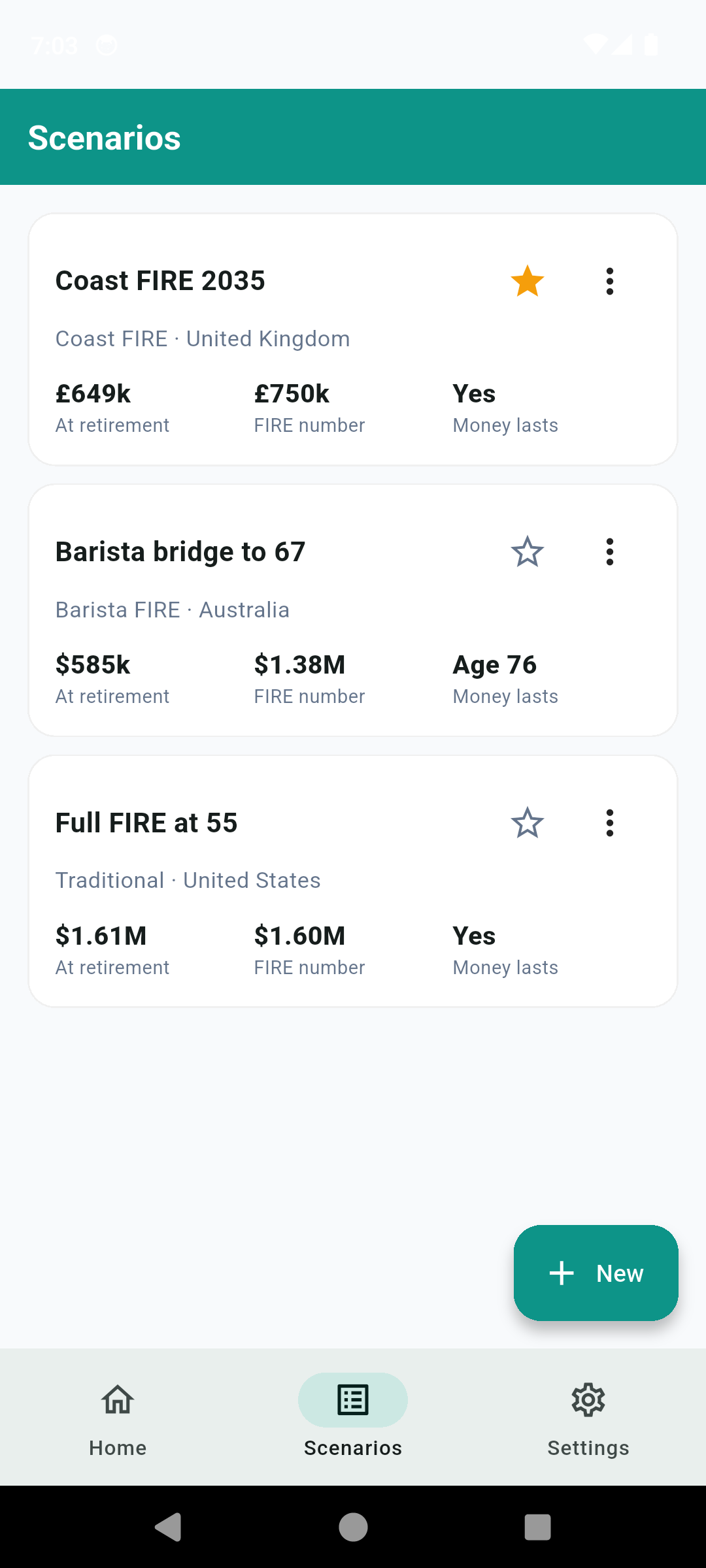
That is the reason FireCalc asks which country a scenario belongs to rather than assuming one: the access age, the currency and the state pension all move together, and a plan copied from a US calculator gets all three wrong at once.
The underlying maths of financial independence really is universal. Nearly everything wrapped around it, the accounts, the ages, the tax and the bill for staying alive, is local, and that is the half worth checking before you trust a number.
This is general information, not financial advice. Allowances, access ages and tax rules change, and several of the figures above have scheduled changes already legislated. Verify anything consequential against GOV.UK or the IRS, and check plans of this size with a regulated adviser.
Sources: Normal minimum pension age, State Pension age changes, ISA allowance and the 2027 cash limit, Lump sum allowance and annual allowance, Lifetime ISA, IRS 2026 contribution limits, Accessing US retirement funds early.
Common questions
Can I access my SIPP at 55?
For now, yes. The normal minimum pension age is 55, but it rises to 57 on 6 April 2028. Unless you hold a protected pension age, a plan that assumes access at 55 in 2029 is assuming something that will not be true.
Is there a UK version of the Roth conversion ladder?
No. There is no mechanism to move pension money into an accessible wrapper early, and no penalty-and-proceed option either. Before the minimum pension age the money is simply unavailable, so a UK plan has to bridge the gap with ISAs and taxable savings instead of engineering access.
Does the 4% rule work in the UK?
Treat it as an upper bound rather than a starting assumption. The research behind it was built on US market history and US inflation, and studies using other countries' data generally produce lower sustainable rates. A UK plan also has the state pension arriving later to offset against, which most calculators ignore.
Is a Lifetime ISA good for early retirement?
Rarely, unless you are retiring after 60. The 25% bonus is real, but the money is locked until age 60 for retirement purposes and withdrawing earlier for any other reason costs a 25% government charge that can leave you with less than you paid in. If your target is 50, a LISA is a worse pension rather than a better ISA.
Photos: Alaur Rahman / Pexels , Melvin Silva / Pexels