




























































































Standby Generator Maintenance: Hours, Calendar and the Weekly Exercise
A standby generator runs a few hours a year and still has to start on demand. Here is what actually needs servicing, on which clock, and why the battery fails first.
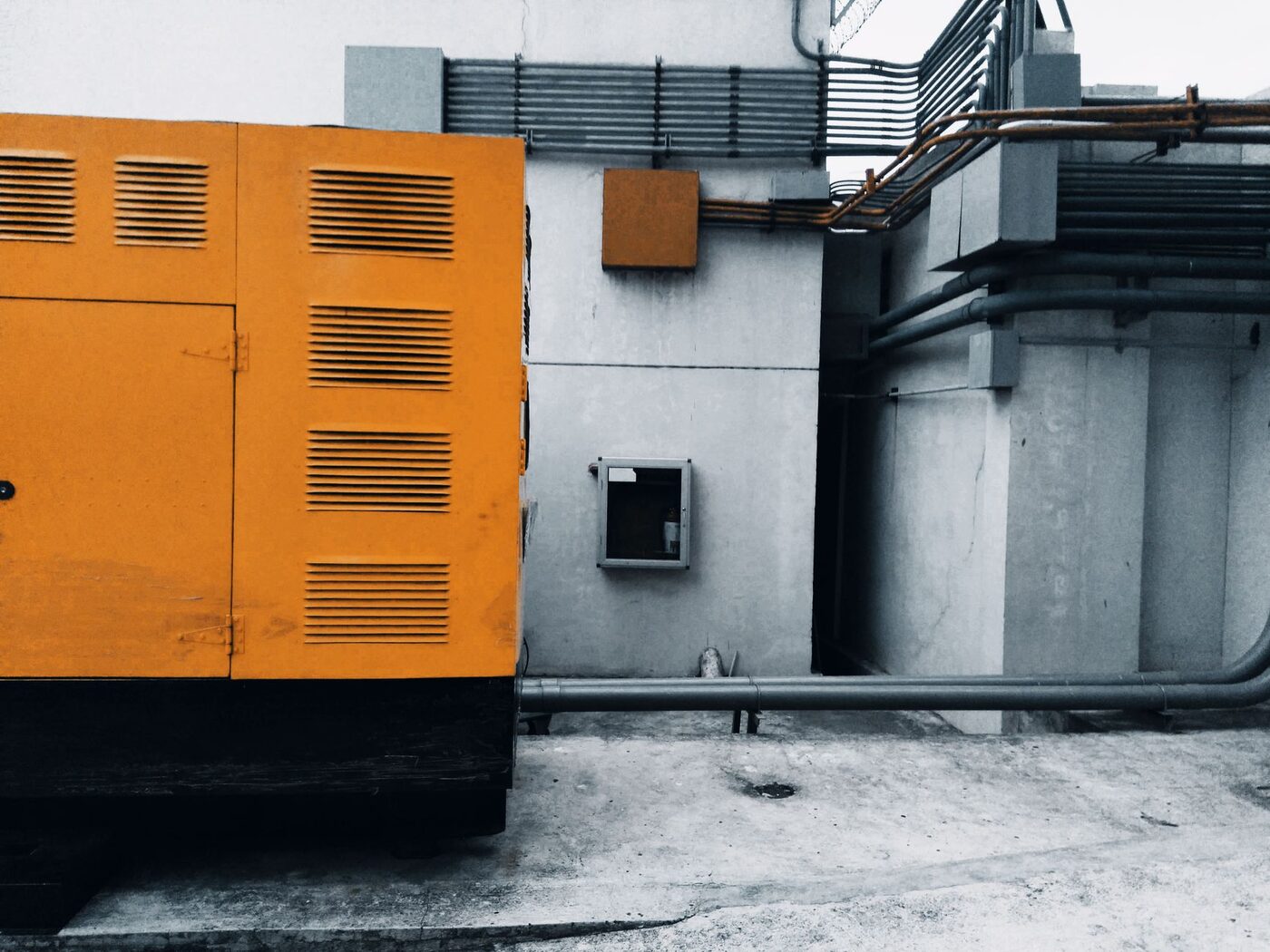
The awkward thing about a home standby generator is that it spends nearly all of its life doing nothing, then has to work perfectly on about ten seconds’ notice. A typical residential unit accumulates somewhere between ten and twenty hours a year, and most of that is the weekly self-test, running for five or twelve minutes at a time with no load on it at all.
That is a strange duty cycle, and it explains why generators fail in ways car engines don’t. You are not maintaining an engine that is wearing out. You are maintaining one that is going stale.
Two clocks, and the calendar almost always wins
Every manufacturer publishes intervals as a pair: run hours or elapsed time, whichever comes first. Generac’s air-cooled residential range puts its main service schedule at 200 hours or two years. Liquid-cooled units come round more often, and plenty of installing dealers recommend an annual oil change regardless, on the grounds that oil in a machine that barely runs degrades by sitting rather than by working.
Do the arithmetic on your own unit and you’ll see the point. At fifteen hours a year, 200 hours is thirteen years away. The two-year figure is the one that will ever fire. If you have a farm or a rural property where the power is genuinely unreliable and the unit racks up eighty or a hundred hours a season, the hour meter starts to matter and you may hit the hour trigger first. Almost nobody else will.
So the honest version of the schedule for most homeowners is: service it on the calendar, and watch the hour meter for the exceptions. Which is exactly backwards from how you’d treat a car.
The 25-hour service that gets skipped
There is one exception to the calendar rule, and it catches people because it happens early and only once. New air-cooled units want an oil and filter change plus a valve clearance adjustment after the first 25 hours of running.
That is a break-in service. A fresh engine sheds fine metal particles as the rings and bearings bed in, and the point is to flush them out before they circulate for the next decade. Valve lash shifts as the valve seats settle for the same reason.
The trap is that 25 hours of weekly five-minute exercises takes years to accumulate. So the break-in service often falls due long after the install crew has gone, at a point where the unit has never once run under load and feels like it can’t possibly need anything. It does. Check the hour meter and get it done.
What a service actually consists of
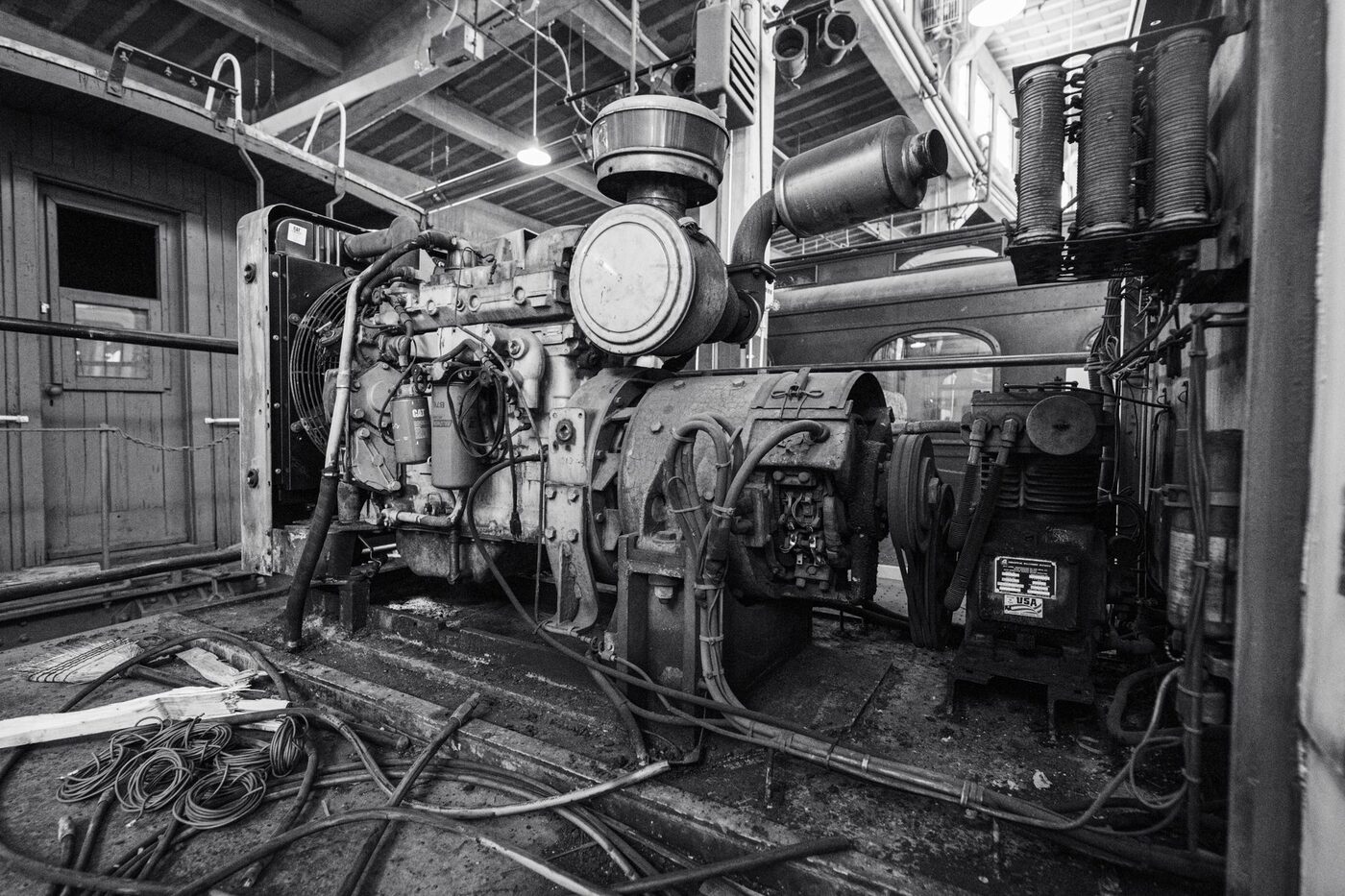
Strip away the invoice language and a residential service is a short list.
Engine oil and filter, using the viscosity in the manual for your climate rather than whatever is on the shelf. Air filter, which on an outdoor enclosure fills with grass clippings and pollen faster than the hour meter suggests. Spark plugs on air-cooled units, cleaned and gapped or replaced. Valve clearance, typically checked every 400 to 500 hours after the initial break-in, and usually a technician’s job because the spec is measured in thousandths of an inch.
Then the checks that aren’t parts at all: coolant level and condition on liquid-cooled sets, battery voltage and terminal condition, the block heater actually drawing current, the enclosure clear of nests and leaf litter, no oil weeping at the base, no chewed wiring, and the control switch left in AUTO. That last one deserves its own paragraph, because a generator left in OFF after a service will sit through the entire outage with its lights on and do nothing whatsoever.
| What | Typical interval | Notes |
|---|---|---|
| Break-in oil, filter, valve lash | Once, at 25 hours | Often years after install on a home unit |
| Oil and filter | 200 hours or 2 years; many dealers say annually | Viscosity depends on climate |
| Air filter | With the oil service, or sooner if dirty | Grass and pollen, not hours, drive this |
| Spark plugs | With the main service on air-cooled units | Gap to the manual figure |
| Valve clearance | Every 400 to 500 hours after break-in | Measured in thousandths; specialist job |
| Battery | Replace at 2 to 3 years | The single most common no-start cause |
| Coolant | Per manual on liquid-cooled sets | Not applicable to air-cooled |
| Visual and enclosure check | Monthly if you can | Rodents, nests, leaks, switch in AUTO |
Confirm every figure against the manual for your exact model. The spread between a 9 kW air-cooled unit and a 48 kW liquid-cooled one is large, and generic advice will be wrong for one of them.
The weekly exercise proves less than you think
Standby units self-test on a schedule, usually weekly, for five to twenty minutes. It is a genuinely valuable thing: it circulates oil, keeps seals from drying, keeps the battery topped by charging through the alternator, and it tells the controller everything is awake.
What it does not do is test the generator.
A no-load exercise never transfers the load. The engine spins, the alternator makes voltage, and nothing draws it. That means a unit can pass its exercise cycle happily for a year while having a transfer switch problem, an undersized or failing battery that manages a warm start but not a cold one, or a fuel supply that can deliver enough for a twelve-minute idle and not enough for four hours at full output.
Commercial practice makes the distinction explicit. NFPA 110, which governs emergency power systems in buildings, asks for a monthly run of at least 30 continuous minutes carrying no less than 30 percent of nameplate rating, or enough load to reach the manufacturer’s minimum exhaust temperature. Level 1 systems get a four-hour load test every three years on top. Nobody is going to hold a home installation to that standard, but the reasoning behind it applies to your house just the same: unloaded running is not evidence of capability.
The practical version at home is to kill the utility supply at the main once or twice a year and let the generator carry the actual house for half an hour. You find out whether it picks up, whether the transfer is clean, and whether anything trips. That is the test. If you are not comfortable operating your own main disconnect, have the technician do it as part of the annual visit.
The battery is what fails
If you take one thing from this: it is almost always the battery.
A standby battery lives a miserable life. It sits on a float charger for years at a time, is never deeply discharged and then properly recharged, gets a few minutes of alternator charging a week, and is asked to deliver its highest current of the year on the coldest night of the year, when its capacity is lowest. Voltage tests flatter it. A battery can read a healthy resting voltage and still collapse under crank load.
Common guidance is to replace at two to three years whether or not it looks fine. That feels wasteful right up until the first outage it doesn’t survive, when you discover a generator is an expensive fixture that needs a working battery to become a generator. Check terminals for corrosion at every visit, keep the charger output verified, and diarise the replacement rather than waiting for a symptom.
Diesel sets have their own problem
If yours is diesel, light running is not just unhelpful, it is actively harmful. Run a diesel repeatedly at low or no load and unburnt fuel and soot accumulate in the exhaust and turbo, glazing the bores and fouling the injectors. That is wet stacking, and the cure is running the set hard enough and long enough to burn the deposits out. This is precisely why the commercial standard specifies a percentage of nameplate load rather than just a running time. A diesel standby that only ever idles for its weekly test is being slowly damaged by the maintenance routine that is meant to protect it.
Fuel age matters too. Stored diesel picks up water and grows microbial contamination over a couple of years. Polishing or treating the tank is part of a real diesel maintenance plan and has no equivalent on a natural gas unit, which is one of the quiet advantages of gas for a home installation.
Write it down, because the hour meter is the only honest record
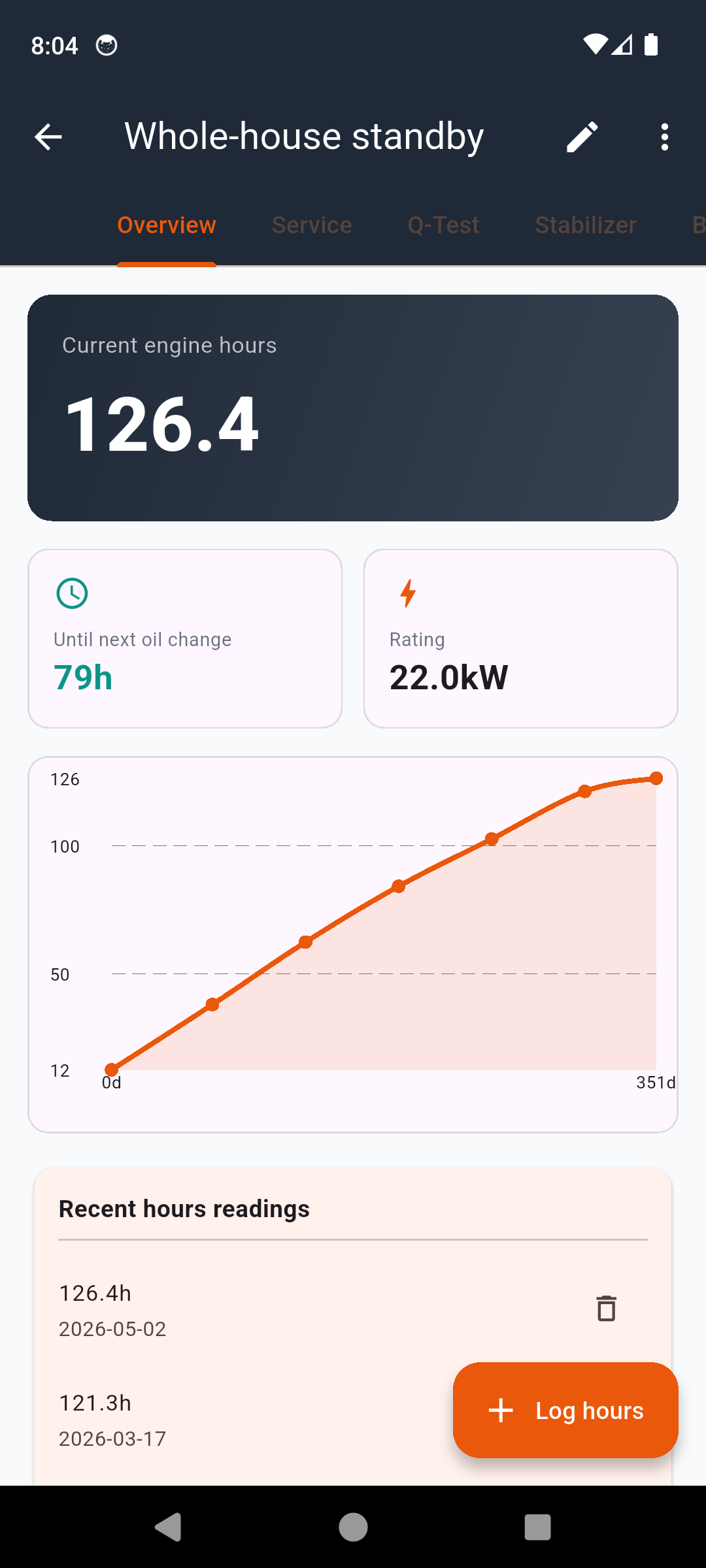
Two years is long enough to forget. The service sticker falls off, the dealer changes hands, and when something goes wrong under warranty you are asked to produce evidence of maintenance that you are fairly sure happened but cannot prove. Manufacturers are within their rights to ask.
So take the hour reading at every visit, note the date, and record what was replaced. That gives you a real hours-per-year figure for your unit, which is what tells you whether you are on the calendar clock or the hours clock, and it gives you a countdown to the next service that means something. GeneratorLog keeps that history per machine, runs the interval off logged hours rather than a guess, and tracks outages and runtime so you can see what the unit has actually done. A notebook in the enclosure does the same job as long as it survives the weather.
The single mistake worth avoiding is treating the weekly self-test as the maintenance programme. It isn’t. It’s the machine telling you it is still switched on.
This is general information and not professional or safety advice. Follow the manual for your specific model, and use a qualified technician for fuel systems, transfer switches and any work covered by your warranty or local electrical rules.
Common questions
How often should a home standby generator be serviced?
Most air-cooled residential units call for a full service every 200 hours or two years, whichever arrives first, and since a typical home unit only accumulates ten to twenty hours a year, the calendar is what triggers it. Plenty of installers shorten that to annual oil and filter work. There is also a one-off break-in service due at 25 hours.
Does the weekly exercise cycle count as maintenance?
It is useful but it is not a test. A no-load self-test proves the engine starts and the controller is awake. It proves nothing about whether the unit can carry your house, because it never picks up the load. Treat a successful exercise as the minimum bar, not as evidence of readiness.
Why do standby generators fail to start?
The battery, more often than anything else. It sits on a trickle charger for years, gets exercised for a few minutes a week, and quietly loses cranking capacity until the first cold night it is asked for real. Most guidance puts replacement at two to three years regardless of whether it still reads twelve volts.
Can I service a standby generator myself?
Oil, filters, plugs, battery and the visual checks are within reach of anyone comfortable working on a lawnmower engine, and manufacturers sell packaged maintenance kits for exactly that. Valve clearance, the transfer switch and any fuel work are jobs for a qualified technician, and doing them yourself can affect your warranty.
Photos: ezrah lane / Pexels , princess / Pexels