






















































































































































The 4% Rule and Safe Withdrawal Rates Explained
Where the 4% rule came from, what its original study actually tested, and why the man who invented it now says 4.7% while others argue for 3.7%.

Almost every conversation about retirement eventually arrives at the same number. Four percent. Draw that much from your portfolio each year and it will last. It is repeated so often, and with such confidence, that it has stopped sounding like what it actually is: the output of one specific study, testing one specific portfolio, over one specific length of time, in one country’s market history.
Knowing what was actually tested is the difference between using the rule well and trusting it further than it can carry you.
What the research actually did
The number traces to William Bengen’s 1994 work, followed by the 1998 Trinity Study, which examined US market history and asked a narrow question: what starting withdrawal rate, increased by inflation each year, would have survived a 30-year retirement in every historical period tested?
The answer was about 4%. On a roughly 50/50 US stock and bond mix, across the periods studied, a 4% starting withdrawal held up in the overwhelming majority of cases, including retirements that began just before serious crashes.
Notice the specifics, because all four of them are load-bearing. Thirty years. US markets. A balanced stock and bond portfolio. And a rigid, inflation-adjusted withdrawal that never responds to what the portfolio is doing.
Change any one and the number moves.
The rule’s own author no longer says 4%
This is the part that rarely survives the journey into forum advice.
Bengen continued the work and later revised his figure upward, to roughly 4.7%, largely by widening the range of asset classes rather than sticking to the original two-fund mix. Diversification, in his later modelling, bought a meaningfully higher sustainable withdrawal.
Meanwhile Morningstar has published notably lower figures, in the region of 3.7%, arguing from present conditions rather than long history: bond yields and equity valuations at the point you retire matter, and starting from expensive markets is not the same as starting from cheap ones.
So the honest state of play is a range, not a rule. Current research clusters somewhere between about 3.7% and 4.2% for a 30-year retirement, depending on the assumptions you accept.
| Source | Figure | Reasoning |
|---|---|---|
| Trinity Study / Bengen 1994 | ~4.0% | 30-year US history, 50/50 portfolio |
| Bengen, later work | ~4.7% | Broader asset diversification |
| Morningstar (recent) | ~3.7% | Current yields and valuations |
| Long-horizon research | ~3.25-3.5% | 40-50 year retirements |
Two credible researchers, a full percentage point apart. On a £40,000 spending target that is the difference between needing £850,000 and needing £1,080,000. Anyone quoting a single figure without the assumptions attached is skipping the interesting part.
Why early retirees should be more careful
Every version of the classic rule was built around a 30-year retirement, which suits someone stopping at 65.
Retire at 45 and you may be funding 50 years. That is not a minor extension. A portfolio has to survive more market cycles, more inflation regimes, and considerably more sequence risk, and the research on longer horizons consistently lands lower, at roughly 3.25% to 3.5%.
The practical consequence is unwelcome but simple: the earlier you retire, the larger the multiple of spending you need. At 4% you need 25 times your spending. At 3.25% you need about 31 times. Using the standard rule for a 45-year retirement is the most common way FIRE plans quietly overstate how close they are.
The rigidity is the real flaw

Read the rule literally and it describes behaviour no sensible person would exhibit. Markets fall 35%, your portfolio is down a third, and you withdraw the same inflation-adjusted amount as last year, because the rule says so.
Nobody does that. And the fact that nobody does that is good news, because spending flexibility is one of the most powerful levers available. Trimming withdrawals modestly during poor years improves survival odds substantially, without requiring a bigger portfolio or better returns.
That observation is what flexible strategies formalise. Guyton-Klinger guardrails let you take a raise when the portfolio does well and require a cut when it falls past a threshold. Variable percentage withdrawal ties the amount to the balance every year. Both accept more variable income in exchange for a far lower chance of running out, which for most people is the right trade.
How to actually use it
Treat 4% as a sanity check, not a plan. It is a fast way to see whether a target is in the right postcode: multiply spending by 25 and you have a first approximation.
Then adjust for your own facts. Retiring early pushes the rate down. Willingness to flex spending pushes it up. Other income arriving later, like a state pension, means your portfolio is bridging a gap rather than funding every year alone, which changes the shape entirely.
And then stop reasoning with a single average, because that is the deepest problem with a fixed rate. It quietly assumes returns arrive smoothly. They don’t, and the order they arrive in can decide the outcome between two retirees who saw identical averages.
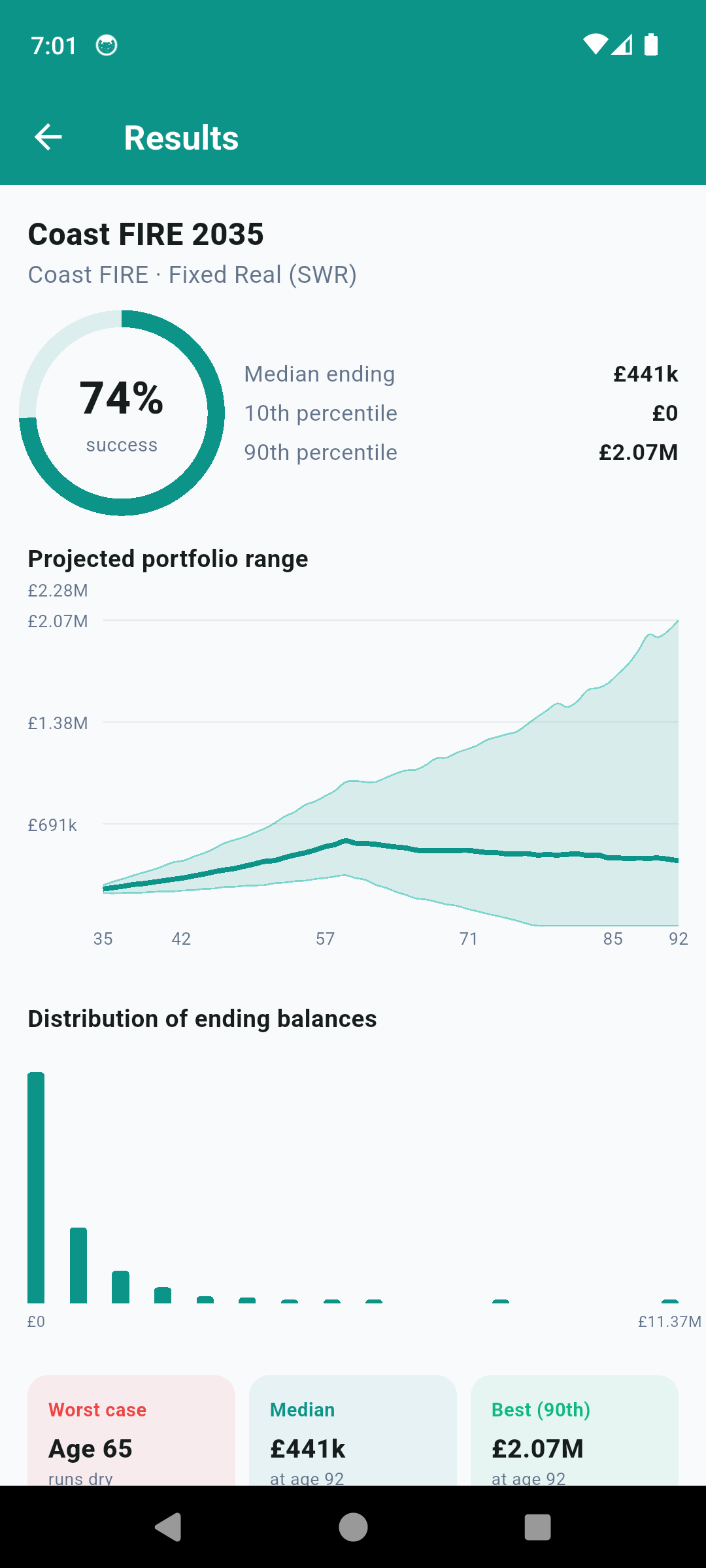
That is the case for testing a plan rather than calculating it once. FireCalc runs the withdrawal strategies above against thousands of market paths and reports how often the plan survived, which is a more useful answer than a single number that was always a range in disguise.
The 4% rule is a genuinely good piece of research. It is just thirty years old, built for a shorter retirement than yours, and frequently quoted by people who have never read what it tested.
Next, work out your own FIRE number using the multiple that fits your horizon, and check whether you have already passed Coast FIRE along the way.
This is general information, not financial advice. Withdrawal research is contested and your own horizon, taxes and circumstances differ; check anything consequential with a regulated adviser.
Sources: Bengen’s 4.7% update, Safe withdrawal rates and today’s conditions, Updated Trinity Study data, William Bengen.
Common questions
What is the 4% rule?
Withdraw 4% of your portfolio in the first year of retirement, then increase that amount with inflation each year after. It came from research suggesting this survived a 30-year retirement in almost all historical periods on a balanced US portfolio.
Is the 4% rule still accurate?
It is contested in both directions. William Bengen, who produced the original research, later revised his figure up to about 4.7% after widening the asset mix. Morningstar moved the other way, publishing around 3.7% based on current bond yields and equity valuations. Most current work lands between roughly 3.7% and 4.2% for a 30-year horizon.
Does the 4% rule work for early retirement?
Less well, because it was built on 30-year retirements. Someone retiring at 45 may need the money to last 45 or 50 years, and research on longer horizons points to roughly 3.25% to 3.5% instead.
Do I have to withdraw exactly 4% every year?
No, and the rigidity is the rule's biggest weakness. It assumes you keep spending the inflation-adjusted amount regardless of what markets do. In practice, trimming spending in bad years dramatically improves the odds, which is what flexible strategies like guardrails formalise.
Photos: kaboompics.com / Pexels , Alesia Kozik / Pexels