





















































































































































What Is My FIRE Number? How to Work Out What You Actually Need
Your FIRE number is roughly 25 times your annual spending, but the spending figure is where almost everyone goes wrong. Here is how to get it right.

Ask ten people in a FIRE forum what their number is and you get ten confident answers, most of them wrong. Not because the arithmetic is hard, but because almost everyone plugs in the wrong figure at the start and then compounds the error for a decade.
The formula itself takes three seconds. Take what you expect to spend in a year once you have stopped working, and multiply it by 25. Thirty thousand a year gives you a target of £750,000. Forty thousand gives you a million. That’s it, that’s the number everyone talks about.
The 25 is not arbitrary. It’s the inverse of the 4% rule: drawing 4% of a pot every year is the same as needing 25 times what you draw. So the multiple and the withdrawal rate are the same idea wearing different clothes.
Spending, not income. This is where it goes wrong.
The single most common mistake is anchoring on salary.
If you earn £60,000 and save a third of it, your portfolio never has to replace £60,000. It has to replace the £40,000 you actually live on. Anchor on income and you have just added £500,000 to your target and several years to your working life, for no reason at all.
There’s a quiet irony here that catches good savers. The more aggressively you save, the further your spending sits below your income, and the more badly the income-based number overshoots. The people most committed to retiring early are the ones most likely to overestimate what they need.
So the first job is not maths, it’s measurement. Track your actual spending for a year, or pull twelve months of bank and card statements and total them. A year matters because it catches the things a good month hides: the car insurance renewal, Christmas, the boiler, the dentist.
Then adjust for the life you are actually going to live
Today’s spending is the starting point, not the answer. Retirement changes the shape of it.
Some costs disappear. Commuting, work clothes, the coffees, and crucially the saving itself, which is often the largest line in a FIRE saver’s budget and is not a retirement expense at all.
Some costs arrive. More travel in the early years, hobbies that now have time to expand, and health cover if you are somewhere that ties it to employment.
And some change on a schedule. This is the one people skip. If your mortgage has eleven years left and you’re planning to stop work in eight, your spending drops sharply three years into retirement. Modelling one flat number for a forty-year period quietly ignores that, and usually in the direction of making you work longer than necessary.
The multiple is not fixed at 25
Twenty-five times comes from research into 30-year retirements. That was the horizon the original work studied, and for someone finishing at 65 it’s a sensible planning window.
If you’re retiring at 45, you might be funding 45 or 50 years. That’s a different question, and the research is fairly consistent that longer horizons need a lower withdrawal rate. Where a 30-year plan supports something in the region of 4%, 40 to 50 year horizons point closer to 3.25% to 3.5%.
Turned into multiples, that looks like this:
| Withdrawal rate | Multiple of spending | Roughly suits |
|---|---|---|
| 4.0% | 25x | 30 years |
| 3.75% | 27x | 35 years |
| 3.5% | 29x | 40 years |
| 3.25% | 31x | 45-50 years |
On £30,000 of spending, the gap between 25x and 31x is £180,000. That’s not a rounding error, it’s a few years of your life, and it’s the single biggest reason to be honest about your horizon rather than defaulting to the number everyone quotes.
Subtract the income you will get anyway

Your portfolio does not have to fund every year on its own, and treating it as though it does inflates the target badly.
If a state pension starts at 67 and covers a meaningful slice of your spending, then from 67 onward your portfolio’s job shrinks. The same applies to any defined benefit pension, rental income, or part-time work you actually intend to do. What your portfolio is really funding is the gap: everything before those incomes start, plus the shortfall after.
The rough way to handle it is to work out your number for the years before other income begins, then a smaller number for the years after, rather than applying one multiple to one flat figure for four decades. It’s more fiddly, and it usually produces a smaller and more truthful target.
One number, then stress test it
A FIRE number is a single figure describing a forty-year future, which should tell you how much confidence to place in it. It assumes an average return, an average inflation rate, and steady spending, and reality supplies none of those.
The two things that actually break plans are the order in which returns arrive, which matters far more than the average, and spending that turns out higher than the version you wrote down. Neither shows up in a 25x calculation. That’s not a reason to skip the calculation, it’s a reason to treat it as the beginning rather than the end.
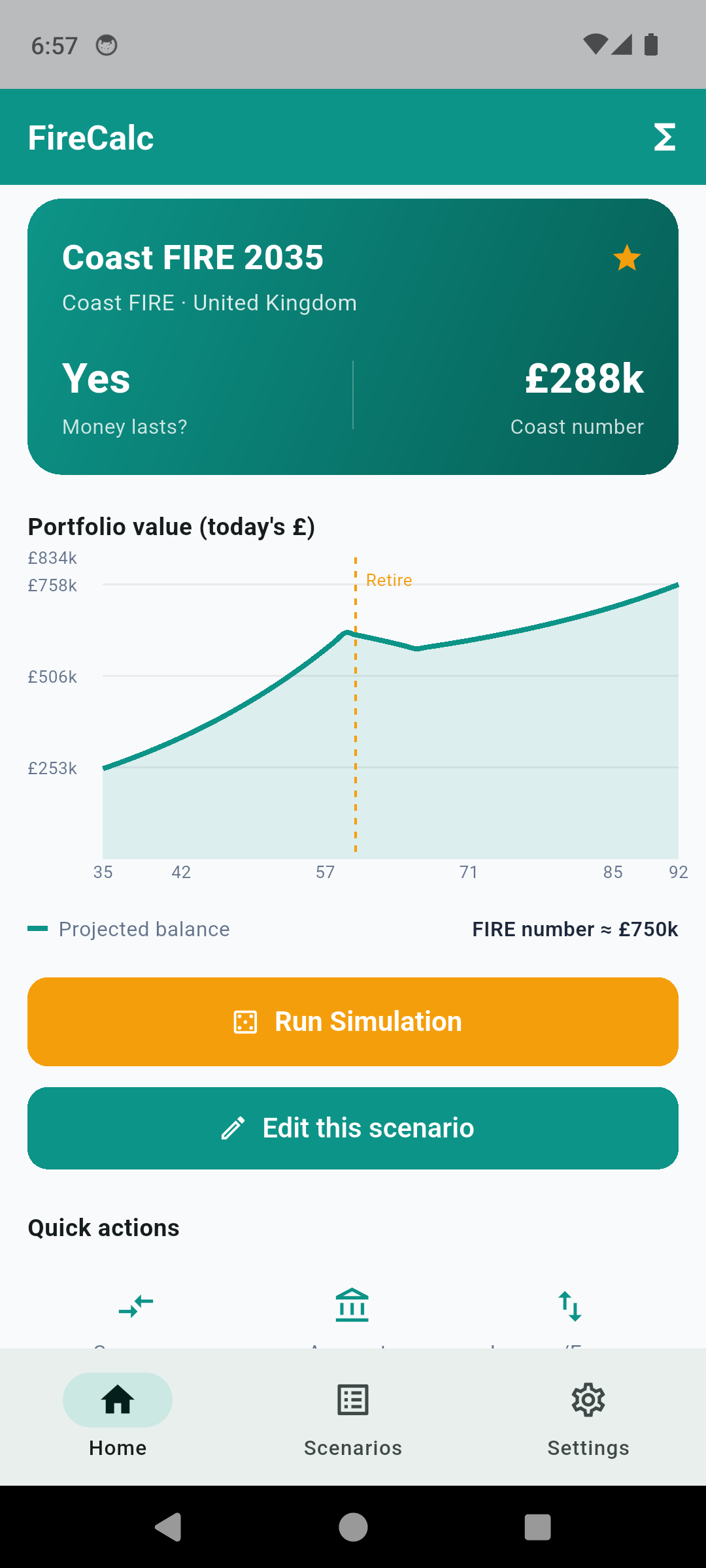
That’s the gap FireCalc is built to fill. It takes the spending figure and the horizon you actually have, then tests the plan against thousands of market outcomes instead of one average, so you can see how often it survives rather than whether it works on paper once.
Start with the honest spending figure, though. Get that wrong and every number after it is wrong too, however sophisticated the model on top.
If you want the reasoning behind the multiple itself, the 4% rule and where it comes from is the companion to this one. And if you are earlier in the journey than you thought, Coast FIRE is worth knowing about, because the point where you can stop saving arrives long before the point where you can stop working.
This is general information, not financial advice. Your circumstances, tax position and time horizon are yours alone; check anything consequential with a regulated adviser.
Common questions
How do I calculate my FIRE number?
Multiply your expected annual spending in retirement by 25. If you expect to spend £30,000 a year, that is £750,000. The 25 comes from the 4% rule, since withdrawing 4% of a pot is the same as needing 25 times what you withdraw.
Should I use my income or my spending?
Spending, always. Your portfolio has to replace what you spend, not what you earn. Using income silently inflates your target by whatever you were saving, which for a committed saver can be half the number.
Is 25x still the right multiple?
It is a reasonable starting point for a 30-year retirement, but early retirees are planning for 40 or 50. Longer horizons point to a lower withdrawal rate, which means a bigger multiple: 28x to 30x is a more honest target if you are retiring in your forties.
Does the state pension change my number?
Yes, and a lot of people forget it. Any income that starts later (state pension, a defined benefit scheme, rental income) reduces what your portfolio has to cover from that point on. Your portfolio is bridging a gap, not funding every year alone.