























































































































Proof of Work for Subcontractors: Documenting a Job So You Get Paid
Photos prove the work happened. They don't prove you were entitled to be paid for it. What a main contractor accepts, and the records that end an argument.
The argument you are going to have about money has usually already been decided. It got decided weeks earlier, on some ordinary Tuesday, when the site manager walked past and asked you to move a run of sockets to the other wall, and you said yes, and you did it, and nobody wrote anything down.
That is the shape of most subcontractor payment disputes. Not fraud, not some main contractor plotting to stiff you. Just a chain of small sensible verbal decisions that made complete sense at the time and left no trace, so that when the final account lands there are two honest people with two different memories, and only one of them has to find the money.
Documentation is not really about proving you are honest. Everyone assumes that right up until the number gets big. It is about making it easy for the person on the other side to agree with you, and about making disagreement expensive.
Two different things get called proof
Worth separating early, because subcontractors routinely over-invest in one and skip the other entirely.
The first is evidence that the work exists and was done properly: photos, test certificates, commissioning sheets, delivery notes, sign-offs. Most trades are decent at this now, partly because it feels like proof and partly because it’s the bit that looks good on a phone.
The second is evidence that you were entitled to be paid for it. That an instruction was given. That the scope changed. That the hours were incurred and by whom. That the fortnight you lost was not your fault. This is what decides the money, and it is almost entirely paperwork rather than photography.
A folder of beautiful photographs of a wall you were never asked to build gets you nothing. A two-line email confirming you were asked to build it gets you paid.
The email that beats a conversation
If you take one habit from this, take this one. When you’re given an instruction verbally, send a short written confirmation the same day, while it’s still fresh and before anyone has a reason to remember it differently.
It does not need legal language. Four facts do the job: what you were asked to do, who asked, when they asked, and what you intend to do about the cost. Something like: “Confirming that on site this morning Dave asked us to relocate the socket run on the east wall to the north wall. This is outside the drawings issued 14 May, so we’ll price it as a variation. Let us know before Thursday if that’s not right and we’ll hold off.”
Three things are happening in that message. You’ve created a dated record of an instruction. You’ve flagged the cost consequence before doing the work, which is the difference between a variation and a gift. And you’ve put the burden on the other side: silence now reads as acceptance, not as an unanswered question.
Contractually this is often called a confirmation of verbal instruction, and many standard subcontracts have a formal mechanism for it with its own time limit. Read yours and use the mechanism if it exists. But even where no mechanism exists, the plain email is worth sending, because an adjudicator, a quantity surveyor, or the commercial manager who has to approve your account is looking for contemporaneous records. A document written at the time carries weight that a reconstruction written afterwards never will.
The rule of thumb: if a decision on site changes what you build, how long it takes, or what it costs, it needs to exist in writing before you go home.
Hours are the other thing nobody records properly
Variations get attention because they feel like money. Time quietly loses more of it.
Dayworks sheets are the standard answer for work that can’t sensibly be priced by measure, and they only work if they’re signed on the day. A sheet with names, hours, plant and materials, signed by someone from the main contractor before you leave, is a straightforward document. The same sheet produced three weeks later, unsigned, is an invitation to a negotiation you will lose. If nobody will sign it, send it by email that evening and say you’re treating it as agreed unless you hear otherwise. Not as good, but far better than nothing.
Then there is the record almost nobody keeps: what stopped you working. The scaffold that wasn’t struck, the two days waiting for a power supply, the other trade occupying your area, the drawings that arrived on the eighteenth. A short dated line each time takes seconds. Assembled over a job, those lines become the only version of events with dates on it, which matters enormously if the conversation later turns to delay, disruption, or who is charging whom for prolongation.
Keep it factual and unemotional. “23 June, no access to plot 4, scaffold not adapted, two operatives stood down 0800-1200” is useful. “Absolute shambles again” is not, and you will regret it if the file is ever read by anyone else.

What actually settles which argument
Different disputes turn on different documents, and knowing which is which stops you gathering the wrong pile.
| The argument | What actually settles it |
|---|---|
| ”That was in your original price” | The tender scope and drawings, with revision numbers and dates |
| ”Nobody told you to do that” | The dated confirmation of the verbal instruction, unanswered |
| ”You didn’t spend that long on it” | Signed dayworks sheets, or the same-day emailed version |
| ”The work isn’t finished” | Completion photos plus a dated sign-off or handover record |
| ”You caused the delay” | Your own dated log of access, information and other trades |
| ”You damaged that” | Arrival photos of the areas you didn’t come to work on |
| ”We never received your application” | The sent email, with the date, and what your contract says about service |
Notice how many of those are one line of text rather than a photograph. Photographs support the record. They rarely are the record.
The clock most subcontractors don’t know is running
In the UK, payment on construction contracts runs on a statutory timetable, and it is unusually unforgiving in both directions.
Once a payment becomes due, the paying party has to issue a payment notice saying what they consider due and how they worked it out, no later than five days after the due date. If they want to pay less than the notified sum, they need a separate pay less notice, served before the final date for payment. Where the contract doesn’t set those dates itself, the Scheme fills the gap: the final date for payment sits seventeen days after the due date, and a pay less notice has to arrive no later than seven days before it.
The part worth understanding is what happens when they miss it. If no valid payment notice is issued, your application can become the notified sum, and without a valid pay less notice the full amount falls due on the final date. That is why subcontractors who submit applications properly, on time, in the format the contract specifies, and who keep proof of sending them, occupy a much stronger position than ones who invoice whenever the month feels finished.
Check your own contract for the actual dates, because the Scheme only fills gaps and most subcontracts set their own. In the US the equivalent machinery is different again: prompt payment statutes vary state to state, and mechanics lien rights have preliminary notice and filing deadlines that are strict and short, so the local rule is the one that matters rather than any general summary.
That is enough law for a working guide. This is general information rather than legal advice, and if real money is at stake, the dates in your own contract and a proper opinion on them are worth more than any article.
Retention, and the account that never quite closes
Retention is where good records earn their keep long after the job.
At practical completion, the sensible move is a dated set of photographs of the finished work along with whatever sign-off you can get. When the defects period ends and you go back for the balance, you’ll be asked to demonstrate the state you left things in, often by someone who never visited the site and joined the company after you finished. A complete dated record makes that a five-minute conversation. Its absence makes it a discount.
Diarise the release date the day the job ends. Retention is the money most often lost simply because nobody chased it and everybody moved on.
The filing problem is the real problem
Most subcontractors already generate the right evidence. What fails is retrieval. Instructions live in WhatsApp, photos live in the camera roll, dayworks sheets live in the van, and applications live in sent items, so reconstructing one job means assembling four systems eighteen months after the fact. That reconstruction cost is precisely why people settle for less than they’re owed: not because they were wrong, but because proving they were right took longer than the difference was worth.
The fix is boring and structural. One place per job, with the client and address attached, that everything lands in at the moment it happens. Anything that depends on you tidying up on a Sunday evening will not survive contact with a busy month.
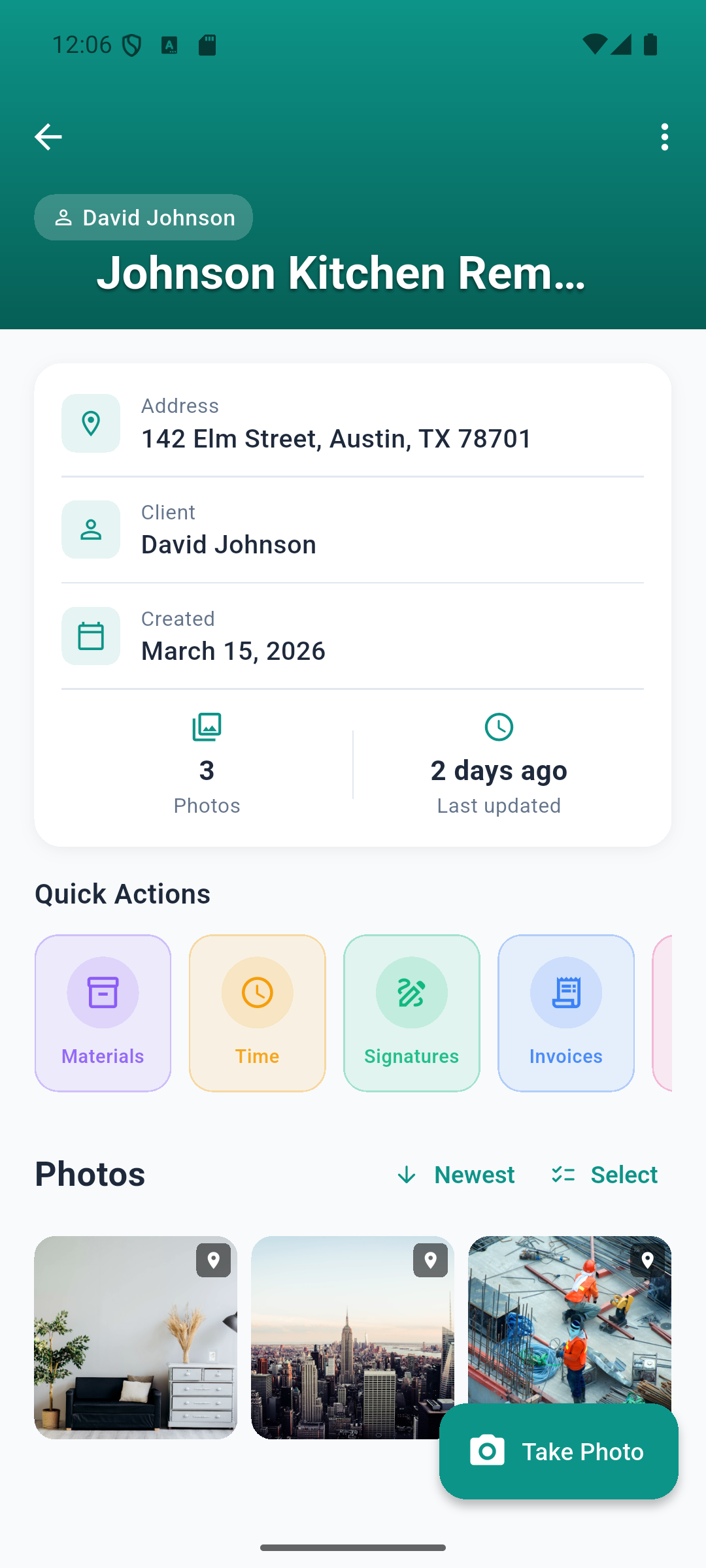
That’s the job SiteProof does: photos land in the project they belong to, stamped with date and location, and come back out as a PDF when someone asks for the file. The tool is less important than the habit. A shared drive with a folder per job, that you actually keep up, beats any app you abandon in week three. If you want the photography side in more depth, the companion piece on what to capture and when covers the four moments that matter.
The ones that cost people money
Doing the extra work first and pricing it afterwards. Once it’s built, your leverage is gone and you’re asking rather than agreeing.
Treating WhatsApp as the record. Messages get deleted, phones get replaced, and exporting a readable chat history two years later is not the afternoon you think it is. Move anything that matters into email the same day.
Waiting for the final account to raise everything at once. A list of nineteen disputed items arriving in one document reads as opportunism, however fair each line is. The same items raised individually, at the time, each with its own dated record, read as a well-run job.
Assuming a good relationship is protection. It usually is, right up until the person you had the relationship with changes jobs and the file is all that’s left of them.
The test is simple enough. If you handed your file for this job to a stranger who was not there, could they work out what you were asked to do, when, how long it took, and what stopped you? If yes, you’re covered. If not, the gap is where the money goes.
Common questions
What counts as proof of work for a subcontractor?
Two separate things, and you need both. Evidence the work exists and is right: photos, test results, delivery notes, sign-offs. And evidence you were entitled to be paid for it: the instruction that told you to do it, the hours it took, and a record of anything outside your original scope. The second set is what actually decides the money.
The site manager told me verbally to do extra work. Am I covered?
Not until you write it down. Send a short email the same day saying what you were asked to do, who asked, when, and that you will price it as a variation unless told otherwise. That email is not a contract, but an unanswered written record of an instruction is a very different position from two people remembering a conversation differently six weeks later.
What should I do if the main contractor just goes quiet?
Check your contract's payment dates before anything else, because in the UK the deadlines for a payment notice and a pay less notice are strict and missing them shifts the position substantially. Then put the position in writing, calmly and with the records attached. Most of the leverage in a payment argument comes from having dated documents rather than from being annoyed.
Do I really need signatures if I have photos?
Photos and signatures answer different questions. A photo shows a thing was built. A signature shows someone on the other side accepted it, or accepted the hours, or agreed the work was complete on that date. When the disagreement is about entitlement rather than quality, the signature is worth more.
Photos: David Brown / Pexels , Kaboompics / Pexels