





















































































































Backflow Preventer Types: RP, DC, PVB and SVB Explained
What each backflow assembly does, which hazard it is approved for, where code will and will not let you put it, and the readings a tester writes on the report.
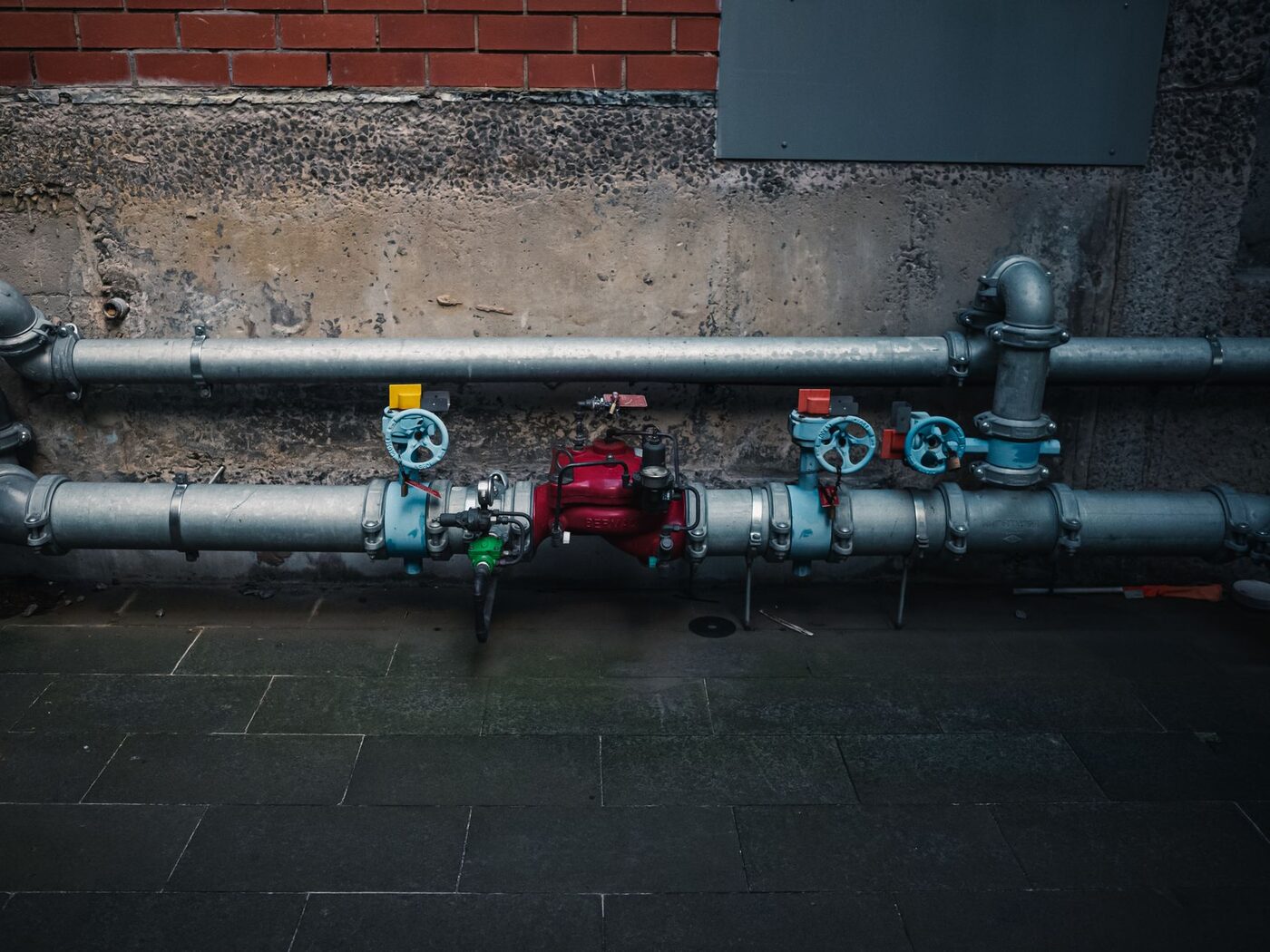
Ask a room of apprentices which backflow assembly a job needs and most will start by looking at the pipe. Wrong end of the problem. Pipe size tells you which model to order, not which type. The type is decided by two questions, and if you answer both correctly the assembly picks itself.
The first question is what happens if the water comes back. The second is how it could come back. Everything else is detail.
Two ways water goes the wrong direction
Backsiphonage is a pressure loss upstream. A main breaks, a hydrant opens on a fire, a booster pump shuts down, and the supply line briefly pulls a vacuum. Whatever is sitting at the far end of an open connection gets drawn back towards the main. This is the failure mode behind the classic incidents: a hose left in a chemical drum, a sprinkler head sitting in a puddle of fertiliser run-off.
Backpressure is the opposite. Pressure downstream rises above the supply and pushes. That needs an energy source on the customer’s side, which in practice means a pump, a boiler, a pressurised tank, an elevated system, or a heat exchanger. A plain irrigation zone fed off the house pressure cannot produce backpressure. A boiler make-up line can, all day long.
Some assemblies handle both. Vacuum breakers handle only the first, and installing one where backpressure exists is the most common serious mistake in this field, because the assembly will sit there looking perfectly healthy while doing nothing at all.
Two grades of consequence
The second question is degree of hazard, and the vocabulary matters because it maps directly onto what is allowed.
A non-health hazard, sometimes called a pollutant, is something that would make the water objectionable in taste, odour or colour without making anyone ill. A health hazard, or contaminant, is something that could cause illness or death: sewage, process chemicals, boiler treatment additives, pesticides, reclaimed water.
Health hazard means a reduced pressure principle assembly, full stop, unless the design uses a physical air gap instead. Non-health hazard opens the door to a double check. The person who decides which category a given cross-connection falls into is your local water purveyor or authority having jurisdiction, and their determination beats anyone’s opinion including the customer’s.
Reduced pressure principle assembly (RP)
Two independent spring-loaded check valves with a differential relief valve in the zone between them, plus two shutoffs and four test cocks.
Under normal flow, the zone between the checks is held at a lower pressure than the inlet. If the first check fouls or the supply drops, that differential collapses and the relief valve opens, dumping the zone to atmosphere. The assembly does not silently fail. It announces the failure by putting water on the floor, which is exactly the design intent and also why a discharging RP is a diagnostic signal rather than a defect in itself.
RPs handle backpressure and backsiphonage, and they are the assembly approved for health hazards. The cost of that relief path is where you can put it. Because it discharges to atmosphere, codes generally prohibit installing an RP in a pit or vault that could flood, since a submerged relief port defeats the whole mechanism. It also needs a drain able to take a full discharge with an air gap, which on a large assembly is a lot more water than people expect.
On test, the relief valve must open at a differential of at least 2.0 psid. The first check must hold at least 5.0 psid, and the second check must be tight, holding at least 1.0 psid. Manufacturers set relief valve opening points anywhere in roughly the 2 to 5 psid range, so a reading that looks unusual is not automatically a fault.
Double check valve assembly (DC)
The same two independent check valves, the same shutoffs and test cocks, no relief valve.
A DC protects against both backpressure and backsiphonage, which surprises people who assume the missing relief valve costs it a capability. It does not. What the missing relief valve costs is the ability to fail loudly. If both checks foul, nothing tells you, and that silence is precisely why the DC is limited to non-health hazard applications where a slow undetected failure is unpleasant rather than dangerous.
Each check valve has to hold a minimum of 1.0 psid, tested separately. That is the whole pass criterion, and it is a lower bar than the RP because there is no relief valve whose opening point the checks have to stay above.
Fire sprinkler systems are the common DC application, usually as a detector assembly with a metered bypass so the utility can spot a leak or an unauthorised tap. Plain water in the pipes is a non-health hazard. Put antifreeze or any additive in that system and the classification changes, and so does the required assembly.
Pressure vacuum breaker (PVB)
A single spring-loaded check valve with an air inlet valve above it, shutoffs either side, two test cocks.
When supply pressure drops, the air inlet opens and admits atmosphere above the check, breaking the siphon. That is the entire mechanism, and it explains both the strength and the limit. It is simple, cheap and testable, and it does nothing whatsoever about backpressure.
The installation rule that gets ignored: a PVB has to sit at least 12 inches above the highest downstream outlet and above the highest point in the downstream piping. Not 12 inches above the ground, and not 12 inches above the valve box. Above the highest sprinkler head on the zone. On sloping ground this routinely means the assembly ends up at what looks like an absurd height, and shortening that riser to make it tidier is the single most common way a correctly specified PVB becomes a non-compliant one.

Both the air inlet and the check are tested against a 1.0 psid minimum: the air inlet must open at or above 1.0 psid, and the check valve must hold at least 1.0 psid.
Spill-resistant vacuum breaker (SVB)
Functionally a PVB with the sequencing changed. On pressurisation, the air inlet closes before the check valve opens, so the assembly does not spit water out of the vent every time the system comes up to pressure.
That is the whole point of it. A standard PVB spilling a cupful onto a lawn is nothing. The same spill inside a plant room, over a ceiling, or above a finished floor is a callback. So the SVB, covered by ASSE 1056, is the one to reach for indoors or anywhere a discharge is unwelcome.
Everything else carries over unchanged. Backsiphonage only, no backpressure, and the same 12 inch height rule above the highest downstream outlet. The air inlet is tested to the same 1.0 psid minimum. People sometimes assume spill-resistant means it can be mounted low. It does not.
The quick comparison
| RP | DC | PVB | SVB | |
|---|---|---|---|---|
| Backsiphonage | yes | yes | yes | yes |
| Backpressure | yes | yes | no | no |
| Health hazard | yes | no | no | no |
| Height rule | none, but not in a floodable pit | none | 12 in above highest outlet | 12 in above highest outlet |
| Field test minimums | relief 2.0 psid, check 1 at 5.0 psid, check 2 at 1.0 psid | 1.0 psid each check | 1.0 psid air inlet and check | 1.0 psid air inlet and check |
Devices are not assemblies
An assembly has two shutoff valves and test cocks, which is what makes it testable in the field. A device has neither, so it cannot be verified and gets relied on structurally rather than by inspection. The distinction is worth being pedantic about, because a report can only exist for an assembly.
An atmospheric vacuum breaker is the common device. It is cheap, it protects against backsiphonage only, it must be installed at least 6 inches above the highest downstream outlet, and there must be no shutoff valve downstream of it. The rule people forget is the duty cycle: an AVB must not be under continuous supply pressure for more than 12 hours. Leave one pressurised permanently and the poppet can stick to its seat, at which point it will not open when it is finally needed. An irrigation valve left energised over a hot weekend is exactly how that happens.
An air gap is the other end of the scale and the only one with nothing to fail. A physical vertical separation of at least twice the supply pipe diameter, never less than 1 inch, between the outlet and the flood level rim. No moving parts, no annual test, no failure mode short of somebody sticking a hose in the tank.
Where the tests actually go wrong
An RP dribbling from the relief port is the classic call-out, and the assumption is always a bad relief valve. It usually is not. A continuous discharge points at the first check not seating, letting inlet pressure into the zone and holding the relief open. Grit, a scale flake, a chunk of pipe dope from a repair upstream. Flush it and the discharge often stops.
On a double check, verify the number two shutoff is holding before you trust either reading. A weeping downstream shutoff feeds pressure back into the assembly and produces numbers that look plausible but describe nothing. It is a quiet source of wrong reports.
PVB air inlets tend to fail on the way into autumn rather than in spring, after a season of hard water evaporating around the poppet. If one is slow to open on test, look at scale before you look at the spring.
And whichever assembly you are on, the test only counts if the report reaches the water purveyor. Testing intervals are set locally, annual being the most common, and in a lot of jurisdictions a report that arrives late is treated exactly like a failed test. The paperwork is not the administrative tail on the job. For enforcement purposes it is the job.
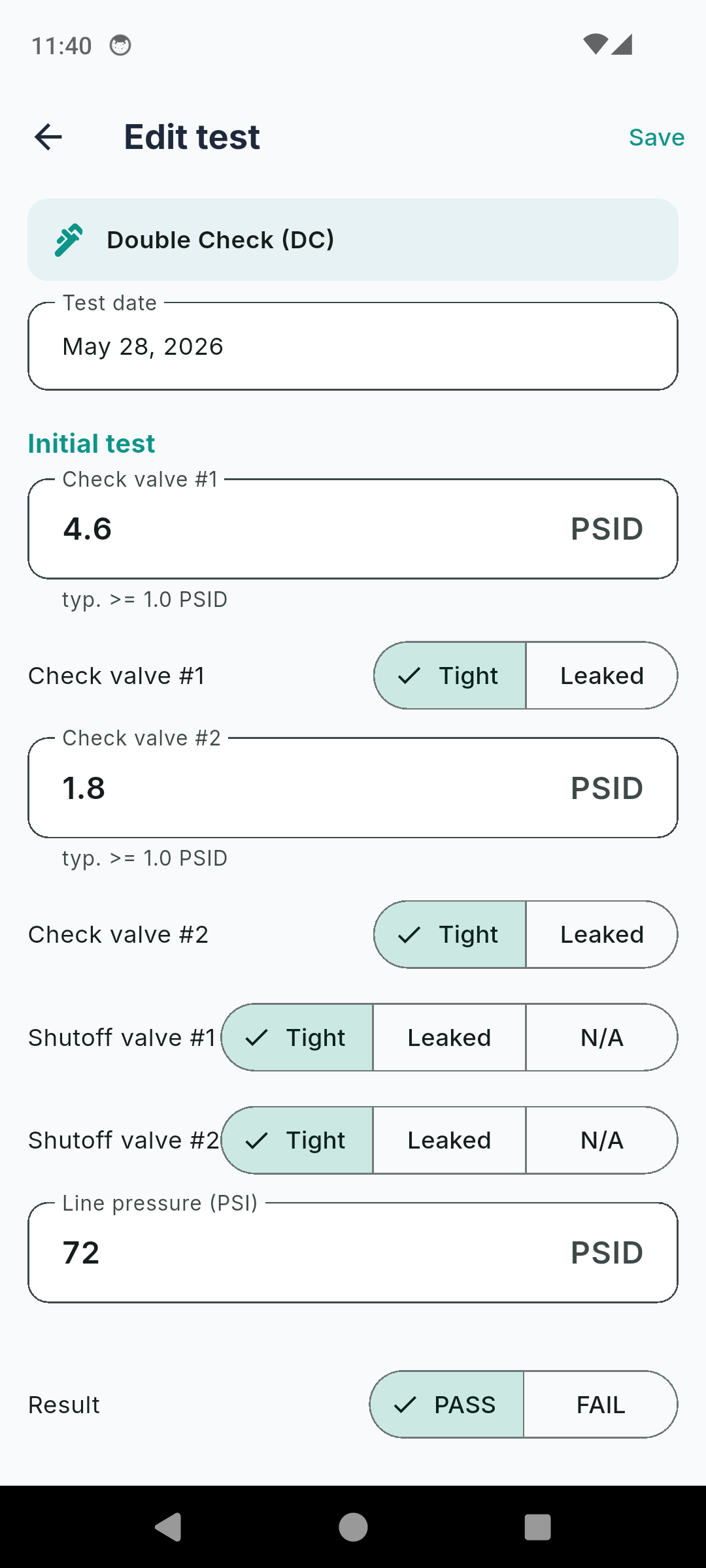
Keeping those reports straight across a few hundred assemblies, each with its own next-due date and its own purveyor, is its own problem, and it is the one Backflow Test Report Log is built for: the assembly record, the readings in the right fields for the type, and the due dates tracked per customer.
This is general information rather than professional advice. Test procedures, pass criteria and testing intervals are set by your state or provincial programme and your local water purveyor, and the accepted procedure varies between editions and between authorities. Follow the procedure your certification and your purveyor accept, and confirm hazard classifications with the authority having jurisdiction before specifying anything.
Common questions
What is the difference between an RP and a DC?
Mechanically, the RP adds a differential relief valve between the two check valves, which dumps water to atmosphere the moment the zone between them loses its pressure differential. That relief path is why an RP is approved for health hazards and a double check is not. A DC has the same two checks and no way to announce that both have failed.
Can a PVB be used where there is backpressure?
No. A pressure vacuum breaker protects against backsiphonage only. If anything downstream can push pressure back towards the supply, such as a pump, an elevated line or a pressurised vessel, the PVB is the wrong assembly and the installation needs an RP or a DC depending on the hazard.
How high does a pressure vacuum breaker have to be installed?
At least 12 inches above the highest downstream outlet and above the highest point in the downstream piping. An atmospheric vacuum breaker, which is a device rather than a testable assembly, sits at least 6 inches above the highest outlet and must not be under continuous pressure for more than 12 hours.
What readings make a double check assembly pass?
Each check valve must hold a differential of at least 1.0 psid, tested separately. If either reads below that, the assembly fails and the report says so. A leaking number two shutoff will also invalidate the test, so verify it is tight before you trust the numbers.
Photos: Sonny Sixteen / Pexels , Sóc Năng Động / Pexels