























































































































PAT Testing Explained: Pass Criteria and Retest Intervals
PAT testing is not required by law, has no fixed annual interval and needs no sticker. What the tests actually measure, the readings that pass, and how to set intervals.

Someone rings an electrician in January because the sticker on the office kettle says May 2025 and a colleague has announced the certificate has expired. Nothing has expired, because nothing was issued. There is no PAT certificate in UK law, no annual requirement, and no legal obligation to put a sticker on anything at all.
That surprises people who have been buying PAT testing for years on the understanding it was compulsory. What is compulsory is something broader and, once you see it, more sensible.
What the law actually asks of you
The duty sits in regulation 4(2) of the Electricity at Work Regulations 1989: electrical systems and equipment must be maintained so far as reasonably practicable to prevent danger. That is the whole of it. No method, no frequency, no paperwork specified.
The HSE could not be clearer about what that does and does not mean. Its guidance states that the regulations “do not specify what needs to be done, by whom or how frequently (ie they don’t make inspection or testing of electrical appliances a legal requirement, nor do they make it a legal requirement to undertake this annually)”. It goes further on the paperwork: there is no legal requirement to label equipment that has been inspected or tested, nor to keep records of it.
So testing is a means, not the end. You are being asked to run a maintenance regime proportionate to the risk, and to be able to show it works. A hire company putting 110V grinders through a hundred sites a year and a solicitor’s office with fourteen laptops have the same legal duty and should not arrive at remotely the same regime.
Worth saying that “PAT” is trade shorthand nobody official uses. The IET calls it in-service inspection and testing of electrical equipment, which is clumsy but describes the job honestly: inspection first, testing second.
Three levels, and the cheapest one finds the most
The Code of Practice splits the work into three tiers, and understanding the split is what stops you overspending.
The user check comes first. The person about to plug the thing in looks at it. Cracked casing, a lead that has been run over by a chair castor, scorch marks round the pins, a plug that has been repaired with tape. This costs nothing, happens daily, and is the only tier that catches a fault the day it appears rather than eleven months later.
The formal visual inspection is the same idea done deliberately by someone competent, with the plug opened where it is not moulded, checking the fuse rating, the cord grip, the terminal screws and the state of the sheath where it enters the plug and the appliance. The HSE’s own figure is that around nine in ten defects are found this way, before a tester is switched on.
Combined inspection and testing is the visual inspection plus the instrument readings. It is the tier everyone means when they say PAT testing, and it is the tier that finds the remaining tenth, which is also the tenth you cannot see: degraded insulation, a broken earth inside an intact-looking lead.
The practical consequence is that a business doing annual combined testing and nothing else has bought the least effective part of the system and skipped the most effective. Ten minutes of user-check training does more for safety than moving your test interval from two years to one.
Why the frequency table disappeared
For a quarter of a century the trade worked off a table in the IET Code of Practice that listed intervals by equipment type and environment. The 5th edition, published in 2020, took it out.
The reason is instructive. Too many people had stopped reading it as guidance and started treating it as law, quoting a row back at their electrician as though it were a statutory interval. It was always meant as a starting point for a risk assessment, and it had become a substitute for one.
What the 5th edition puts in its place is the risk assessment itself. You set an initial interval based on the equipment, the environment, who handles it and how roughly, then you adjust it using your own failure data. If two consecutive rounds find nothing wrong with the office IT, that is evidence to lengthen the interval. If site tools keep coming back with damaged leads, that is evidence to shorten it and to look at how they are being stored in the van.

The gap between the extremes is much wider than most schedules reflect. A 110V hand tool living on a construction site, dragged through mud and dropped, is commonly checked every three months and inspected far more often than that. A desktop computer that has sat under the same desk since 2022 and is unplugged twice a year is at the other end entirely, and a formal visual inspection every two to four years with combined testing less often than that is a defensible position if your records support it. Neither figure is a rule. Both are starting points you are expected to argue for.
Environment drives more of this than equipment type does. The same drill is a different risk in a joinery workshop and in a facilities cupboard.
The readings, and what counts as a pass
Three or four measurements, depending on the item.
| Test | Applies to | Limit |
|---|---|---|
| Earth continuity | Class I only | 0.1 Ω or less, plus the resistance of the lead |
| Insulation resistance @ 500V DC | Class I | 1 MΩ or more |
| Insulation resistance @ 500V DC | Class II | 2 MΩ or more |
| Insulation resistance @ 500V DC | Heating or cooking over 3 kW | 0.3 MΩ or more |
| Insulation resistance @ 500V DC | Extra low voltage | 0.25 MΩ or more |
| Polarity | Extension and IEC leads | Correct, and no open conductor |
| Functional check | Everything | Works as intended when switched on |
Two of those rows catch people out.
The earth continuity limit is 0.1 ohms plus the resistance of the lead, not a flat 0.1. A long extension lead has real resistance in its own conductor and will read above 0.1 without anything being wrong. Testers that offer a “lead null” function exist precisely to subtract it. Failing a 15 metre lead against a 0.1 limit is a false failure, and it happens constantly.
The heating row runs the opposite way to intuition. Big heating elements leak a little by their nature, so the limit drops to 0.3 megohms rather than rising. A 3kW kettle reading 0.6 megohms is fine; the same reading from a laptop charger would want investigating.
Class II equipment has no earth pin to test, so earth continuity does not apply. The way to identify it is the square-inside-a-square symbol on the rating plate, not the look of the casing. A moulded plastic kettle or microwave with an earthed plug is Class I with a plastic body, and testing it as Class II skips the test that matters most on it.
The failure that usually is not one
If a surge-protected extension lead fails insulation resistance, look at the test voltage before you condemn it.
Surge suppression components are designed to conduct above roughly 300V. Hit them with a 500V insulation test and they do exactly what they were built to do, shorting the test to earth and returning a reading near zero. The lead is healthy; the test was wrong for it. The fix is to test at 250V, or to use a substitute or touch leakage test instead. The same applies to a lot of IT equipment with suppression on the input.
Leakage limits are the one area where I would not trust a number from memory or from an older tester. The class-based figures many instruments still have programmed in date from earlier editions, and the 5th edition revised them. Check the current Code and what your instrument is actually set to before you fail something on leakage.
What genuinely fails, in practice
Almost none of it is the appliance. It is the lead and the plug, every time.
The sheath nicked where it enters the plug, so the cord grip is clamping the inner cores instead of the outer sheath. The 13A fuse fitted to a 0.5mm² lead on a table lamp, which will happily let the lead cook before it blows. Terminal screws that were never tightened. Pins bent by being kicked out of a socket sideways for two years. Daisy-chained extension leads under a desk, which is a loading problem rather than a test failure, but is the thing you should actually be worried about in the photo at the top of this page.
None of that needs an instrument to find. All of it needs someone to look.
Records, if not for the law then for the argument
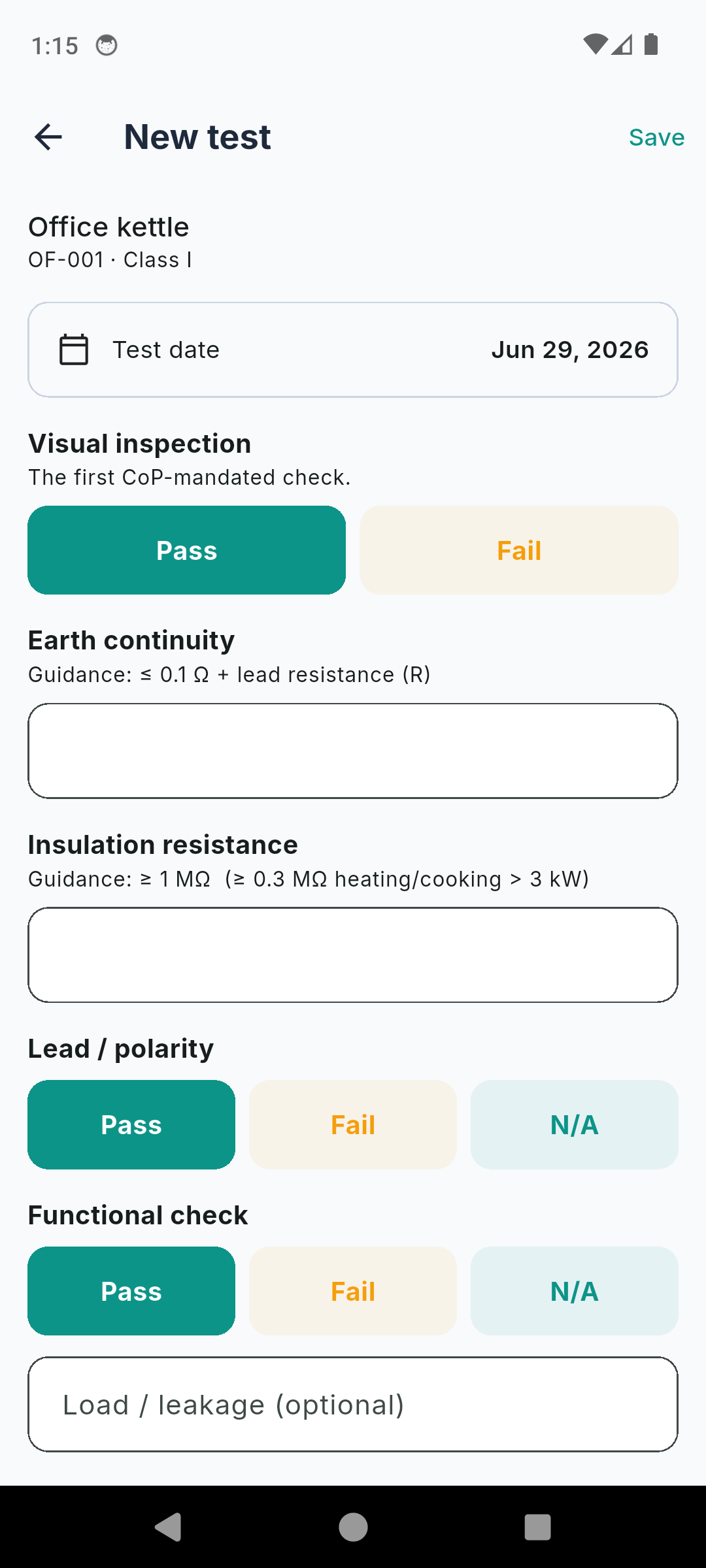
The HSE does not require records. Your insurer, your client’s facilities manager and anyone investigating an incident will all ask for them anyway, and “we do it annually” is a much weaker answer than a register showing what was tested, when, by whom and what it read.
Record the readings, not just the word Pass. A Class I appliance that read 0.03 ohms in 2024 and 0.08 in 2026 has passed both times and is telling you something. Pass or fail alone throws that away.
A useful entry has the asset ID and where it lives, the class, the date, the actual readings, the result, who tested it and when it is next due. That is the shape PATBook puts on it, holding the register and the retest dates on the phone rather than in a spreadsheet on the office PC, with the limits printed next to each field so the numbers get sanity-checked at the point of entry.
Whatever you use, the register is the deliverable. The stickers are just a convenience for the people using the kit.
Who is allowed to do it
Competence, not a certificate. The HSE’s position is that the person doing the work needs to be competent to do it, which for user checks and formal visual inspections can reasonably be a trained member of staff, and for combined inspection and testing needs greater knowledge and experience. There is no legal qualification called a PAT tester. A City and Guilds 2377 course is the usual route and is worth having, but it is evidence of competence rather than a licence.
This is general information rather than professional advice, and it is written for the UK. Verify anything you are relying on against the HSE’s own guidance and the current IET Code of Practice, and get a competent person involved where the risk warrants it.
Common questions
Is PAT testing a legal requirement in the UK?
No. The Electricity at Work Regulations 1989 require you to maintain electrical equipment so it does not cause danger, but the HSE states plainly that the regulations do not make inspection or testing of appliances a legal requirement, nor do they make it a legal requirement to do it annually. Testing is one way of meeting the maintenance duty, not the duty itself.
How long does a PAT test last?
There is no expiry date, because there is no certificate in law to expire. The retest date on a label is the interval whoever tested it decided was appropriate for that item in that environment. A year is a habit, not a rule, and for a desktop computer in an office it is usually far shorter than the risk justifies.
What readings does an appliance have to pass?
For Class I equipment, earth continuity of 0.1 ohms or less plus the resistance of the lead itself, and insulation resistance of at least 1 megohm at 500V DC. Class II equipment has no earth to test and wants at least 2 megohms. Heating and cooking appliances over 3kW are allowed down to 0.3 megohms, and extra-low-voltage equipment down to 0.25.
Why does my surge-protected extension lead fail the insulation test?
Because the surge protection is doing its job. The suppression components inside conduct at somewhere around 300V, so a 500V insulation test sees them as a short to earth and returns a reading near zero. Test surge-protected leads and sensitive IT equipment at 250V instead, or substitute a leakage test. A genuinely faulty lead is rare; this false failure is common.
Do I have to put a sticker on tested equipment?
There is no legal requirement to label equipment or to keep records of inspection and testing. Both are worth doing anyway, because they are how you demonstrate the maintenance regime actually happened when someone asks, and a label is the fastest way for a user to spot an item that has slipped through a round.