






















































































































DVIR Explained: What Drivers Must Inspect and Log
What a Driver Vehicle Inspection Report has to cover, why no defect usually means no report, and the signature chain that fails audits even when the truck got fixed.

Ask ten drivers what a DVIR is and most will describe a form you fill in at the end of every shift. Ask them what happens if nothing is wrong with the truck and you get a pause, because the answer runs against the habit: under the federal rule, if you found no defect and nobody reported one to you, there is no report to file.
That surprises people in both directions. Drivers who have filed one every night for a decade discover it was their company’s policy rather than the law. Owner-operators who have filed none discover the rule still applies the moment something is wrong, and that the paperwork they skipped is exactly the paperwork an auditor asks for.
What the rule actually asks for
The obligation lives in 49 CFR 396.11. At the completion of each day’s work, on each vehicle operated, the driver must prepare a written report listing any defect or deficiency they discovered or that was reported to them, where that defect would affect the safety of operation of the vehicle or result in its mechanical breakdown. The report has to identify the vehicle, and the driver has to sign it. On a two-driver operation only one signature is needed, provided both drivers agree on what they found.
The regulation names the parts and accessories the report has to cover:
- Service brakes, including trailer brake connections
- Parking brake
- Steering mechanism
- Lighting devices and reflectors
- Tires
- Horn
- Windshield wipers
- Rear vision mirrors
- Coupling devices
- Wheels and rims
- Emergency equipment
That list is the floor, not the ceiling. A defect outside it that would ground the truck still belongs on the report, because the test in the rule is the effect on safe operation, not membership of a list.
The no-defect exemption came in with FMCSA’s December 2014 final rule for property-carrying vehicles, and the same relief was extended to passenger-carrying vehicles effective in 2020. The agency’s reasoning was blunt: a driver certifying that nothing was wrong produced paper, not safety. It estimated passenger carrier drivers alone were spending around 2.4 million hours a year on reports that said nothing had happened.
Three operations sit outside the section entirely: a private motor carrier of passengers running non-business, a driveaway-towaway operation, and any motor carrier operating only one commercial motor vehicle. If you are a single-truck carrier, 396.11 does not reach you, though the maintenance and periodic inspection rules still do, and your state’s intrastate rules may say something different.
The chain, and where it breaks
The DVIR is not one document. It is a three-link chain, and audits fail on the links rather than the first report.
A driver finds a defect and writes it up. The carrier or its agent then has to repair any defect likely to affect safe operation before the vehicle goes out again, and certify on the report either that the repair was made or that repair was unnecessary. Then, under 396.13, the next driver has to review that last report and sign to acknowledge the certification.
Miss the middle link and you have a documented defect with no record of a fix. Miss the last one and you have a truck that was properly repaired with nothing showing that the driver who took it out knew. Both read the same way to an investigator: the carrier knew about a problem and cannot demonstrate what happened next. The repair invoice in a different folder helps, but the certification on the report is what the rule asked for.
That signature at the start of the shift is the single most commonly skipped item in the whole of Part 396, and it takes about four seconds.
What counts as a defect
The standard in the rule is whether the condition would affect the safety of operation or result in a mechanical breakdown. In practice drivers err in both directions on the same shift. A torn seat cover and a scuffed bumper get written up, while a slow air leak or a marginal tyre gets a shrug because the truck still moves.
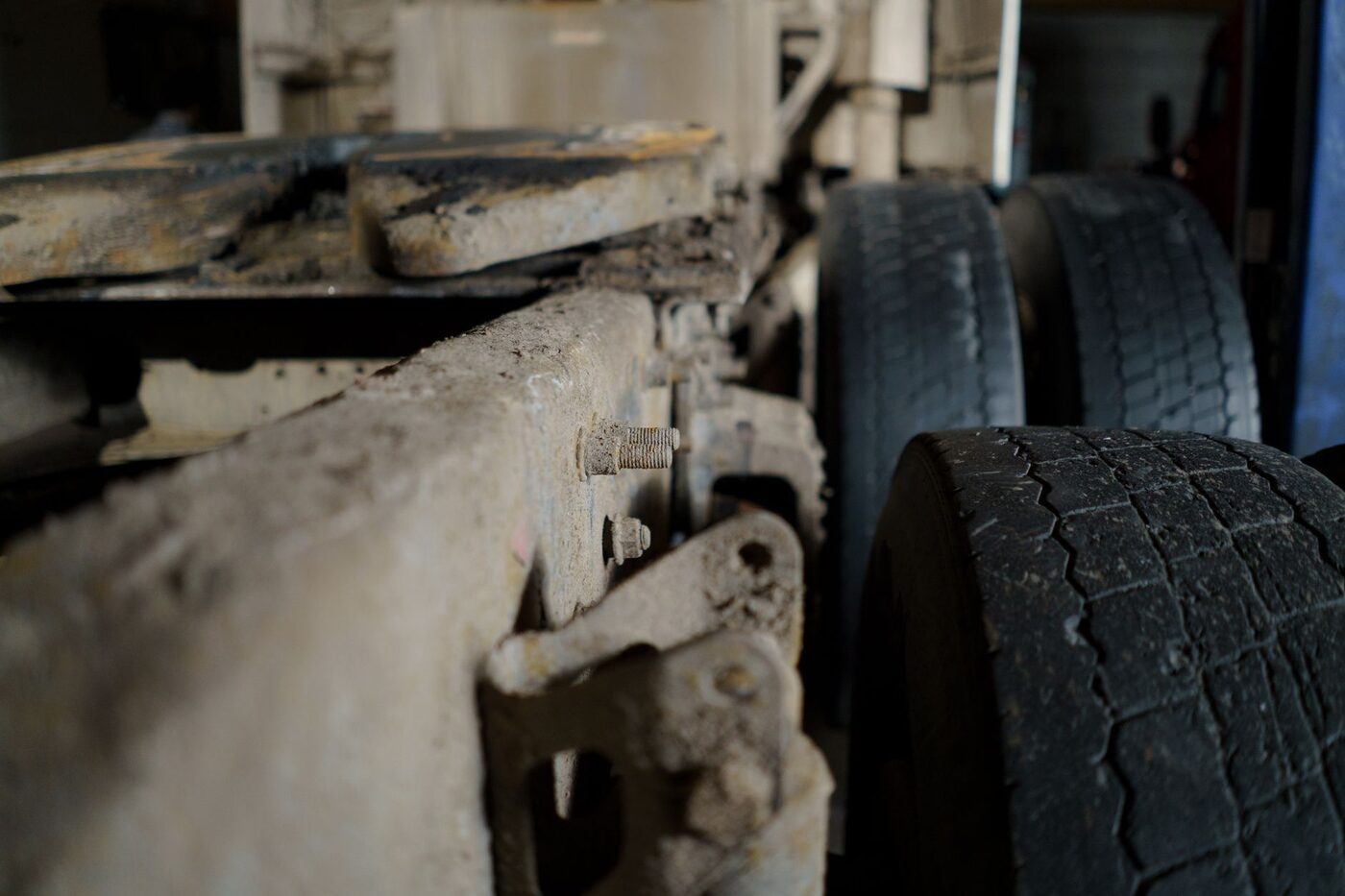
Brakes and tyres are where that judgement costs the most. In CVSA’s annual Roadcheck inspection blitz, brake systems and tyres are consistently the top two vehicle out-of-service categories, and in the 2025 results they made up roughly 45% of all vehicle out-of-service violations between them. Those are two items on an eleven-item list, and they are the ones that reward getting under the truck rather than ticking a box on the walk back to the cab.
Specificity matters as much as detection. “Brakes bad” is worse than nothing, because it establishes that the carrier was on notice without recording what was found, which is a gift to the other side’s lawyer. “Left front brake, audible air leak at the chamber, worse under application” tells the shop what to look at and tells a court what you actually did. Add the odometer, the location and the time, because a report that cannot be placed on a particular day at a particular yard is easy to characterise as reconstructed after the fact.
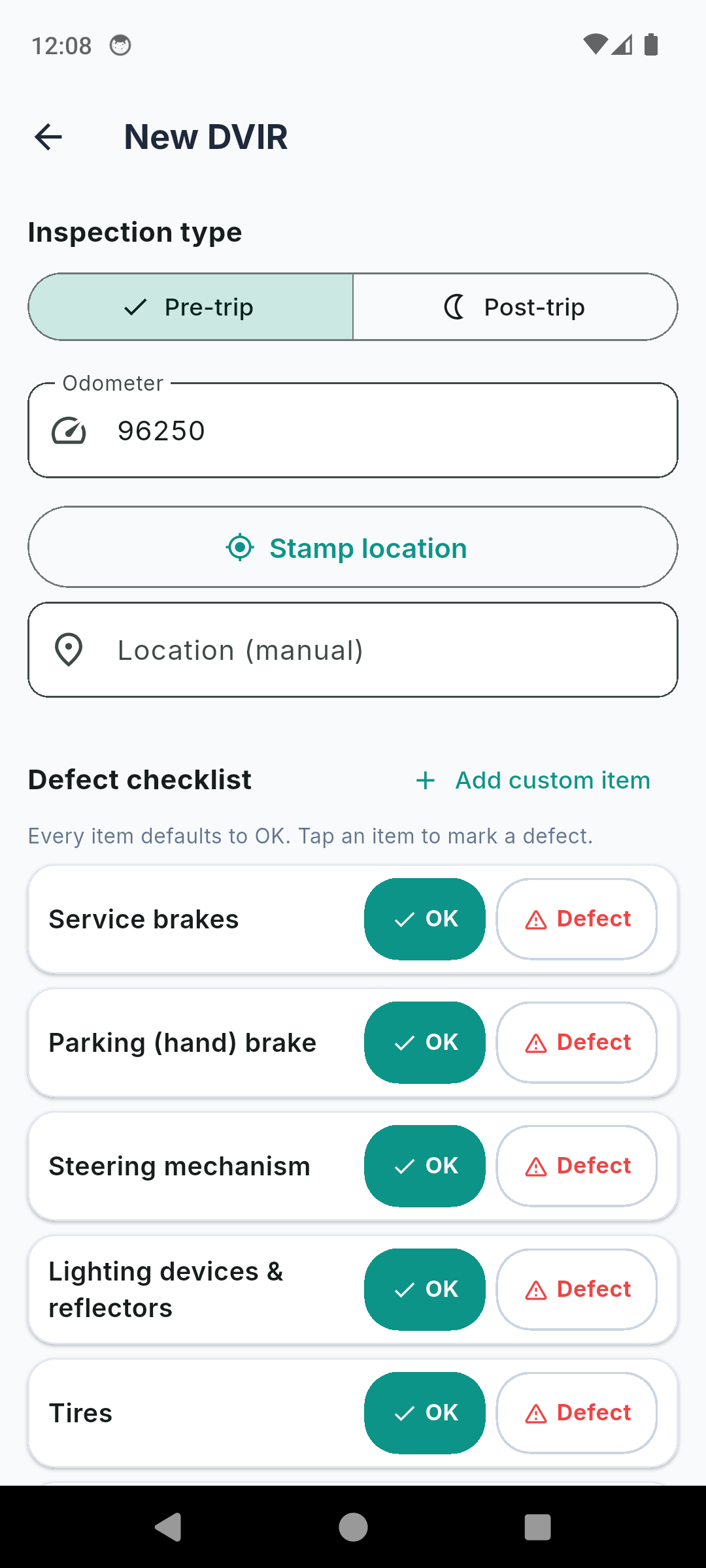
Electronic records are explicitly allowed under 49 CFR 390.32, and for most operations they are easier to defend than a paper book, because the timestamps and the signature chain are captured rather than remembered. That is the job DVIRLog does, keeping the pre-trip and post-trip reports, the defect status and the review signatures on one vehicle timeline so the chain is visible rather than assembled later.
Three different clocks
The DVIR is one of several records Part 396 wants, each with its own retention period, and mixing them up is a common way to throw away something you needed.
| Record | When it is required | Keep it for |
|---|---|---|
| DVIR, plus the repair certification and the driver’s review signature | when a defect is found or reported | 3 months from the report date (396.11) |
| Periodic inspection report, each unit of a combination inspected separately | at least once every 12 months (396.17) | 14 months from the report date, where the vehicle is housed or maintained (396.21) |
| Systematic inspection, repair and maintenance records for each vehicle | ongoing programme (396.3) | 1 year, and 6 months after the vehicle leaves your control |
The periodic inspection is the one small fleets underestimate. It has to meet the minimum standards in appendix A to Part 396, and every unit in a combination counts separately, so a tractor with a semitrailer and a full trailer plus a converter dolly is four inspections rather than one. It also has to be done by a qualified inspector, and the report has to identify who inspected it, the carrier, the date, the vehicle, the components inspected, and the results.
Making the paperwork do its job
Two habits separate a file that survives an audit from one that merely exists.
The first is contemporaneous entry. A report written at the truck, at the time, with the odometer read off the dash, is evidence. A batch of reports filled in on Friday for the week is a story about evidence, and it usually shows, because the handwriting is too consistent and the odometer readings are too round.
The second is treating the defect as open until the chain closes. A defect written up on Tuesday, repaired Wednesday and never certified is still an open item in your file no matter what the shop did. Whatever system you keep, the useful question is not “did we log it” but “can we show what happened to every defect we logged”.
Both of those are unglamorous, and both are the reason a well-kept inspection file quietly reduces your exposure after an incident, when someone goes looking for what you knew and when.
This is general information, not compliance or legal advice. Part 396 is amended from time to time, intrastate rules vary by state, and your carrier’s own policy may require more than the federal minimum. Verify the current text of 49 CFR Part 396 and check anything consequential with a qualified compliance professional.
Sources: 49 CFR 396.11, 49 CFR 396.13, 49 CFR 396.17, 49 CFR 396.21, Passenger carrier no-defect DVIR final rule, DVIR final rule 2014, CVSA International Roadcheck.
Common questions
Do I have to fill out a DVIR every day?
Not under the federal rule. Since the December 2014 final rule, a driver of a property-carrying commercial motor vehicle only has to prepare a written report if a defect or deficiency was found or reported to them. The same change was extended to passenger carriers in 2020. Many carriers still require a daily report as company policy, which is allowed and often sensible, but it is a company rule rather than a federal minimum.
How long do DVIRs have to be kept?
Three months from the date the report was prepared, and that covers the report itself, the carrier's certification that the defect was repaired or that repair was unnecessary, and the driver's certification of review. The annual periodic inspection report is a separate record with a fourteen-month retention.
Is a pre-trip inspection required by law?
Yes, but not in the form most people picture. 49 CFR 396.13 requires the driver to be satisfied the vehicle is in safe operating condition, to review the last inspection report where one was required, and to sign it to acknowledge that the listed defects were certified as repaired. There is no federal requirement to document the pre-trip walkaround itself.
Can DVIRs be electronic?
Yes. 49 CFR 390.32 permits records required by the safety regulations to be created and kept electronically, provided they contain the required information and the signatures are attributable to the right person. An electronic DVIR with a proper audit trail is generally easier to defend than a smudged paper book.