






















































































































































Do Landlords Need PAT Testing? England, Scotland and Wales
In Scotland PAT testing of landlord-supplied appliances is part of the law. In England and Wales it is not named, but the duty to keep them safe still applies.

Scotland is the answer most landlords do not expect. North of the border, testing the appliances you supply is part of the legal standard a rented home has to meet. In England and Wales the law never names PAT testing, and plenty of guides stop there. That leaves out the duty that does apply, which is that anything you hand a tenant with a plug on it has to be safe, and you need some way of showing it was.
What England requires
The Electrical Safety Standards in the Private Rented Sector (England) Regulations 2020 are about the fixed installation: the consumer unit, the wiring, the sockets and switches. Under regulation 3 the installation has to be inspected and tested at intervals of no more than five years, sooner if the last report says so. You give the tenant a copy within 28 days of the inspection, a new tenant gets one before they move in, the council gets one within 7 days of asking in writing, and any remedial work is done within 28 days.
None of that mentions a kettle. The regulations stop at the installation, which is why you will read that private landlords in England have no PAT duty. The government’s own landlord guidance does add a line for the social sector, after the rules were extended to it in 2025: social landlords who provide electrical equipment must also have it tested.
So a private landlord in England is not breaking the 2020 regulations by never testing a fridge. That is a narrower claim than “you don’t need to bother”, and the gap between the two is where the trouble starts.
Why the safe condition duty still bites
If you supply an appliance and it hurts someone, nobody will ask whether a regulation used the letters PAT. They will ask what you did to make sure it was safe. A dated record of a visual inspection and test, by someone competent, answers that question. “It looked fine when I bought it” does not.
Licensed HMOs have it in writing. The mandatory licence conditions in Schedule 4 of the Housing Act 2004 require the licence holder to keep electrical appliances and furniture they make available in a safe condition, and to give the council, on demand, a declaration as to the safety of those appliances. Signing a declaration about appliances you have never had checked is not a comfortable position. Many councils go further and write PAT testing into their own licence conditions, so read your licence, not a summary of somebody else’s.

Is PAT testing a legal requirement in Scotland?
Yes, for appliances the landlord provides. The Repairing Standard sets out what a private rented home in Scotland must meet, and the Scottish Government’s statutory guidance on electrical safety splits the electrical safety inspection into two parts. One is the installation condition report. The other is a record of testing of appliances provided by the landlord, and the guidance gives it its proper name: in-service inspection and testing of electrical equipment, also known as PAT testing.
The details are more specific than most landlords realise:
- The minimum is an inspection at least every five years, but the retest date the tester sets will usually be sooner.
- An annual visual check is described as good practice in tenancies that last longer than a year.
- White goods such as fridges and washing machines are in scope, along with unfixed electric fires. Fixed equipment the landlord provides should be inspected and tested where needed.
- Equipment bought new less than a year before the inspection is excluded. Second-hand equipment is not.
- Anything that fails is repaired or replaced straight away.
- The duty does not cover appliances that belong to the tenant.
The guidance also says what the paperwork looks like: an equipment register listing the portable appliances in the property, and a formal visual and combined inspection and test record showing the results, attached to the installation report. New equipment goes in the register with its first test due date. That is a register, a results record and a due date per item, which is a more useful thing to keep than a sheet of stickers.
Can a landlord do the testing themselves?
In Scotland, yes, with training. The guidance accepts a skilled person or “a person (including the landlord) who has completed appropriate training”, and lists training routes through landlord and trade bodies. Membership of a scheme such as SELECT, NICEIC or NAPIT is treated as evidence of competence for contractors.
In England and Wales nothing stops you either, but the point of the record is that it would stand up if questioned. A landlord with a short PAT course, a calibrated tester and written-down readings has a defensible record. A landlord with a plug-in tester that shows three lights has a gadget.
Where Wales sits
Wales follows the English pattern with its own law. The Renting Homes (Fitness for Human Habitation) (Wales) Regulations 2022 require an electrical condition report on the installation, valid for five years unless it sets a shorter interval, and the contract holder must get a copy within 7 days of the occupation date. As in England, the regulation talks about the installation for the supply of electricity and says nothing about appliances.
The same reasoning applies. Supplied appliances have to be safe, a house that is unsafe is not fit to live in, and a test record is the cheapest proof you have.
The three rules side by side
| England (private) | Scotland | Wales | |
|---|---|---|---|
| Installation check | At least every 5 years | At least every 5 years | Report valid 5 years |
| Landlord appliances named in law | No | Yes, as part of the inspection | No |
| Appliance interval | Your judgement | At least every 5 years, usually sooner | Your judgement |
| Tenant’s own appliances | Not your duty | Excluded | Not your duty |
| Copy to tenant | Within 28 days, and before a new tenant moves in | Latest report before a new tenancy starts | Within 7 days of occupation |
“Your judgement” does not mean never. It means the interval is a risk call. A washing machine that stays put can go a long time between tests. A heater that gets dragged between rooms, or an extension lead in a student house, cannot.
What a sensible record looks like
Take the Scottish guidance as the template even if you let in Leeds or Cardiff. It is the most detailed official description of the job.
For each property, keep a list of every appliance you supply, with an asset number on the item, a description and where it lives. For each test, record the date, the class of the appliance, the visual inspection result, the measured readings (earth continuity in ohms for earthed equipment, insulation resistance in megohms), the overall result, the next due date and who did it. Our explainer on what the PAT readings mean and the limits they are judged against covers the numbers.
Then make the due dates do some work. The common failure is a register that was right three years ago: an appliance replaced, a microwave added at a change of tenancy, nothing written down. Updating the list at every check-in, when you are already walking the property with the inventory, keeps it current.
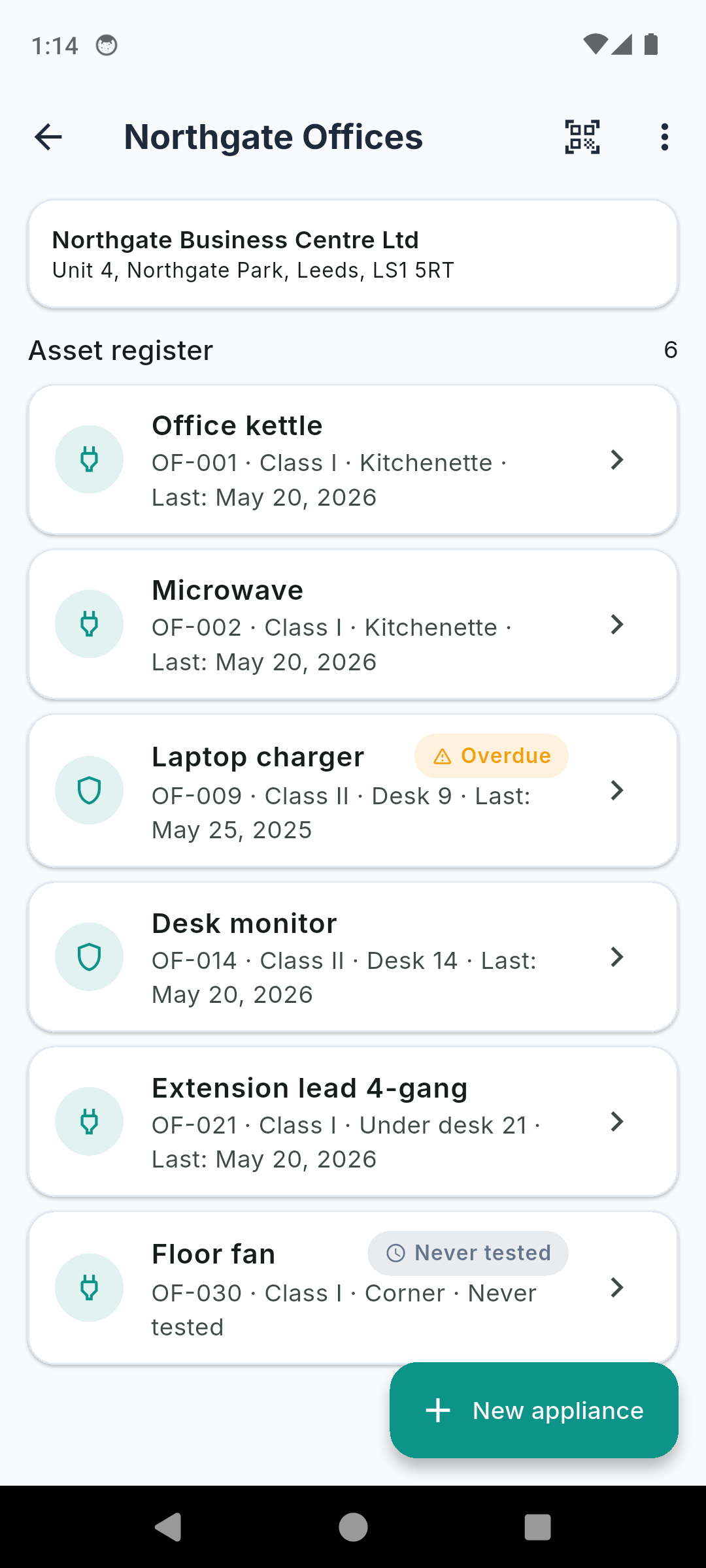
For contractors who do this across dozens of rentals, our PAT testing log and certificate app is built around that shape. Each property is a site with its own asset register. Every appliance carries its asset ID and its test history, readings are typed in from whichever tester you own, and a retest date is set per test from presets or by hand, with a reminder when it comes due. From a site you can export a PDF certificate of the tests and a separate PDF asset register, which together are close to the register and results record the Scottish guidance asks for. The app records your result; it never decides the pass or fail for you.
The mistakes that come up most
The tenant’s own things end up on the landlord’s register. Leave them off; you did not supply them and you are not testing them.
Second-hand goods get treated like new ones. A fridge from a previous property, or one bought used, is in scope immediately in Scotland, and an older appliance has had more years to collect damage.
The installation report gets mistaken for the appliance test. An EICR from a good electrician says nothing about the toaster. In Scotland the two belong together, and in England an electrician may happily do both on the same visit if you ask.
This is general information about the rules in England, Scotland and Wales as published at the time of writing, not legal advice. Check your local authority’s licence conditions and the current statutory guidance for your nation, and ask a qualified electrician or your letting agent’s compliance team where your case is unusual.
Common questions
Is PAT testing a legal requirement for landlords in England?
Not for private landlords, at least not by name. The 2020 electrical safety regulations cover the fixed installation, inspected at least every five years. Appliances you supply still have to be safe, and HMO licence holders must keep them safe and give the council a declaration about their safety when asked. Social landlords who provide equipment must now have it tested.
How often do landlords in Scotland have to PAT test?
At least every five years, as part of the electrical safety inspection that also covers the installation. The Scottish statutory guidance says the retest date set by the tester will usually be sooner than that, and calls an annual visual check good practice in tenancies that run longer than a year.
Do I have to test the tenant's own appliances?
No. The Scottish guidance says the duty does not apply to appliances that belong to tenants, and the English and Welsh rules only reach what the landlord provides. If a tenant's own heater looks dangerous, raise it with them, but it does not go in your register.
Do brand new appliances need a PAT test?
In Scotland, equipment bought new less than a year before the inspection is excluded, though it should still go in the register with its first test date. Second-hand equipment is included from day one, which is the case that catches people out at a change of tenancy.
Photos: Max Vakhtbovych / Pexels , Towfiqu barbhuiya / Pexels