





































































































































































Barista FIRE: How Much Part-Time Income Do You Need?
The part-time income formula for Barista FIRE, why it overstates what a job saves you, and what the work does for your state pension and health cover.

Enough to cover the gap between what you spend and what your portfolio can safely pay, for as long as you keep the job. That last part is where most Barista FIRE maths goes wrong. Take an illustrative budget of £30,000 a year and a part-time job paying £12,000. The standard formula says you need £450,000 invested at a 4% withdrawal rate instead of £750,000, so the job appears to be worth £300,000 of savings.
It is worth that only if you work it for the rest of your life. Most people picture a few years of easy shifts before the state pension arrives, and a job that stops is worth far less.
So the answer has two parts: how much part-time income you need, and for how long. The second part matters more.
The formula everyone quotes
Barista FIRE is the version of financial independence where your investments cover most of your spending and a part-time job covers the rest. The name comes from the idea of taking a café job for the pay and, in the US, the health plan. In practice it is any work you would do anyway at a lower pace: tutoring, shifts at a garden centre, two days a week of your old profession on contract.
The arithmetic you will find everywhere is:
Portfolio needed = (annual spending minus part-time income) ÷ withdrawal rate
At a 4% withdrawal rate, dividing by 0.04 is the same as multiplying by 25. That 25 is borrowed from the research behind the 4% rule; the piece on safe withdrawal rates and the 4% rule covers where it came from and why early retirees often use a lower rate.
The problem is what multiplying by 25 assumes about the job.
Why does the shortcut overstate what the job saves?
Multiplying the part-time income by 25 values it as if it ran for the whole retirement, the same way the portfolio does. A café job at 45 is not going to be paying you at 85.
The honest way to value a job that stops is to ask how much money, invested today, would replace its pay for exactly the years you expect to work. That is a present value. The table below uses an illustrative 3% return after inflation, with each year’s pay counted at the end of that year.
| Part-time pay a year | Shortcut (pay × 25) | Worth if it lasts 10 years | 15 years | 20 years |
|---|---|---|---|---|
| £8,000 | £200,000 | £68,000 | £96,000 | £119,000 |
| £12,000 | £300,000 | £102,000 | £143,000 | £179,000 |
| £16,000 | £400,000 | £136,000 | £191,000 | £238,000 |
Read the middle row. Fifteen years of £12,000 a year knocks roughly £143,000 off the portfolio you need, a little under half of what the shortcut promised. The other £157,000 has to come from somewhere, because once the job stops, the portfolio is paying the whole £30,000 again.
There is a partial rescue. If the job runs until your state pension starts, the pension takes over much of what the job was paying, and the shortcut gets closer to the truth. That is why a Barista plan needs an end date, not “a bit of work for a while”.
How long will you keep the job?
Easing out through a smaller job is common. A Bureau of Labor Statistics working paper on how baby boomers retire found that most people with career jobs later in life leave in stages, and that bridge employment, meaning a new job between the career and full retirement, passed 50 percent among wage and salary workers in all but one of the groups studied, where it was 48 percent.
The less comfortable figure comes from the Federal Reserve’s 2023 survey of household finances (SHED). In it, 29 percent of retirees said a health problem was a factor in when they retired, and health, caring for family and a lack of work together shaped the timing for 46 percent. Part-time work was more common than full-time work among retirees, 11 percent against 4 percent. Plenty of people work in retirement; far fewer get to pick the day it stops.
So plan two versions. One where the job lasts as long as you hope, and one where it ends five or ten years earlier. If the second one fails, the plan leans on your health and your employer more than you meant it to.

What does a barista job pay?
Less than the name makes it sound. The US Bureau of Labor Statistics puts the median hourly wage for food and beverage serving workers at $15.24 in May 2025, and notes that part-time work is common in the field. Twenty hours a week for a full year at that rate comes to about $15,850 before tax, which is the illustrative figure worth holding in your head when you see a plan that assumes $30,000 from “a part-time job”.
In the UK, the National Living Wage for workers aged 21 and over is £12.71 an hour from April 2026. Sixteen hours a week at that rate is £203.36 a week, or about £10,575 over a year.
Those are floor wages, and part-time work in your own field can pay better.
The UK numbers that make sixteen hours a week interesting
That £203.36 a week sits in a band the UK system treats kindly. According to GOV.UK’s National Insurance guidance, if you earn from £129 to £242 a week from one job, you do not usually pay National Insurance but may still qualify for the State Pension, because your contributions are treated as paid. The £129 is the Lower Earnings Limit for 2026/27, £6,708 over a full year. Above £242 a week, employees pay 8% on earnings up to £967.
Income tax is as gentle at this level. The standard Personal Allowance is £12,570, so £10,575 of wages owes no income tax if it is your only taxable income. The catch is the word only: if you are also drawing from a pension, the two incomes are added together and the allowance gets used up faster.
A qualifying year is worth more than the wage suggests
The full new State Pension is £241.30 a week, and GOV.UK’s State Pension guidance says you need 35 qualifying years to get it if your record started after April 2016. You need 10 qualifying years to get anything.
Divide £241.30 by 35 and each qualifying year is worth roughly £6.89 a week, or about £358 a year, for the rest of your life once the pension starts. For an illustrative saver who stopped full-time work at 45 with 25 years on their record, a decade of low-hours work could be what closes the gap to 35.
You can buy missing years instead. Voluntary Class 3 contributions cost £18.40 a week in 2026/27, about £957 for a full year, and GOV.UK points people earning under £129 a week towards them. Paying £957 to add roughly £358 a year to your pension is a good trade if the year is missing and will count; check your own forecast rather than assume it. Older records, especially anyone who was contracted out before 2016, do not follow the simple division above.
Timing matters too. Section 26 of the Pensions Act 2014 is the law that moves State Pension age up to 67. People born between 6 April 1960 and 5 March 1961 reach it at somewhere between 66 years and 1 month and 66 years and 11 months, and those born from 6 March 1961 to 5 April 1977 reach it at 67. Under current law it rises again, to 68 for anyone born on or after 6 April 1978, and that timetable could change after a review, so check your own date with GOV.UK’s State Pension age checker. If your Barista years are meant to carry you to the State Pension, that is the date the plan has to reach.
Leave the private pension alone while you work
One UK trap catches Barista plans in particular. Taking flexible income from a defined contribution pension, such as cash from drawdown or an uncrystallised lump sum, triggers the money purchase annual allowance, which lowers how much you can pay into pensions afterwards. GOV.UK lists those withdrawals among its examples of flexible access.
That matters if your part-time employer offers a workplace pension you want to keep paying into. Live on the ISA, cash or the wages while the job lasts, and treat the pension as the pot that opens later. The comparison of SIPPs, ISAs and US accounts for FIRE sets out the allowance figures and the order most people draw in.
In the US, the job feeds Social Security too
Social Security works out your benefit from your average indexed monthly earnings, which uses up to 35 years of earnings, picking the highest ones. Take an illustrative early retiree who stopped full-time work at 40 with 18 years behind them: the formula divides by 35 years, and the missing 17 count as zeros.
A part-time year at $15,850 replaces one of those zeros. The effect is modest, because one low year only nudges a 35-year average. It is an increase you keep for life.
There is also a threshold for eligibility. According to Social Security’s page on work credits, in 2026 you earn one credit for every $1,890 of covered earnings, up to four credits a year once you reach $7,560. You need 40 credits to qualify for retirement benefits at all, so a very early retiree with a thin record should count theirs.
Will part-time pay cut my Social Security if I claim early?
Only above a line. The retirement earnings test applies if you claim before your full retirement age and keep working. For 2026, the lower exempt amount is $24,480, rising to $25,560 in 2027, and Social Security withholds $1 of benefits for every $2 you earn above it.
That $15,850 barista year sits well under the line, so it would not trigger anything. A consulting arrangement at $40,000 would.
Two details change how bad this is. Withheld benefits are not gone: once you reach full retirement age, Social Security raises your monthly benefit permanently to account for the months it held back. And claiming early is already expensive on its own: someone retiring at exactly 62 in 2027 gets a benefit 30 percent below their full amount. A job that lets you put off claiming avoids that cut.

Is health insurance the real reason to take the job?
For American readers it usually is, and this is where the plan is most fragile.
The Affordable Care Act’s employer rules define a full-time employee as someone who averages at least 30 hours of service a week, and the employer shared responsibility rules, which can charge a payment for not offering coverage, apply only to employers with an average of at least 50 full-time employees, counting equivalents. A 20-hour shift pattern at a small independent café can come with no health plan at all. An employer can offer more than the rules require, but nothing obliges it to, and its policy can change.
The fallback is the Marketplace, and here the part-time income cuts both ways. Marketplace savings are based on your income estimate for the year you want coverage, so the job’s pay feeds straight into what you get. But the IRS’s premium tax credit questions and answers explain that the expansion which removed the 400 percent of poverty line ceiling only applied to tax years 2021 through 2025. With the ceiling back, a household that earns a little too much from the job plus portfolio withdrawals can lose the credit entirely, rather than gradually.
Medicare starts at 65. Premiums for every year before that birthday belong in the spending figure you start from.
In the UK, the NHS removes this reason, and the plan comes down to income and National Insurance years.
Putting your own numbers through it
The useful test is not a single target. It is a year-by-year projection where the part-time pay starts on your retirement date, stops on the day you think it will, and the portfolio picks up everything after that.
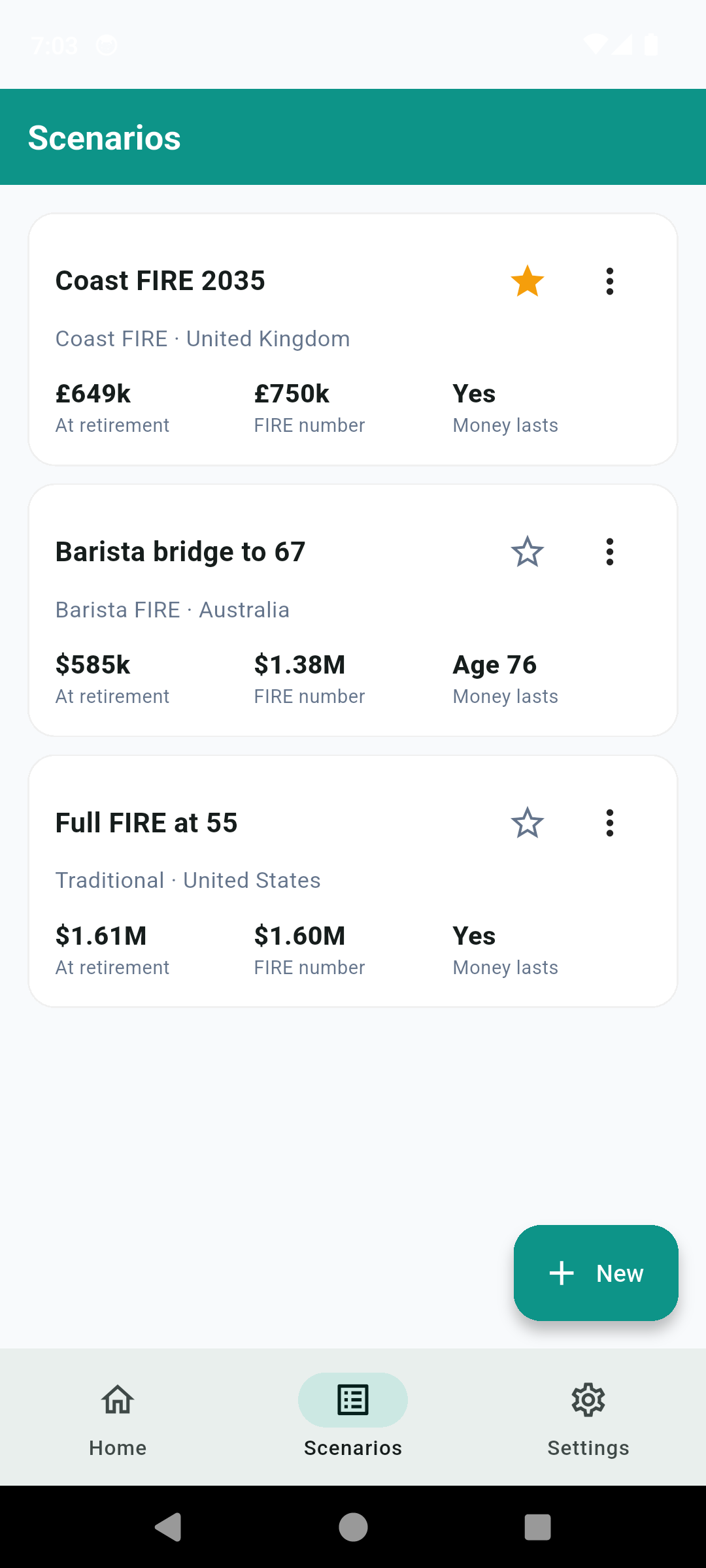
That is how FireCalc, a FIRE retirement calculator, treats it. In Barista mode you enter your part-time income as an annual figure, and the projection subtracts it from what you withdraw each year from your retirement age until state pension age, which the app sets at 67 for UK and US plans. That is a year early for UK savers born from 6 April 1978, whose State Pension age is 68 under current law. Everything runs in today’s money, after inflation, and the Monte Carlo run applies the same income. The headline FIRE number shows your full target divided by your withdrawal rate, because the job does not change what the portfolio must eventually carry. The figures to read are whether the money lasts and the balance at the end.
Barista mode assumes the job runs all the way to state pension age. For the stop-early version, add the pay as an income stream instead (a paid feature), as a monthly amount with a start age and an end age, so it can stop at 60. The Compare screen, also part of the paid tier, then puts two plans side by side, with the FIRE mode, the balance at retirement, whether the money lasts and the final balance in two columns. If one column says the money runs out at 76, as one of the sample plans above does, the part-time income is doing less work than the shortcut suggested.
What I would do with the answer
Start from spending, including health cover if you are American. Decide the age the job ends, and assume it ends earlier than you would like. Value the income for those years only. Then count what the work does that the wage does not show: UK qualifying years at roughly £358 a year each, or a Social Security record with fewer zeros in it.
Barista FIRE is a good plan when the job is a bonus on top of a portfolio that can survive without it after a known date. It is a fragile plan when the job is load-bearing until you are 85.
This is general information about how these rules and calculations work, not financial or tax advice. Figures are for the 2026/27 UK tax year and 2026 US rules; check your own position with HMRC and GOV.UK’s State Pension forecast in the UK, or with the Social Security Administration and the IRS in the US, before you act on it.
If you want to see how many years of part-time pay your own plan needs, start with one Barista scenario in FireCalc; a second scenario beside it and the Compare screen that reads the two columns side by side are part of the paid tier.
Common questions
How do you calculate a Barista FIRE number?
The usual shortcut is to take your yearly spending, subtract your part-time income, and divide what is left by your withdrawal rate. At 4%, that means multiplying the gap by 25. The shortcut assumes the job lasts as long as the retirement does, so if you expect to stop working after ten or fifteen years, the portfolio has to be larger than the formula says.
How many hours a week is Barista FIRE?
There is no fixed number. It is whatever covers the gap you choose to leave in your plan. In the UK, earning from £129 to £242 a week from one job in 2026/27 means you do not usually pay National Insurance but your contributions are treated as paid, and £129 is a little over ten hours at the £12.71 National Living Wage. In the US, the employer health coverage rules treat 30 hours a week as full time.
Does part-time work count towards my UK State Pension?
It can. If you earn from £129 to £242 a week from one job, you usually pay no National Insurance but your contributions are treated as paid, so the year can count as a qualifying year. You need 35 qualifying years for the full new State Pension and 10 for any at all. Check your own record and forecast on GOV.UK, because older records follow different rules.
Will a part-time job reduce my Social Security if I claim early?
Only if your earnings pass the retirement earnings test before your full retirement age. For 2026 the lower limit is $24,480, and Social Security withholds $1 of benefits for every $2 earned above it. The withheld money is not lost: your monthly benefit is raised once you reach full retirement age.
Is Barista FIRE mainly about health insurance?
In the US it often is, because health cover before Medicare at 65 is expensive. But a part-time job does not guarantee it. Employer coverage rules under the Affordable Care Act turn on 30 hours a week and on employers with 50 or more full-time staff, so many part-time roles carry no health plan at all. In the UK the NHS removes that reason, and the job is mostly about income and National Insurance years.
What if I have to stop the part-time job early?
Then the portfolio has to cover the full spending sooner than planned, which is the main risk in this plan. In the Federal Reserve's 2023 survey of household finances, 29 percent of retirees said a health problem affected when they retired. Plan with a version where the job ends early and check that the money lasts.
Photos: Ketut Subiyanto / Pexels , Marcus Aurelius / Pexels , Kampus Production / Pexels