












































































































































































How Much Does It Cost to Make a Bar of Soap?
One cold process batch costed line by line: oils, lye, cure weight loss, labour, wrapping and Etsy fees, ending in a true cost per bar and a price that holds.
About $1.23 a bar in materials and wrapping, and close to $4 once you pay yourself for the time. Those are the numbers for one ordinary batch of cold process soap, 1,000 grams of oils cut into eleven bars, costed below with illustrative supplier prices that you should swap for your own. The usual “add up the oils” method goes wrong in three places: the water that leaves the bar while it cures, the hour of tidying nobody times, and the fixed fees that hit a cheap bar harder than an expensive one.
The batch: 1,000 grams of oils at a 5% superfat
The recipe is a plain bar with no palm oil, the kind most soapmakers will recognise in some form: 450 g olive oil, 300 g coconut oil (the 76 degree kind), 200 g shea butter and 50 g castor oil. A kilo of oils is easy to cost and fits a standard loaf mould.
The superfat is 5%: the lye is cut back by a twentieth so a little oil stays unreacted, which makes the bar gentler and covers small weighing errors. The water is 2.33 parts per part of lye, the default in the soap calculator used below. Fragrance oil goes in at 30 g, 3% of the oil weight. Check the rinse-off maximum on your supplier’s IFRA certificate before copying that, because it differs by scent.
How the lye number gets made, and why it matters to cost
Each oil needs a different amount of lye to become soap, written as its SAP value: grams of sodium hydroxide per gram of oil. In the SAP table CraftCost uses, olive oil is 0.135, coconut oil is 0.178, and shea and castor are both 0.128. Coconut needs about a third more lye per gram than olive, so coconut-heavy recipes cost a little more in lye too.
Multiply each oil by its figure and add them up: 60.75 g for the olive, 53.4 g for the coconut, 25.6 g for the shea and 6.4 g for the castor, so 146.15 g of sodium hydroxide at zero superfat. Take 5% off and the batch needs 138.84 g. Multiply by 2.33 and the water is 323.50 g.
Keep an eye on that water. It costs almost nothing, and much of it is going to leave.
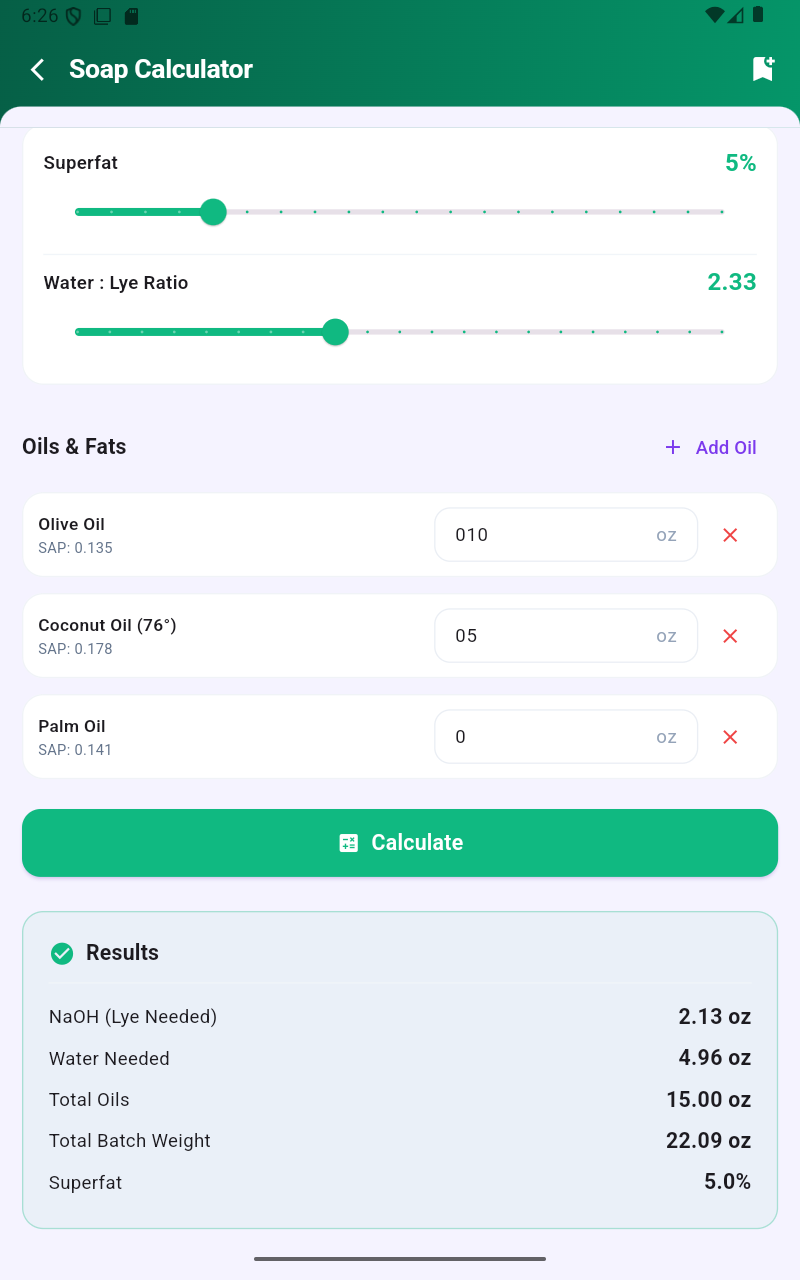
Check the numbers against a published SAP reference before you weigh anything. CraftCost’s own soap screen opens with that warning, and it is right to: a lye calculation that is off by a typo makes caustic soap. The NIOSH pocket guide entry for sodium hydroxide lists eye and skin burns among its effects and aluminum, tin and zinc among the metals it attacks, which is why lye goes into stainless steel or heavy plastic, never an aluminum pan. Goggles, gloves and a dedicated jug are a one-off cost that shrinks to almost nothing per bar once it is spread over a year of batches. Buy them before the first batch, not after the first splash.
The materials bill
Here is the whole batch. The prices per kilo are illustrative only, since craft supplier prices vary by brand, country and pack size.
| Ingredient | Weight | Illustrative price | Cost |
|---|---|---|---|
| Olive oil | 450 g | $7.00 per kg | $3.15 |
| Coconut oil, 76 degree | 300 g | $6.00 per kg | $1.80 |
| Shea butter | 200 g | $12.00 per kg | $2.40 |
| Castor oil | 50 g | $8.00 per kg | $0.40 |
| Sodium hydroxide | 138.8 g | $8.00 per kg | $1.11 |
| Distilled water | 323.5 g | $0.40 per kg | $0.13 |
| Fragrance oil | 30 g | $40.00 per kg | $1.20 |
| Batch total | 1,492.3 g | $10.19 |
Two things stand out. Shea butter is only a fifth of the oils but nearly a quarter of the cost. And the water, more than a fifth of the batch by weight, costs thirteen cents.
Why this batch makes eleven bars, not twelve
A 1,492 g loaf cut into twelve gives bars of about 124 g each, comfortably over 4 ounces (113.4 g) on the day you cut them. Twelve bars at $10.19 is 85 cents of material a bar. Stop there and you have a tidy figure that is wrong.
Then the soap cures. The 323.5 g of water is 21.7% of the wet loaf, and while the bars sit on the rack much of it evaporates. How much depends on your recipe and your room, so weigh your own bars over the weeks. For this example, assume an illustrative 10% loss. Each of those twelve bars now weighs about 112 g. That is under 4 ounces.
If the label says 4 oz, those bars are short. NIST Handbook 133, the guide weights and measures inspectors use to check package contents, says the average net quantity of a lot “must at least equal” the quantity on the label, and treats individual packages short by more than an allowed variation as unreasonable errors. The handbook does allow for moisture lost in ordinary distribution, but I would not lean on that for water you knew was leaving before the bar was ever wrapped.
So cut eleven. At 135.7 g wet, each bar cures to roughly 122 g under the same illustrative 10% loss, which clears 4 ounces with room for a thin end piece or an uneven cut. Material cost per bar goes from 85 cents to 93 cents. That eight-cent difference is the cure, priced in.
Time is the dearest ingredient
Weighing, mixing, pouring and cleaning every jug is one session. Cutting the loaf next day is another, then bevelling, turning bars on the rack, and wrapping and labelling at the end of the cure. Two hours for the whole job is an illustrative figure, and probably a low one. Time your next three batches and use the average.
At $15 an hour, two hours across eleven bars is about $2.73 a bar, nearly three times the materials. That is the line people leave out when they say soap costs a dollar a bar to make, and it is the line that decides whether a wholesale order makes you money or only keeps you busy.
Wrapping, labels and the bits that go in the bin
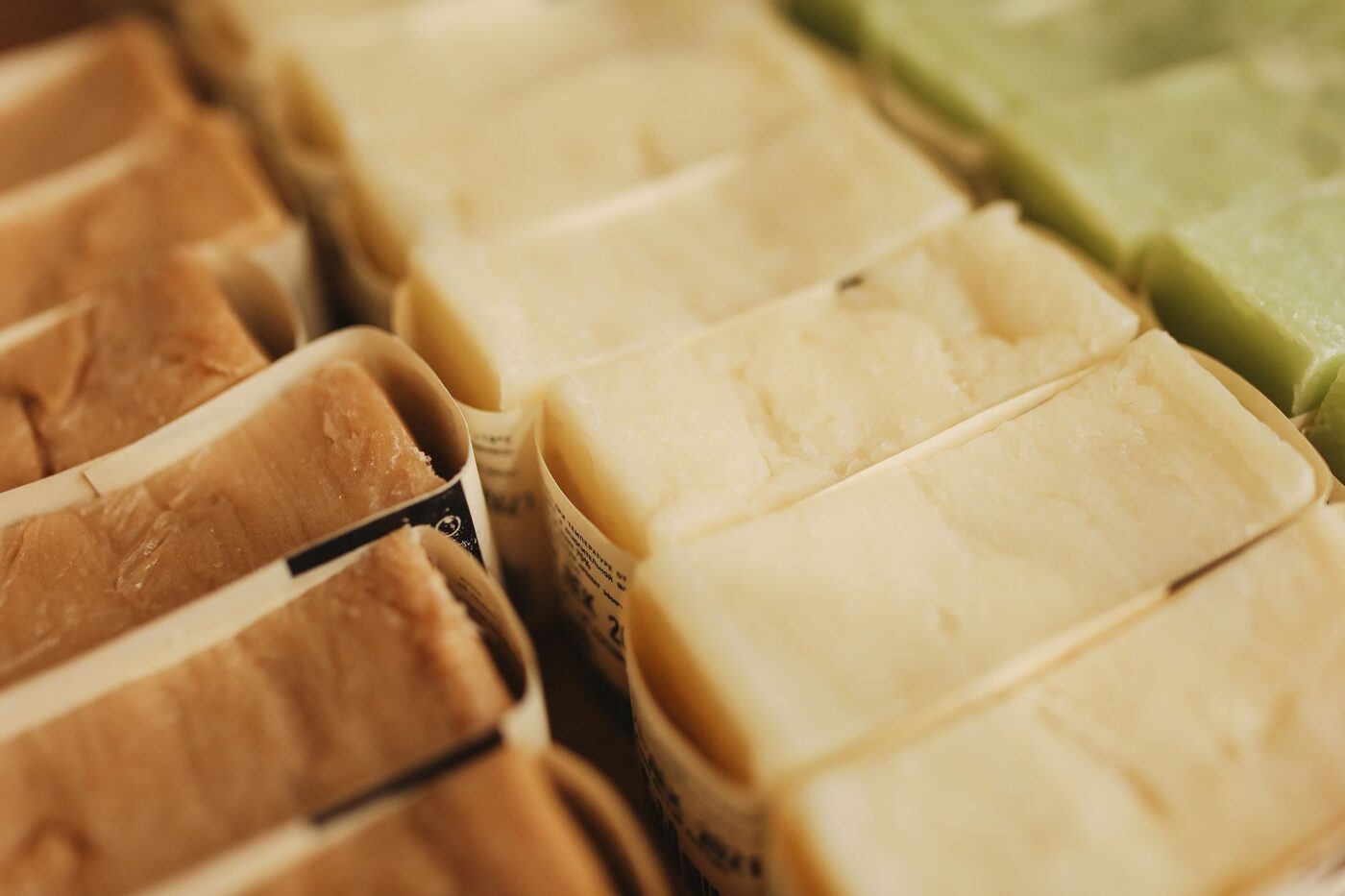
A paper band and printed label like the ones in the hero photo might cost 30 cents a bar in small runs, an illustrative figure that depends on how many you print. Boxes and shrink bands cost more.
Trims count too. Bevelled edges, loaf ends and the bar that cracked on unmoulding are material you paid for and cannot sell as a bar. Sell offcuts as sample bags if you like, but price the full bars as if the offcuts earn nothing.
Putting it into a price
In the CraftCost pricing calculator, the batch goes in as materials $0.93, labour at $15 an hour for 11 minutes a bar (two hours divided by eleven), packaging $0.30, shipping $0, and the Etsy preset. The calculator’s breakdown reads $0.93 materials, $2.75 labour, $0.30 packaging, $0.26 platform fees, $4.24 total cost.
Set the profit slider to 150% and the suggested retail comes out at $10.60, with a wholesale line of $8.48, which is twice the total cost. The slider is markup on cost, not margin on price, and the Actual Margin line underneath shows the difference: 150% markup is a 60% margin. Round it up to $11 for the shelf and the listing.
If you make candles as well, the candle version of this costing walks through the same idea with jars and wicks, where the vessel does to the price what labour does here.
What Etsy takes from an $11 bar
The pricing calculator’s Etsy preset charges 6.5% on your costs, which gave $0.26 above. Treat that line as a floor. The fees Etsy charges are worked out on what the buyer pays, and two of them are fixed amounts that bite hardest on a low-priced item.
Etsy’s fee basics page sets a $0.20 listing fee, charged again for each additional item bought from a multi-quantity listing, and a 6.5% transaction fee on the order total including shipping and gift wrap. Added to that, Etsy’s payment processing fee table lists 3% plus $0.25 for a US shop (4% plus £0.20 in the UK), taken on the total the buyer pays, shipping and tax included.
For one $11 bar with no shipping charged, that is $0.20 + $0.72 + $0.58, or $1.50. That is 13.6% of the price, and $1.24 more than the calculator’s floor. What is left after fees and the $3.98 of costs is about $5.52.
Now say the buyer arrived through one of Etsy’s Offsite Ads. Those orders carry a further 15% of the order total, or 12% once a shop has made $10,000 in any 365-day period, capped at $100 an order. On the $11 bar that is another $1.65. Fees become $3.15, nearly 29% of the price, and what is left drops to about $3.88. Shops that have always stayed under $10,000 can opt out.
The fixed parts are why sets pay. Three bars listed as one item at $30 pay $3.30 in the same fees, 11% of the price, or $1.10 a bar against $1.50 for a single. Whatever the calculator suggests, run this fee arithmetic on the actual price before you publish the listing.
When the label changes what you are making
The FDA’s frequently asked questions on soap set three conditions for true soap: it is mainly the alkali salts of fatty acids, those salts do all the cleaning, and it is labelled and marketed only as soap. A bar that meets all three is regulated by the Consumer Product Safety Commission, not the FDA. Write “moisturizing” or “deodorizing” on the label and the FDA treats it as a cosmetic. Claim it kills germs or helps eczema and it becomes a drug.
Selling to children carries a cost of its own. The CPSC’s business guidance on soap says makers of children’s soaps must issue a Children’s Product Certificate, and the bars need a permanent tracking label and testing for total lead content by a third-party, CPSC-accepted laboratory. Divide that testing cost by the bars you expect to sell of that recipe and add it to each one.
In Great Britain there is no true soap shortcut. The UK cosmetics regulation lists toilet soaps among cosmetic products, and the government’s guidance on making cosmetic products available to consumers in Great Britain requires each product’s safety to be checked by a qualified assessor, someone with a degree in pharmacy, toxicology, medicine or a similar subject, before it reaches a customer. Because the check is per product, its fee spreads over one recipe’s bars, which is the strongest argument I know for a short range of recipes that each sell well.
Recost when the coconut oil runs out
Supplier prices move, and coconut oil has moved more than most. The World Bank’s November 2026 Pink Sheet of commodity prices puts the average bulk price of coconut oil at $1,075 a tonne in 2023, $1,519 in 2024 and $2,480 in 2025, and $2,029 in October 2026. Craft-size tubs do not track the bulk market cent for cent, but a bulk price that more than doubles in two years is a good reason to check the tub price on your supplier’s site before every order.
In this recipe, coconut is $1.80 of the batch. Double it and the batch costs $11.99, or $1.09 a bar in materials instead of $0.93. Sixteen cents does not sound like much until it is sixteen cents on every bar you sold at last year’s price.
The practical habit is to cost each batch as made, at the price paid on the receipt, every time. That is the job of a soap cost calculator that logs each batch’s cost per bar. In CraftCost’s paid batch log you record the craft, the recipe name, how many bars came out and what the batch cost, and the batch detail shows the cost per bar. The paid ingredient inventory keeps a unit cost and reorder level for each oil, so the material cost you type into the pricing calculator comes from your last receipt rather than from memory.
This is general information, not legal, tax or safety advice. Check the rules that apply to you with the FDA, the CPSC or the UK government’s cosmetics guidance, and check every lye calculation against a second published SAP source before you mix.
Your next step is to weigh one cured bar and time one batch, then put both into CraftCost, which works out the lye and water and prices the bar with your labour rate, packaging and selling fee. Logging each batch as you go means the next recosting takes minutes instead of an evening with receipts.
Common questions
How much does it cost to make one bar of cold process soap?
In the batch costed here, materials came to $0.93 a bar and the wrap and label to $0.30, so $1.23 before labour, using illustrative supplier prices. Paying yourself $15 an hour for two hours of work across eleven bars adds about $2.73, which puts the full cost near $4 a bar. Your oils, fragrance and batch size will move every one of those figures, so cost your own recipe rather than borrowing this one.
Should I weigh my soap before or after it cures?
After. Much of the water you mixed the lye with leaves the bar while it cures, so a bar weighed straight off the cutting board is heavier than the bar the customer receives. Weigh the cured bars, print a weight the lightest of them can meet, and then work out how many bars your batch makes at that weight.
Does the FDA have to approve my soap before I sell it?
No. The FDA says cosmetics and their ingredients, other than color additives, do not need its approval, and a bar that meets its definition of true soap is regulated by the Consumer Product Safety Commission instead. What changes the rules is the wording on your label: claims about moisturizing or scent make the bar a cosmetic, and claims about killing germs make it a drug.
How much of my soap price does Etsy take?
On an $11 bar sold on its own in the US, the listing fee, the 6.5% transaction fee and the 3% plus 25 cent processing fee add up to about $1.50, roughly 13.6% of the price. If the order came through an Offsite Ad, add another 15% of the order total. Fees are charged on shipping too, so charging for postage raises the fee Etsy takes from you.
Photos: Polina Tankilevitch / Pexels , Ksenia Chernaya / Pexels