











































































































































































How Often to Service an Outboard: A Season Worked Out
Outboard service runs on hours and the calendar at once. One twin-engine season worked through with real manual intervals, the impeller and the records.
Every 100 hours or once a year, whichever comes first, is the usual answer for a four-stroke outboard. Yamaha puts its engine and lower unit oil changes there, and a new Yamaha or Honda gets a short first service at 20 hours. The manual for your engine can be stricter: Honda’s manual for its BF250D family asks for oil every six months or 100 hours, which on a boat that sits all winter means the calendar fires long before the hour meter does.
The trouble with “100 hours or a year” is that it sounds like one rule. It is two clocks, and on a boat with two engines it is four. Below, one illustrative twin-engine boat goes through a season on a real manual’s intervals.
One hundred hours, a year, and the small print
Start with what the makers publish. Yamaha’s page on outboard maintenance intervals puts the core of it in one line: changing engine and lower unit oils every 100 hours, flushing regularly, replacing fuel filters, preventing corrosion and treating fuel. Its chart has an “After First 20hrs” column for a new outboard and an “Annually or 100hrs” column for the routine work, alongside every-50-hour and lay-up columns. The 100-hour service kit it sells for four of its four-stroke models contains a water pump, spark plugs and anodes, which tells you what Yamaha expects to be replaced at that point rather than inspected.
Honda is the stricter one. Its manual for the BF200D, BF225D and BF250D lists the engine oil change at the first month or 20 hours, then every six months or 100 hours. The oil filter is on a longer leash, every year or 200 hours.
Mercury’s guidance for its FourStrokes puts the first scheduled maintenance at the 100-hour mark for a properly broken-in engine, with oil, filter and gear oil at that service.
None of these is wrong for its own engine. The right interval is the one printed for your engine, not the one quoted on the next slip.
The boat in this example
Say the boat is a 27-foot center console with a pair of Honda BF250D outboards. Everything about the boat, its hours and its dates is illustrative; the intervals come from the maintenance schedule on pages 85 and 86 of the Honda BF200D, BF225D and BF250D owner’s manual, whose table is headed with the rule that matters: perform each item at the indicated month or operating hour interval, whichever comes first.
At the spring service on April 15, the port engine reads 200 hours and the starboard engine reads 186. Both get the full treatment that day: oil, gear case oil, oil filter, the water pump and impeller check, the thermostat, the anodes and the plugs.
That one morning starts every clock in the table further down, once for each engine.
Why two engines never read the same
Owners of twin rigs often assume the meters stay together because the engines start and stop together. They do not. One engine gets rebuilt and starts from a different number. One gets run alone at idle through a long no-wake zone, or used on its own for trolling while the other is tilted up. One meter gets replaced. A 14-hour gap at the start of a season can be a 24-hour gap by October.
In our example the owner sometimes trolls on the port engine alone, and over the summer that adds about eight hours to port that starboard never sees. Nobody notices, because both engines sound fine and the boat goes out every Saturday.
The fix is boring. Read both meters, write both numbers down, and work out each engine’s next due point from its own last service. If you keep a standby generator, you know this problem already: the generator service schedule runs on hours and the calendar at once, and whichever arrives first wins.
April to August: port gets there first
After the April 15 service, port is due its next oil and gear oil change at 300 hours and starboard at 286, or on October 15 by the calendar, whichever comes first.
By late August, after a busy summer, port reads 303 hours and starboard reads 281. Port is three hours past its oil change. Starboard still has five hours to go.
The sensible thing is to do both on the same day, August 23, and that is what happens. Starboard gets its oil five hours early, which costs five hours of oil life and nothing else. What matters is that the record shows the real number for each engine: 303 for port, 281 for starboard. Log both as “the August service at about 300 hours” and you have already lost the 22-hour gap, and next summer you will be guessing again.
While the gear case drains, look at what comes out. Mercury’s FourStroke maintenance article says milky gear oil means water has entered the gear case. It also points out that the drain screw is magnetic, so metal shavings on it can point to a gear problem. That two-minute look is the best inspection on the job.
Where everything stands after the August service
Six items on two engines make twelve due points, and the August service reset only four of them: oil and gear oil on each engine. The intervals are Honda’s for the BF250D; the hours and dates are the illustrative ones from above.
| Item | Honda interval | Port: done at, next due | Starboard: done at, next due | Calendar limit |
|---|---|---|---|---|
| Engine oil | 6 months or 100 hrs | 303, next 403 | 281, next 381 | February 23 |
| Gear case oil | 6 months or 100 hrs | 303, next 403 | 281, next 381 | February 23 |
| Oil filter | 1 year or 200 hrs | 200, next 400 | 186, next 386 | April 15 |
| Water pump and impeller check | 1 year or 200 hrs | 200, next 400 | 186, next 386 | April 15 |
| Thermostat check | 1 year or 200 hrs | 200, next 400 | 186, next 386 | April 15 |
| Low-pressure fuel filter | replace every 2 years or 400 hrs | 200, next 600 | 186, next 586 | April 15, two years on |
The oil changed in August comes due again on February 23 even if the boat never leaves the trailer. And every item now has a different due point on each engine. Nobody holds those in their head through a winter.
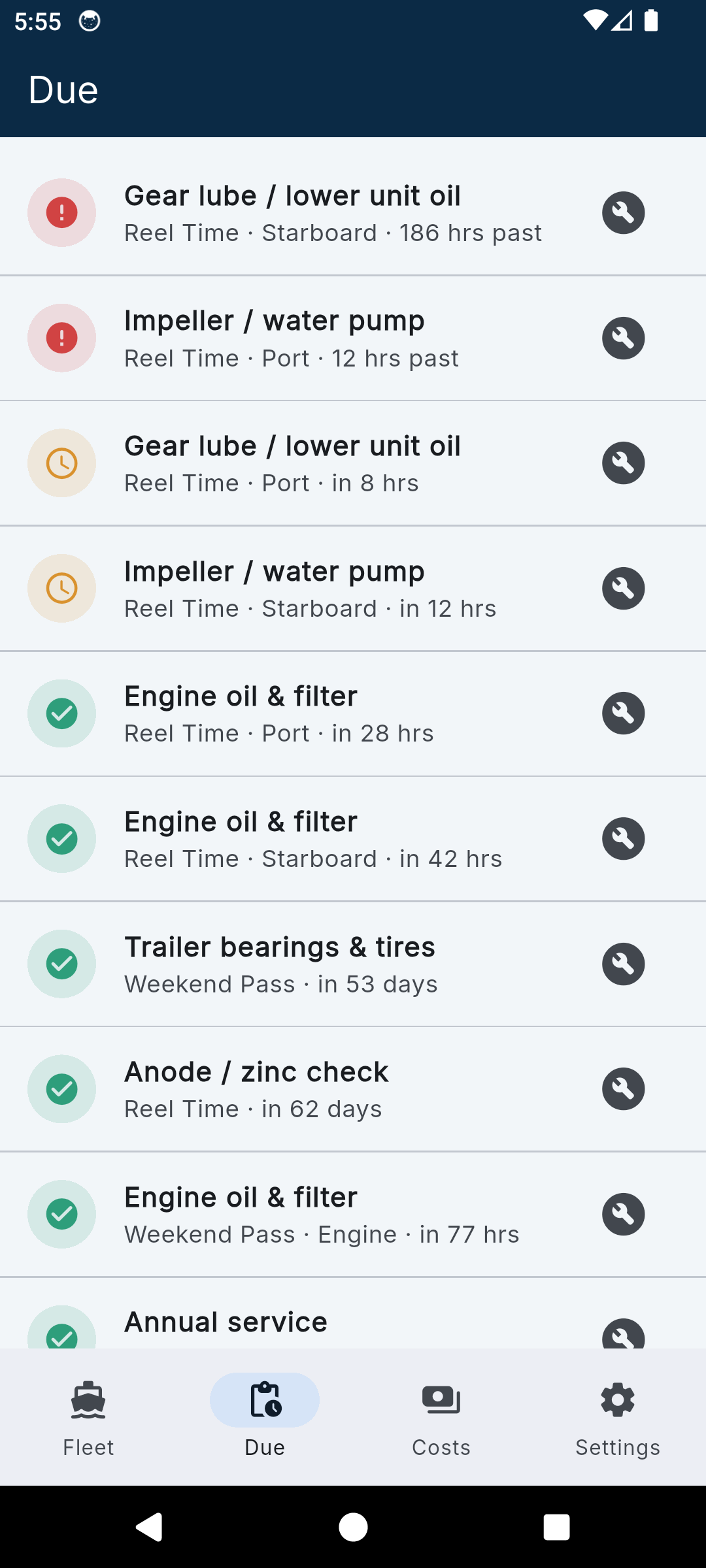
That is the job a boat maintenance log that keeps a separate hour clock for each engine is built for. In BoatLog you add each engine with its position and its current meter reading, set an interval per item from your manual (the app preloads no numbers), and tap Update hours after an outing. An item tracked by hours resolves against each engine on its own, so the port impeller can be overdue while starboard’s still has hours left. An item comes up as Due soon once it is within 10 percent of its hour interval, or within 30 days for a dated one. Honda’s oil rule needs two entries: one hours item for the 100, which the app tracks on each engine separately, and a dated item for the boat for the six months.
The impeller, the item nobody remembers
BoatUS put it bluntly in its step-by-step guide to outboard water-pump impeller service: ask around at the marina and most boat owners have no idea when the water pump on their outboard was last serviced. The same piece says a blocked or failing pump will overheat the engine, which can lead to permanent damage, and that the manual should give the interval, though often every other year is about right. It also shows why age matters even on a pump that looks fine: the vanes take a set, a permanent bend, after several months in the housing.
The makers disagree a little here too. Honda’s BF250D schedule has the water pump and impeller checked every year or 200 hours. Mercury’s article on FourStroke maintenance at the 100-hour and one-year services describes the dealer changing the impeller at the one-year service even when it is in good shape, because inspecting the pump takes enough labor that the part is replaced as a precaution.
My view: if the lower unit comes off to check the pump, the labor is already paid for, so fit the new impeller while it is open. In our example both impellers are checked in April at 200 and 186 hours, and the next check falls at 400 and 386 or the following April. On a boat that runs in sand or salt, I would not stretch that.
Salt water moves the schedule
Honda’s schedule carries two footnotes written for the coastal boat. The engine should be flushed with clean water after each use in salt water, turbid or muddy water, and lubrication should be done more often in salt. Yamaha’s chart says the same about flushing: after each use, especially in salt or brackish water.
Anodes are the other salt item. Honda says to replace them when they have worn to about two-thirds of their original size, or if they are crumbling. That is a judgment you make by looking, so it belongs on a dated check rather than an hour count.
In BoatLog the flush is a preset called Post-saltwater flush. Tap Log saltwater trip when you get back, and every item set to follow a saltwater trip comes due until you log it as done. The anode check is a dated item with whatever interval you choose.

October: lay-up, fuel and the oil you drain
By the last weekend of October, port reads 338 hours and starboard 314. Neither is due anything by hours, which is why lay-up catches people out. The calendar items are the ones running now.
Fuel first. The EPA’s page on where E15 gasoline can and cannot be used lists boats among the nonroad vehicles that cannot use it, so check the pump label every time you fill. Mercury’s advice on fuel age is plain: buy gas at a busy station, and do not let it sit in the tank for more than a few months. A boat going into storage for the winter is the case that advice was written for.
Then the oil you drain, at any service. The EPA’s guide to managing and recycling used motor oil says the used oil from one oil change can contaminate one million gallons of fresh water, and reminds do-it-yourselfers to drain and recycle the old filters too. Two outboards’ worth of crankcase oil goes in a sealed jug to a collection point, never down a drain.
The record your warranty may ask about
Machinery failure is not a fringe cause of trouble on the water. The US Coast Guard’s 2024 recreational boating statistics report ranks machinery failure among the top five primary contributing factors in boating incidents, alongside operator inattention, improper lookout, inexperience and navigation rules violations.
Warranty is the other reason to keep the paper. Honda’s manual is fair about it: a warranty claim will not be denied simply because the maintenance schedule was not followed, but a part that fails specifically because of missing or badly done maintenance is not covered. When that question comes up, dated entries with each engine’s hours and the receipts beat “I always do it at about a hundred”.
This is where BoatLog’s paid plan earns its place. The Service history PDF puts each engine on the cover with its make, model, serial number and current hours, then lists every logged service with the date, the item, the engine, the hours, the cost and whether a shop or the owner did it, followed by the receipt photos for each job (up to three per record). In our example, the August oil changes read port at 303 and starboard at 281: separate rows, separate engines, the same date. The app describes that export as a history for resale or a marine survey; a warranty conversation needs the same pages.
Everything above is general information, not professional advice. The owner’s manual for your engine and an authorized dealer for your make are the authority on your intervals and your warranty terms.
Before the boat goes back in the water
Tonight, find the maintenance chart in your own manual and copy out three rows: engine oil, gear oil and the water pump. Next to each one, write the interval in hours and in months, and the meter reading at the last service for each engine. If you cannot fill in that last column, the spring service is where your record starts. BoatLog, the boat maintenance log, will hold those numbers per engine from the first entry, and the next time someone asks when the impeller was last done, the answer will be on the list with a date and an hour reading against it.
Common questions
How often should an outboard motor be serviced?
Yamaha puts engine oil and gear lube at 100 hours or once a year, and Mercury's FourStroke guidance puts the first service at 100 hours and the second at about a year. Yamaha and Honda add a first service at 20 hours on a new motor. Some manuals are stricter: Honda's BF200D to BF250D manual asks for oil every six months or 100 hours. Your own owner's manual sets the numbers for your engine.
Should both engines on a twin rig be serviced at the same time?
Doing them together is sensible, as long as neither goes past its interval and you write down each engine's own hour reading at the service. The two engines rarely run identical hours, so their next due points drift apart. Treat them as two motors with two clocks, even when one mechanic does both on the same morning.
How often should an outboard water pump impeller be replaced?
It depends on the maker. Honda's BF250D schedule has the water pump and impeller checked every year or 200 hours, and Mercury's FourStroke maintenance article describes the dealer replacing the impeller at the one-year service as a precaution. BoatUS suggests every other year is often about right. The figure in your manual comes first.
Can skipping scheduled maintenance affect my outboard warranty?
It can. Honda's manual says a claim will not be denied simply because the schedule was not followed, but a part that fails because of missing or poorly done maintenance is not covered. A dated record with the engine hours and receipts is how you show the work was done. Check your own engine's warranty terms.
Photos: Stuart Reece / Pexels , Michał Robak / Pexels